

Introduction
A morning mindset is the combination of thoughts, emotions, intentions, and behaviors that shape how a person approaches the beginning of the day. Tai, a common example used to explore morning mindset work, illustrates how small shifts in early-day thinking can support a more intentional daily rhythm. Rather than claiming that morning thoughts automatically determine everything that follows, a morning mindset is better understood as a starting point — a way to establish direction before the demands of the day take over.
This article explains what a morning mindset is, how it connects to motivation, emotional regulation, and daily habits, and how to build one that fits real schedules and real energy levels. The goal is practical understanding: how to wake up with a positive mindset, how to set an intention for the day, and how to sustain that practice over time without forcing false positivity.
Quick Summary
- A positive morning mindset starts with intentional thoughts and realistic expectations rather than forced positivity.
- A simple morning routine can create cues for reflection, planning, movement, and purposeful action.
- Mindset development is a gradual process; consistency matters more than having a perfect morning.
- Quotes and affirmations can reinforce a mindset, but they work best when connected to practical behaviors.
What Does a Morning Mindset Actually Mean?
The Difference Between Morning Motivation and Mindset
Motivation is a temporary surge of energy or willingness to act, while mindset is a broader mental pattern developed through repeated thinking and behavior over time. Motivation can rise and fall depending on sleep, stress, or circumstances, but mindset tends to be more stable because it reflects habitual ways of interpreting situations. A morning routine does not create a mindset out of nothing — it reinforces and reactivates a mindset that is built gradually through consistent practice.
Understanding this distinction matters because many people search for a way to feel motivated every morning, when the more sustainable goal is a consistent mindset that does not depend on feeling energized every day. Mindset, motivation, habits, and intentionality are closely related, but they are not interchangeable, and confusing them often leads to disappointment when motivation naturally dips.
Why the First Part of the Day Can Influence Your Approach
The first part of the day can influence a person’s overall approach because early decisions often create behavioral momentum — one small action, like checking a phone or taking a few quiet minutes, tends to set the tone for the choices that follow. Environmental cues, such as a consistent wake-up routine or a quiet space, can support focused attention before the day becomes reactive.
At the same time, mornings look different for everyone. Work schedules, family responsibilities, sleep quality, and personal preferences all affect how much time and mental space is realistically available. A morning mindset approach should account for these constraints rather than assume a universal ideal morning exists.
How to Wake Up With a Positive Mindset
Start With a Realistic Mental Reset
Waking up with a positive mindset starts with noticing the first automatic thoughts of the day and gently replacing overly negative predictions with neutral or constructive alternatives. Many people wake up with an immediate mental forecast — “today is going to be stressful” — that shapes behavior before the day has even begun.
Realistic optimism, rather than forced positivity, tends to be more sustainable. Realistic optimism acknowledges genuine challenges while still identifying a reasonable path forward, whereas pretending every morning feels good can create pressure that backfires when a difficult day inevitably arrives.
Use a Small Number of Intentional Morning Habits
Choosing one or two behaviors that clearly signal the start of the day can be more effective than attempting an elaborate routine. These signal behaviors act as habit cues that transition the mind from a passive, half-awake state into a more intentional one.
Common examples include:
- Brief reflection
- Journaling
- Reading
- Movement or exercise
- Reviewing priorities
- Quiet time
- Gratitude practice
The specific behavior matters less than its consistency. A small, repeatable action performed daily tends to build a stronger mindset foundation than an ambitious routine that is abandoned after a few attempts.
Adapt the Routine to Different Morning Circumstances
A sustainable morning mindset approach adjusts to individual circumstances rather than following a single fixed template:
- Students may benefit from a short routine focused on priority-setting before classes begin.
- Professionals often need a routine that fits around commute times and early meetings.
- Parents may only have a few consistent minutes before children wake up.
- People working irregular shifts need a flexible definition of “morning” tied to their personal wake time, not the clock.
- People with limited morning time benefit most from a minimal, high-value routine rather than a lengthy one.
| Lifestyle | Available Time | Best Approach |
|---|---|---|
| Students | 5–10 minutes | Quick priority review before class |
| Professionals | 5–15 minutes | Intention-setting paired with commute time |
| Parents | 2–5 minutes | Micro-routine before household demands begin |
| Shift workers | Varies | Routine tied to personal wake time, not clock time |
| Limited time | Under 5 minutes | One habit cue, performed consistently |
A five-minute routine that is followed consistently is generally more sustainable than an elaborate routine that becomes difficult to maintain.
How to Develop a Happier and More Positive Mindset
Build Positive Thinking Without Ignoring Difficult Emotions
Constructive optimism differs from toxic positivity in an important way: constructive optimism allows space for real stress, uncertainty, or tiredness while still maintaining a forward-looking perspective, whereas toxic positivity pressures a person to suppress or deny difficult emotions. Acknowledging genuine feelings, rather than masking them, tends to make mindset practices more sustainable because it removes the added burden of pretending.
Emotional awareness — noticing and naming what is actually being felt — supports mindset work because it prevents the buildup of suppressed stress that can eventually undermine motivation altogether.
Practice Gratitude and Intentional Thinking
Gratitude can redirect attention toward positive aspects of daily life that might otherwise go unnoticed. Reflection prompts that ask for something specific — such as one concrete moment from the previous day — tend to be more effective than vague prompts like “what am I grateful for,” because specificity engages more focused thinking.
Gratitude connects to broader mindset development by training attention to notice available resources and progress, rather than defaulting to what is missing or difficult.
Focus on Actions You Can Control
Separating controllable actions from uncontrollable circumstances is a foundational mindset practice. Weather, other people’s behavior, and unexpected events typically fall outside personal control, while the next useful action — sending an email, starting a task, taking a walk — remains within reach. For a deeper breakdown of this principle, see our guide on how to focus on what you can control when circumstances feel overwhelming.
Focusing on the next controllable action can reduce mental overwhelm because it narrows attention from an entire day’s uncertainty down to a single, manageable step. This principle connects directly to resilience and effective goal setting, since progress is built through a sequence of small controllable actions rather than a single large outcome.
How to Master Your Mindset Over Time
Mindset Is Developed Through Repeated Practice
Mindset change is generally a gradual process rather than an overnight transformation, because it involves rewiring habitual thought patterns through repetition. Repeated thoughts, consistent behaviors, and stable environmental cues work together to reinforce a mindset over time. If you’re ready to turn this into a structured practice, see our guide on how to build good habits in 30 days
Consistency matters more than intensity. A modest daily practice performed reliably tends to produce more durable change than an intense but irregular effort.
Use Morning Reflection to Identify Thought Patterns
A short morning reflection can surface thought patterns before they influence the rest of the day. Useful reflection questions include:
- What am I expecting from today?
- What is within my control?
- What is distracting me?
- What is one meaningful priority?
- What thought pattern do I want to respond to differently?
These questions are designed to build self-awareness without requiring extensive time investment. If you want structured prompts to guide this reflection, explore these journal prompts for self growth.
Turn Mindset Intentions Into Daily Behaviors
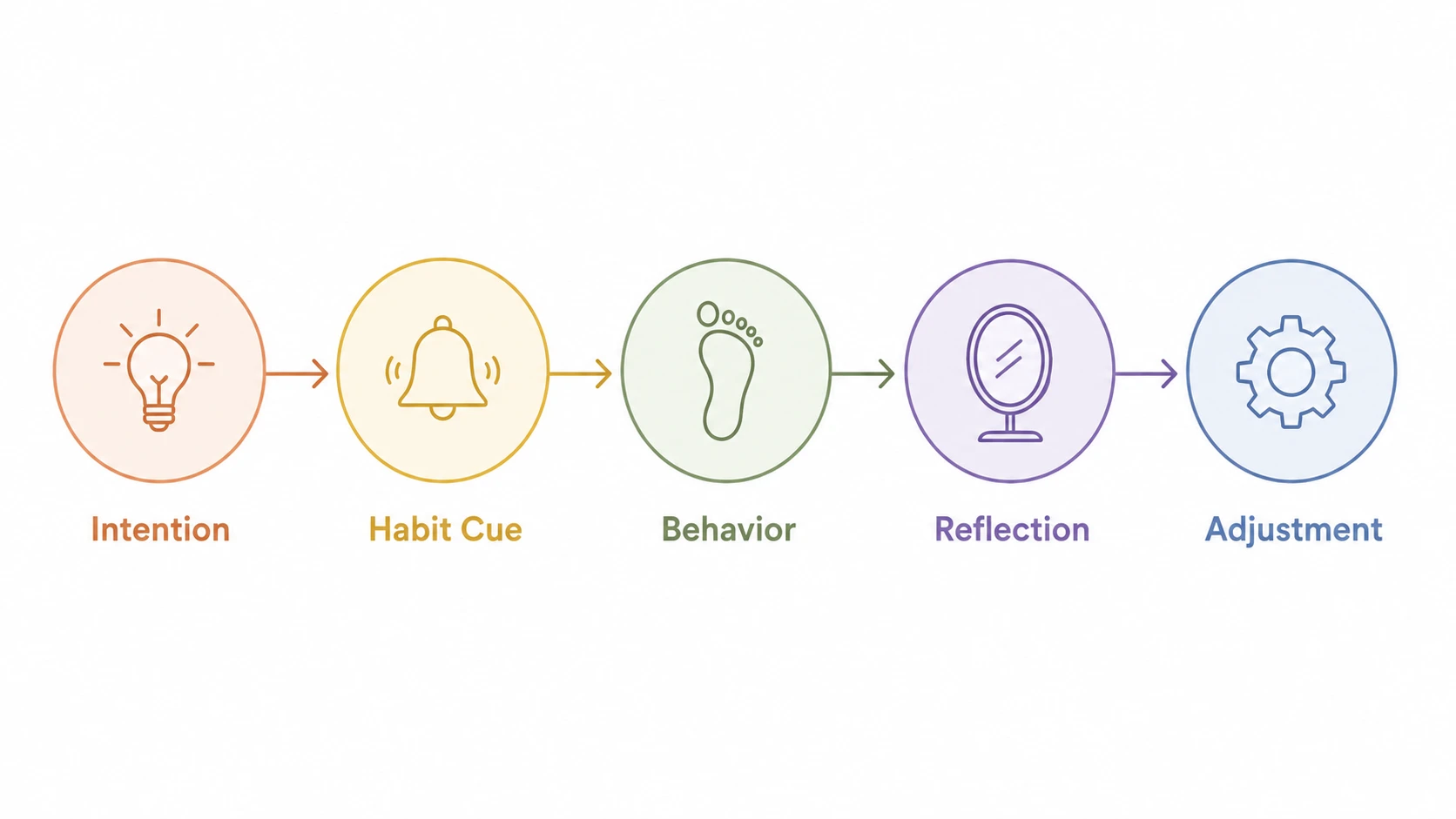
Mindset becomes practically useful when it is translated into observable action through a simple sequence:
intention → habit cue → behavior → reflection → adjustment
An intention on its own — such as “I want to be more patient” — remains abstract until it is linked to a specific habit cue and behavior, observed through reflection, and adjusted based on what is actually working.
How to Set Your Mindset for the Day
Choose a Daily Mental Intention
Setting a mindset for the day means selecting a specific mental focus rather than expecting a switch that instantly changes how the day feels. Common daily intentions include:
- Focus
- Patience
- Curiosity
- Discipline
- Gratitude
- Calmness
- Resilience
Choosing one intention, rather than several, tends to be more effective because it keeps the mental focus clear and easy to return to throughout the day.
Connect the Intention to One Concrete Action
An intention becomes more effective when paired with a specific, observable behavior:
- Focus → complete one priority task before checking distractions.
- Patience → pause before responding to frustration.
- Confidence → take one action that has been avoided.
This pairing strengthens the relationship between mindset, intention, behavior, and measurable daily progress, making the intention easier to apply rather than simply remember.
Morning Mindset Quotes: How to Use Them Effectively
What Makes a Morning Mindset Quote Useful?
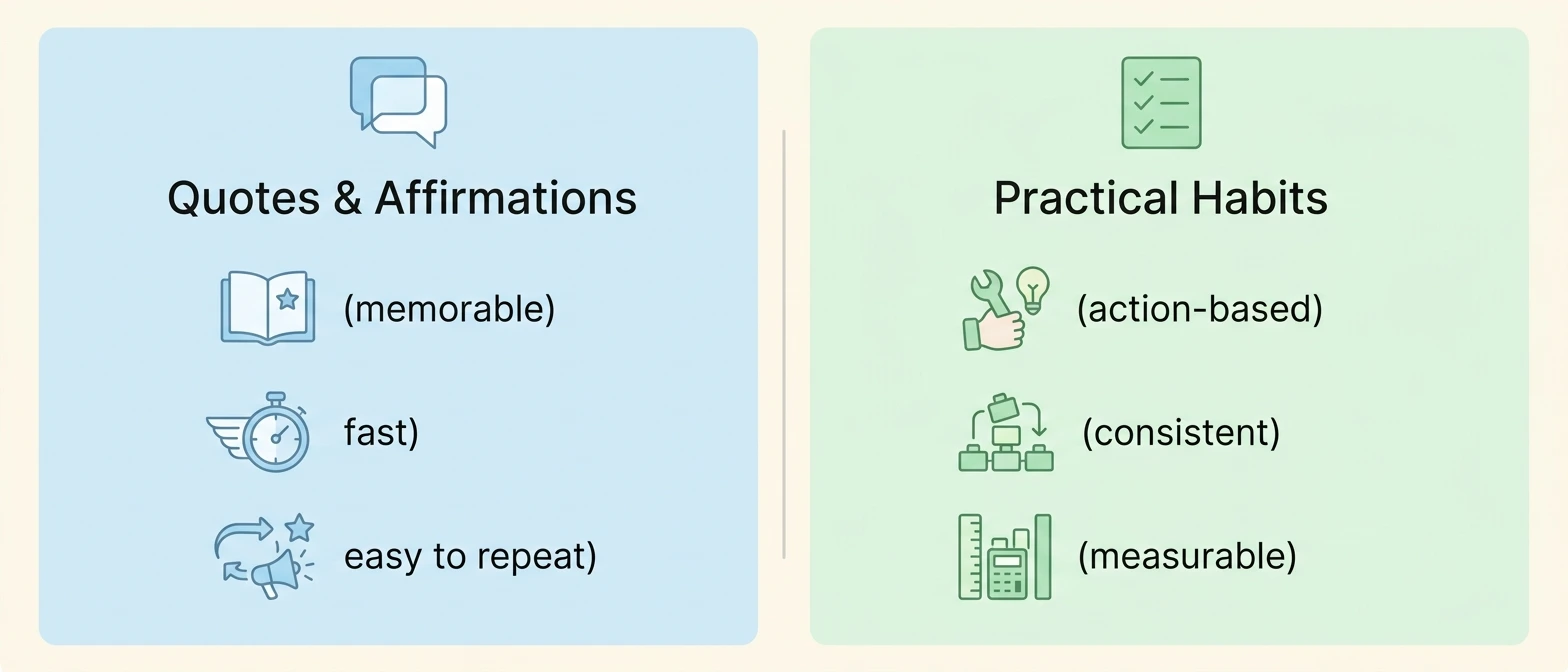
A short statement can function as a mental cue or reminder that redirects attention toward an intended mindset at a specific moment. However, inspirational language is different from evidence-based behavioral change — a quote can prompt a thought, but it does not, by itself, produce lasting change in behavior.
Readers tend to benefit most from selecting statements that feel personally meaningful and realistic, rather than generic phrases that do not connect to their actual circumstances.
Quote-Based Motivation vs. Practical Mindset Habits
| Approach | Primary Purpose | Strength | Limitation |
|---|---|---|---|
| Morning quotes | Mental reminder | Quick and memorable | May not change behavior alone |
| Affirmations | Reinforce an intended belief or identity | Easy to repeat | Can feel unrealistic if disconnected from action |
| Journaling | Reflection and awareness | Encourages deeper thinking | Requires more time |
| Goal review | Connect mindset to priorities | Action-oriented | Can become stressful if overcomplicated |
| Morning routine | Establish repeated cues | Supports consistency | Requires sustainable habits |
In our experience helping readers build better habits, quotes work best as a small part of a broader routine rather than as a standalone strategy — they are most effective when paired with at least one concrete action from the sections above.
A Practical Morning Mindset Routine You Can Actually Maintain

A 5-Minute Version
- Pause and identify the current mental state.
- Choose one intention.
- Identify one priority.
- Take one small action.
A 15-Minute Version
- Reflection
- Gratitude
- Mindset intention
- Priority setting
- Brief movement or quiet time
A Longer Morning Routine
A longer routine can combine reflection, physical activity, learning, planning, and personal development where time and circumstances allow. However, adding more activities does not automatically make a routine better — the value of a routine comes from consistency and relevance to personal goals, not from its length or complexity.
Common Morning Mindset Mistakes and How to Fix Them
Trying to Feel Positive All the Time
Why it happens: Positivity is often misunderstood as the complete absence of negative emotions. How to fix it: Use realistic optimism and acknowledge difficult emotions rather than suppressing them. How to prevent it: Define success as responding intentionally, not as feeling happy every single morning.
Creating an Overly Complicated Routine
Why it happens: Elaborate routines seen online are often copied without considering personal circumstances. How to fix it: Reduce the routine to its highest-value behaviors. How to prevent it: Build the routine gradually, adding one habit at a time.
Relying on Motivation Instead of Systems
Why it happens: Motivation feels easier to rely on than the discipline of building consistent habits. How to fix it: Establish clear cues and repeatable behaviors that do not depend on feeling motivated. How to prevent it: Make the routine simple enough to perform even on low-motivation days.
Expecting Immediate Mindset Transformation
Why it happens: Self-improvement content can create unrealistic expectations about the speed of change. How to fix it: Track gradual behavioral changes instead of expecting an instant shift. How to prevent it: Evaluate progress over weeks rather than judging the outcome of a single difficult morning.
How Long Does It Take to Build a Morning Mindset Habit?
Typical Difficulty and Time Investment
The difficulty of building a morning mindset habit depends on existing habits, work and sleep schedules, responsibilities, and individual personality. Beginner-friendly routines typically involve a single habit performed for a few minutes, while more advanced routines combine multiple practices and require greater consistency to maintain. Regardless of routine complexity, consistency is a stronger predictor of success than the duration of any single session.
What Progress Can Look Like
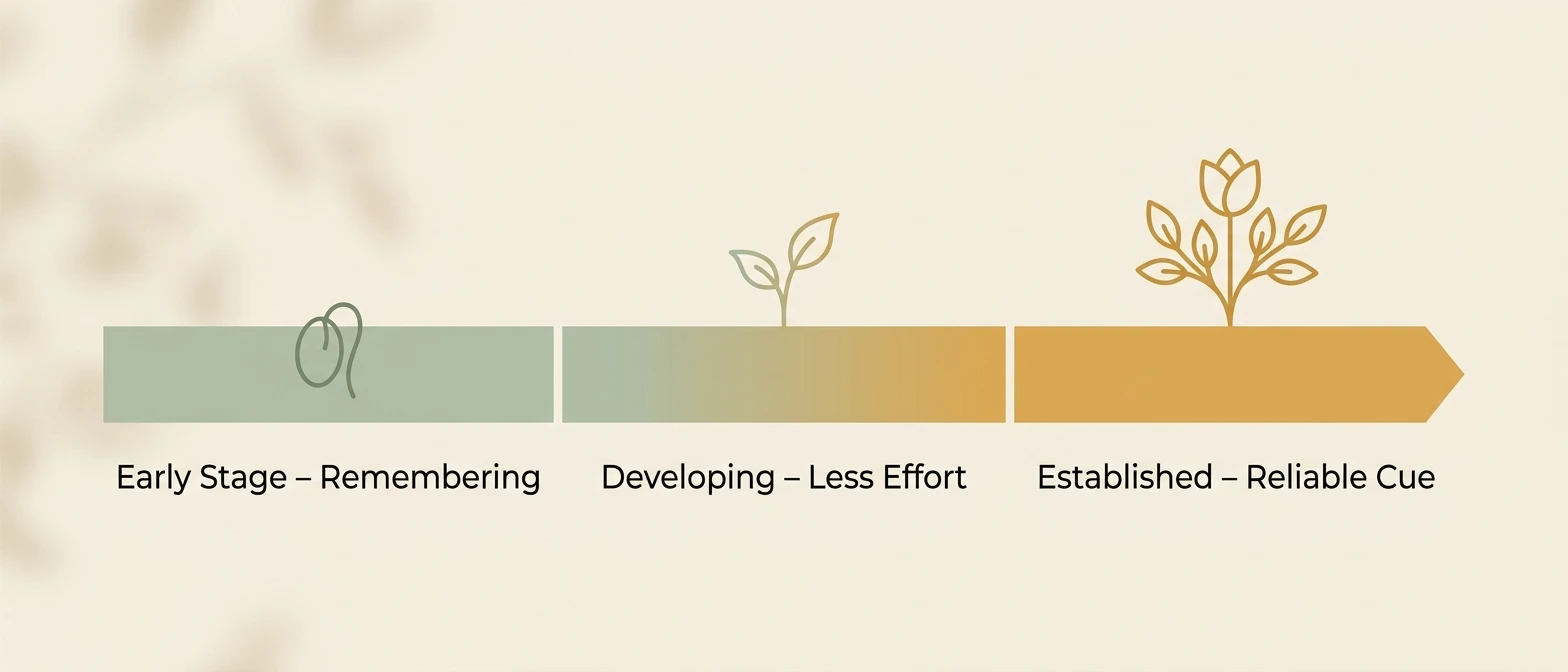
Progress in mindset development tends to move through recognizable stages:
- Early stage: Remembering to perform the routine at all.
- Developing stage: Performing the routine with noticeably less effort.
- Established stage: Using the routine as a reliable cue for intentional behavior throughout the day.
Progress is often inconsistent, and occasional missed mornings do not require perfect adherence to remain meaningful. As of 2026, behavioral science guidance increasingly emphasizes flexible, identity-based habit formation over rigid streak-based tracking, reflecting a broader shift toward sustainable rather than all-or-nothing routines.
Morning Mindset for Different Goals and Lifestyles
For Productivity and Time Management
Using the morning to identify the day’s most important task can prevent time from being lost to lower-value activities later. Planning is useful only when it leads to action — it should not become a way to delay starting meaningful work.
For Personal Growth and Goal Setting
Connecting a daily intention to a longer-term goal helps a single morning practice contribute to something larger. Small, repeated actions compound over time, and morning mindset work is often most effective when tied to a specific, ongoing personal growth goal.
For Resilience and Difficult Days
On days when circumstances cannot be controlled, a morning mindset routine can still establish a sense of direction. Flexibility, rather than perfection, is the more useful standard — a shortened or adjusted routine on a difficult day still supports resilience.
When a Morning Mindset Routine Is Not Working
Certain signs indicate that a routine needs adjustment rather than continued forcing:
- It consistently causes stress.
- It takes too much time relative to available time.
- It depends on unrealistic motivation to sustain.
- It conflicts with sleep or existing responsibilities.
- It creates guilt when missed.
When these signs appear, the routine can be simplified, rescheduled, or partially replaced with a more sustainable alternative. The core purpose of a morning mindset routine is to support daily functioning — when it becomes another source of pressure, it is no longer serving that purpose and should be adjusted.
Conclusion
A morning mindset is best understood as an intentional starting point built through practical morning behaviors, not a single ritual or motivational quote. Tai’s morning mindset journey, referenced throughout this article, reflects a broader principle: a positive mindset develops through repeated actions, realistic optimism, and self-awareness rather than through forced positivity or a one-time transformation.
Sustainable routines, honest acknowledgment of difficult emotions, and consistency over time are what ultimately shape a durable morning mindset. The clearest takeaway is straightforward — choose one small morning practice that helps you approach the day with greater intention, then refine it gradually as circumstances change.
FAQ: Morning Mindset Questions People Commonly Ask
What is a morning mindset? A morning mindset is the combination of thoughts, intentions, emotions, and routines that shape how a person approaches the start of the day. It is developed gradually rather than created instantly, and it influences — without single-handedly determining — the rest of the day.
How can I wake up with a positive mindset? Start with a realistic mental reset that replaces automatic negative predictions with neutral or constructive thoughts, then follow with one or two consistent morning habits such as brief reflection, movement, or reviewing priorities. Difficult emotions do not need to be ignored for this process to work.
How do I set my mindset for the day? Choose a single mental intention, such as focus, patience, or gratitude, and pair it with one concrete behavior that puts that intention into practice, such as completing a priority task before checking distractions.
How can I master my mindset? Mindset mastery involves repeated awareness, intentional thinking, consistent habits, and behavioral practice over time rather than a one-time change. Morning reflection questions can help identify thought patterns that benefit from adjustment.
Do morning mindset quotes actually help? Quotes can serve as useful mental reminders or cues, but they are more effective when paired with a specific action rather than relied on as a standalone strategy for behavioral change.
What is the best morning routine for a positive mindset? There is no single universal best routine. The most effective routine is one that matches available time, lifestyle demands, and personal goals, and that can realistically be maintained on a consistent basis.
How long does it take to develop a positive morning mindset? The timeline varies based on individual habits, schedule, and consistency. Rather than expecting a fixed number of days, progress is better measured through gradual behavioral changes and increasing ease of performing the routine over time.