
Introduction
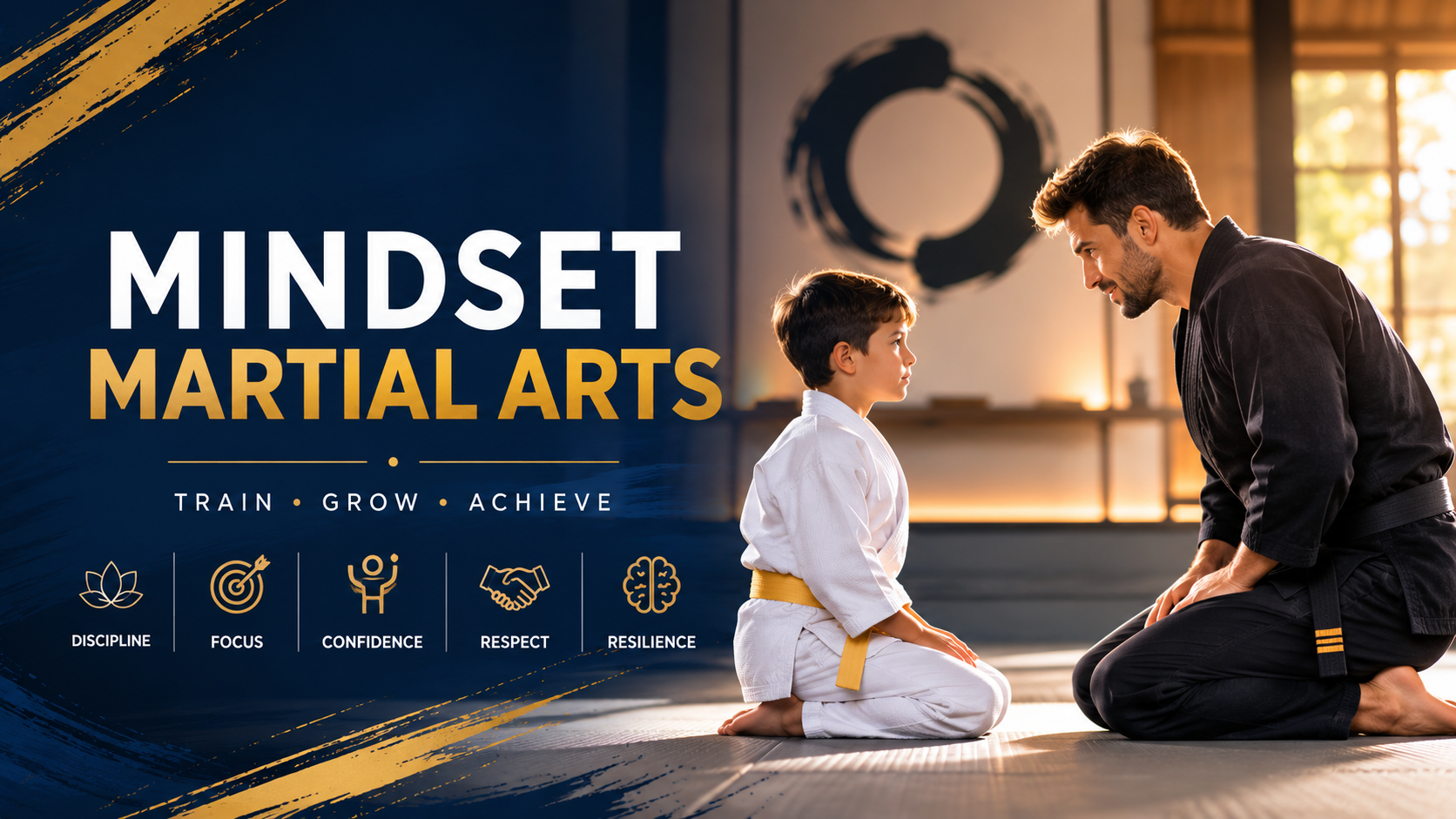
Mindset Martial Arts is a martial arts academy built around a simple idea: physical skill and mental discipline develop together, not separately. Rather than treating technique and character as separate tracks, the program integrates confidence building, focus, and resilience directly into physical training. This article covers the training philosophy behind Mindset Martial Arts, the programs it typically offers, its teaching methods, what students can expect in a class, and the benefits students commonly experience. Whether you’re evaluating a martial arts school for a child, a teen, or yourself as an adult, this guide explains what a mindset-focused approach looks like in practice.
Quick Summary
- Mindset Martial Arts combines martial arts training with character development, confidence building, and discipline.
- Programs typically serve children, teens, and adults with age-appropriate instruction.
- Students develop physical fitness alongside important life skills such as focus, resilience, and respect.
- Choosing a martial arts school involves understanding teaching philosophy, class structure, instructor experience, and student goals.
What Is Mindset Martial Arts?
Mindset Martial Arts is a martial arts and fitness program that pairs traditional physical training with structured mental and character development. The academy’s approach treats martial arts not just as a combat skill but as a framework for building discipline, self-control, and confidence over time.
The mission behind mindset martial arts & fitness is straightforward: students should leave each class physically stronger and mentally sharper. Rather than isolating fitness from personal growth, instruction is designed so that every drill, sparring exercise, and conditioning segment reinforces both.
The Core Philosophy Behind Mindset Martial Arts
Why Mindset Matters in Martial Arts Training
Mental discipline is treated as a trainable skill, not a fixed trait. Instructors typically emphasize:
- Mental discipline — the ability to stay focused through repetitive, sometimes difficult drills.
- Confidence — built incrementally through mastering achievable skills.
- Respect — for instructors, training partners, and the learning process itself.
- Self-control — particularly important in contact-based training.
- Focus — sustained attention during instruction and practice.
- Emotional resilience — the capacity to handle frustration, setbacks, and physical fatigue without disengaging. This blend of focus, self-control, and emotional resilience is sometimes described as a warrior mindset — a mental posture martial artists train just as deliberately as any physical technique.
How Physical Training Supports Personal Growth
Physical conditioning does more than build strength. Structured training supports:
- Consistency — showing up regularly builds routine-based discipline.
- Goal achievement — belt or skill milestones create tangible markers of progress.
- Problem-solving — sparring and drills require real-time decision-making.
- Positive habits — regular training often carries over into diet, sleep, and daily routine.
Services Offered by Mindset Martial Arts
The services offered by Mindset Martial Arts generally span age groups and training goals, from foundational classes to specialized instruction.
Children’s Martial Arts Programs
Age-appropriate classes focused on coordination, listening skills, and basic technique in a structured, encouraging environment.
Teen Martial Arts Classes
Programs that address the specific needs of teenagers, including confidence-building, peer accountability, and more advanced technical work.
Adult Martial Arts Training
Classes emphasizing fitness, self-defense, and stress relief alongside technical skill development.
Fitness and Conditioning Classes
Sessions focused primarily on cardiovascular fitness, strength, and mobility using martial arts-based movement patterns.
Self-Defense Training
Practical instruction centered on situational awareness and defensive techniques rather than competitive sparring.
Private Lessons and Specialized Coaching
One-on-one or small-group sessions tailored to individual goals, whether accelerating technical progress or addressing specific physical limitations.
What Skills Can Students Develop?
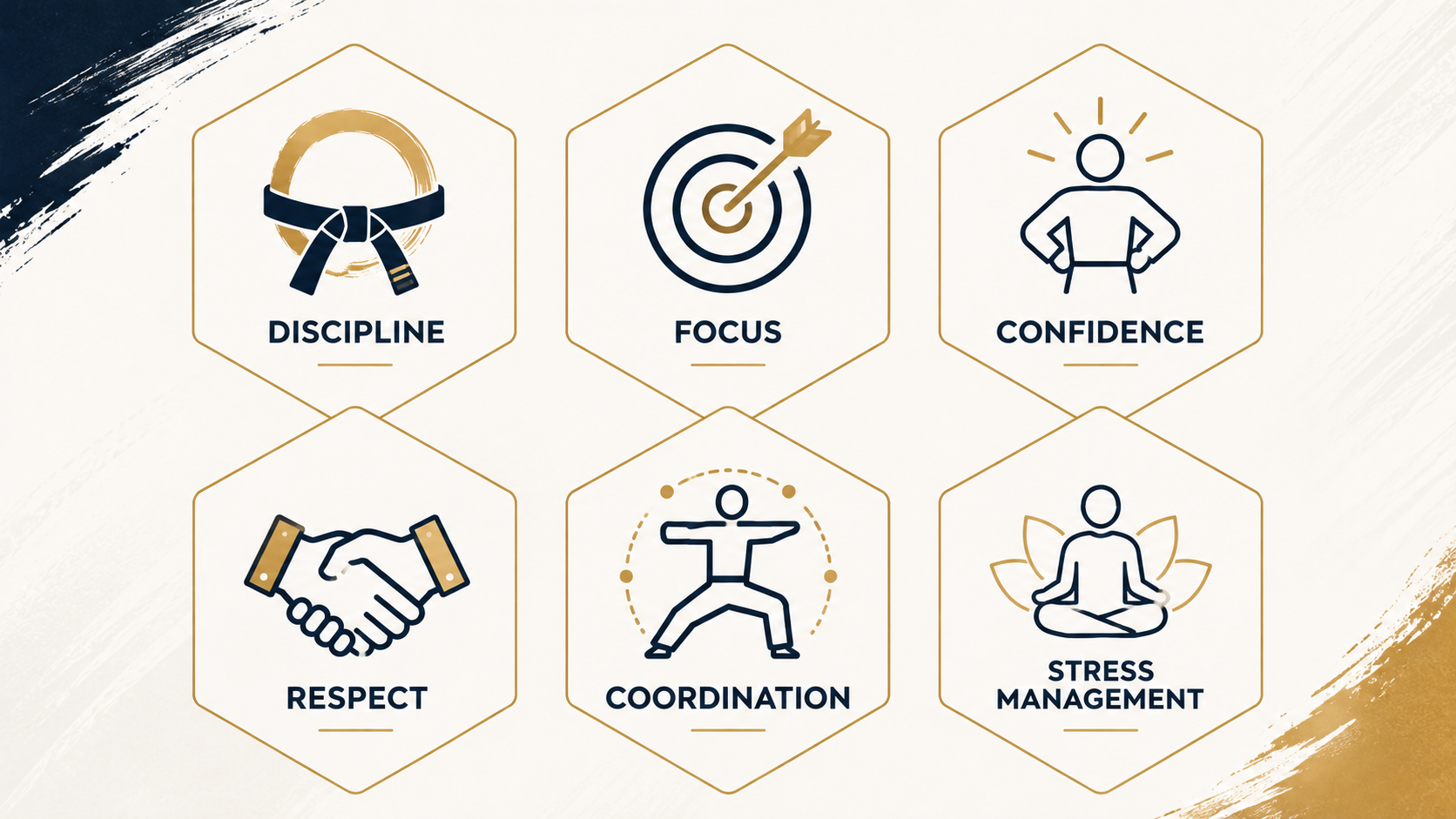
Students in a mindset-focused martial arts program can typically develop:
- Discipline
- Focus
- Confidence
- Respect
- Leadership
- Coordination
- Balance
- Flexibility
- Physical fitness
- Self-defense awareness
- Stress management
These skills tend to develop gradually and reinforce one another; for example, improved coordination often supports confidence, which in turn supports willingness to take on new challenges.
Typical Class Structure at a Martial Arts Academy
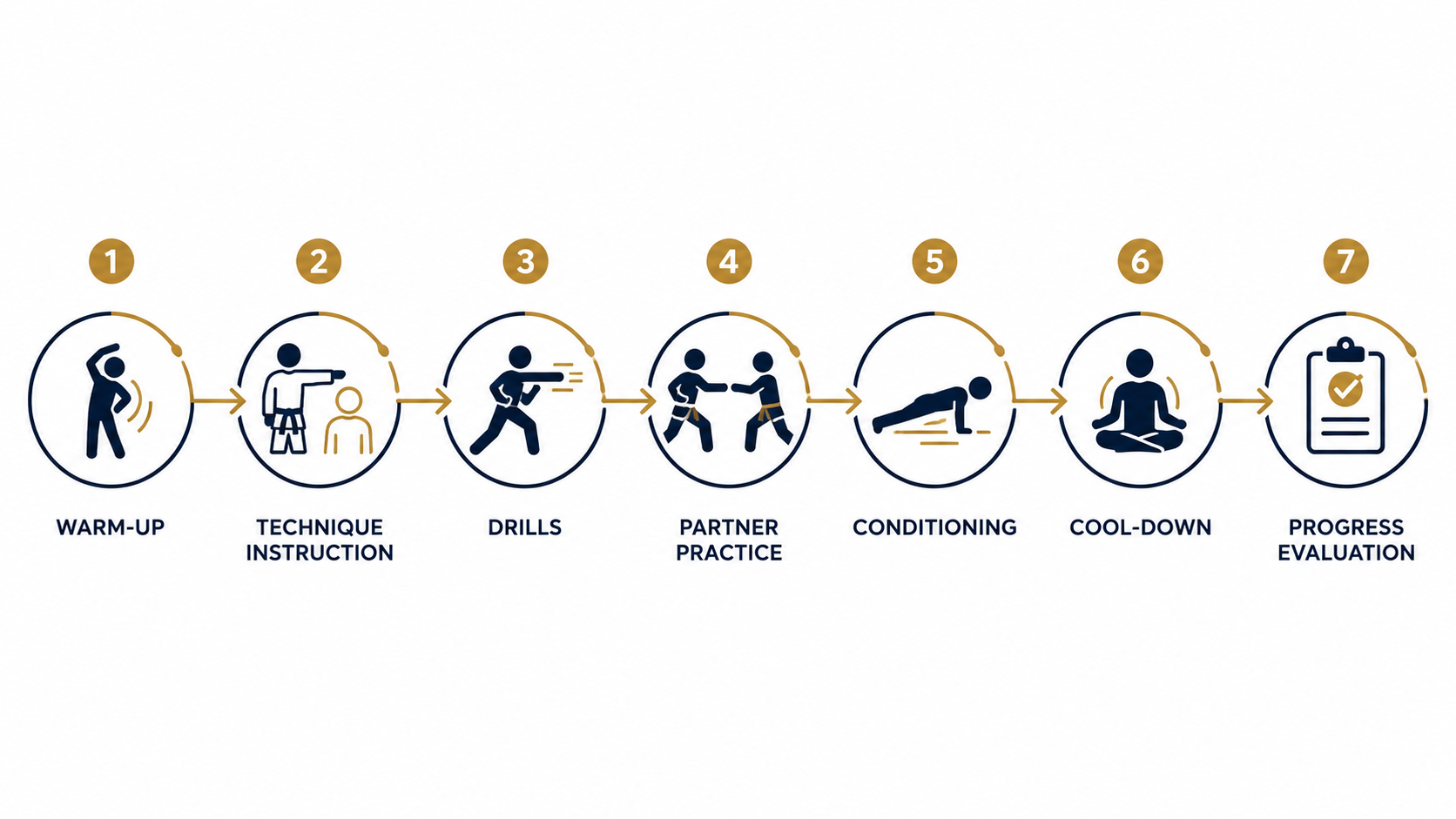
Beginners can generally expect a predictable class format, which helps reduce first-class anxiety and supports steady progress:
- Warm-up — light cardio and mobility work
- Technique instruction — introduction or review of specific skills
- Drills — repetition to build muscle memory
- Partner practice — applying technique with a training partner
- Conditioning — strength and endurance work
- Cool-down — stretching and recovery
- Progress evaluation — informal or formal review of skill development
How Mindset Martial Arts Supports Different Age Groups
Young Children
Classes focus on listening skills, basic coordination, and introducing structure through short, engaging drills.
Teenagers
Instruction shifts toward confidence-building, peer accountability, and more technically demanding material as attention spans and physical capability increase.
Adults
Training typically balances fitness goals, stress management, and practical self-defense with steady technical progression.
Families Training Together
Some programs support parents and children training in parallel or overlapping classes, which can reinforce shared routines and mutual accountability at home.
Benefits Beyond Martial Arts
The effects of consistent training often extend well beyond the training floor:
- Better concentration
- Improved confidence
- Healthier lifestyle habits
- Emotional regulation
- Better decision-making under pressure
- Teamwork
- Communication skills
In our experience helping readers build better habits, physical routines like martial arts often become an anchor that makes other lifestyle changes — like improved sleep or nutrition — easier to sustain.
Mindset Martial Arts vs Traditional Martial Arts Schools
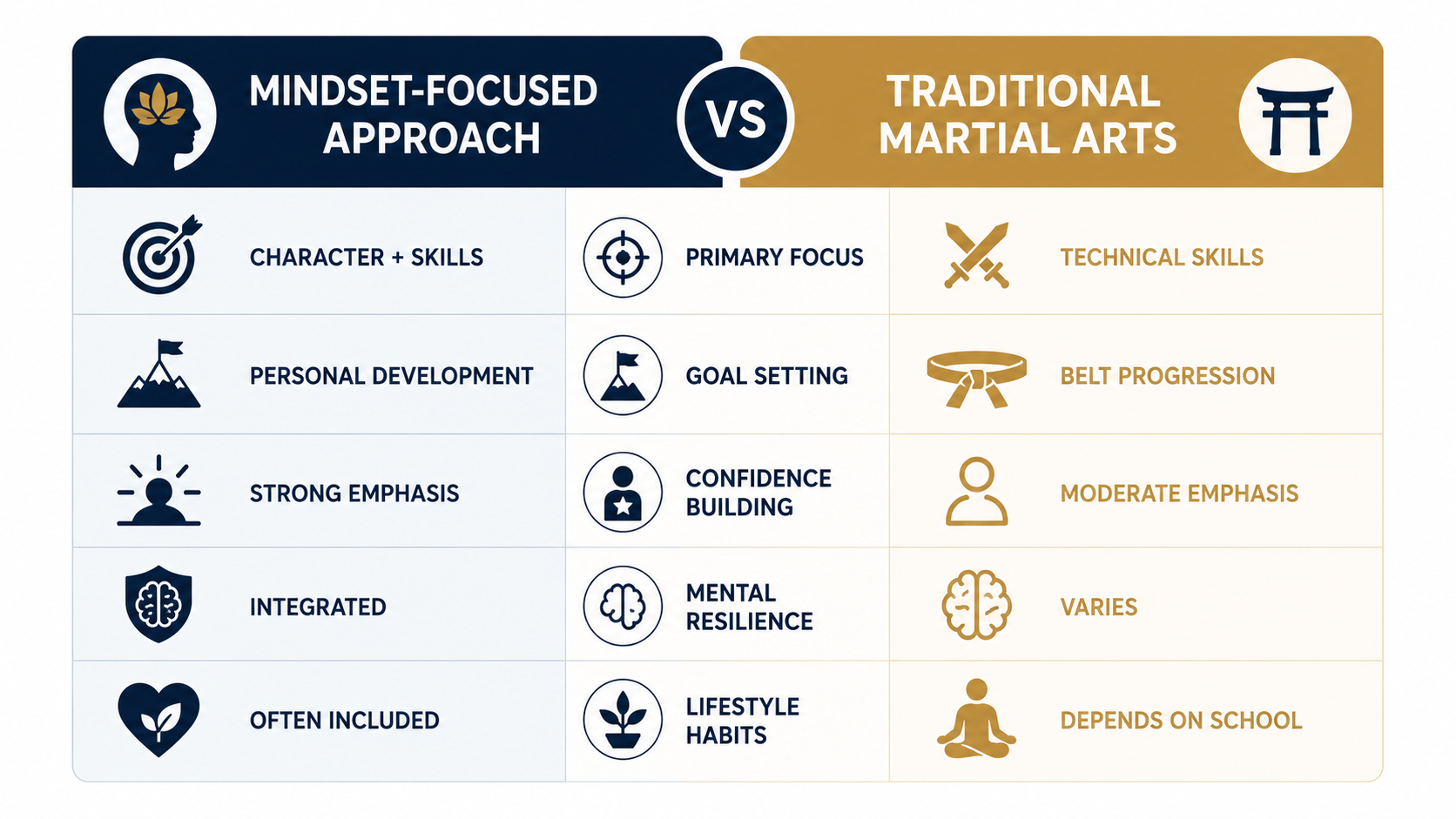
This comparison highlights differences in philosophy rather than suggesting one approach is superior.
| Feature | Mindset-Focused Approach | Traditional Martial Arts |
|---|---|---|
| Primary focus | Character + skills | Technical skills |
| Goal setting | Personal development | Belt progression |
| Confidence building | Strong emphasis | Moderate emphasis |
| Mental resilience | Integrated | Varies |
| Lifestyle habits | Often included | Depends on school |
What Makes a Quality Martial Arts Program?
When evaluating any academy, several factors indicate program quality:
- Qualified instructors with demonstrated teaching experience
- Safe learning environment with clear safety protocols
- Structured curriculum that builds skills progressively
- Progressive skill development rather than inconsistent lesson plans
- Student support for individual pacing and questions
- Community atmosphere that encourages consistent attendance
Common Beginner Questions Before Joining
Am I too old? Most martial arts programs accommodate a wide range of ages and fitness levels, with modifications available as needed.
Do I need experience? No. Beginner classes are designed for students with no prior background.
What equipment is needed? Requirements vary by style but often include a uniform and, in some cases, protective gear for sparring.
How often should I train? Most instructors recommend two to three sessions per week for steady progress.
How long does progress take? Visible improvement typically begins within the first few weeks, with more substantial skill development over several months.
Common Mistakes New Martial Arts Students Make
Expecting instant results. This happens because early enthusiasm outpaces realistic timelines. The fix is setting incremental, skill-based goals rather than focusing solely on outcomes like belt rank. On days when motivation is low, students often benefit from learning how to build discipline without motivation — treating training as a fixed commitment rather than something that depends on feeling ready.
Inconsistent attendance. Life schedules often interfere with regular training. Preventing this usually involves treating class times as fixed commitments, similar to any other recurring appointment.
Comparing progress with others. Students frequently measure themselves against peers with different starting points. Refocusing on personal benchmarks helps correct this.
Ignoring recovery. Overtraining without adequate rest can lead to fatigue or injury. Building rest days into a weekly routine helps prevent this.
Focusing only on belts. Rank-focused thinking can overshadow skill mastery. Instructors often recommend prioritizing technique quality over promotion speed.
Skipping fundamentals. Students eager to learn advanced techniques sometimes rush past basics. Reinforcing fundamentals consistently prevents technical gaps later on.
How to Get the Most From Martial Arts Training
Students who progress most consistently tend to follow similar practices:
- Train consistently, even on lower-motivation days
- Set realistic, incremental goals
- Practice outside of class when possible
- Stay physically active between sessions
- Maintain good nutrition to support recovery and energy
- Ask instructors for direct feedback
- Track progress over time, not just by belt rank
Difficulty and Time Investment
Martial arts training is generally beginner-friendly, with a learning curve that accommodates a wide range of starting fitness levels. Most programs recommend a weekly commitment of two to three classes for consistent progress. Physical adaptation — improved stamina, flexibility, and strength — typically develops over the first several weeks. Individual fitness differences mean progress speed varies, and long-term progression depends on consistency more than natural athletic ability.
Results Timeline
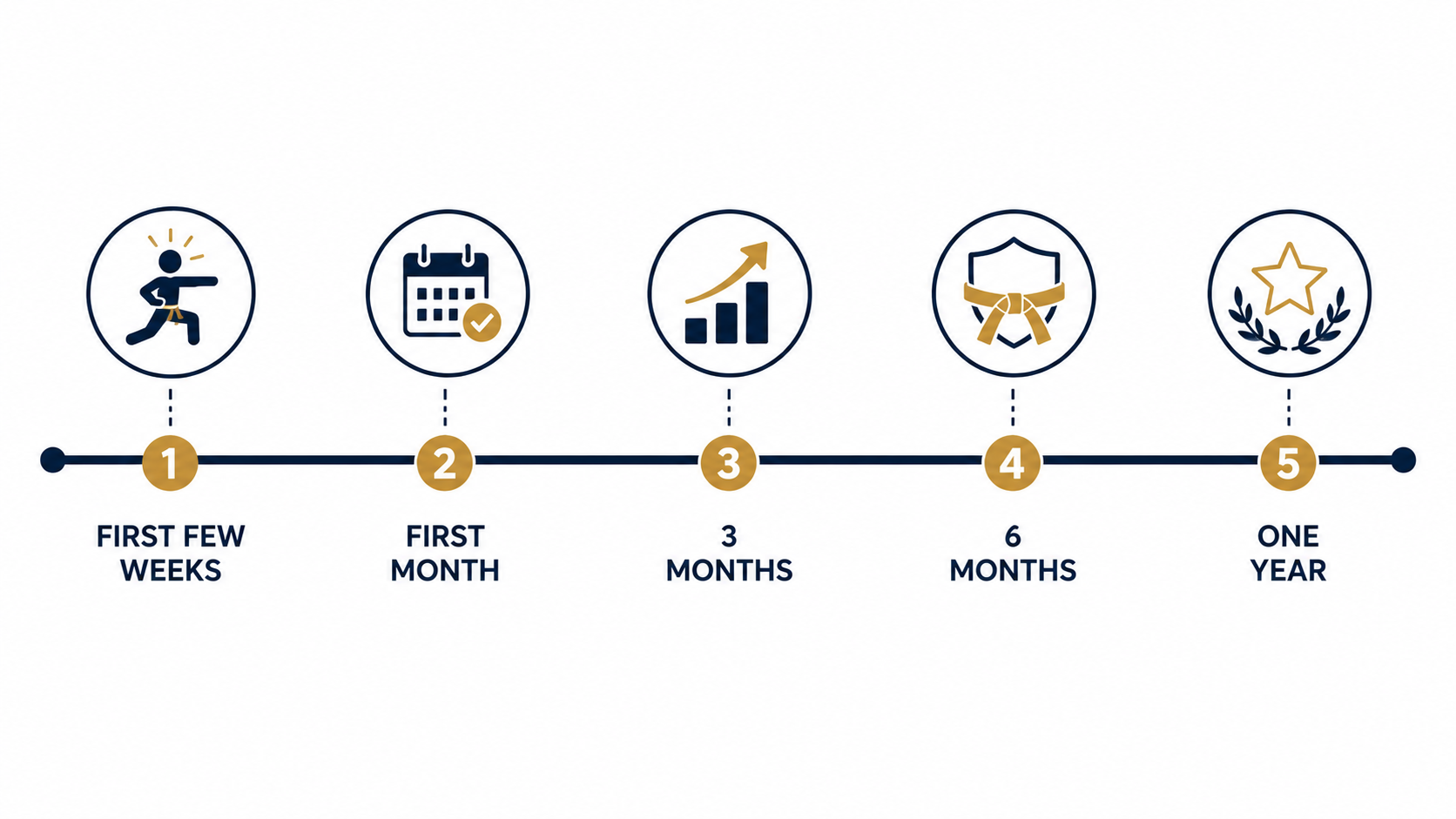
Progress in martial arts training typically follows a general pattern, though individual results vary based on consistency, prior fitness level, and training frequency.
- First few weeks: Familiarity with basic movements and class structure
- First month: Noticeable improvement in coordination and stamina
- 3 months: More consistent technique execution and growing confidence
- 6 months: Measurable skill progression, often reflected in rank advancement
- One year: Significant technical competence and established training habits
Factors such as attendance consistency, physical starting point, and outside practice all influence how quickly results appear.
Practice Guide for Long-Term Success
Sustained progress in martial arts depends less on individual sessions and more on long-term habits: For students looking to fast-track consistency, our guide on how to build good habits in 30 days breaks down how new training routines become automatic.
- Weekly routine: Establishing fixed class days supports consistency
- Home practice: Reviewing technique between classes reinforces learning
- Motivation: Connecting training to personal goals helps sustain effort
- Accountability: Training partners or instructors can help maintain consistency
- Goal tracking: Logging progress makes improvement visible over time
- Recovery: Adequate rest supports both physical and mental performance
- Long-term consistency: Steady, moderate effort outperforms sporadic intense training
- Lifestyle adjustments: Sleep and nutrition changes often support training outcomes
Frequently Asked Factors When Choosing a Martial Arts School
When selecting any academy, consider:
- Instructor credentials and teaching experience
- Teaching style and whether it matches personal learning preferences
- Class size, which affects individual attention
- Facility cleanliness and overall safety standards
- Schedule flexibility to fit training around other commitments
- Community culture, since a supportive environment often improves consistency
Conclusion
Mindset Martial Arts represents an approach to training that treats physical skill and personal development as inseparable. Rather than isolating belt progression from character growth, this philosophy integrates discipline, confidence, and resilience into every class. For students of any age, the appeal of mindset martial arts lies in this dual focus: measurable physical progress paired with meaningful personal growth. The core takeaway is simple — consistent training, guided by a mindset-focused philosophy, tends to produce benefits that extend well beyond the training floor.
Frequently Asked Questions
What is Mindset Martial Arts? Mindset Martial Arts is a martial arts academy that combines physical training with structured character development, focusing on discipline, confidence, and mental resilience alongside technical skill.
What age groups can join Mindset Martial Arts programs? Programs typically serve young children, teenagers, and adults, with age-appropriate instruction and, in some cases, options for families to train together.
What services are commonly offered by Mindset Martial Arts? Common services include children’s classes, teen programs, adult training, fitness and conditioning sessions, self-defense instruction, and private coaching.
How does mindset training improve martial arts performance? Mindset training improves performance by building focus, emotional control, and resilience, which support consistent technique execution and faster skill retention under pressure.
How often should beginners attend martial arts classes? Most instructors recommend two to three classes per week for beginners to build steady progress without risking burnout or injury.
Is martial arts suitable for improving confidence and discipline? Yes. Structured martial arts training is widely recognized as an effective way to build confidence and discipline through incremental skill mastery and consistent practice.
What should beginners expect during their first class? Beginners can expect a structured format including warm-up, basic technique instruction, guided drills, and cool-down, with instructors typically accommodating no prior experience.