
Introduction
Mindset avançado refers to an advanced approach to shaping thought patterns, decision-making, resilience, and continuous personal growth. Before exploring what makes it “advanced,” it helps to define mindset itself: a mindset is the set of beliefs and habitual thinking patterns that shape how a person interprets situations and responds to them. An advanced mindset builds on this foundation by adding intentional self-awareness, emotional regulation, and long-term strategic thinking. Mindset development is not a one-time achievement — it is an ongoing process shaped by habits, reflection, learning, and lived experience. Concepts like growth mindset, cognitive flexibility, emotional intelligence, and resilience all play a role in this evolving process.
Quick Summary
- An advanced mindset focuses on continuous learning, adaptability, and intentional decision-making.
- Developing an advanced mindset requires consistent habits, self-reflection, and resilience rather than natural talent alone.
- Mental models, emotional regulation, and strategic thinking are core components of long-term mindset development.
- Small, consistent improvements often produce greater long-term results than occasional major efforts.
What Is an Advanced Mindset?
An advanced mindset is a thinking pattern that combines self-awareness, adaptability, and strategic decision-making to support sustained personal growth. Mindset avançado extends beyond basic positive thinking by focusing on how beliefs, behaviors, and decisions interact over time rather than simply maintaining an optimistic outlook.
Where a beginner mindset often reacts to circumstances, mindset advanced approaches emphasize evaluating evidence, adjusting beliefs when new information appears, and making deliberate choices aligned with long-term goals. This distinction matters because outcomes are shaped less by isolated moments of motivation and more by the consistency of underlying thought patterns.
What Does “Mindset” Stand For?
Mindset stands for the collection of habitual thinking patterns a person relies on to interpret experiences and make decisions — it is not a fixed personality trait. Psychologists generally describe mindset as a cognitive framework that can shift based on experience, feedback, and deliberate effort. Because mindset is learned rather than inherited, it can be refined over time through structured practice and self-observation.
Characteristics of an Advanced Mindset
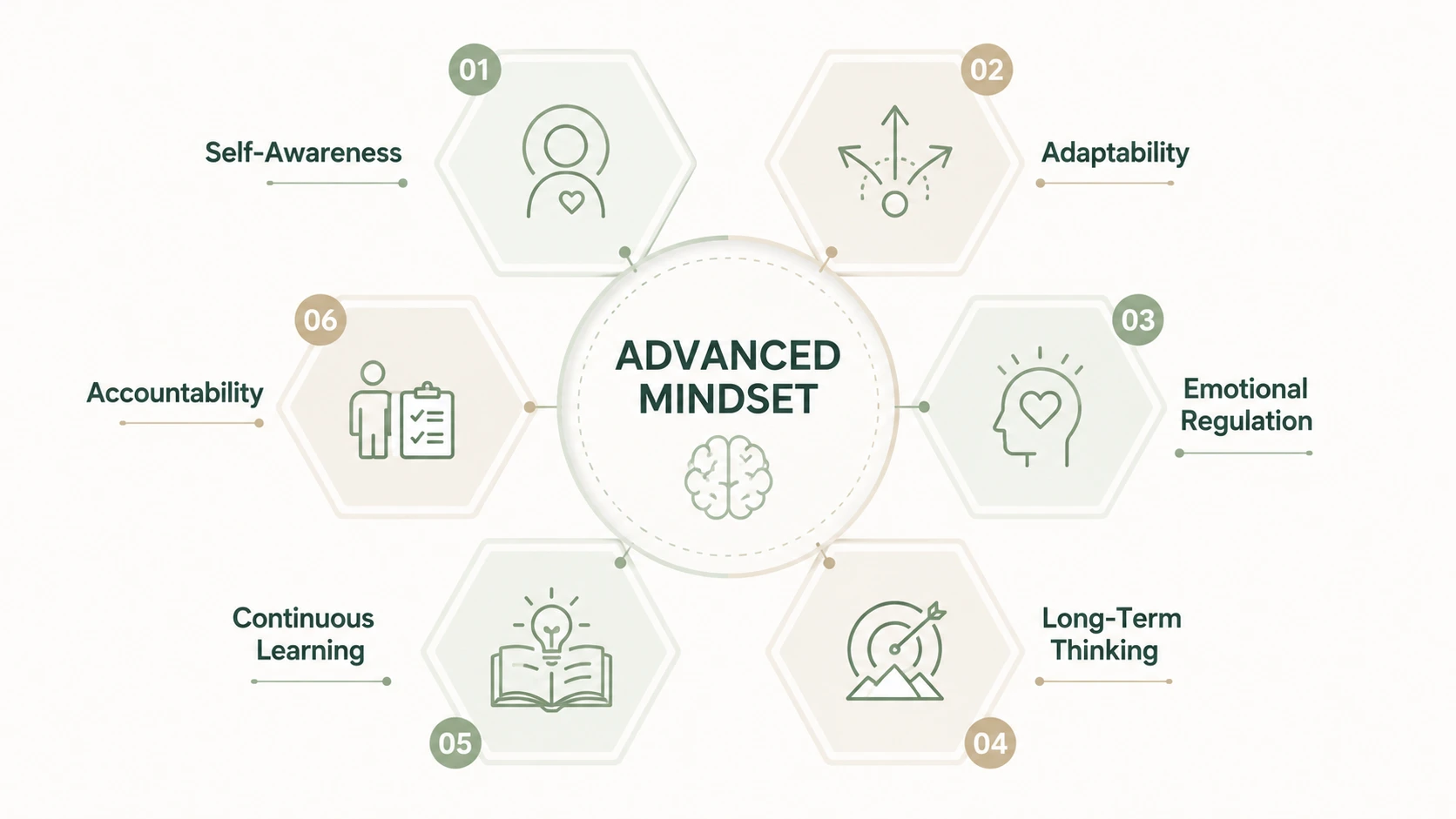
People with an advanced mindset typically demonstrate the following characteristics:
- Self-awareness – recognizing personal strengths, weaknesses, and emotional triggers
- Adaptability – adjusting plans and beliefs when circumstances change
- Emotional regulation – managing reactions under stress or uncertainty
- Long-term thinking – prioritizing sustainable progress over short-term wins
- Continuous learning – actively seeking new information and skills
- Accountability – taking ownership of decisions and outcomes
Why an Advanced Mindset Matters
Mindset directly shapes outcomes across personal growth, career development, learning ability, relationships, and problem-solving. A person’s habitual thought patterns influence how they interpret setbacks, whether they seek feedback, and how persistently they pursue goals — creating a cause-and-effect relationship between mindset and long-term results. Mindset is only one piece of the picture — for a broader look, see our guide on how you can grow as a person.
In career contexts, an advanced mindset supports better judgment under pressure and stronger adaptability during organizational change. In learning environments, it encourages curiosity and reduces the fear of making mistakes. In relationships, it improves communication and conflict resolution by promoting emotional regulation over reactive responses.
Fixed vs Growth vs Advanced Mindset
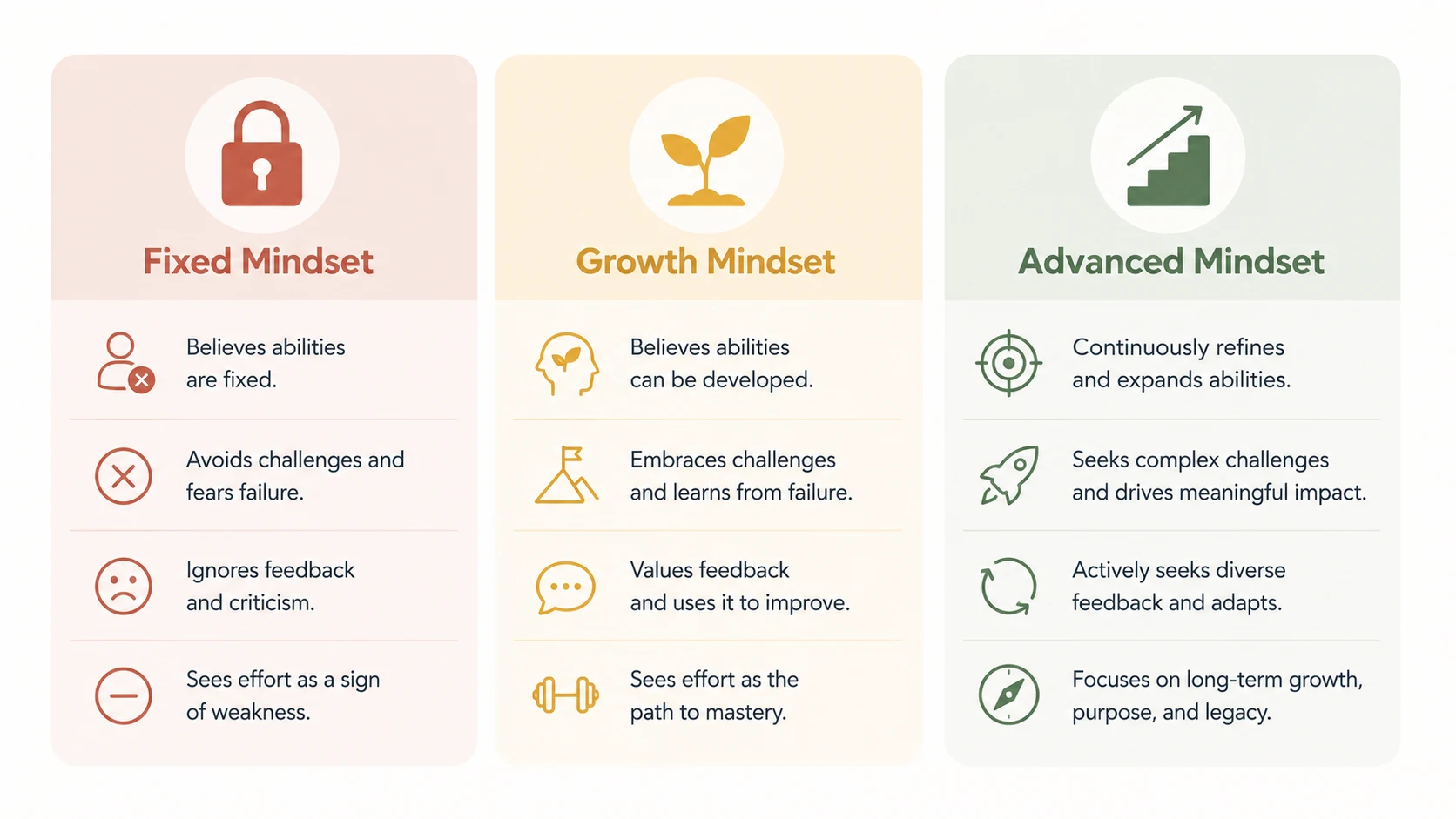
These three thinking patterns represent different stages of cognitive development, each with distinct advantages and limitations. If you’re still building this foundation, our guide on why growth mindset matters is a good starting point before layering on advanced strategies.
| Feature | Fixed Mindset | Growth Mindset | Advanced Mindset |
|---|---|---|---|
| Core belief | Abilities are static | Abilities can improve with effort | Abilities improve through structured, reflective practice |
| Response to failure | Avoidance | Learning opportunity | Data point for strategic adjustment |
| Focus | Proving competence | Building competence | Optimizing long-term decision-making |
| Feedback | Often perceived as criticism | Welcomed as useful | Actively sought and analyzed |
| Time orientation | Short-term validation | Medium-term improvement | Long-term, strategic planning |
Core Components of an Advanced Mindset
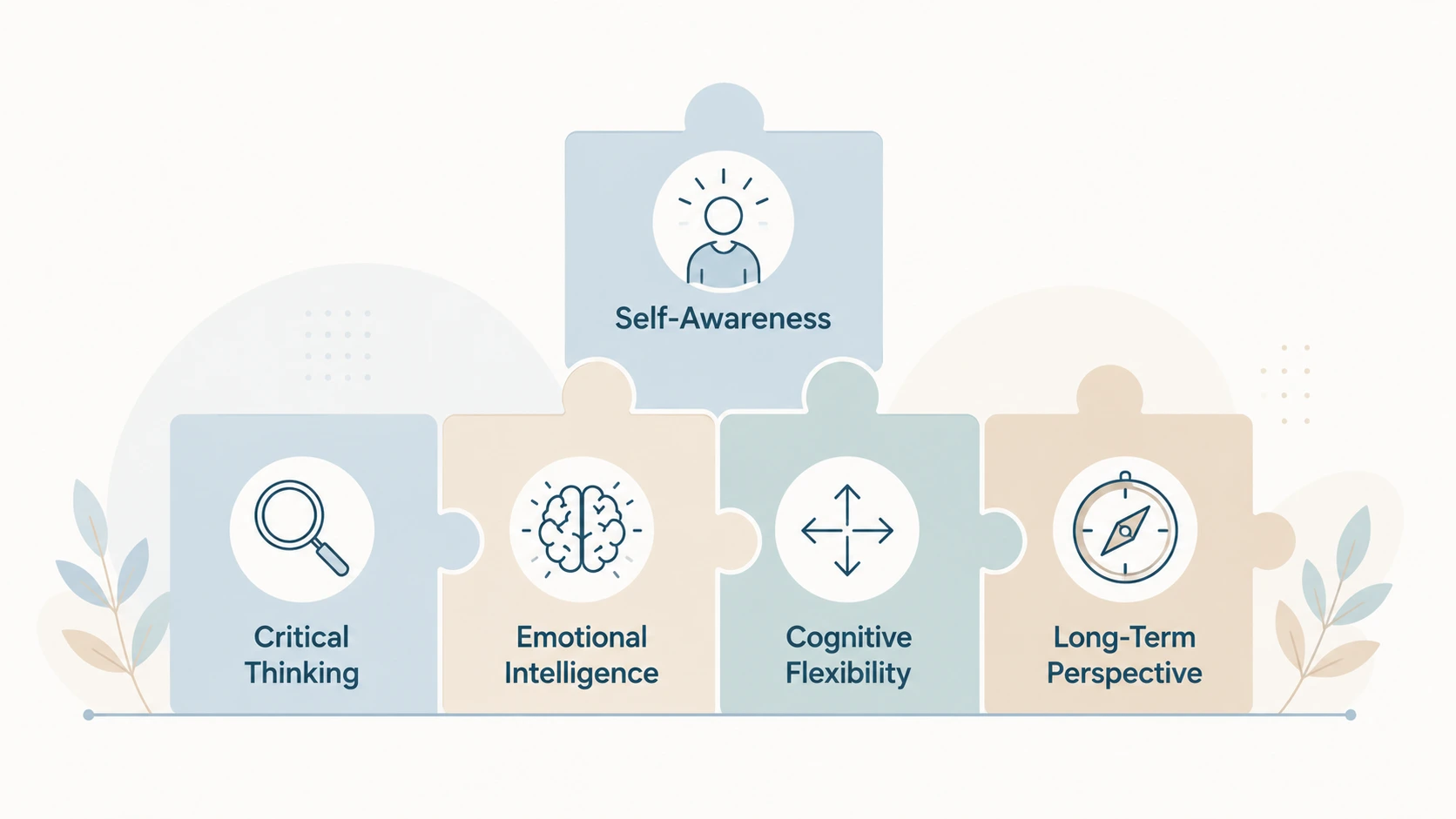
Several foundational concepts support advanced thinking. Together, they form the cognitive and emotional skill set that distinguishes mindset avançado from more basic approaches to personal development.
Self-Awareness
Self-awareness involves recognizing personal strengths and weaknesses accurately, along with understanding emotional triggers before they influence decisions. This awareness allows for more objective self-assessment and reduces reactive behavior.
Critical Thinking
Critical thinking requires evaluating evidence carefully, avoiding unfounded assumptions, and making decisions based on objective analysis rather than impulse. This component helps prevent common cognitive biases from distorting judgment.
Emotional Intelligence
Emotional intelligence includes managing personal emotions effectively, understanding the emotional states of others, and using this understanding to improve communication. It plays a central role in both professional and personal relationships.
Cognitive Flexibility
Cognitive flexibility is the ability to adapt to changing situations and revise beliefs when new information becomes available. It prevents rigid thinking and supports better decision-making in uncertain environments.
Long-Term Perspective
A long-term perspective involves practicing delayed gratification, engaging in strategic planning, and prioritizing sustainable growth over short-term convenience.
How to Develop an Advanced Mindset
Developing an advanced mindset requires actionable, repeatable strategies rather than isolated bursts of motivation.
Build Learning Habits
Consistent learning habits — including reading, structured reflection, deliberate skill development, and seeking feedback — build the knowledge base that supports better decision-making over time.
Improve Decision-Making
Improving decision-making involves evaluating available options systematically, managing uncertainty without becoming paralyzed by it, and treating mistakes as sources of useful information rather than failures to avoid.
Practice Mental Resilience
Mental resilience is built by responding constructively to setbacks, maintaining consistency even when motivation fluctuates, and building confidence gradually through small, repeated wins.
Useful daily practices for building an advanced mindset include:
- Daily reflection
- Journaling
- Goal review
- Learning reviews
- Habit tracking
Common Challenges When Developing an Advanced Mindset
Progress toward an advanced mindset is rarely linear. Understanding common obstacles helps set realistic expectations.
Fear of Failure
Fear of failure often stems from associating mistakes with personal inadequacy rather than viewing them as part of the learning process. It can be addressed by reframing failure as feedback, setting smaller incremental goals, and normalizing imperfect progress. Preventing this fear from taking hold usually involves consistent exposure to manageable challenges.
Limiting Beliefs
Limiting beliefs are negative or inaccurate thinking patterns that restrict potential — for example, assuming a skill is unattainable without evidence. These beliefs can be addressed by identifying the underlying assumption and replacing it with evidence-based reasoning.
Lack of Consistency
Motivation naturally fluctuates due to changes in energy, stress, and external circumstances. Building sustainable routines — rather than relying on motivation alone — helps maintain consistency through low-motivation periods. Motivation naturally fluctuates due to changes in energy, stress, and external circumstances — for a deeper breakdown of this, see our guide on how to build discipline without motivation.
Practical Applications of an Advanced Mindset
An advanced mindset applies across multiple areas of everyday life, not just abstract personal development goals.
Professional Development
In professional settings, an advanced mindset supports stronger leadership, more effective problem-solving, greater adaptability to change, and sustained career growth.
Education and Learning
In educational contexts, it improves study effectiveness, supports lifelong learning habits, and accelerates skill acquisition by encouraging active engagement rather than passive absorption of information.
Personal Relationships
In personal relationships, an advanced mindset strengthens communication, supports healthier conflict resolution, and builds empathy and emotional maturity over time.
Advanced Mindset Compared with Similar Concepts
Distinguishing mindset avançado from related concepts clarifies what makes it unique.
Advanced Mindset vs Positive Thinking
An advanced mindset involves action and evidence-based adjustment, while positive thinking relies primarily on maintaining an optimistic outlook. Positive thinking alone does not account for strategic planning or emotional regulation, which are central to advanced mindset development.
Advanced Mindset vs Mental Toughness
Mental toughness emphasizes resilience and the ability to persist through difficulty, while an advanced mindset emphasizes adaptability and strategic adjustment. These two concepts are complementary — resilience helps a person endure challenges, while adaptability helps them adjust their approach effectively.
| Concept | Primary Focus | Strengths | Limitations |
|---|---|---|---|
| Positive Thinking | Maintaining optimism | Improves short-term motivation | Lacks strategic or evidence-based structure |
| Mental Toughness | Enduring difficulty | Builds persistence and discipline | May not adapt approach when circumstances change |
| Advanced Mindset | Strategic adaptability | Combines resilience, reflection, and planning | Requires sustained, deliberate effort to develop |
Beginner Mistakes and Misconceptions
Several common misconceptions can slow progress toward developing an advanced mindset:
- Expecting immediate transformation
- Confusing confidence with competence
- Ignoring emotional regulation
- Avoiding constructive feedback
- Seeking motivation instead of systems
Difficulty and Time Investment
Developing an advanced mindset requires moderate to high sustained effort rather than intense short-term bursts. Beginner-friendly approaches focus on small, consistent habits such as daily reflection, while more advanced variations incorporate structured goal systems, feedback loops, and deliberate exposure to challenging situations.
Personal factors — including existing self-awareness, prior exposure to feedback, and current stress levels — influence how quickly someone develops these skills. Someone already practicing reflection or goal-setting may progress faster than someone starting without any structured habits in place.
Results Timeline
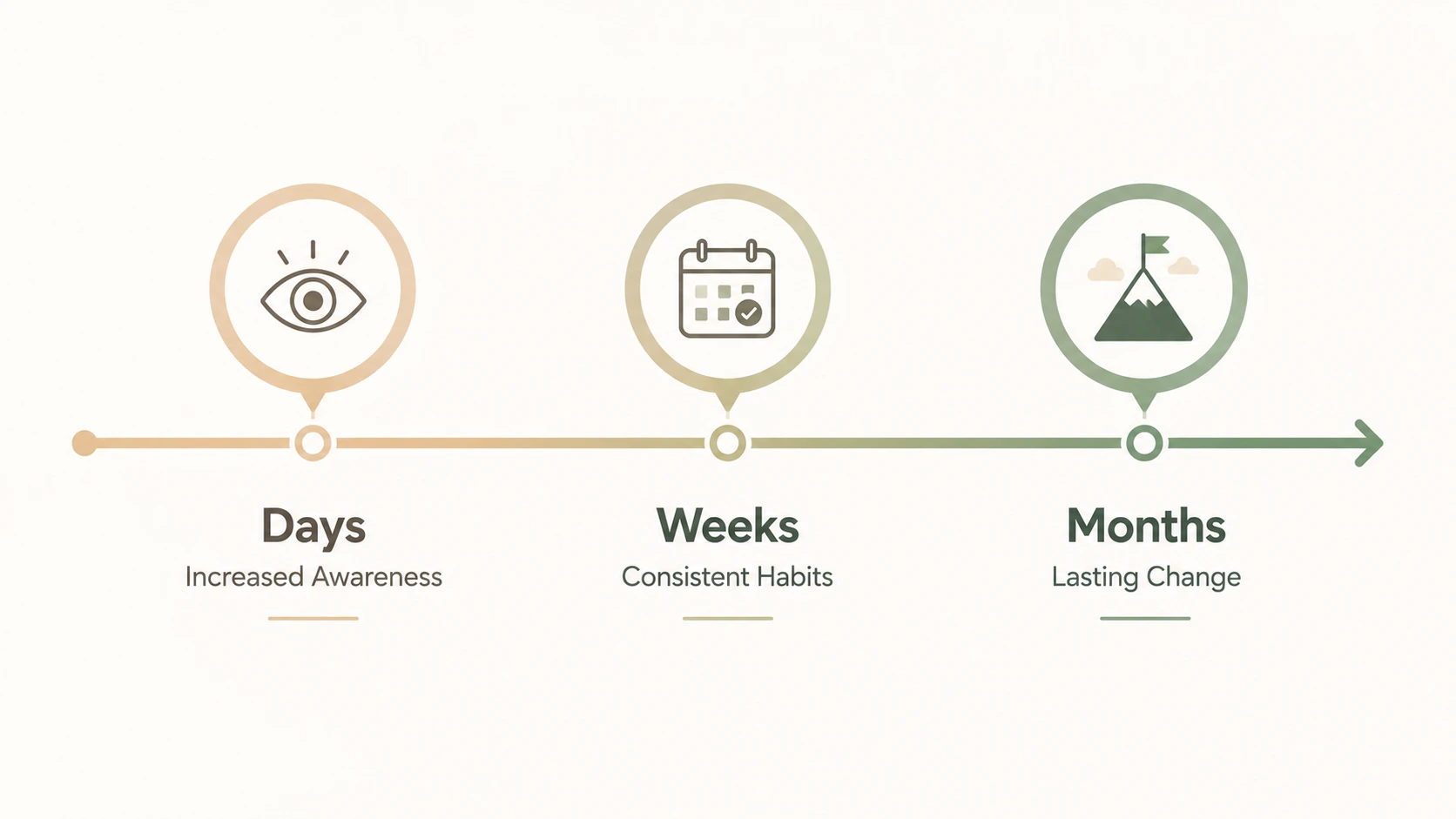
Results from mindset development typically appear gradually rather than immediately. In our experience helping readers build better habits, most people notice small shifts in self-awareness within the first few weeks, more consistent decision-making patterns within a few months, and durable changes in resilience and adaptability after six months or more of consistent practice.
Progress often follows this general pattern:
- Days: Increased awareness of thought patterns and triggers
- Weeks: More consistent habits and improved emotional regulation
- Months: Noticeable shifts in decision-making and long-term planning ability
Factors such as consistency, environment, stress levels, and access to feedback all influence how quickly these changes take hold.
Practice Guide for Building an Advanced Mindset
A sustainable practice routine combines daily, weekly, and long-term habits.
Daily Practices
- Reflection
- Reading
- Goal review
- Gratitude
- Skill practice
Weekly Practices
Weekly practices should include structured progress reviews, feedback sessions with trusted peers or mentors, and periodic habit evaluation to identify what is and isn’t working.
Long-Term Sustainability
Long-term sustainability requires avoiding burnout by pacing effort realistically, adjusting goals as circumstances change, and maintaining consistency through structured routines rather than relying solely on motivation. Your Daily Thrive recommends revisiting goals every few months to ensure they remain aligned with current priorities.
Frequently Overlooked Factors That Influence Mindset Development
Several external factors are often left out of mindset discussions but play a meaningful role in shaping progress:
- Environment – surroundings that either support or hinder consistent habits
- Social influences – the mindset and behavior patterns of close relationships
- Sleep – directly affects emotional regulation and decision-making quality
- Stress – chronic stress can impair cognitive flexibility and self-awareness
- Lifestyle – daily routines and physical health influence mental clarity
- Continuous learning – ongoing exposure to new information and perspectives
As of 2026, behavioral science research continues to emphasize the connection between physical well-being — particularly sleep and stress management — and cognitive performance, reinforcing that mindset development cannot be separated from overall lifestyle factors.
Conclusion
Mindset avançado represents a deliberate, evidence-based approach to thinking that combines self-awareness, emotional regulation, adaptability, and long-term strategic planning. Unlike basic positive thinking, it requires consistent practice, honest self-reflection, and a willingness to adjust beliefs based on new information. Building this kind of mindset is not about achieving perfection — it is about maintaining steady, incremental improvement over time. Readers looking to develop mindset avançado should focus on small, sustainable habits, seek regular feedback, and remain patient with the gradual nature of meaningful change.
Frequently Asked Questions
What is an advanced mindset?
An advanced mindset is a thinking pattern built on self-awareness, adaptability, and strategic decision-making that supports sustained personal growth, distinguishing it from basic positive thinking or a standard growth mindset.
What does mindset stand for?
Mindset stands for the habitual thought patterns a person uses to interpret experiences and make decisions, functioning as a learned cognitive framework rather than a fixed trait.
Can anyone develop an advanced mindset?
Yes, an advanced mindset can be developed by anyone through consistent practice, structured habits, and accumulated experience — it depends primarily on effort and repetition rather than innate ability.
How long does it take to build an advanced mindset?
Initial shifts in self-awareness often appear within a few weeks, while durable changes in decision-making and resilience typically take several months of consistent practice, depending on individual circumstances.
What habits help develop an advanced mindset?
Helpful habits include daily reflection, structured learning, seeking feedback, practicing resilience after setbacks, and setting clear, reviewable goals.
How is an advanced mindset different from a growth mindset?
A growth mindset focuses on the belief that abilities can improve with effort, while an advanced mindset builds on this belief with structured, reflective practice, strategic planning, and consistent emotional regulation.