

Introduction
A money mindset is the set of beliefs, attitudes, emotions, and habits that shape how a person thinks about earning, spending, saving, debt, and wealth. Money mindset tips are practical strategies for recognizing unhelpful financial beliefs and replacing them with healthier decision-making patterns. A positive money mindset is not simply “thinking positively” about money — it combines realistic beliefs with consistent financial behaviors. Mindset connects closely with financial habits, goal setting, productivity, and long-term resilience, and understanding this relationship is the first step toward meaningful change. This article covers money mindset examples, actionable tips for beginners, and how mindset fits into real financial planning.
Quick Summary
- A healthy money mindset helps you make financial decisions based on goals, evidence, and long-term priorities rather than fear, shame, or impulsive emotions.
- The first step is identifying your existing beliefs about money and noticing how they influence spending, saving, earning, and financial risk-taking.
- Practical money mindset tips include reframing limiting beliefs, setting realistic financial goals, tracking behavior, and building consistent habits.
- A positive money mindset does not guarantee wealth; it supports healthier financial decision-making and more sustainable progress.
What Is a Money Mindset and Why Does It Matter?
What does “money mindset” mean?
A money mindset is the collection of beliefs and assumptions a person develops about earning, spending, saving, debt, investing, and financial security over time. These beliefs are often shaped by upbringing, culture, past experiences, and social environment. A money mindset is different from financial literacy: financial literacy refers to practical knowledge and skills, while money mindset refers to the underlying beliefs and emotional patterns that influence whether and how that knowledge gets applied.
How does your mindset affect financial behavior?
Beliefs about money can influence several areas of financial behavior, including:
- Spending decisions and impulse control
- Consistency in saving over time
- Avoidance of financial tasks like budgeting or checking account balances
- Willingness to learn new financial skills
- Emotional responses to financial setbacks
- Long-term goal setting and follow-through
Mindset influences behavior, but it does not operate independently of income, financial circumstances, education, or external constraints. Two people with the same mindset can have very different financial outcomes depending on their starting resources and life situation.
Common Money Mindsets: Helpful and Unhelpful Patterns
Examples of limiting money beliefs
Common limiting money mindset examples include:
- “I will never be good with money.”
- “Talking about money is uncomfortable.”
- “Spending money makes me feel successful.”
- “Saving is impossible unless I earn more.”
- “Debt is always a sign of failure.”
Each belief can shape financial behavior differently. For example, believing debt always signals failure may discourage someone from using strategic, low-cost debt for education or a home, even when it reflects a reasonable financial choice rather than a mindset problem. It’s also worth noting that some of these statements may reflect a real financial constraint — such as low income relative to expenses — rather than purely a mindset issue.
Examples of a positive money mindset
Constructive beliefs that support a positive money mindset include:
- Money is a resource that can be managed, not just something that happens to you.
- Financial skills can be learned at any age.
- Small improvements can compound meaningfully over time.
- Spending should reflect personal priorities rather than social pressure.
- Financial mistakes provide information that can improve future decisions.
These beliefs support better decision-making, but they are not a substitute for practical financial action. A positive money mindset works alongside budgeting and planning — not in place of it.
10 Practical Money Mindset Tips for Beginners
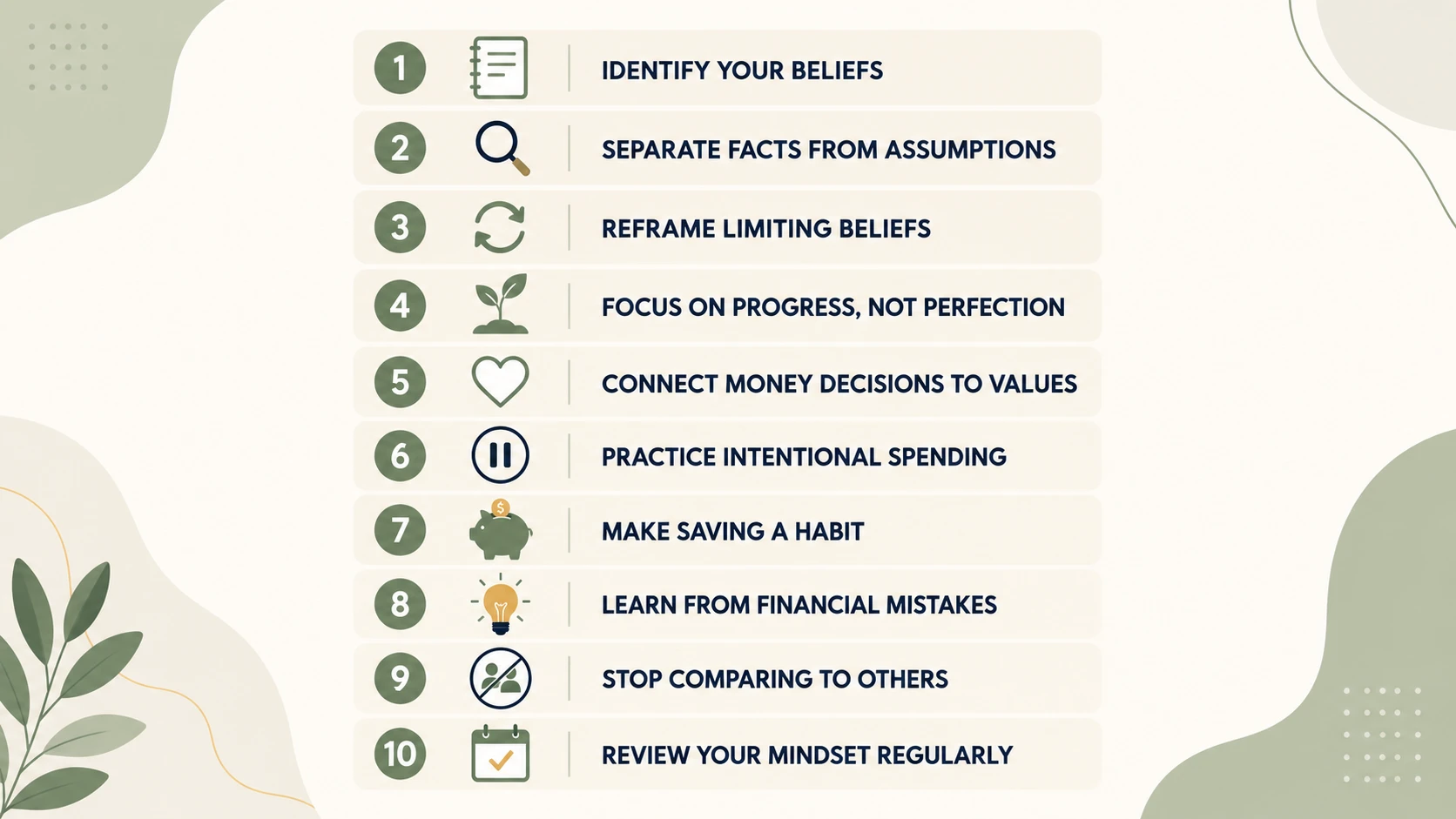
1. Identify your current money beliefs. Write down recurring thoughts about money and notice which ones create fear, guilt, avoidance, or impulsive spending.
2. Separate facts from financial assumptions. Distinguish your actual income, expenses, debt, and savings from emotional interpretations of those numbers. Accurate information reduces uncertainty and anxiety.
3. Replace limiting beliefs with realistic alternatives. Reframe absolute statements (“I’m bad with money”) into actionable ones (“I’m learning to track my spending”). Realistic reframing works better than unrealistic affirmations.
4. Focus on progress instead of perfection. Sustainable financial improvement usually comes from small, repeatable behavioral changes rather than dramatic overhauls. Setbacks don’t require abandoning long-term goals.
5. Connect money decisions to personal values. Financial goals are easier to sustain when they have a meaningful purpose behind them, rather than existing as abstract numbers.
6. Practice intentional spending. Intentional spending differs from restrictive budgeting — it means pausing before a purchase to check whether it aligns with your priorities, which reduces emotionally driven decisions.
7. Make saving a habit. Consistency and automation matter more than the exact amount saved. The right savings strategy depends on individual income and circumstances. Small, consistent actions compound over time — see how small habits that changed my life for readers applying this principle outside of finances too.
8. Learn from financial mistakes. Treat mistakes as feedback rather than evidence of personal failure. Reviewing what happened can directly improve future decisions.
9. Stop comparing your financial life with others. Visible spending on social media or in daily life rarely reflects someone’s complete financial picture, including their debt, savings, or financial stress.
10. Review your mindset regularly. A weekly or monthly reflection helps track changes in financial behavior, emotional responses, and decision-making over time.
How to Develop and Improve Your Money Mindset
How to have a healthier money mindset
Improving a money mindset generally follows a repeatable sequence: build awareness of current beliefs, identify recurring financial emotions, challenge unhelpful assumptions, define realistic priorities, pair mindset changes with concrete habits, and review progress periodically. If reframing feels difficult at first, it can help to review broader techniques on how to change your thoughts before applying them specifically to money.
How to improve money mindset when old habits return
Old financial habits often resurface under stress. When this happens: identify the trigger, pause before acting, examine the belief behind the reaction, choose a behavior consistent with your long-term goal, and review the result without self-judgment.
Is there a money mindset development formula?
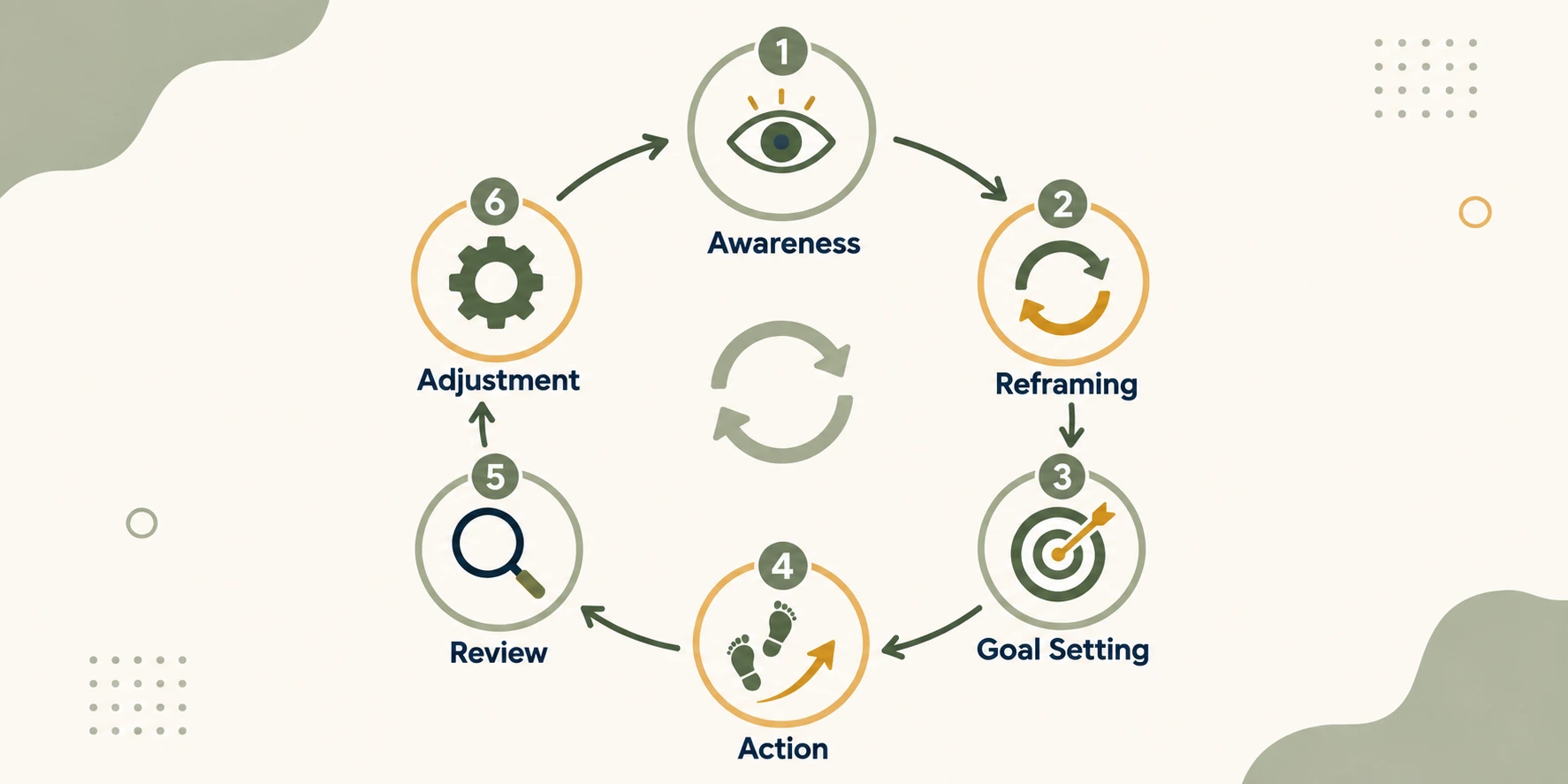
There is no universal, scientifically guaranteed formula for financial success through mindset alone. A practical framework instead follows this cycle: Awareness → Reframing → Goal Setting → Action → Review → Adjustment. This cycle can be repeated as financial circumstances, income, and goals change over time.
Positive Money Mindset vs. Unrealistic “Abundance” Thinking
What is a positive money mindset?
A positive money mindset combines realistic optimism with concrete planning. Confidence in this context encourages learning, persistence, and responsible financial action — not the expectation that outcomes will improve without effort.
What is an abundance mindset with money?
An abundance mindset refers to viewing opportunities and resources through a less scarcity-driven lens. It can help reduce excessive fear around money, but it should not replace budgeting, risk assessment, or financial planning.
Positive thinking vs. practical financial behavior
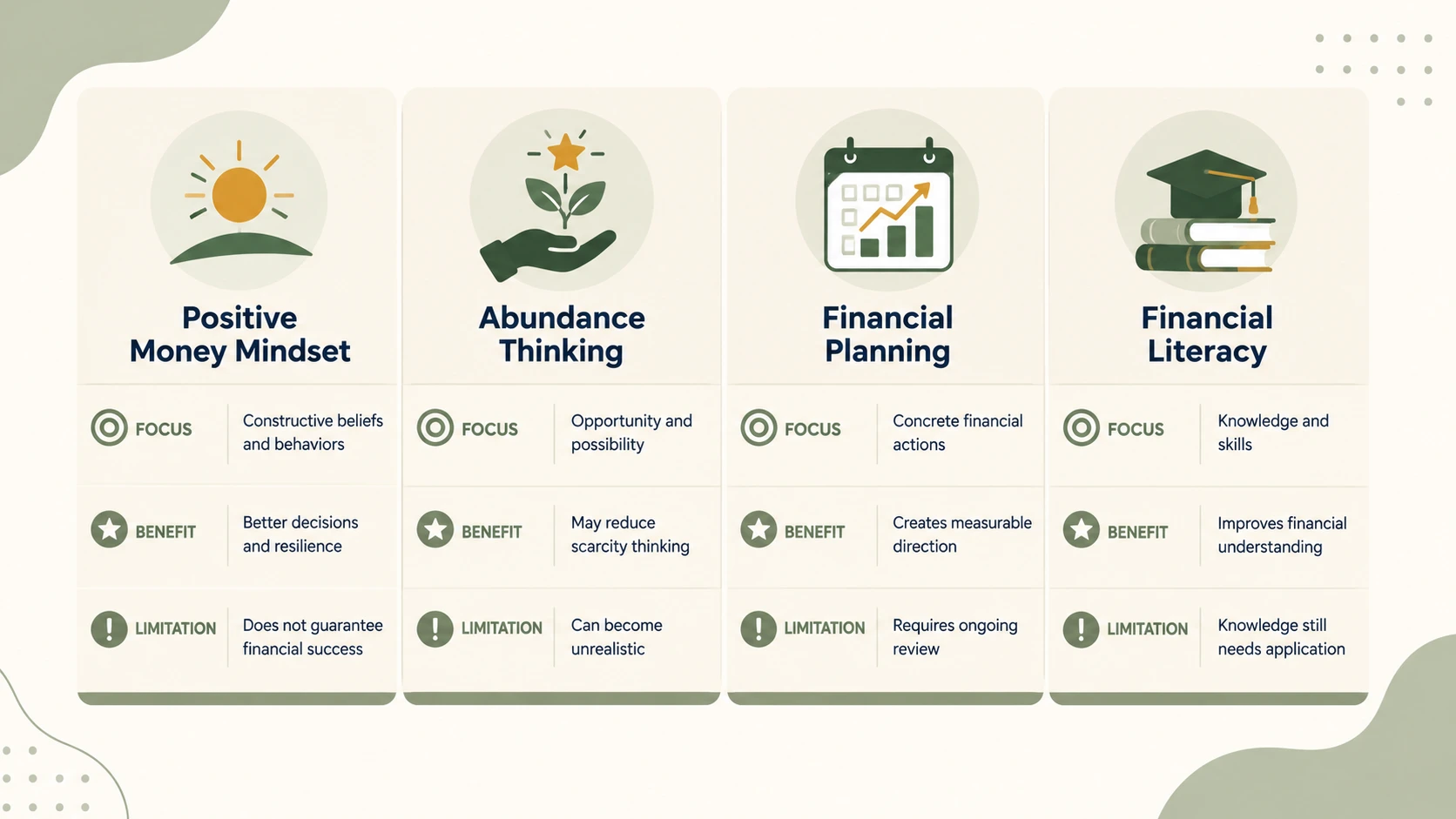
| Approach | Main Focus | Potential Benefit | Important Limitation |
|---|---|---|---|
| Positive money mindset | Constructive beliefs and behaviors | Better decision-making and resilience | Does not guarantee financial success |
| Abundance thinking | Opportunity and possibility | May reduce excessive scarcity thinking | Can become unrealistic without financial constraints |
| Financial planning | Concrete financial actions | Creates measurable direction | Requires ongoing review |
| Financial literacy | Knowledge and skills | Improves understanding of financial choices | Knowledge still needs to be applied |
Money Mindset and Financial Goals
How does mindset affect goal setting?
Beliefs about money directly influence motivation and how financial goals are set. Vague goals (“save more money”) are harder to sustain than measurable ones (“save $200 per month for six months”). Effective goals also reflect actual resources and priorities rather than idealized expectations.
How to build a money goal you can maintain
Define the objective clearly, establish a realistic timeframe, identify the specific behavior required, track progress consistently, and adjust the goal when circumstances change.
Money mindset and the idea of becoming a millionaire
Building significant wealth requires more than adopting a particular mindset. Income level, savings rate, investing knowledge, time horizon, risk tolerance, available opportunities, and broader economic circumstances all play a role. Mindset can support the behaviors needed for wealth-building, but it does not guarantee millionaire status on its own.
Money Mindset for Different Life Situations
Money mindset tips for students and young adults
Developing financial awareness early, avoiding lifestyle comparison, learning basic budgeting and saving skills, and understanding that early financial mistakes can usually be corrected over time.
Money mindset for people dealing with financial setbacks
Avoiding shame-based thinking, separating an unfavorable financial situation from personal identity, focusing on controllable next steps, and adjusting goals to fit current circumstances.
Money mindset for higher earners
Higher income does not automatically eliminate poor financial habits. Lifestyle inflation — increasing spending as income rises — can prevent higher earners from building savings unless spending and goals are deliberately aligned.
Common Money Mindset Mistakes and How to Fix Them
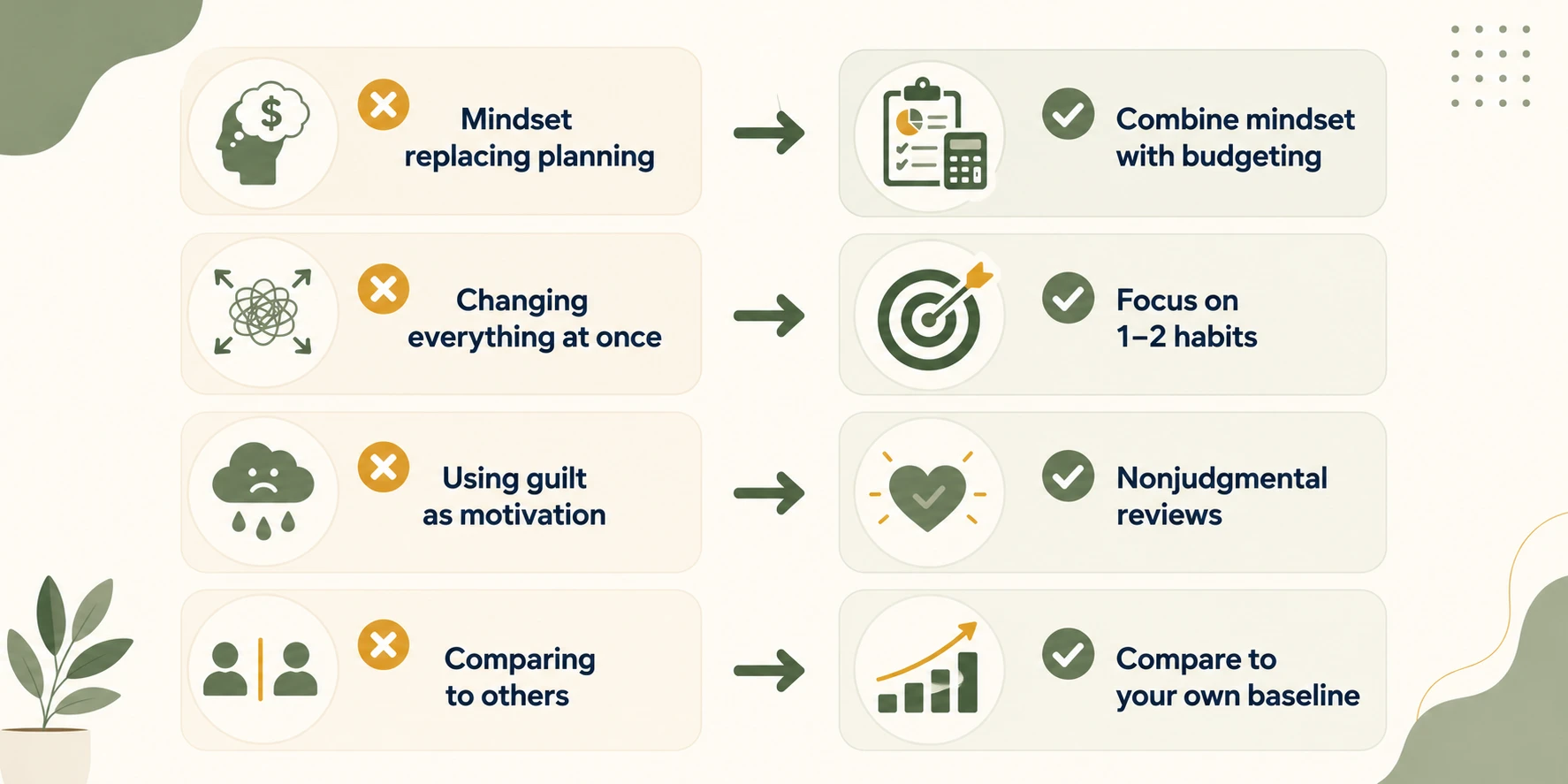
Mistake: Treating mindset as a substitute for financial planning. This happens because positive thinking can feel easier than confronting financial numbers directly. The fix is combining mindset work with budgeting, saving, debt management, and financial education, and measuring actual behaviors rather than relying only on feelings.
Mistake: Trying to change everything at once. Motivation can create unrealistic expectations for rapid change. The fix is choosing one or two high-impact habits first and using gradual, sustainable changes going forward.
Mistake: Using guilt as motivation. People often interpret financial mistakes as personal failures. The fix is analyzing the behavior and its trigger instead of self-criticism, supported by regular, nonjudgmental financial reviews.
Mistake: Comparing your progress with someone else’s. Income, lifestyle, and wealth are highly visible in social environments, which distorts comparison. The fix is comparing current behavior with your own previous baseline and defining personal financial goals.
How to Practice Money Mindset Skills Consistently
A simple weekly money mindset routine
Review recent spending decisions, identify one helpful and one unhelpful financial behavior, check progress toward a current goal, write down one belief that needs reframing, and choose one action for the following week. For a more structured approach to building this routine, our guide on how to build good habits in 30 days offers a step-by-step framework.
How to maintain motivation without burnout
Keep goals realistic, focus on repeatable behaviors, allow room for normal financial setbacks, and celebrate behavioral progress rather than only large financial outcomes.
How to measure whether your money mindset is improving
Possible indicators include:
- Greater willingness to review your finances
- Less avoidance of financial decisions
- More intentional spending
- More consistent saving behavior
- Better responses to financial setbacks
- Greater confidence in learning financial concepts
In our experience helping readers build better habits, the earliest sign of progress is usually reduced avoidance — checking an account balance without dread — well before any major change in account totals.
Money Mindset Quotes: How to Use Them Constructively
Can money mindset quotes actually help?
Short statements can act as reminders or prompts that reinforce a belief or intention. However, quotes do not replace practical financial action on their own.
How to turn a money mindset quote into an actionable habit
Identify the principle behind the quote, convert it into a measurable behavior, and review whether that behavior is realistic and useful for your situation.
Examples of themes to look for in money mindset quotes
Financial responsibility, long-term thinking, patience, learning, intentional spending, and resilience after setbacks are common themes worth focusing on.
Can a Money Mindset Quiz Help You Understand Your Financial Habits?
What can a money mindset quiz reveal?
A money mindset quiz can reveal patterns in spending attitudes, saving preferences, financial avoidance, risk attitudes, emotional responses to money, and beliefs about earning and wealth.
How to interpret quiz results responsibly
Treat quiz results as reflection prompts rather than diagnoses. Look for recurring patterns, compare results with actual financial behavior, and turn useful observations into specific, actionable steps. Your Daily Thrive recommends pairing any quiz result with a real look at recent bank statements, since self-reported attitudes and actual spending behavior don’t always match.
Money Mindset: Key Concepts to Remember
- Money mindset = beliefs + emotions + behavioral patterns surrounding money.
- Awareness is the starting point for changing unhelpful patterns.
- A positive mindset should remain grounded in financial reality.
- Consistent habits matter more than short-term motivation.
- Financial circumstances and external constraints must be considered.
- Mindset improvement is an ongoing process rather than a one-time transformation.
Conclusion
Improving a money mindset starts with identifying existing beliefs, challenging unrealistic assumptions, setting meaningful and measurable goals, practicing intentional financial behaviors, and reviewing progress consistently. A positive money mindset is ultimately about developing a healthier relationship with financial decisions — not believing that thoughts alone create wealth. As of 2026, behavioral finance research continues to reinforce that the most effective mindset changes are the ones paired with practical action and adapted to individual circumstances. The clearest takeaway: improving your money mindset begins with understanding how you currently think about money, then deliberately choosing more useful behaviors going forward.
Frequently Asked Questions
What are the best money mindset tips for beginners? The most effective starting points are building awareness of current beliefs, adopting realistic (not just positive) beliefs, practicing intentional spending, building consistent saving habits, setting measurable financial goals, and reviewing progress regularly.
How can I develop a positive money mindset? Developing a positive money mindset involves identifying limiting beliefs, reframing them realistically, learning practical financial skills, and connecting mindset changes with concrete financial habits rather than relying on beliefs alone.
How do I improve my money mindset when I have negative beliefs about money? Start by identifying where the belief came from, separate the emotional reaction from the actual financial facts, reframe the belief into something realistic and actionable, and practice a small behavior that contradicts the old pattern.
What are some examples of a healthy money mindset? Examples include viewing saving as a learnable skill, treating financial mistakes as useful feedback, spending in line with personal priorities, setting measurable goals, and staying consistent with financial habits over time.
Does a positive money mindset make you rich? No. A positive money mindset can support better decisions and persistence, but it cannot guarantee wealth, since income, opportunities, financial decisions, market conditions, and other external factors also play a significant role.
What is the difference between a positive money mindset and an abundance mindset? A positive money mindset focuses on realistic, constructive financial beliefs and behaviors, while an abundance mindset focuses more broadly on opportunity and possibility. Abundance thinking should still be paired with financial planning to remain practical.
Can money mindset quotes really change your financial habits? Quotes can reinforce ideas or serve as reminders, but lasting change requires repeated behaviors and consistent financial action, not just exposure to motivational statements.
What does a money mindset quiz tell you? A money mindset quiz can highlight financial attitudes and behavioral tendencies, but it should be treated as a reflection tool rather than a definitive or complete financial assessment.