
Introduction
Growth mindset poems are short pieces of poetry that reinforce the belief that abilities and intelligence can be developed through effort, learning, and persistence. Rooted in the psychological concept of a “growth mindset,” these poems use rhythm, imagery, and metaphor to make lessons about perseverance, resilience, and self-belief easier to remember and internalize. Instead of simply stating a fact, a poem lets the reader feel the process of struggling, learning, and improving.
This makes growth mindset poetry a practical tool for students, teachers, parents, and anyone who wants a quick, memorable source of motivation. The ideas connect naturally to mindset development, resilience, learning, motivation, perseverance, self-improvement, and positive thinking — all core concepts in behavioral science and educational psychology.
Quick Summary
- Growth mindset poems encourage continuous learning, resilience, and embracing challenges.
- They help students and adults develop positive attitudes toward mistakes and personal growth.
- Different poem styles suit different audiences, including children, students, and educators.
- Reading and reflecting on growth mindset poetry can strengthen motivation and emotional resilience.
- Poems work alongside affirmations and quotes, but offer deeper emotional and narrative engagement.
What Are Growth Mindset Poems?
Growth mindset poems are pieces of mindset poetry written to reflect the idea that skills, intelligence, and character develop through effort rather than being fixed at birth. Short poems about growth mindset typically focus on a specific moment of struggle or setback, followed by a shift toward learning and improvement.
Poetry works well for this purpose because metaphor and structured language make abstract psychological ideas concrete. A poem about a seed pushing through soil, for example, communicates persistence more memorably than a plain statement like “keep trying.” This is why growth mindset poems are widely used in classrooms, therapy settings, and personal development routines — the emotional resonance of poetry helps the lesson stick.
What Makes a Poem Reflect a Growth Mindset?
A poem reflects a growth mindset when it centers on the process of improvement rather than a fixed outcome. Key markers include:
- Perseverance — continuing effort despite difficulty
- Learning from failure — treating mistakes as information, not identity
- Continuous improvement — framing progress as ongoing, not finished
- Hope and optimism — a forward-looking tone
- Personal transformation — a visible shift in the speaker’s perspective by the poem’s end
Why Growth Mindset Poems Matter
Growth mindset poems matter because they translate a well-established area of educational psychology into an accessible, emotionally engaging format. Carol Dweck’s research on mindset theory showed that people who believe abilities can be developed tend to persist longer through challenges than those who believe abilities are fixed. Poetry reinforces this belief by modeling it: the speaker in the poem struggles, reflects, and grows, giving the reader a template to follow. For a deeper look at the psychology behind this shift in belief, see our full breakdown of why growth mindset is important.
Beyond the psychological framework, poems provide emotional encouragement in a compact form. A short poem can be read in under a minute, making it easy to revisit during moments of self-doubt. Reading and re-reading these poems also supports reflection, since the compressed language often reveals new meaning on each pass.
Benefits for Students
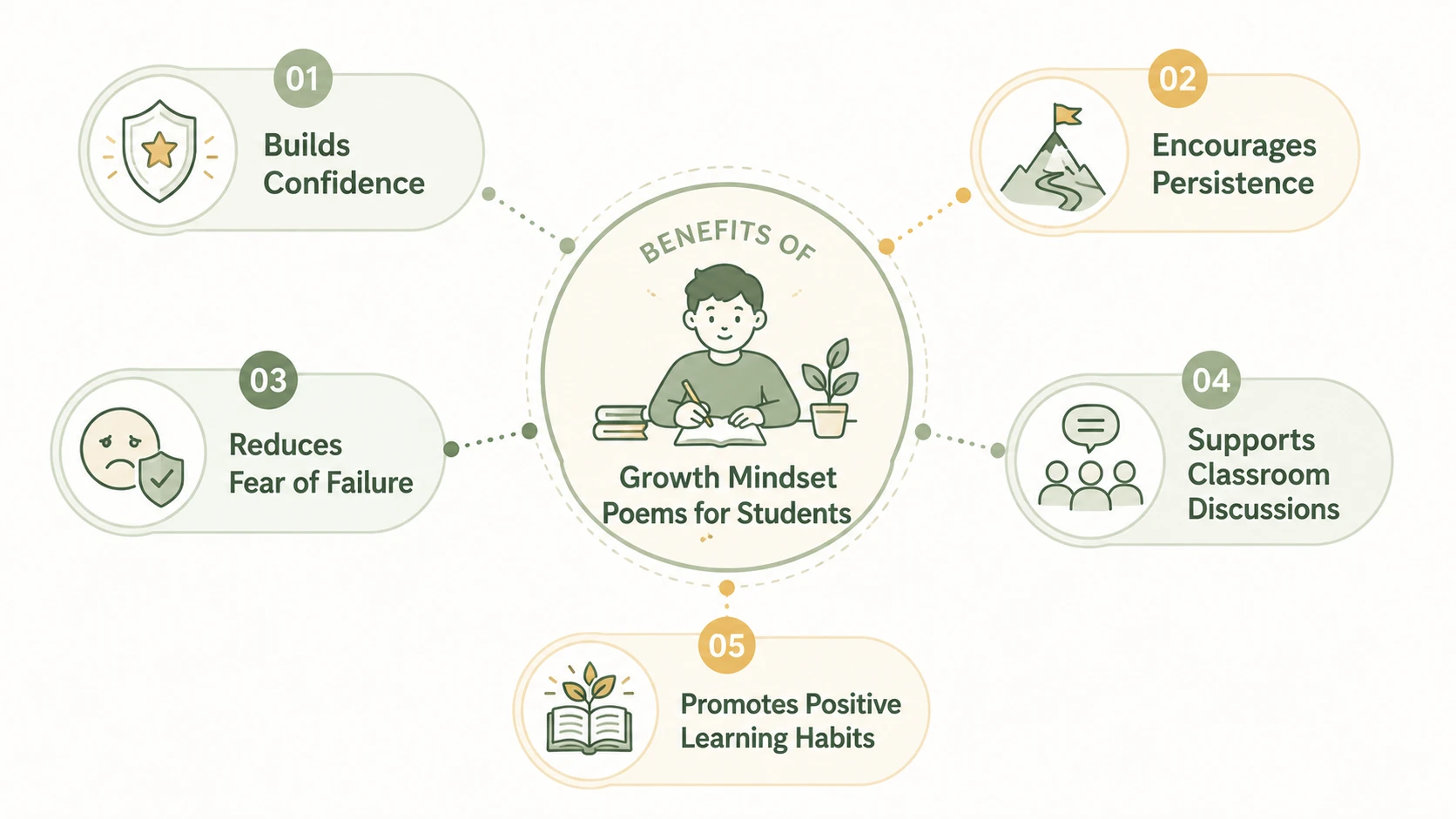
Growth mindset poems for students and motivational poems for students offer several classroom advantages:
- Builds confidence by normalizing struggle as part of learning
- Encourages persistence during difficult assignments
- Reduces fear of failure by reframing mistakes as feedback
- Supports classroom discussions about effort versus outcome
- Promotes positive learning habits that extend beyond a single subject
Benefits for Children
Growth mindset poems for kids are typically written with simple language, short lines, and concrete imagery so younger readers can follow the emotional arc without difficulty. For children, these poems support:
- Simple language that reduces cognitive load while still delivering the mindset lesson
- Emotional development, since children learn to name feelings like frustration or pride
- Confidence building through repeated exposure to stories of overcoming challenges
- Classroom activities, such as choral reading, illustration prompts, or short discussion circles
Common Themes Found in Growth Mindset Poems
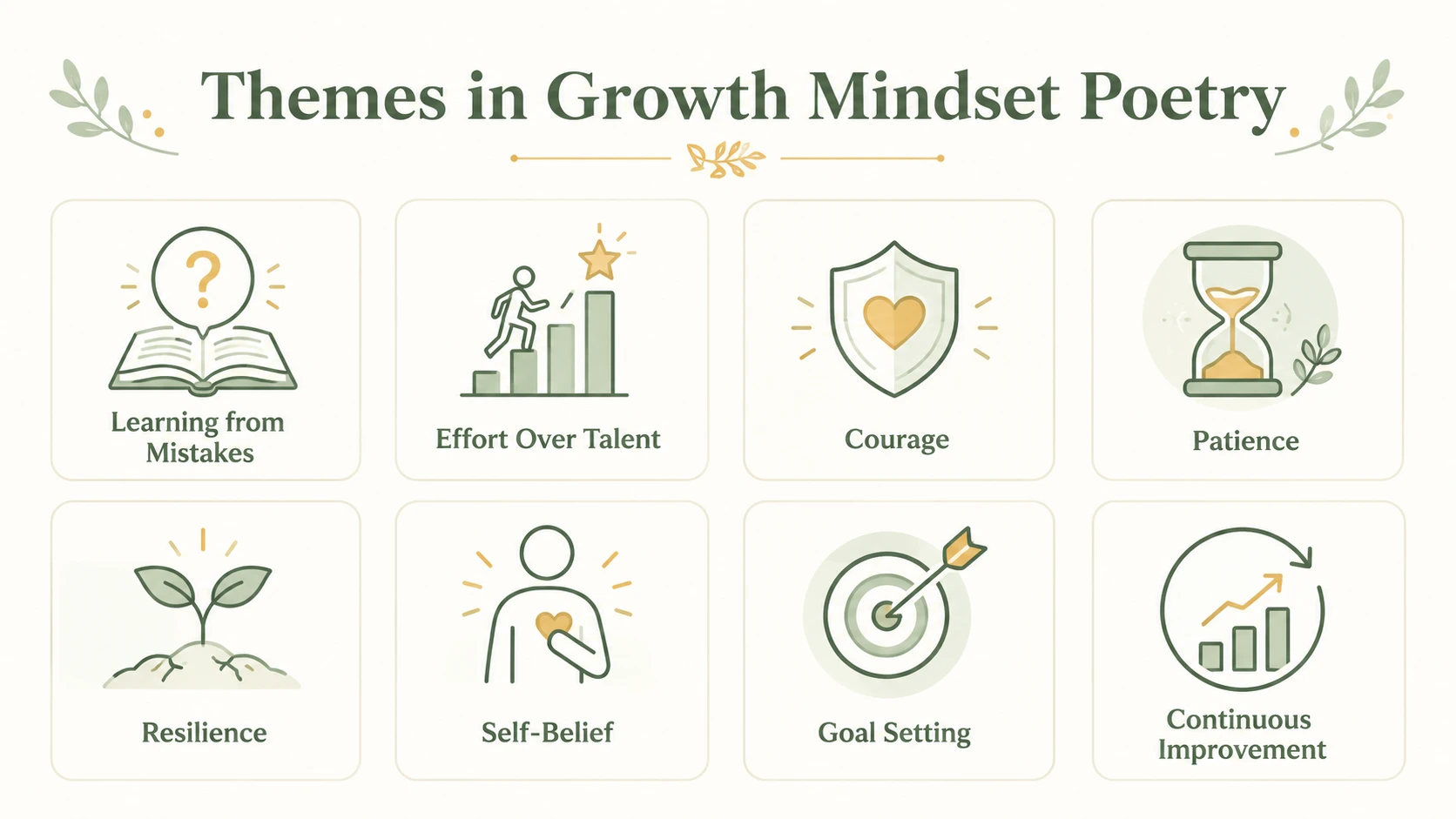
Most growth mindset poems draw from a consistent set of recurring concepts:
- Learning from mistakes
- Effort over talent
- Courage in the face of uncertainty
- Patience during slow progress
- Resilience after setbacks
- Self-belief and inner dialogue
- Goal setting and direction
- Continuous improvement over time
These themes are not exclusive to poetry — they appear throughout behavioral science literature on motivation and self-efficacy — but poems compress them into memorable, emotionally resonant lines.
Types of Growth Mindset Poems
Growth mindset poetry is not one-size-fits-all. Readers typically look for one of a few common types, depending on their setting and purpose.
Short Growth Mindset Poems
Short growth mindset poems and short poems about growth mindset are designed for quick consumption. Their typical uses include:
- Easy classroom use — short enough to read aloud in under a minute
- Morning motivation — a quick mindset reset before the school or work day begins
- Quick reflection exercises — useful as journaling prompts or discussion starters
Inspirational Growth Mindset Poems
Inspirational growth mindset poems tend to be longer and more emotionally layered. They focus on:
- Emotional encouragement during difficult life transitions
- Personal development by walking through a full arc of struggle and growth
- Building resilience through repeated imagery of recovery and renewal
Motivational Poems for Success
Short motivational poems for success and other powerful motivational poems in this category emphasize the connection between sustained effort and long-term achievement. Common threads include:
- Success as the result of consistent effort, not a single event
- Persistence through repeated setbacks
- Long-term achievement framed as a series of small, compounding gains
Growth Mindset Poems vs Traditional Motivational Poems
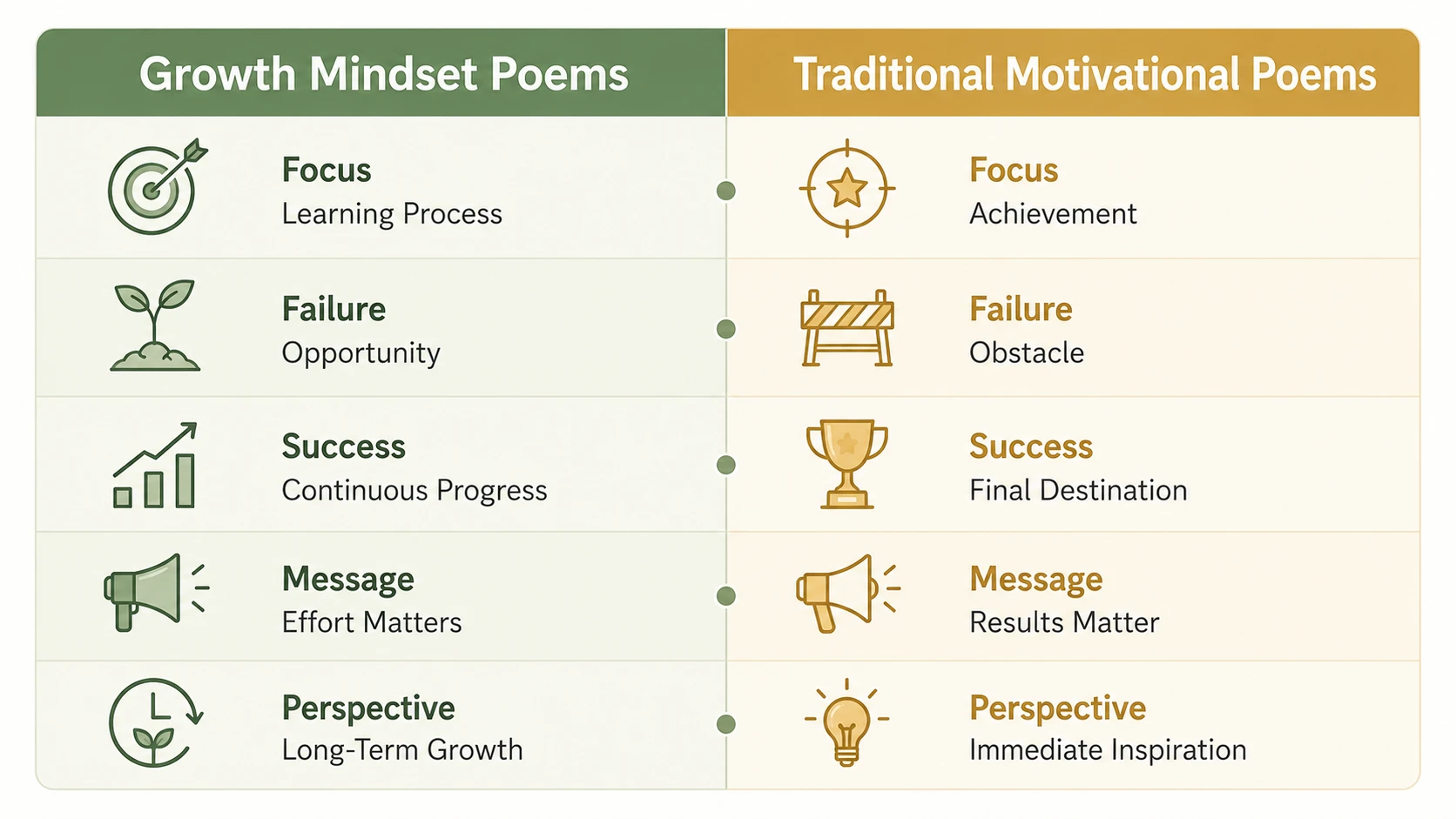
While both poem types aim to inspire, they differ in focus and message.
| Feature | Growth Mindset Poems | Traditional Motivational Poems |
|---|---|---|
| Focus | Learning process | Achievement |
| Failure | Opportunity to improve | Obstacle to overcome |
| Success | Continuous progress | Final destination |
| Message | Effort matters | Results matter |
| Perspective | Long-term growth | Immediate inspiration |
Understanding this distinction helps readers choose the right poem for their goal — a growth mindset poem for building a sustainable habit, or a traditional motivational poem for a short-term push.
How Teachers Can Use Growth Mindset Poems in the Classroom
Growth mindset poems for students and motivational poems for students fit naturally into classroom routines. In our experience helping readers build better habits, the most effective classroom applications include:
- Morning meetings, where a short poem sets a positive tone for the day
- Writing prompts, asking students to respond to or extend a poem’s theme
- Reading comprehension exercises tied to mindset vocabulary
- Group discussions about the poem’s central struggle and resolution
- Reflection journals where students connect the poem to personal experiences
- Classroom displays featuring rotating growth mindset poems
- Weekly motivation activities that pair a poem with a related goal-setting task
How Parents Can Encourage a Growth Mindset Through Poetry
At home, parents can use poetry as a low-pressure way to reinforce mindset concepts introduced at school. Practical applications include:
- Bedtime reading of short, calming growth mindset poems
- Family discussions about a poem’s meaning and how it applies to a recent challenge
- Encouraging positive self-talk by referencing lines from a favorite poem during difficult moments
- Celebrating effort rather than only celebrating results
- Learning after setbacks, using a poem’s message to reframe a recent mistake
Your Daily Thrive recommends keeping these conversations brief and consistent rather than occasional and lengthy — short, regular touchpoints tend to reinforce mindset language more effectively than infrequent deep discussions.
Real-Life Growth Mindset Examples Inspired by Poetry
Growth mindset examples drawn from everyday life mirror the themes found in mindset poetry. Common examples include:
- Learning a musical instrument, where early mistakes are part of skill acquisition
- Improving school grades through revised study habits rather than innate ability
- Sports practice, where repeated drills lead to gradual performance gains
- Art and creativity, where early drafts are expected to be imperfect
- Building confidence by tracking small wins over time
- Career development, where feedback is treated as a growth opportunity rather than criticism
Each of these examples reflects the same underlying pattern found in growth mindset poems: effort, setback, reflection, and improvement.
Growth Mindset Statements and Positive Affirmations
Growth mindset statement examples are shorter and more direct than poems, making them useful for quick daily reinforcement. The table below shows the core message behind common statements. If you’d like a longer, ready-to-use list, explore our complete collection of growth mindset affirmations to pair with your daily reflection routine.
| Growth Mindset Statement | Core Message |
|---|---|
| I learn from mistakes. | Resilience |
| Every challenge teaches me something. | Learning |
| Practice helps me improve. | Persistence |
| I haven’t mastered it yet. | Continuous growth |
Poems, affirmations, and mindset statements each serve a different purpose. Affirmations work well for quick daily repetition, while poems are better suited to deeper reflection since they carry narrative and emotional context that a single sentence cannot.
Growth Mindset Poems and Motivational Quotes
Powerful growth mindset quotes and growth mindset poems overlap in purpose but differ in form. Quotes are brief, easily memorized, and useful for quick reminders. Poems, by contrast, use extended imagery and structure to build emotional depth over multiple lines or stanzas.
- Poems vs quotes — poems tell a small story; quotes state a single idea
- Depth vs brevity — poems offer more context; quotes offer speed and memorability
- Emotional storytelling — poems let the reader experience a shift in perspective
- Memorable lessons — both formats aim for lasting impact, but through different mechanisms
Can You Download Growth Mindset Poems as PDFs?
Growth mindset poems pdf collections are commonly used as educational printable materials. These resources typically appear as:
- Educational printable collections for classroom bulletin boards
- Classroom worksheets pairing a poem with reflection questions
- Personal study resources for individual journaling
- Reading packets used across a school term or semester
When looking for these materials, prioritize sources that clearly outline licensing and usage rights for classroom or personal use.
How to Write Your Own Growth Mindset Poem
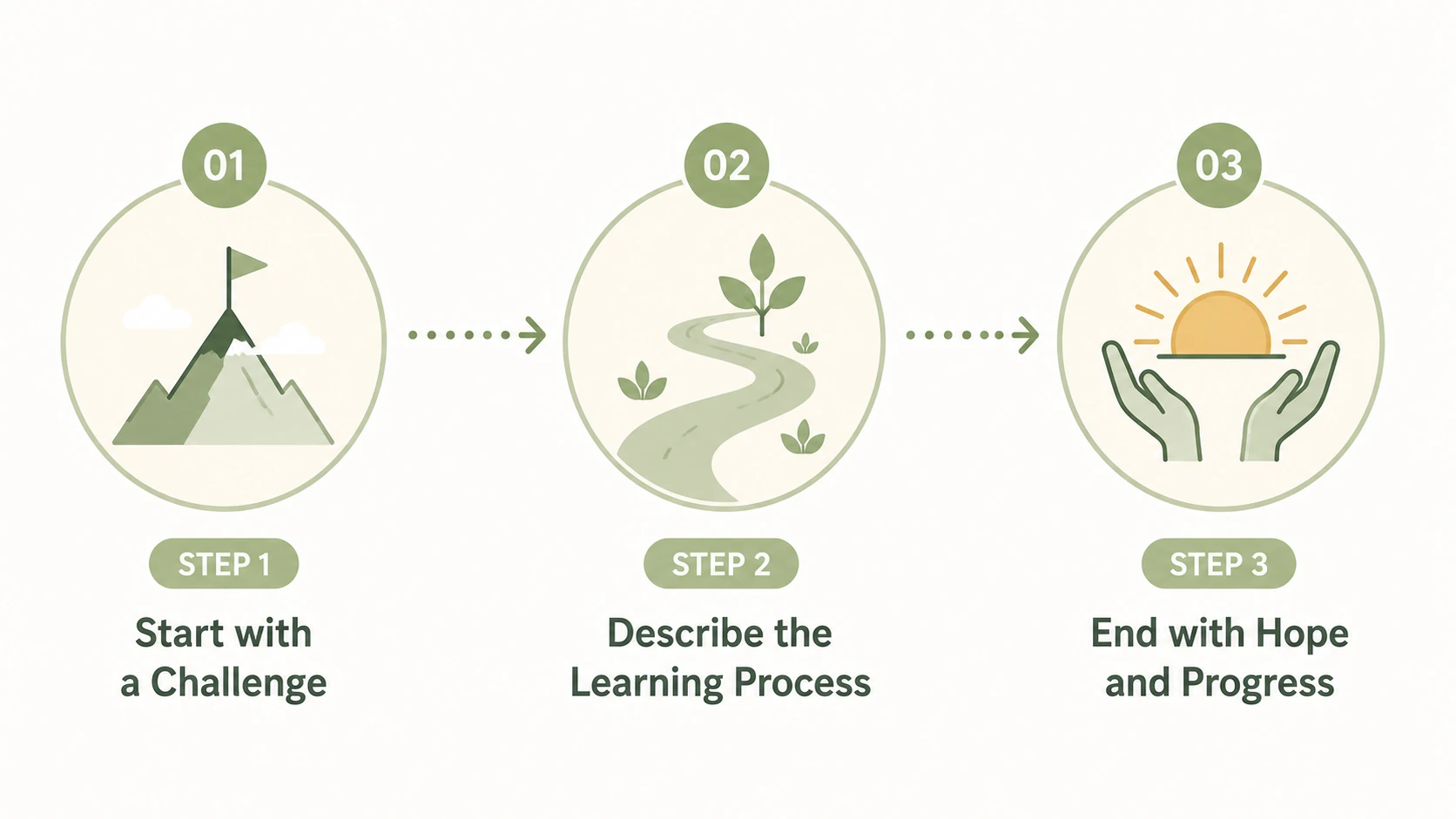
Writing an original growth mindset poem follows a simple three-part structure.
Start with a Challenge
Begin by naming a specific, relatable difficulty — a missed goal, a hard lesson, or a moment of doubt. Concrete details make the poem more relatable than vague statements about struggle.
Describe the Learning Process
The middle of the poem should show what changed: new effort, new strategy, or a shift in perspective. This is the core of a growth mindset poem, since it demonstrates process rather than a sudden transformation.
End with Hope and Progress
Close with a forward-looking line that signals continued growth rather than a finished, perfect outcome. This keeps the poem consistent with growth mindset principles, which emphasize ongoing development.
To get started:
- Choose a personal experience as the poem’s foundation
- Focus on effort rather than talent or luck
- Use positive imagery that reflects growth (seeds, sunrise, climbing, building)
- Keep language simple, especially for younger audiences
- End with encouragement rather than a definitive conclusion
Common Mistakes When Reading or Writing Growth Mindset Poems
Several overlooked issues can weaken the impact of growth mindset poetry.
- Confusing positivity with growth — a poem can sound upbeat without actually describing a learning process; genuine growth mindset poems show how improvement happened, not just that it did
- Ignoring the learning process — skipping the middle struggle section removes the poem’s core lesson
- Focusing only on success — poems that jump straight to victory miss the resilience-building value of the struggle itself
- Overusing clichés — generic phrases like “never give up” lose impact without specific imagery or context
- Forgetting personal reflection — reading a poem without connecting it to a real experience limits its practical benefit
Avoiding these mistakes means choosing or writing poems that clearly show effort, setback, and gradual improvement — not just a positive ending.
Practical Ways to Apply Lessons from Growth Mindset Poems
Reading growth mindset poems is only the first step. Applying their lessons consistently reinforces long-term behavioral change through:
- Daily journaling that connects a poem’s theme to a current challenge
- Classroom reflection activities tied to specific poem lines
- Goal setting that mirrors the poem’s process of gradual improvement
- Weekly mindset review sessions to track personal growth
- Family discussions that reinforce positive self-talk at home
- Personal affirmations drawn from favorite poem lines
- Habit tracking to visualize consistent effort over time
These practices connect directly to broader concepts like habit formation, productivity, resilience, and lifelong learning, extending the value of a poem well beyond the initial reading. Not sure where to start? Our list of journal prompts for growth mindset offers specific questions to pair with each poem you read.
Conclusion
Growth mindset poems offer a compact, emotionally engaging way to reinforce resilience, learning, and continuous improvement. By modeling the process of struggle, reflection, and growth, these poems give students, children, and adults a memorable framework for approaching challenges. Whether used in a classroom, at home, or as a personal reflection tool, growth mindset poetry works best when readers actively apply its lessons — through journaling, discussion, and consistent practice — rather than treating the poem as a one-time read. Used regularly, growth mindset poems can become a practical, lasting tool for building a more resilient and growth-oriented approach to learning and life.
Frequently Asked Questions
What is a growth mindset poem?
A growth mindset poem is a short piece of poetry that reinforces the belief that abilities and skills develop through effort, practice, and learning from mistakes rather than being fixed traits.
How do growth mindset poems help students?
Growth mindset poems help students build confidence, reduce fear of failure, and develop persistence by framing mistakes as part of the learning process rather than as personal shortcomings.
What themes are common in growth mindset poetry?
Common themes include perseverance, learning from failure, effort over talent, patience, resilience, self-belief, and continuous improvement.
Are growth mindset poems suitable for children?
Yes, growth mindset poems for kids use simple language and concrete imagery, making them well-suited for supporting emotional development and confidence building in young readers.
What is the difference between a growth mindset poem and a motivational poem?
Growth mindset poems focus on the learning process and treat failure as an opportunity to improve, while traditional motivational poems typically emphasize achievement and immediate inspiration.
Can teachers use growth mindset poems in classroom activities?
Yes, teachers commonly use growth mindset poems for morning meetings, writing prompts, reading comprehension exercises, group discussions, and classroom displays.
How can I write my own growth mindset poem?
Start by describing a specific challenge, show the learning process that followed, and end with a hopeful, forward-looking line that reflects ongoing progress rather than a finished outcome.
Are printable growth mindset poem PDFs useful for learning?
Yes, printable PDF collections of growth mindset poems are commonly used as classroom worksheets, reading packets, and personal study resources, provided usage rights are clearly outlined.