

Introduction: Understanding the Warriors Mindset and Why It Matters
A warriors mindset is a psychological approach built around discipline, resilience, courage, emotional control, and purposeful action. It is not about aggression or conflict; instead, it focuses on developing the mental strength required to handle challenges, uncertainty, and personal growth. The warrior mindset combines principles from behavioral psychology, leadership development, martial arts philosophy, and performance training. Understanding what is a warrior mindset helps people build stronger habits, improve decision-making, and respond to adversity with greater clarity. Whether applied to fitness, professional goals, relationships, or personal development, the mindset of a warrior is based on preparation, responsibility, and continuous improvement.
By Your Daily Thrive | Self-Improvement & Personal Growth Expert
Quick Summary
- A warriors mindset is a framework focused on discipline, resilience, preparation, and controlled responses to challenges.
- The psychology of a warrior involves emotional regulation, mental toughness, accountability, and purposeful action.
- Historical examples such as Miyamoto Musashi and Masutatsu Oyama demonstrate principles associated with warrior thinking.
- Building a warrior mindset requires consistent practice, self-awareness, and the ability to continue despite discomfort.
What Is a Warriors Mindset? Meaning, Definition, and Core Principles
Defining the Warrior Mindset
A warrior mindset is a way of thinking that emphasizes discipline, resilience, responsibility, and controlled action when facing difficulty. It is a mental framework rather than a physical identity. While the word “warrior” historically refers to combat roles, modern use of the concept often describes individuals who develop strength of character and the ability to overcome challenges.
The warrior mindset meaning centers on becoming mentally prepared rather than simply feeling motivated. Confidence may help someone believe they can succeed, but a warrior mindset focuses on creating the habits and behaviors that make success more likely.
Core principles include:
- Discipline: Following through even when motivation decreases.
- Resilience: Recovering and adapting after setbacks.
- Courage: Taking meaningful action despite fear or uncertainty.
- Adaptability: Changing strategies when circumstances require it.
- Self-control: Managing emotions and reactions effectively.
Unlike a purely competitive mindset, the warrior mindset is not focused only on winning. It emphasizes mastery, preparation, and personal responsibility.
The Psychology of a Warrior Mindset
The psychology of a warrior involves the ability to remain focused, calm, and purposeful under pressure. From a behavioral science perspective, many warrior-like qualities overlap with concepts such as emotional regulation, self-efficacy, cognitive flexibility, and psychological resilience.
A person with a strong warrior mentality typically develops the ability to:
- Stay calm during stressful situations
- Focus on preparation rather than fear of outcomes
- Accept responsibility for decisions
- Manage uncomfortable emotions
- Continue working toward goals despite obstacles
The warrior mentality meaning is often misunderstood as being aggressive or emotionally hardened. In reality, effective warriors historically relied on awareness, patience, strategy, and self-control.
The warrior mind is not about eliminating fear. It is about recognizing fear and choosing purposeful action despite it. Someone who is warrior minded understands that discomfort is often part of growth.
The Core Elements That Build a Warrior Mindset
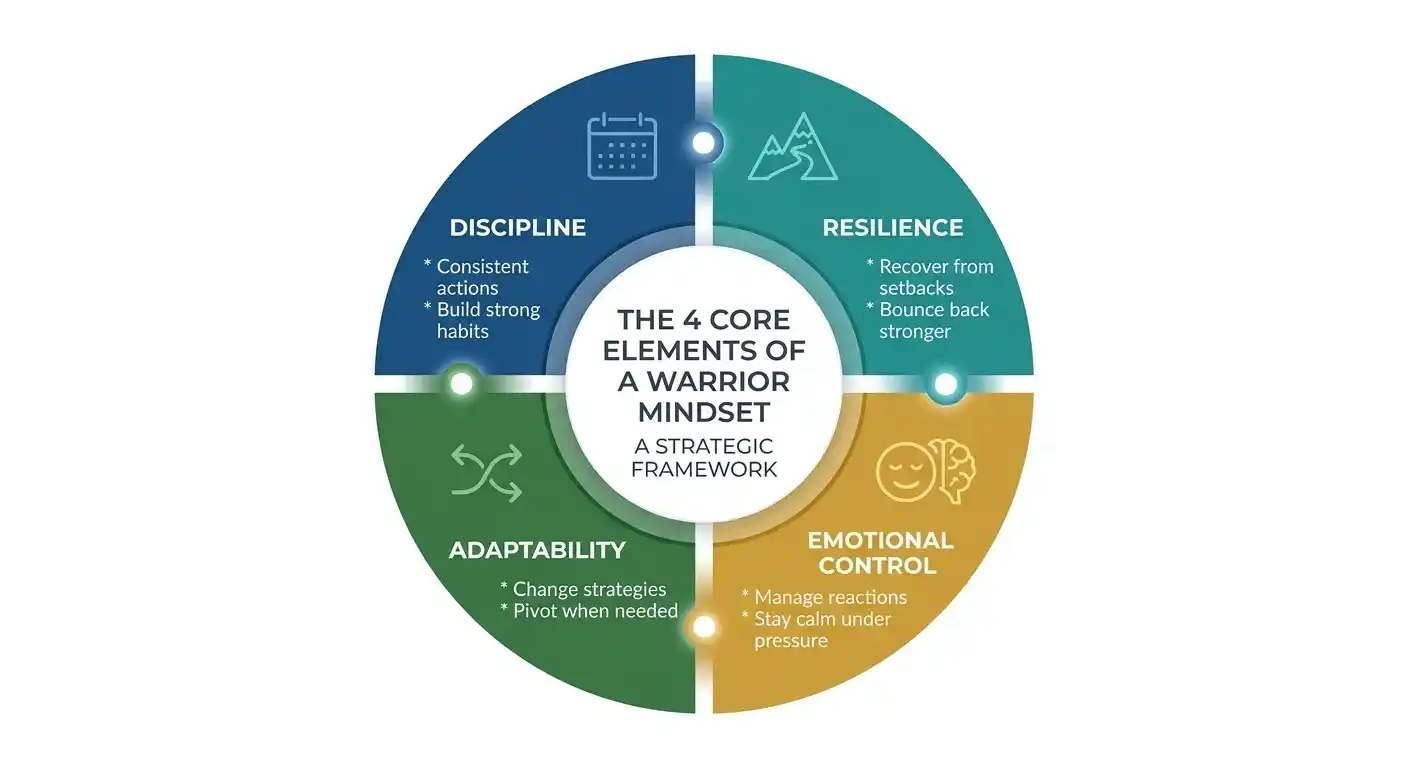
Discipline: The Foundation of Warrior Thinking
Discipline is the foundation of long-term performance because it allows people to act consistently regardless of temporary emotions. Research in behavioral psychology shows that repeated behaviors become easier over time through habit formation. For readers looking to strengthen this foundation, learning how to build discipline without motivation can help create systems that support long-term consistency.
A disciplined approach supports:
- Consistent routines
- Better time management
- Goal achievement
- Improved self-trust
- Reduced dependence on motivation
In our experience helping readers build better habits, one common challenge is expecting motivation to create change. Sustainable progress usually comes from designing systems that make desired actions easier to repeat.
Examples of disciplined practices include:
- Creating a regular exercise schedule
- Setting specific daily priorities
- Reviewing progress weekly
- Limiting distractions during important tasks
Discipline transforms goals from intentions into repeated behaviors. Understanding that self-discipline is a skill can help people recognize that mental strength is developed through practice, repetition, and intentional behavior.
Resilience: Developing Strength Through Adversity
Resilience is the ability to recover from challenges while continuing toward meaningful goals. A warrior mindset does not assume that difficulties can be avoided; instead, it prepares people to respond effectively when difficulties appear.
Common resilience-building practices include:
- Learning from mistakes instead of avoiding them
- Viewing setbacks as feedback
- Adjusting strategies without abandoning goals
- Maintaining perspective during difficult periods
Beginners often make the mistake of interpreting failure as proof they are incapable. A resilient approach treats failure as information that helps improve future decisions.
For example, someone trying to build a fitness habit may miss several workouts. A resilient response is to examine what caused the disruption and adjust the routine rather than quitting completely.
Emotional Control and Mental Clarity
Emotional control is a key part of warrior psychology because effective decisions require awareness and regulation. Emotional control does not mean suppressing feelings. Suppression ignores emotions, while regulation involves understanding emotions and choosing appropriate responses.
Mental clarity improves when individuals learn to:
- Pause before reacting
- Identify emotional triggers
- Separate facts from assumptions
- Make decisions based on values rather than temporary feelings
A warrior mindset encourages controlled responses instead of impulsive reactions.
Warrior Mindset Training: How to Develop Mental Toughness
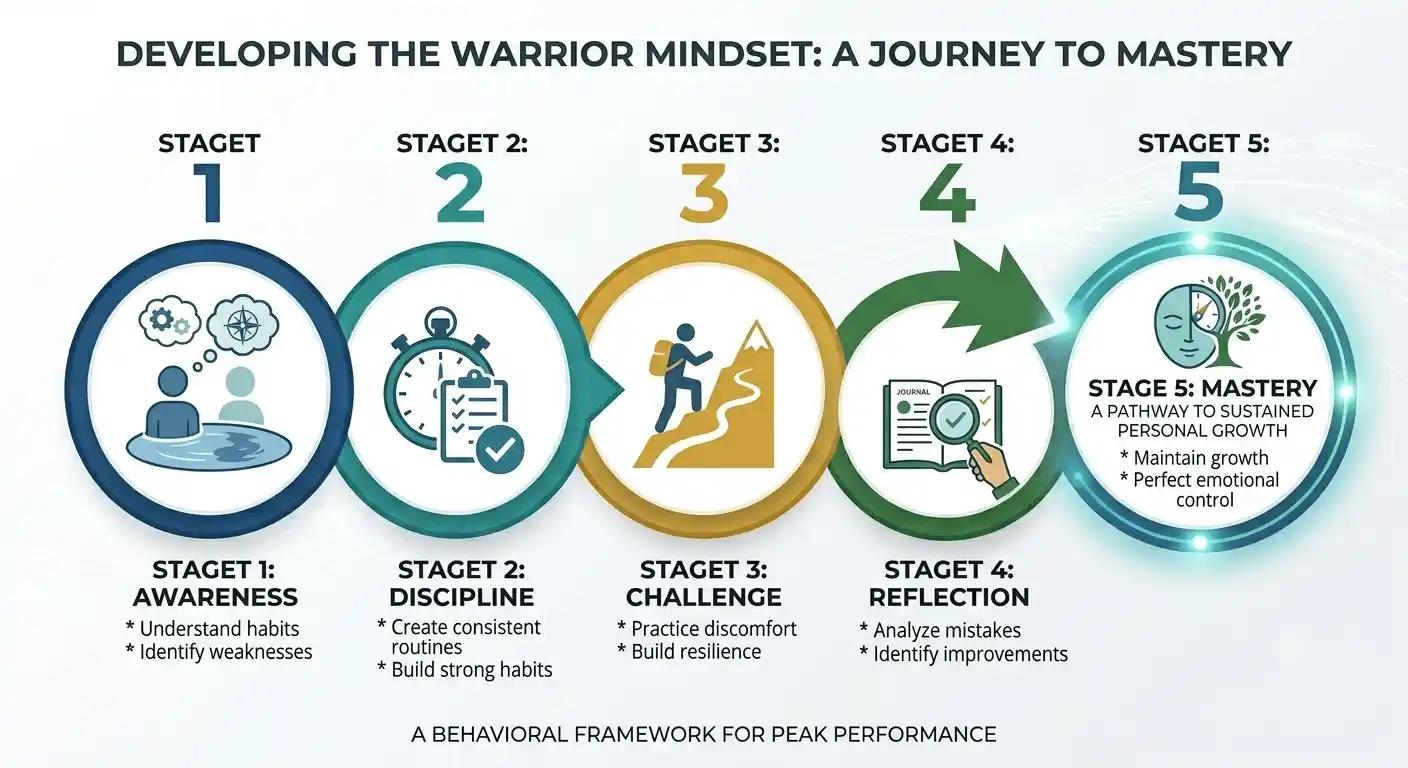
Daily Practices for Building a Warrior Mindset
Warrior mindset training involves developing habits that strengthen discipline, awareness, and resilience over time. It is not a single exercise but a consistent practice.
Useful daily practices include:
- Develop a structured routine
- Train physical and mental endurance
- Practice intentional discomfort
- Review mistakes and improve systems
- Set meaningful goals
- Build consistency instead of relying on motivation
Your Daily Thrive recommends focusing on small, repeatable improvements because behavioral change is usually created through consistency rather than extreme short-term effort.
A practical routine may include:
- Morning planning to identify priorities
- Physical activity to strengthen discipline
- Reflection to evaluate decisions
- Goal tracking to measure progress
The 40% Rule and Expanding Mental Limits
The 40% rule is a popular concept associated with the idea that people often stop when they believe they have reached their maximum capacity. It is frequently discussed in endurance and mental toughness communities.
The concept suggests that perceived limits may occur before actual capability is reached. However, responsible application is important.
A healthy approach includes:
- Distinguishing discomfort from injury
- Progressing gradually
- Respecting recovery needs
- Avoiding unsafe extremes
Mental toughness is not about ignoring physical signals. True discipline involves knowing when to push forward and when recovery is necessary.
Difficulty and Time Investment: How Long Does Warrior Mindset Training Take?
Developing a warrior mindset is a gradual process. The timeline depends on personal habits, environment, goals, and commitment.
Beginner Stage
Beginners typically focus on:
- Building basic discipline habits
- Improving self-awareness
- Creating consistent routines
Intermediate Stage
Intermediate development involves:
- Handling challenges more consistently
- Increasing accountability
- Improving emotional control
Advanced Stage
Advanced practitioners focus on:
- Maintaining composure under significant pressure
- Making decisions according to principles
- Leading others effectively
As of 2026, personal development approaches increasingly emphasize sustainable behavior change rather than extreme transformation methods.
Historical Examples and Lessons From Warrior Philosophy
Miyamoto Musashi vs Kojiro: Lessons in Strategy and Mindset
The famous Musashi vs Kojiro rivalry is often discussed as an example of strategy, preparation, and adaptability. Their historical duel represents broader lessons about competition and decision-making.
| Concept | Musashi Approach | Kojiro Approach |
| Strategy | Adaptability and unconventional thinking | Technical mastery and precision |
| Preparation | Studying circumstances and opponents | Refining skill and technique |
| Lesson | Flexibility can create advantage | Excellence requires mastery |
The lesson of this rivalry is not simply about defeating an opponent. It demonstrates that preparation, awareness, and adaptability influence outcomes.
Mas Oyama and the Philosophy of Extreme Discipline
Masutatsu Oyama is often associated with extreme discipline, perseverance, and mastery through repetition.
Principles connected with his philosophy include:
- Commitment to practice
- Physical conditioning
- Persistence through difficulty
- Continuous improvement
The example of Mas Oyama shows how repeated effort and disciplined training can shape capability over time.
Modern Warrior Philosophy and Chad Wright
Modern interpretations of warrior philosophy often focus on responsibility, leadership, service, and personal standards. Chad Wright discusses concepts related to discipline, accountability, and developing mental strength.
Modern warrior thinking applies these principles beyond combat by emphasizing:
- Leadership under pressure
- Responsibility for choices
- Commitment to personal values
- Service to others
Warrior Mindset vs Similar Mental Approaches
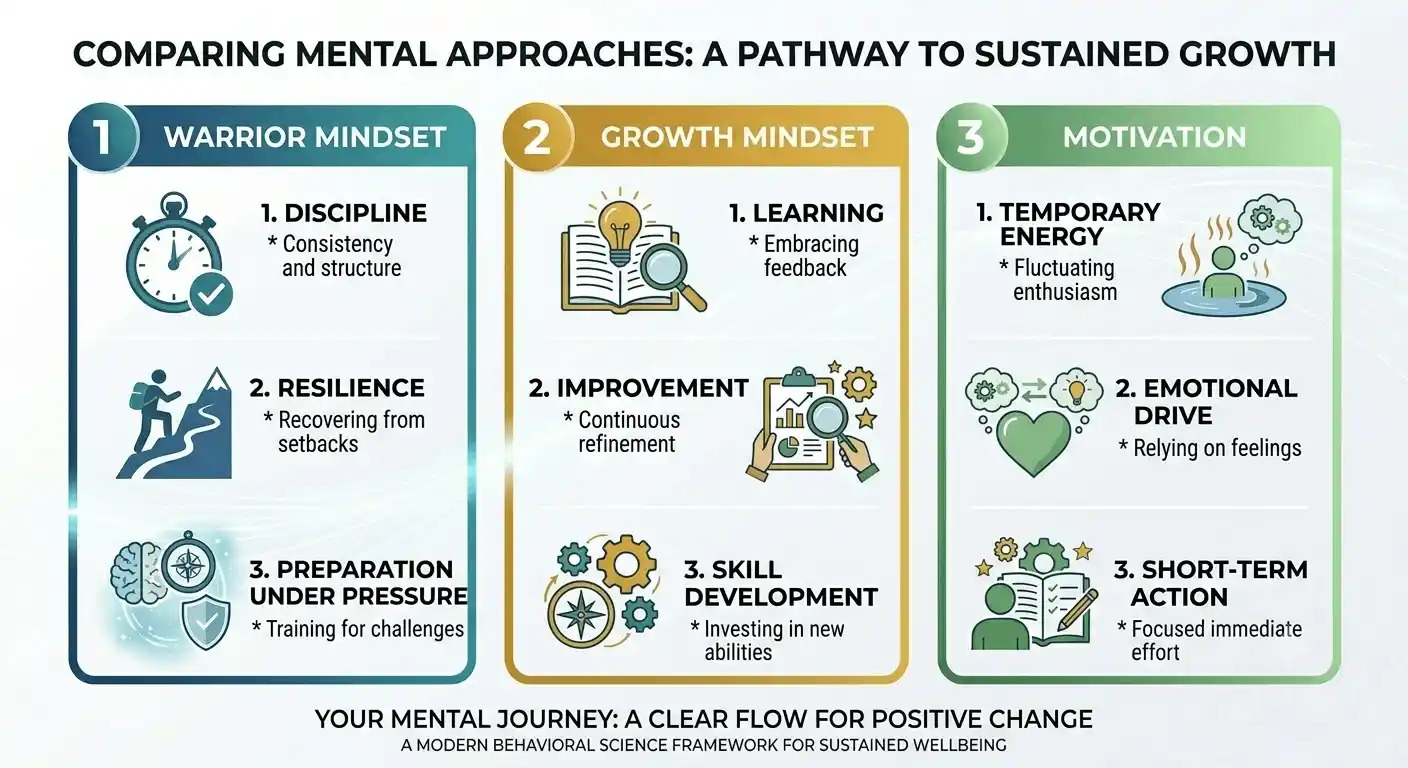
Warrior Mindset vs Growth Mindset
Both approaches focus on improvement but emphasize different areas.
| Approach | Main Focus |
| Warrior mindset | Discipline, resilience, preparation under pressure |
| Growth mindset | Learning, development, improving abilities |
A growth mindset focuses on believing abilities can improve. A warrior mindset focuses on developing the discipline required to continue improving. The connection between these approaches becomes clearer when exploring why growth mindset principles influence learning, resilience, and long-term development.
Warrior Mindset vs Motivation
Motivation is temporary and influenced by emotions, circumstances, and energy levels. A warrior mindset depends more on systems and discipline.
Motivation asks:
“Do I feel ready?”
A warrior mindset asks:
“What action aligns with my goals?”
Warrior Mindset vs Aggressive Mentality
A warrior mindset is different from aggression. Aggression often focuses on dominance or emotional reaction, while a warrior mindset emphasizes control.
| Warrior Mindset | Aggressive Mentality |
| Controlled responses | Emotional reactions |
| Purpose-driven action | Ego-driven action |
| Responsibility | Blame |
Common Mistakes That Prevent Developing a Warrior Mindset
Mistake 1: Confusing Hardness With Strength
Mental toughness does not mean ignoring emotions or refusing recovery. True strength includes awareness, adaptation, and balance.
A healthier approach is:
- Accept emotions
- Learn from challenges
- Maintain discipline without self-destruction
Mistake 2: Depending Only on Motivation
Motivation changes daily. Relying only on motivation makes consistency difficult.
Better strategies include:
- Creating routines
- Reducing unnecessary decisions
- Tracking progress
Mistake 3: Ignoring Recovery and Reflection
Long-term performance requires recovery and evaluation.
Important practices include:
- Rest
- Reflection
- Adjusting strategies
- Learning from experience
Practical Applications of the Warrior Mindset in Daily Life
Warrior Mindset for Students
Students can apply warrior principles by:
- Creating consistent study routines
- Managing academic pressure
- Developing focus
- Overcoming procrastination
The mindset encourages preparation rather than last-minute reactions.
Warrior Mindset for Professionals and Leaders
Professionals benefit from warrior principles through:
- Better decision-making
- Increased accountability
- Handling uncertainty
- Leading during pressure
Strong leaders often demonstrate emotional control and responsibility.
Warrior Mindset for Personal Growth
For those starting their personal development journey, practical positive mindset tips for beginners can provide simple strategies for improving daily thinking patterns.
A warrior mindset supports personal growth by strengthening:
- Goal setting
- Productivity
- Resilience
- Lifelong learning
It helps individuals focus on progress rather than perfection.
Results Timeline: When Does a Warrior Mindset Develop?
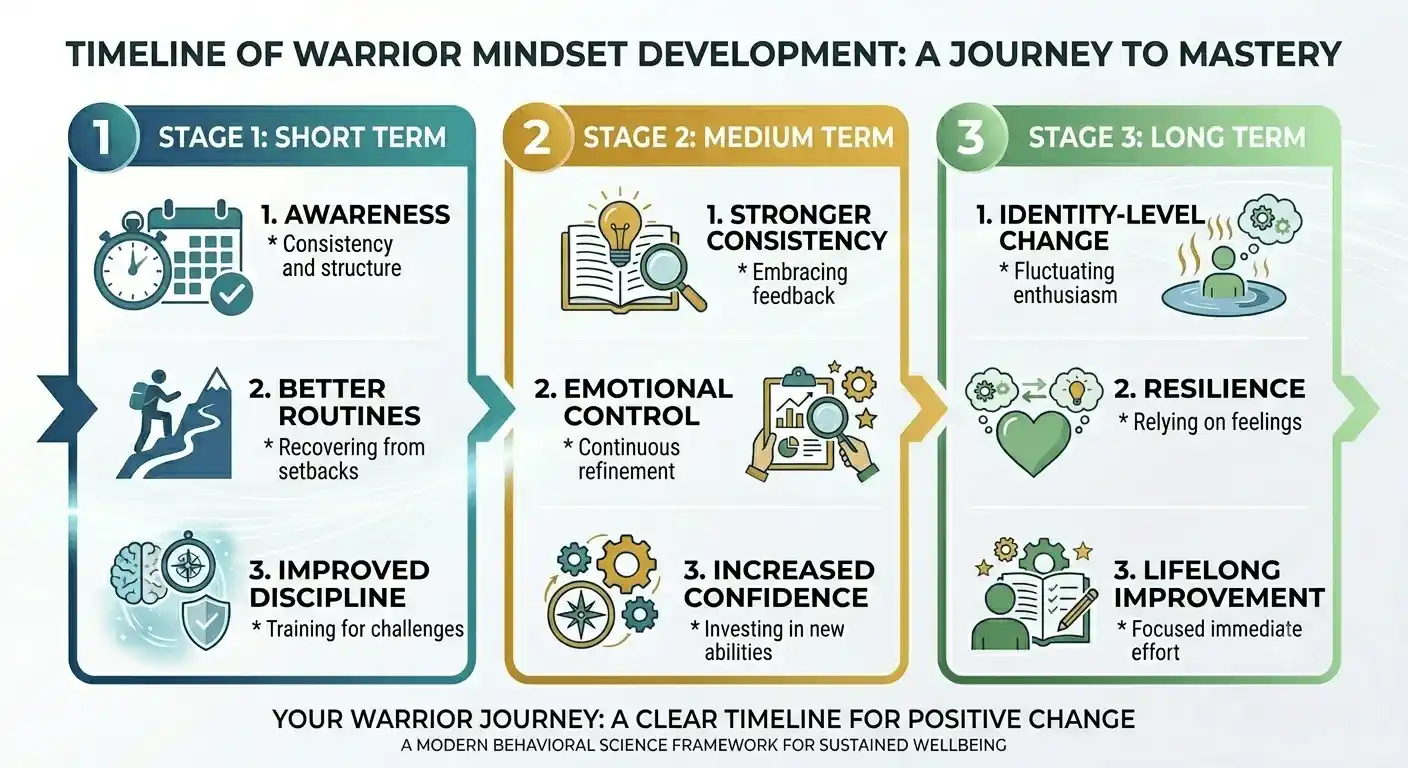
A warrior mindset develops gradually through repeated practice.
Short Term
People may notice:
- Increased awareness
- Better routines
- Improved discipline
Medium Term
Progress often includes:
- Stronger consistency
- Better emotional control
- Improved confidence
Long Term
The mindset can become part of personal identity through:
- Continued practice
- Supportive environments
- Clear values
How to Maintain a Warrior Mindset Long Term
Maintaining a warrior mindset requires continuous development.
Helpful strategies include:
- Continue learning
- Review personal standards regularly
- Track progress
- Surround yourself with disciplined people
- Adapt methods while maintaining core values
A sustainable mindset focuses on lifelong improvement rather than temporary intensity.
Conclusion: Building a Stronger Warriors Mindset
A warriors mindset is built through discipline, resilience, emotional control, and purposeful action. It is not about aggression or avoiding difficulty; it is about developing the ability to respond effectively when challenges appear.
The psychology behind the warrior mindset combines behavioral principles such as habit formation, emotional regulation, and resilience. Historical examples from figures such as Musashi and Mas Oyama demonstrate the importance of preparation, adaptability, and commitment.
Anyone can develop a warrior mindset through intentional practice, consistent choices, and a commitment to personal growth.
Frequently Asked Questions (FAQ)
What is a warrior mindset?
A warrior mindset is a mental framework based on discipline, resilience, emotional control, courage, and purposeful action. It helps individuals handle challenges with preparation and responsibility.
What are the 4 phases of the warrior mindset?
The four phases of the warrior mindset vary depending on the framework used, but many models describe stages involving awareness, discipline, challenge, and mastery. These phases represent progressive development of mental strength.
How do you train a warrior mindset?
You can train a warrior mindset by building disciplined routines, practicing resilience, setting meaningful goals, reflecting on mistakes, and consistently acting despite discomfort.
Is a warrior mindset only for fighters or athletes?
No. A warrior mindset applies to students, professionals, leaders, entrepreneurs, and anyone facing personal or professional challenges. It focuses on mental strength rather than physical combat.
What is the difference between a warrior mindset and a warrior mentality?
The terms are often used similarly. A warrior mindset usually refers to the way a person thinks, while warrior mentality often describes the broader attitude and approach toward challenges.
What books or teachings explain the warrior mindset?
Warrior mindset concepts are discussed through martial arts philosophy, leadership psychology, military training principles, and personal development frameworks. Works related to strategy, discipline, resilience, and leadership often explore similar ideas.