

Introduction
Affirmations for test taking are positive statements students repeat to improve confidence, focus, and emotional control before exams. These statements help reduce negative thinking and encourage a calmer mental state during stressful academic situations. Positive affirmations for test taking can support concentration, lower stress levels, and improve emotional resilience when combined with preparation and healthy study habits.
Positive affirmations for exam success work best when they are repeated consistently and connected to emotional belief. Students often struggle with fear of failure, self-doubt, and mental pressure before exams. Internal dialogue directly affects focus, confidence, and performance under pressure. Testing affirmations for students help replace harmful thought patterns with more supportive and productive thinking habits.
Quick Summary
- Affirmations for test taking help reduce anxiety and improve confidence before exams
- Positive self-talk can support focus, emotional regulation, and calm thinking during stressful situations
- Consistent daily affirmations are more effective than last-minute repetition
- Students perform better when affirmations are paired with preparation, sleep, and healthy study habits
What Are Affirmations for Test Taking?
Affirmations for test taking are short positive statements designed to help students manage stress, improve confidence, and maintain focus during exams. They encourage healthier thinking patterns and emotional regulation under academic pressure.
This works especially well when students learn to focus on what you can control, such as preparation, effort, and mindset, instead of external exam outcomes.
How Positive Affirmations Work
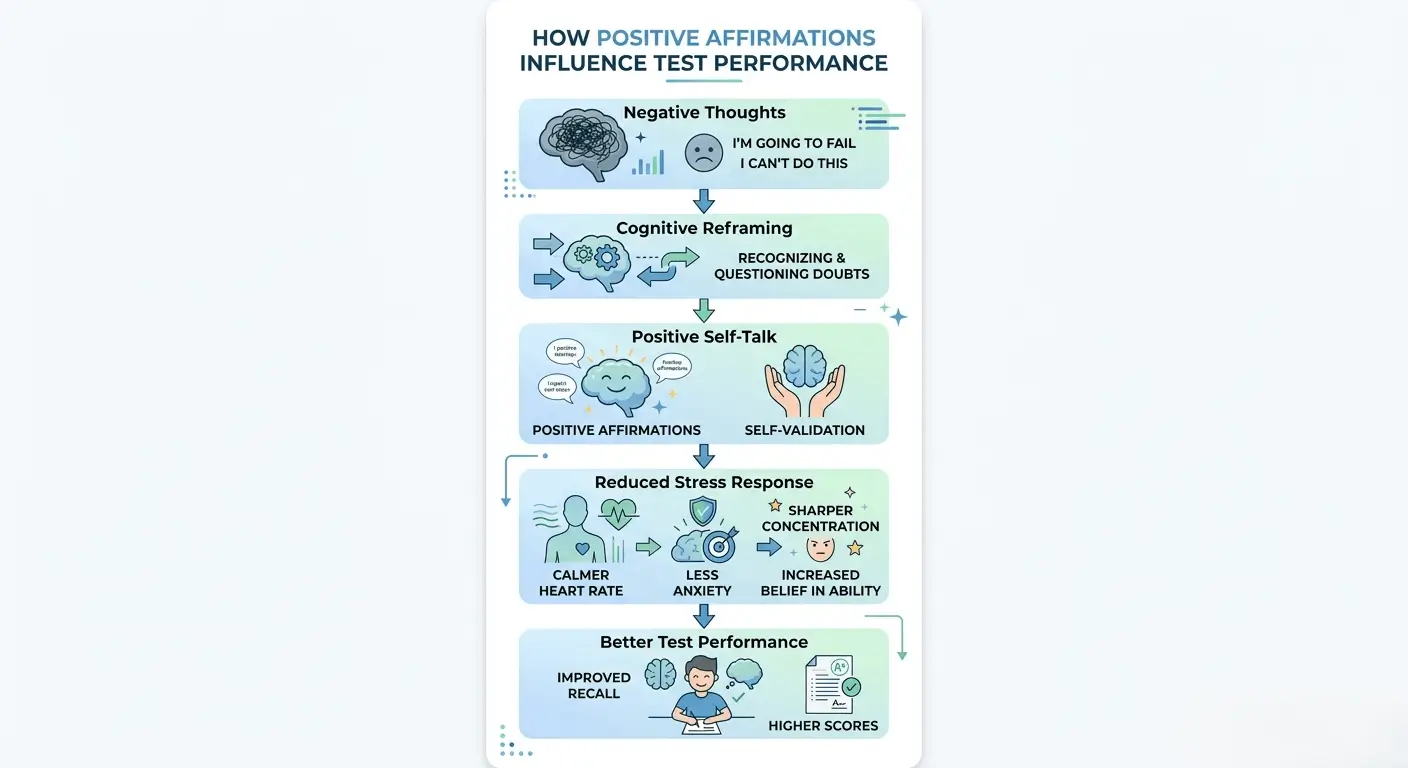
Positive affirmations work by influencing thought patterns and emotional responses over time. Repeated thoughts affect how students interpret stress, challenges, and academic performance.
This process involves:
- Cognitive reframing
- Self-belief reinforcement
- Stress-response reduction
- Emotional conditioning
Cognitive reframing helps students replace thoughts like “I am going to fail” with more balanced thinking such as “I am prepared and capable of doing my best.” Repeating test positive affirmations consistently can reduce automatic negative thinking and improve emotional control.
Positive self talk reminders also help interrupt panic cycles before and during exams. Behavioral psychology research shows that repeated mental patterns influence confidence, motivation, and performance.
Students who repeatedly practice supportive internal dialogue often become more resilient under pressure because the brain gradually becomes more familiar with calmer emotional responses.
Why Students Experience Test Anxiety
Students experience test anxiety because exams are often connected to fear, pressure, and self-worth.
Common causes include:
- Fear of failure
- Perfectionism
- Overthinking
- Comparison with others
- Pressure from grades or expectations
Anxiety affects concentration and memory recall. High stress levels increase mental overload, making it harder for students to retrieve information they already studied.
Many students experience emotional patterns such as:
- Racing thoughts before exams
- Difficulty sleeping the night before a test
- Self-criticism during studying
- Feeling mentally blank during difficult questions
- Catastrophic thinking about poor results
These patterns often reduce confidence and increase avoidance behaviors such as procrastination.
Benefits of Using Positive Affirmations Before a Test
Positive affirmations for test day help students regulate emotions and maintain a more balanced mindset during stressful situations.
Daily affirmations for test taking can provide practical emotional and mental benefits, including:
- Improved confidence
- Calmer mindset
- Reduced negative thinking
- Stronger concentration
- Emotional stability
Key Benefits
- Helps interrupt negative self-talk
- Encourages emotional resilience
- Improves mental focus under pressure
- Creates a more optimistic test-taking mindset
- Supports consistent study motivation
Students who use affirmations regularly often become more aware of harmful thought patterns and learn to respond with healthier mental habits.
Powerful Affirmations for Test Taking
Powerful Affirmations for Confidence and Calmness
Powerful affirmations for test taking can help students build self-trust, emotional stability, and confidence before exams.
Examples include:
- “I trust my preparation and effort.”
- “I stay calm and focused during tests.”
- “I can think clearly under pressure.”
- “I am capable of solving problems calmly.”
- “I control my thoughts and emotions.”
- “I trust myself to do my best.”
An affirmation for trusting yourself is especially helpful for students who struggle with overthinking or fear of failure.
These affirmations work best when repeated consistently and connected to realistic preparation habits.
Short Affirmations for Test Taking
Short affirmations for test taking are easier to remember during stressful moments because anxiety reduces mental processing capacity.
Simple statements are easier to repeat quickly before exams or during moments of panic. Repetition strengthens emotional association and helps students create calmer thinking patterns.
Short Affirmation Examples
- “I am calm and focused.”
- “I trust my preparation.”
- “I can think clearly.”
- “I stay confident under pressure.”
- “I am capable and prepared.”
Daily Affirmations and Habit Building for Exam Success
Why Consistency Matters More Than Intensity
Consistency creates stronger mental conditioning than occasional bursts of motivation.
Many students repeat affirmations only before exams, but long-term repetition creates more stable emotional habits. Daily affirmations for test taking help strengthen supportive thinking patterns gradually over time.
Affirmations to write daily become more effective when they are connected to routines and repeated consistently.
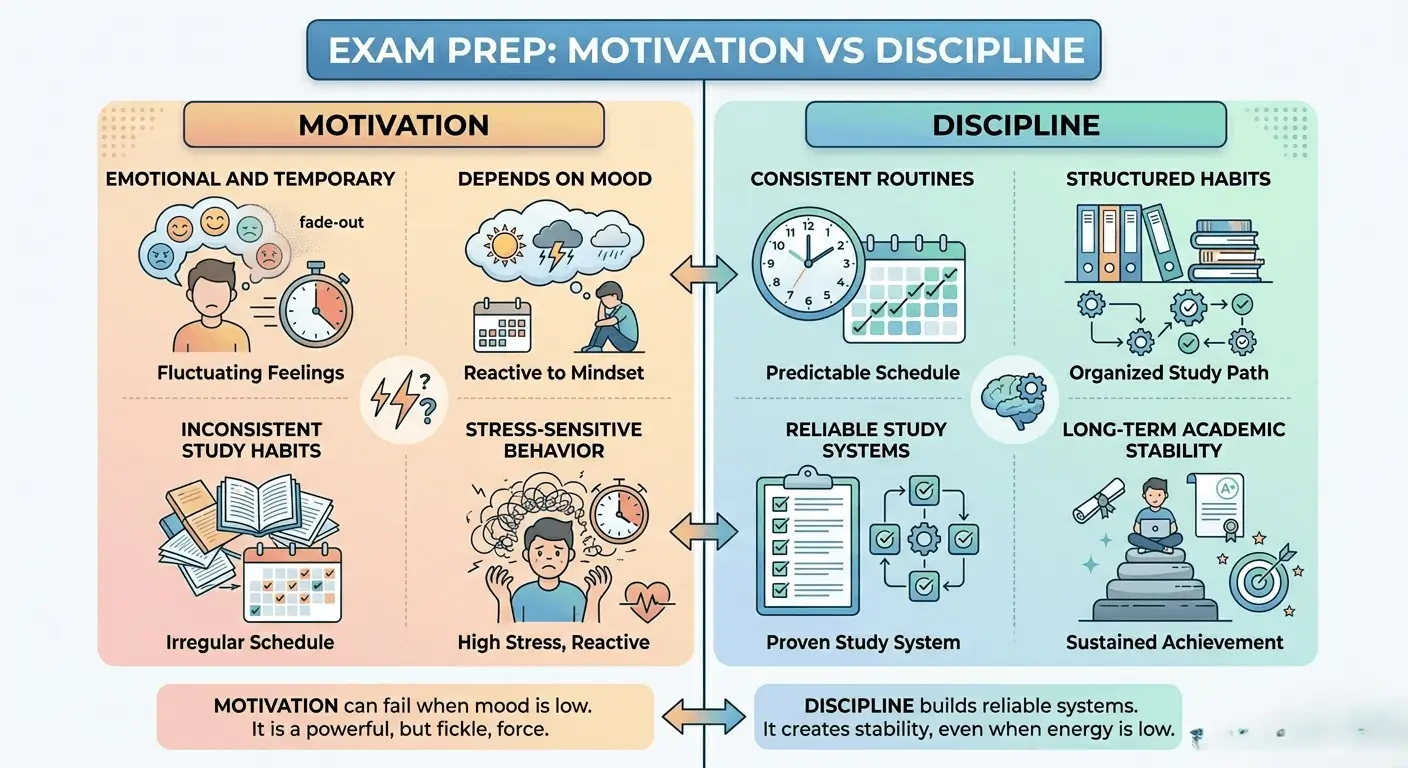
Motivation is emotional and temporary, while habits create long-term stability. Students who depend only on motivation often struggle with procrastination and inconsistency.
Affirmations become even more effective when paired with structured habits, especially when learning how to build discipline without motivation, because consistency matters more than temporary emotional drive.
How to Build a Simple Daily Affirmation Routine
Learning how to do positive affirmations effectively requires repetition and structure.
Many students combine affirmations with reflective writing practices like journaling prompts for self growth to strengthen emotional clarity and reinforce positive thinking patterns.
A simple routine may include:
- Morning repetition
- Journaling affirmations
- Mirror affirmations
- Study-session affirmations
- Bedtime reinforcement
Students learning how to write daily affirmations should focus on realistic and emotionally believable statements.
Understanding how to write effective affirmations involves:
- Keeping affirmations believable and specific
- Repeating them consistently
- Connecting affirmations to actions
- Using present-tense language
- Pairing affirmations with deep breathing or visualization
This combination strengthens emotional conditioning and improves consistency.
Affirmations for Students Taking a Test
Affirmations for High School and College Students
Affirmations for test taking for students can help reduce stress related to academic pressure and performance expectations.
High school and college students often struggle with:
- Burnout from studying
- Fear of disappointing others
- Procrastination cycles
- Constant performance pressure
- Comparing grades with peers
Positive affirmations for students taking a test help students maintain emotional balance and healthier thinking patterns.
Examples include:
- “My effort is helping me improve.”
- “I can stay calm and focused.”
- “I am prepared to succeed.”
- “I trust my ability to learn.”
- “I can handle challenges step by step.”
Affirmations to pass exams should encourage resilience and preparation instead of unrealistic perfection.
Kids Affirmations for Test Taking
Kids affirmations for test taking should use simple and encouraging language. Younger students respond better to emotional reassurance and positive reinforcement.
Test taking affirmations for elementary students should focus on confidence, effort, and learning rather than perfect grades.
Positive test taking affirmations for kids may include:
- “I can do my best.”
- “I am smart and capable.”
- “Mistakes help me learn.”
- “I stay calm during my test.”
Positive affirmations for kids for test taking should:
- Focus on effort instead of perfection
- Use simple and encouraging language
- Reinforce emotional safety and confidence
- Help children normalize mistakes and learning
Motivation vs Discipline During Exam Preparation
| Motivation | Discipline |
|---|---|
| Emotional and temporary | Consistent and structured |
| Depends on mood | Depends on habits |
| Can disappear under stress | Builds reliability |
| Creates bursts of energy | Creates long-term consistency |
Affirmations should support discipline instead of replacing preparation. Positive thinking alone cannot compensate for poor study habits or lack of preparation.
Sustainable academic performance comes from combining mindset improvement with effective routines, time management, and healthy study systems.
Common Mistakes People Make With Affirmations
Expecting Instant Results
Many students expect affirmations to create immediate confidence or remove anxiety instantly.
Mindset shifts require repetition, emotional belief, and consistency. Mental conditioning develops gradually over time through repeated exposure to healthier thought patterns.
Students who stop too early often fail to experience long-term emotional benefits.
Using Affirmations Without Action
Affirmations alone cannot replace studying, preparation, or practice.
Confidence increases when students feel prepared. Positive thinking becomes more effective when supported by action.
Students who combine affirmations with healthy study habits often feel calmer and more capable during exams.
Repeating Unrealistic Statements
Unrealistic affirmations can create emotional resistance and internal skepticism.
For example:
- Unrealistic: “I will never feel anxious again.”
- More realistic: “I can stay calmer and more focused each day.”
Believable affirmations are more effective because the brain responds better to emotionally realistic statements.
Why People Still Struggle With Test Anxiety
Overthinking and Fear of Failure
Overthinking increases stress and weakens concentration. Students often imagine worst-case outcomes before exams, which increases emotional pressure.
Catastrophic thinking affects focus, memory recall, and emotional control.
Helpful emotional regulation strategies include:
- Deep breathing
- Mindfulness exercises
- Positive self talk reminders
- Structured study sessions
- Scheduled breaks
Burnout and Mental Exhaustion
Burnout often results from excessive studying, sleep deprivation, perfectionism, and unrealistic schedules.
Common signs include:
- Mental fatigue
- Difficulty concentrating
- Irritability
- Emotional exhaustion
- Reduced motivation
Practical recovery strategies include:
- Prioritizing sleep
- Taking recovery breaks
- Reducing unrealistic expectations
- Using balanced study schedules
- Managing screen time before sleep
Lack of Self-Trust
Negative academic experiences can damage confidence and increase fear before future exams.
Students who repeatedly criticize themselves often struggle with emotional regulation and performance anxiety.
An affirmation for trusting yourself can help rebuild confidence by encouraging supportive internal dialogue and realistic self-belief.
Practical Strategies That Make Affirmations More Effective
Pairing Affirmations With Visualization
Visualization strengthens emotional conditioning by helping students mentally rehearse calm and confident test performance.
Students can imagine:
- Entering the exam calmly
- Reading questions clearly
- Staying focused during difficult sections
- Managing stress effectively
This process helps reduce emotional panic and improve mental familiarity with calm performance.
Combining Affirmations With Study Systems
Affirmations become more effective when paired with practical study systems.
Helpful systems include:
- Time management
- Active recall
- Spaced repetition
- Consistent study routines
Combining action with mindset creates stronger long-term academic performance and emotional resilience.
Real-Life Scenarios and Practical Examples
Beginner Student Scenario
A student struggling with anxiety and procrastination begins using short affirmations before study sessions.
The student repeats:
- “I can start small.”
- “Progress matters more than perfection.”
- “I can focus for the next 20 minutes.”
The student combines affirmations with shorter study sessions and gradually becomes more consistent.
Advanced Student Scenario
A high-performing student experiences perfectionism and burnout before important exams.
Instead of using pressure-based thinking, the student practices calming affirmations, recovery routines, and healthier sleep habits.
The student focuses on emotional balance rather than unrealistic perfection, which improves concentration and emotional stability.
Best Types of Positive Affirmations for Exam Success
| Type of Affirmation | Purpose | Example |
| Confidence affirmations | Reduce self-doubt | “I trust my preparation.” |
| Focus affirmations | Improve concentration | “I stay present and focused.” |
| Calmness affirmations | Reduce anxiety | “I breathe deeply and stay calm.” |
| Growth mindset affirmations | Encourage resilience | “Mistakes help me improve.” |
| Self-trust affirmations | Build emotional stability | “I believe in my abilities.” |
Different affirmations work better depending on emotional state.
For example:
- Students feeling anxious may benefit from calming affirmations
- Students struggling with procrastination may benefit from action-focused affirmations
- Students dealing with perfectionism may benefit from growth mindset affirmations
Personalization increases effectiveness because emotionally authentic affirmations create stronger mental reinforcement.
What Actually Works vs Common Myths About Affirmations
Common Myths
- “Affirmations alone guarantee success”
- “Positive thinking removes anxiety instantly”
- “Repeating phrases without emotion is enough”
What Actually Works
- Consistent repetition
- Emotional connection
- Realistic phrasing
- Healthy routines
- Effective study habits
- Sleep and stress management
Behavioral psychology research suggests that repeated thoughts strengthen neural pathways over time. Habit repetition and emotional reinforcement gradually influence emotional responses and behavior patterns.
Affirmations become more effective when students combine mindset training with practical actions and realistic expectations.
Conclusion
Affirmations for test taking can help students improve confidence, focus, and emotional control during stressful academic situations. Positive self-talk supports calmer thinking patterns and helps reduce negative mental habits that increase anxiety.
However, affirmations work best when combined with preparation, consistent study habits, sleep, and emotional regulation strategies. Sustainable exam success comes from balancing mindset and action rather than depending only on temporary motivation.
Students who practice self-trust, build healthy routines, and maintain consistent preparation habits are more likely to perform calmly and confidently during exams.
FAQs
Why do I struggle with confidence during tests?
Many students struggle with confidence because of fear of failure, perfectionism, negative past experiences, or pressure from expectations. Anxiety can increase self-doubt and reduce concentration during exams.
Do affirmations actually help with test anxiety?
Yes. Positive affirmations can help reduce anxiety by interrupting negative thought patterns and encouraging calmer emotional responses. They work best when combined with preparation and healthy routines.
How often should I repeat affirmations for test taking?
Daily repetition is usually more effective than occasional use. Morning repetition, study-session affirmations, and bedtime reinforcement can help strengthen emotional conditioning.
What are the best short affirmations for test day?
Helpful examples include:
- “I am calm and focused.”
- “I trust my preparation.”
- “I can think clearly.”
- “I stay confident under pressure.”
Can affirmations improve focus and memory during exams?
Affirmations may improve focus indirectly by reducing stress and negative thinking. Lower anxiety levels often support better concentration and memory recall.
Why do positive affirmations feel fake at first?
Affirmations may feel unnatural when they conflict with long-standing negative beliefs. Realistic and emotionally believable affirmations are usually easier to accept.
How do I stay disciplined when preparing for exams?
Building small daily routines is usually more effective than depending on motivation. Consistent study habits create reliability and reduce procrastination.
What should I do if I lose motivation while studying?
Focus on smaller actions instead of waiting for motivation to return. Short study sessions, breaks, sleep, and realistic goals can help rebuild consistency.
Are affirmations effective for children and elementary students?
Yes. Children often respond well to encouraging affirmations that focus on effort, confidence, and emotional reassurance.
Should affirmations be combined with study techniques?
Yes. Affirmations work best when combined with active recall, spaced repetition, time management, and healthy study habits.