
Introduction
Picture books about growth mindset are illustrated stories that help children understand that abilities improve through effort, practice, and learning from mistakes. They translate an abstract psychological concept into relatable characters and situations, making it easier for young readers to grasp ideas like persistence, confidence, and emotional resilience. As of 2026, educators and parents increasingly use these books alongside classroom curricula and bedtime routines to reinforce healthy learning habits. This guide explains what growth mindset picture books are, why they work, how to choose the right ones by age, and how to reinforce these lessons at home and in school.
Quick Summary
- Picture books help children understand growth mindset through relatable stories and characters.
- Different books are suitable for toddlers, school-age children, older students, and even adults.
- The best growth mindset books teach perseverance, learning from mistakes, and embracing challenges.
- Choosing age-appropriate books improves engagement and reinforces lifelong learning habits.
What Is a Growth Mindset?
A growth mindset is the belief that abilities and intelligence can be developed through effort, strategy, and persistence, rather than being fixed traits a person is simply born with. The concept, popularized by psychologist Carol Dweck’s research on motivation, contrasts sharply with a fixed mindset, in which people believe their talents and intelligence are static and unchangeable. This distinction matters in education, parenting, and lifelong learning because it shapes how children respond to challenges, setbacks, and feedback. Children who internalize a growth mindset tend to view difficulty as a normal part of learning rather than as proof of inadequacy.
Growth Mindset vs. Fixed Mindset
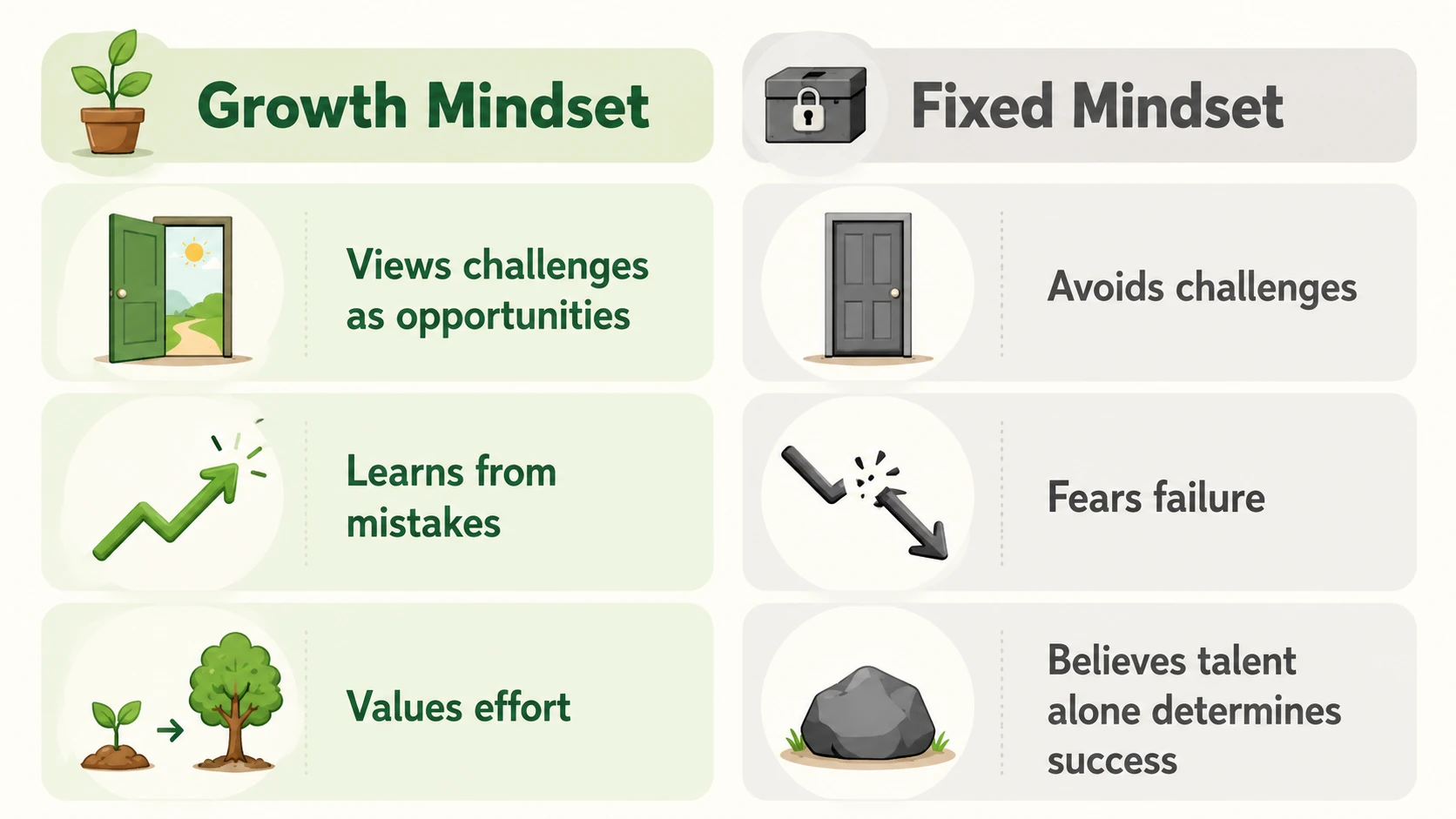
The two mindsets lead to very different behaviors when a person encounters a challenge. A growth mindset treats effort as the path to mastery, while a fixed mindset treats effort as a sign that someone isn’t naturally capable. These underlying beliefs directly influence motivation, confidence, and problem-solving skills over time.
| Growth Mindset | Fixed Mindset |
|---|---|
| Views challenges as opportunities | Avoids challenges |
| Learns from mistakes | Fears failure |
| Values effort | Believes talent alone determines success |
Why Picture Books Are Effective for Teaching Growth Mindset
Picture books are effective for teaching growth mindset because storytelling activates emotional learning in ways that direct instruction often cannot. Visual narratives help children process complex feelings like frustration, disappointment, and pride by connecting those emotions to a character’s journey. The combination of illustration and text improves memory retention, builds empathy by letting children see a situation through someone else’s eyes, and supports comprehension for readers who are still developing verbal reasoning skills. Repeated reading of the same story also reinforces positive thinking patterns, since children begin to predict and internalize how a character overcomes a setback each time the book is revisited.
Skills Children Develop Through Growth Mindset Stories
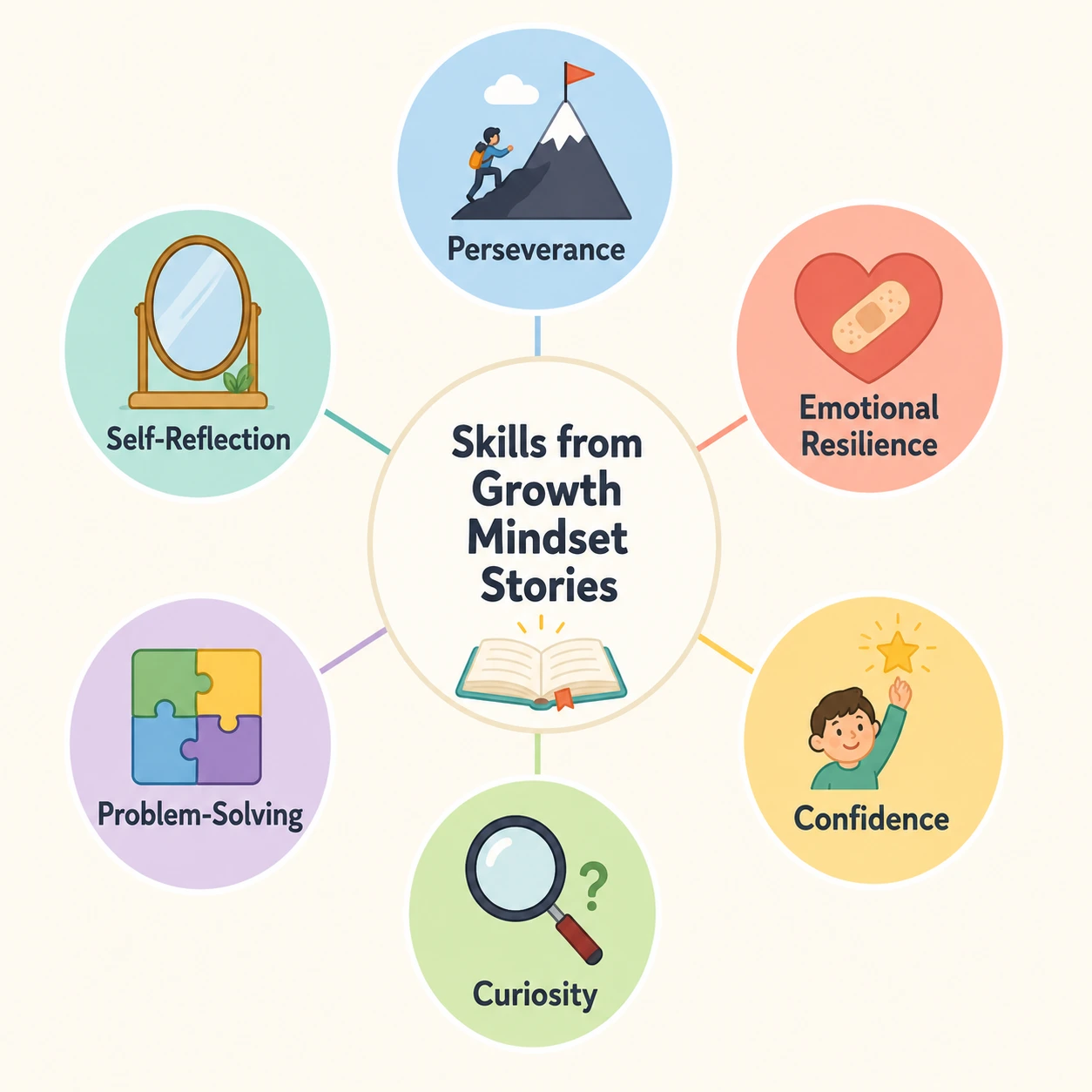
Growth mindset picture books support the development of several interconnected skills:
- Perseverance — continuing to try after an initial failure
- Emotional resilience — recovering from disappointment or frustration
- Confidence — trusting one’s ability to improve over time
- Curiosity — approaching new challenges with interest rather than avoidance
- Problem-solving — generating solutions instead of giving up
- Self-reflection — recognizing personal growth and areas to improve
Characteristics of the Best Picture Books About Growth Mindset
The best growth mindset books are defined by storytelling quality, not popularity or sales rank. Effective books present a believable struggle, show a realistic process of effort and learning, and avoid resolving conflict too quickly or too neatly. A well-written growth mindset story lets the character experience genuine difficulty before growth occurs, which helps young readers understand that setbacks are a normal, expected part of the process. Before diving into specific traits, it helps to see the wider landscape of children’s books about growth mindset available today.
Common Themes Found in Growth Mindset Books
Well-regarded growth mindset books frequently return to a shared set of themes:
- Learning from mistakes
- Trying again
- Persistence
- Courage
- Creativity
- Patience
- Self-belief
- Positive self-talk
Features Parents and Teachers Should Look For
When selecting a book, parents and teachers should evaluate:
- Age-appropriate language that matches the child’s comprehension level
- Relatable characters facing believable, everyday challenges
- Positive messaging that emphasizes effort over innate talent
- Discussion opportunities built into the plot or ending
- Engaging illustrations that support the emotional arc of the story
Picture Books About Growth Mindset for Different Age Groups
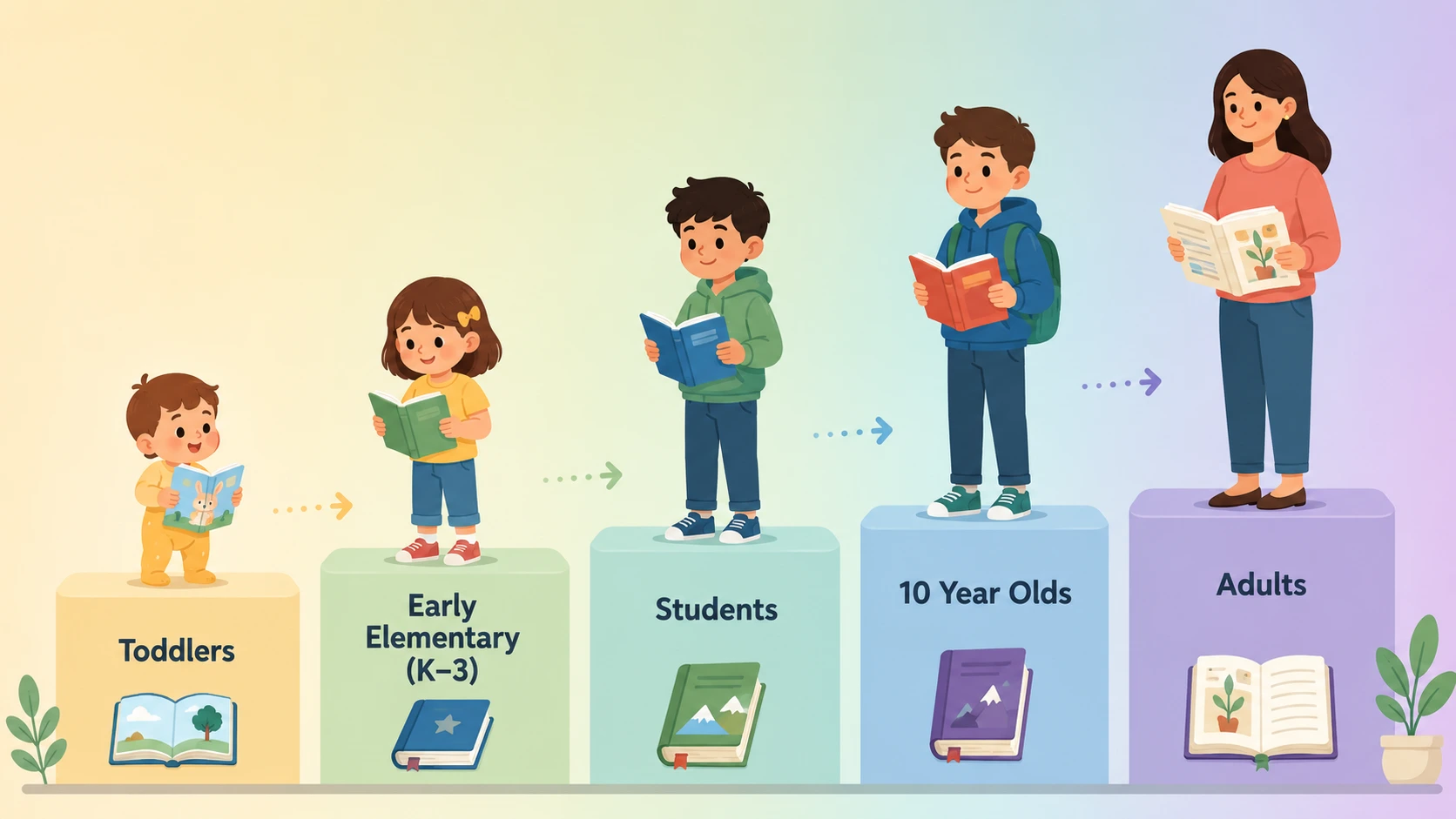
Developmental stage significantly affects how a child understands persistence, failure, and learning, so book selection should shift as children mature.
Picture Books About Growth Mindset for Toddlers
Picture books about growth mindset for toddlers work best when they use simple stories, repetitive language, and clear emotional vocabulary. At this stage, the goal is early confidence building rather than complex narrative structure — toddlers respond to short, rhythmic text and bold illustrations that reinforce basic ideas like “trying again” and “I can do it.”
Growth Mindset Books for Early Elementary Students
For children in kindergarten through grade 3, growth mindset books can support classroom discussions and encourage beginning independence. Stories at this level often introduce slightly more complex characters and situations while still using accessible vocabulary suited to emerging readers. For a broader roundup across all young age groups, see our full list of growth mindset books for kids.
Growth Mindset Books for Students
Growth mindset books for students in general school settings are frequently used for classroom read-alouds, social-emotional learning, and group reading activities. These books help school-aged learners connect personal experiences with a character’s challenges, making them useful tools for guided classroom conversations.
Growth Mindset Books for 10 Year Olds
Growth mindset books for 10 year olds typically feature more complex storylines, deeper character development, and themes involving responsibility and goal setting. At this age, readers can handle longer narratives and more nuanced portrayals of failure, effort, and eventual success.
Picture Books About Growth Mindset for Adults
Picture books about growth mindset for adults are a growing category, since illustrated storytelling remains a powerful tool well beyond childhood. Growth mindset books for adults use visual storytelling to support personal reflection, and many professionals use them in workplace learning and coaching contexts to reinforce concepts like resilience and continuous improvement. For a curated shortlist, check out our guide to the best growth mindset books for adults.
How Parents Can Use Growth Mindset Picture Books at Home
Reading the book is only the first step; the conversation around it is what reinforces the lesson.
Questions to Ask During Reading
Parents can deepen understanding by asking:
- What did the character learn?
- What mistake helped them grow?
- What would you do differently?
- Why didn’t they give up?
Activities After Reading
Following up with hands-on activities helps children apply the lesson beyond the story:
- Drawing a scene showing the character’s growth
- Journaling about a personal challenge
- Setting a small, achievable goal
- Role-playing the character’s problem-solving process
- Having a reflection conversation about effort and mistakes
How Teachers Use Picture Books to Encourage a Growth Mindset
Classrooms offer structured opportunities to reinforce growth mindset concepts through repeated exposure and group discussion.
Morning Meetings
Teachers often open the day with a short growth mindset story to set a positive, effort-focused tone before academic work begins.
Literacy Lessons
Growth mindset books integrate naturally into reading instruction, allowing teachers to combine comprehension skills with social-emotional learning goals.
Social-Emotional Learning Activities
Stories provide a shared reference point for SEL activities, helping students name emotions and discuss coping strategies in a low-pressure context.
Classroom Discussion Prompts
Useful discussion prompts include:
- What challenge did the character face?
- How did their effort change the outcome?
- Have you ever felt like giving up on something?
- What helped you keep trying?
Comparing Picture Books, Chapter Books, and Activity Books for Growth Mindset
Choosing the right format depends on the reader’s age, attention span, and preferred learning style.
| Book Type | Best For | Benefits | Limitations |
|---|---|---|---|
| Picture Books | Young children | Visual learning | Simpler concepts |
| Chapter Books | Older children | Deeper storytelling | Longer attention required |
| Activity Books | Practice | Interactive learning | Less narrative |
Common Mistakes When Choosing Growth Mindset Books
Many parents and educators unintentionally select books that don’t fully support growth mindset development. Common mistakes include:
- Choosing books based only on popularity
- Ignoring the child’s reading level
- Overlooking built-in discussion opportunities
- Assuming every motivational book teaches growth mindset
- Focusing only on success rather than the learning process
Practical Tips for Reinforcing Growth Mindset Beyond Reading
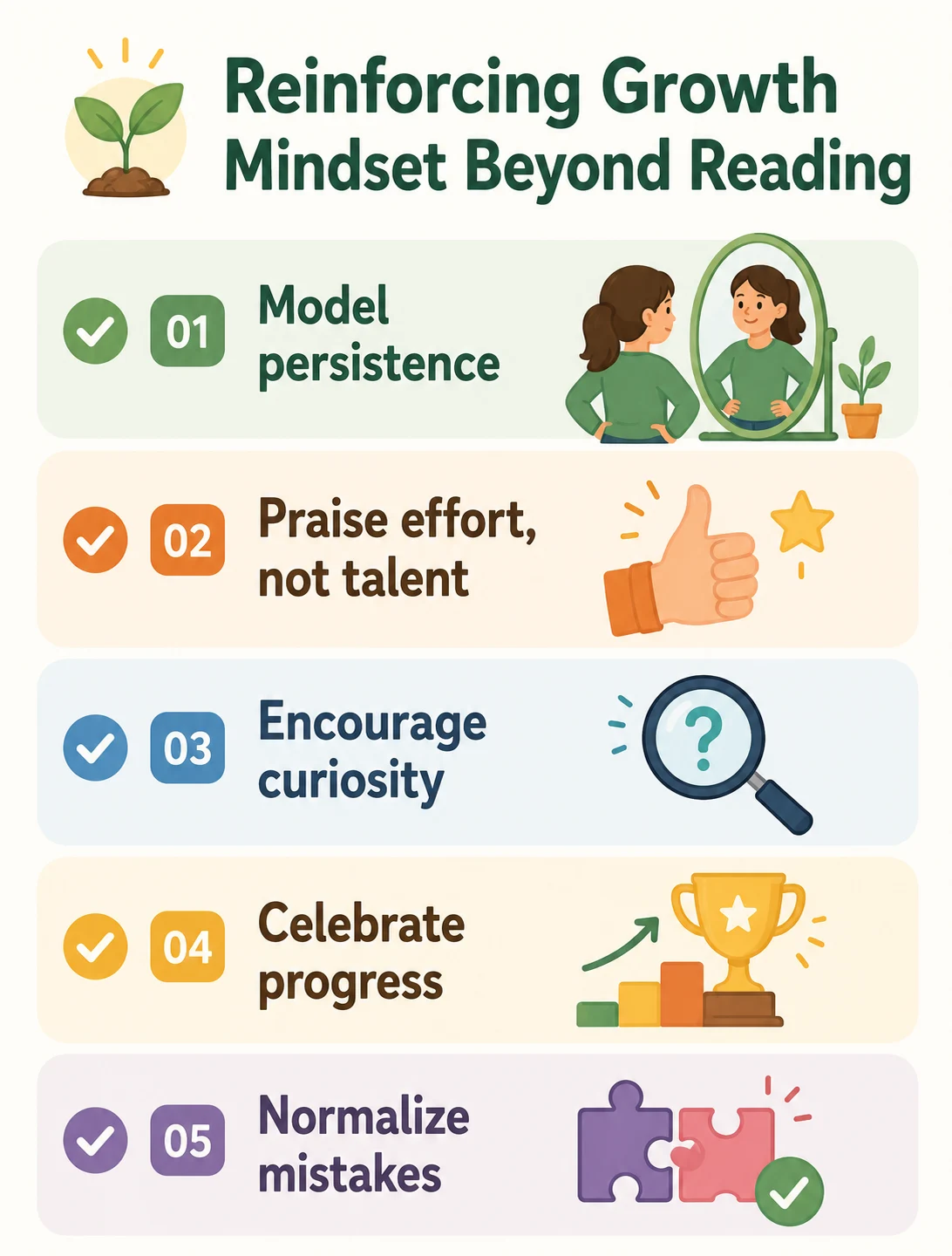
Books work best when they support daily habits rather than standing alone. In our experience helping readers build better habits, the language adults use around a child in everyday moments matters as much as the stories they read together. Consider reinforcing growth mindset through:
- Modeling persistence when facing your own challenges
- Praising effort instead of talent or natural ability
- Encouraging curiosity about new or difficult tasks
- Celebrating progress, not just final outcomes
- Normalizing mistakes as an expected part of learning
Common Challenges When Teaching Growth Mindset and How to Overcome Them
Children Who Fear Failure
Fear of failure often develops when children associate mistakes with judgment or disappointment rather than learning. Addressing it involves reframing errors as useful information and consistently praising effort. Prevention strategies include modeling calm reactions to your own mistakes and avoiding harsh criticism after setbacks.
Giving Up Too Quickly
This pattern typically emerges when a child hasn’t yet experienced the connection between sustained effort and improvement. Breaking tasks into smaller, achievable steps helps address it. Prevention involves celebrating incremental progress so persistence feels rewarding rather than exhausting.
Comparing Themselves to Others
Comparison often stems from an environment that emphasizes outcomes or rankings over personal growth. Shifting the focus to individual progress helps address this pattern. Preventing it long-term requires consistently framing achievement in terms of personal improvement rather than competition.
Expecting Instant Success
Unrealistic expectations about how quickly skills develop can discourage continued effort. Addressing this involves explicitly discussing that mastery takes time and practice. Prevention includes setting realistic milestones and openly discussing the learning timeline before a new task begins.
Frequently Overlooked Factors That Influence Growth Mindset Development
Beyond book selection, several environmental factors shape whether a growth mindset actually takes hold:
- Family language — how effort and mistakes are discussed at home
- Classroom culture — whether errors are treated as learning opportunities
- Peer influence — how classmates respond to struggle and failure
- Consistency — repeated reinforcement over time, not a single lesson
- Emotional safety — feeling secure enough to attempt difficult tasks
- Learning environment — access to supportive resources and feedback
- Realistic expectations — understanding that growth is gradual
Conclusion
Picture books about growth mindset give children an accessible, emotionally engaging way to understand that abilities develop through effort, practice, and learning from mistakes. From simple, repetitive stories for toddlers to more nuanced narratives for older students and even adults, the right book depends on the reader’s developmental stage and needs. As of 2026, both parents and educators increasingly recognize that the books themselves are only part of the equation — the conversations, questions, and daily habits built around them are what truly reinforce resilience, confidence, and a lasting love of learning. Choosing age-appropriate stories and following up consistently is what turns a good book into a lasting lesson.
Frequently Asked Questions
What are picture books about growth mindset?
Picture books about growth mindset are illustrated stories that teach children to view abilities as something that improves through effort, practice, and learning from mistakes, rather than as a fixed trait.
At what age should children start reading growth mindset picture books?
Children can begin engaging with growth mindset picture books as toddlers, using simple, repetitive stories that build early emotional vocabulary and confidence before progressing to more complex narratives.
Can picture books help children become more resilient?
Yes, picture books help children become more resilient by modeling how characters face setbacks, persist through difficulty, and ultimately improve through effort rather than giving up.
Are growth mindset picture books useful in classrooms?
Growth mindset picture books are widely used in classrooms for morning meetings, literacy lessons, and social-emotional learning activities that encourage group discussion and shared reflection.
What’s the difference between growth mindset books and motivational books?
Growth mindset books focus specifically on the learning process, effort, and improvement over time, while general motivational books may emphasize inspiration or success without addressing the psychology of how abilities develop.
Can adults benefit from picture books about growth mindset?
Adults can benefit from picture books about growth mindset, as illustrated storytelling supports personal reflection and is increasingly used in workplace learning and coaching to reinforce resilience and continuous improvement.
How often should parents read growth mindset books with children?
Consistent, repeated reading — ideally as part of a regular routine rather than a one-time activity — helps children internalize growth mindset concepts more effectively than occasional exposure.
What qualities should I look for in a good growth mindset picture book?
Look for age-appropriate language, relatable characters, positive messaging that values effort over innate talent, built-in discussion opportunities, and illustrations that support the story’s emotional arc.