

Introduction
A mindset is the underlying set of beliefs a person holds about their abilities, potential, and the nature of change itself. It shapes how people interpret setbacks, approach learning, form habits, and build relationships, which makes it one of the most influential factors in long-term personal and professional success. This guide focuses on the best books on changing mindset from an educational perspective, rather than offering a simple, unranked list of titles. Different books address different dimensions of mindset — including growth, discipline, resilience, happiness, and achievement — and no single book serves every goal equally well. Readers will learn how these books differ, what makes a mindset book genuinely valuable, and which types of books align with specific personal development goals.
Quick Summary
- A growth-oriented mindset can be developed through learning, reflection, and consistent practice, not through reading alone.
- Different mindset books focus on different goals such as resilience, discipline, happiness, productivity, and success.
- Choosing the right book depends on your current challenges, learning style, and desired outcomes.
- Applying ideas from books consistently is more important than reading many books.
What Is a Mindset and Why Does It Matter?
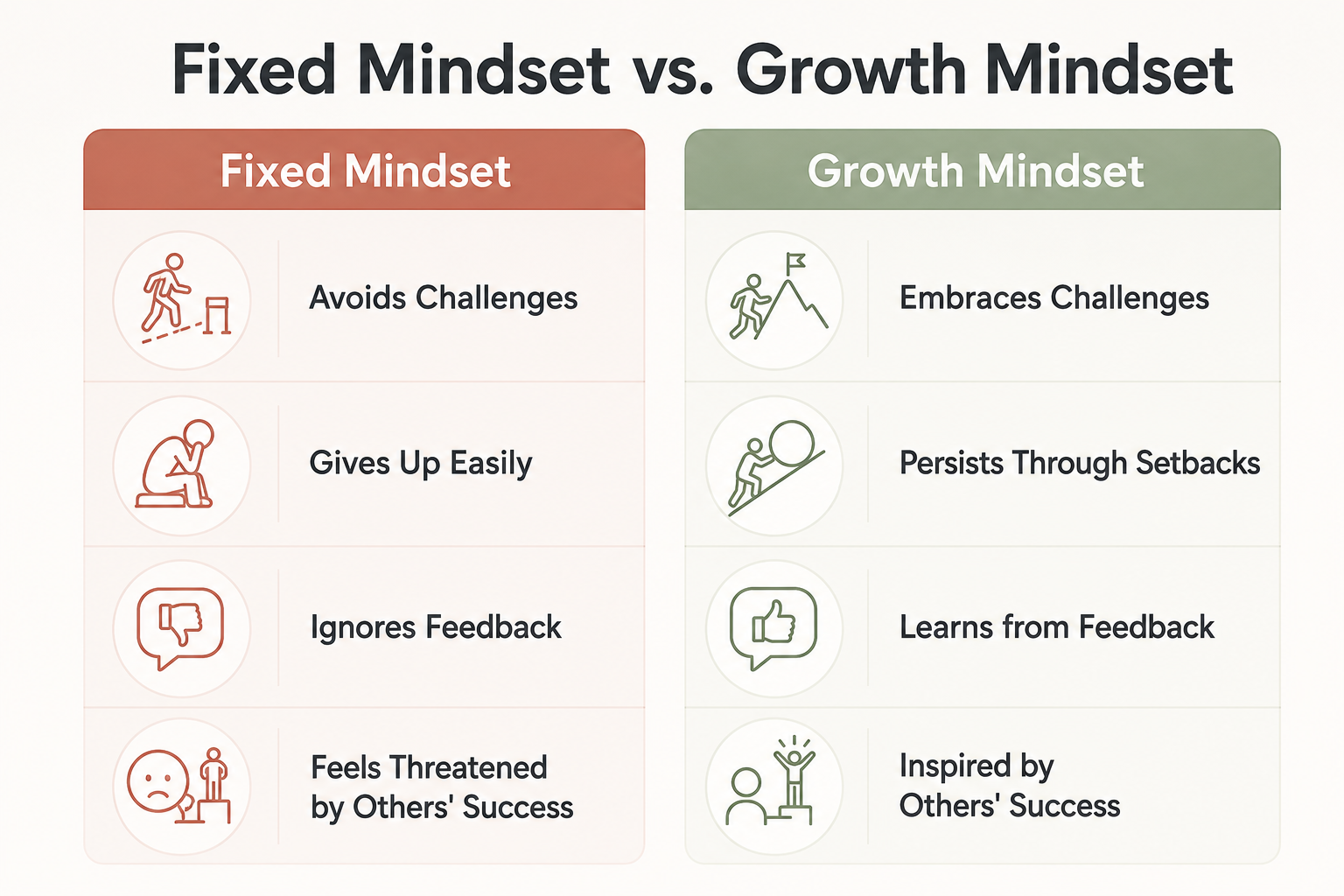
Understanding Fixed vs. Growth Mindset
A mindset is the collection of core beliefs a person holds about whether abilities, intelligence, and personal qualities are fixed traits or skills that can be developed. This concept, popularized by psychological research on motivation and achievement, separates two broad orientations: a fixed mindset, which assumes talent and intelligence are static, and a growth mindset, which assumes ability can be developed through effort, strategy, and feedback. People searching for books on how to change your mindset are typically looking for resources that help them shift from a fixed orientation toward a growth orientation, since this shift is associated with greater resilience, persistence, and openness to learning. This shift matters beyond theory — understanding why growth mindset is important helps explain why some people recover from setbacks faster than others.
How Mindset Shapes Daily Decisions
Mindset does not operate in the background as an abstract belief system; it directly shapes everyday decisions and behaviors. A person’s underlying mindset influences:
- Confidence — how willing someone is to attempt difficult or unfamiliar tasks
- Learning — whether setbacks are treated as useful feedback or as proof of inadequacy
- Problem-solving — the flexibility and creativity applied to obstacles
- Relationships — openness to feedback and willingness to repair conflict
- Career development — persistence through skill gaps and career setbacks
- Financial decisions — long-term thinking versus short-term reactive choices
- Emotional resilience — the ability to recover from stress, failure, or disappointment
What Makes a Mindset Book Truly Valuable?
Characteristics of High-Quality Mindset Books
Not all mindset books provide equal value. A high-quality mindset book is grounded in research rather than opinion, and it translates that research into steps a reader can actually apply. The most useful mindset books share several characteristics:
- Research-backed concepts rooted in psychology or behavioral science
- Practical exercises that move ideas from theory into action
- Real-world examples that clarify abstract concepts
- Actionable advice rather than vague inspiration
- Long-term applicability beyond a single read-through
Different Types of Mindset Books
Mindset books are not a single category. They span several overlapping fields, each contributing a different lens on how thinking patterns can change:
- Personal development — general frameworks for self-improvement
- Psychology — the science of belief, motivation, and behavior
- Habit formation — the mechanics of building and breaking routines
- Success philosophy — mental models associated with achievement
- Leadership — mindset applied to decision-making and influence
- Emotional intelligence — self-awareness and emotional regulation
- Behavioral science — how environment and incentives shape thought patterns
Best Books on Changing Mindset
The following titles are widely recognized among the best books on changing mindset, and each addresses a distinct aspect of belief and behavior change rather than offering interchangeable advice.
- Mindset — introduces the fixed versus growth mindset framework and explains how self-theories shape achievement.
- Atomic Habits — focuses on how small, consistent behavioral changes compound into identity-level shifts over time.
- The Power of Now — centers on present-moment awareness as a tool for reducing anxiety-driven thought patterns.
- The Mountain Is You — addresses self-sabotage and the psychological roots of avoidance behavior.
- The 7 Habits of Highly Effective People — presents a principle-centered framework connecting mindset to long-term effectiveness.
- The Magic of Thinking Big — links belief in one’s own potential to ambition and goal-setting.
- Grit — examines perseverance and passion as predictors of long-term achievement.
- Think Again — encourages intellectual flexibility and the willingness to revise beliefs when new evidence appears.
- The Happiness Advantage — explores how positive mindset states improve performance rather than merely following success.
- Psycho-Cybernetics — an early foundational text linking self-image to behavior and goal attainment.
Readers researching the best books to read to change your mindset, or compiling a top 10 books on mindset list, will notice that these titles cluster around a few core themes: belief change, habit change, resilience, and self-image. Understanding which theme matches a personal goal is more useful than ranking titles by popularity alone.
Best Books for Developing Success and Achievement Mindset
Books Focused on Success Psychology
Books on mindset and success typically emphasize the internal beliefs and habits that precede external achievement. These titles generally cover:
- Achievement habits — the recurring behaviors that separate consistent high performers from inconsistent ones
- Long-term thinking — prioritizing sustained progress over short-term wins
- Self-belief — the confidence required to pursue ambitious goals
- Productivity — converting motivation into consistent output
- Leadership — applying mindset principles to decision-making under pressure
Among the best books on mindset and success, titles like The Magic of Thinking Big and Grit are frequently recommended because they connect internal belief systems directly to measurable, external outcomes.
Best Books for Building Discipline and Mental Toughness
Developing Consistency Through Reading
Books on mindset and discipline focus less on inspiration and more on the mechanics of consistency. These books typically teach:
- Self-discipline — building the capacity to act despite discomfort
- Delayed gratification — prioritizing long-term rewards over immediate ones
- Mental resilience — recovering quickly from setbacks or failure
- Habit consistency — maintaining routines even when motivation fluctuates
- Personal accountability — taking ownership of outcomes rather than external circumstances
Discipline-focused books tend to pair well with habit-formation resources, since discipline is most sustainable when it is supported by structured routines rather than willpower alone.
Since motivation naturally fluctuates, readers often benefit from pairing these books with practical strategies on how to build discipline without motivation.
3. “How to Journal for Self-Growth”
Which Mindset Book Is Right for Your Goals?
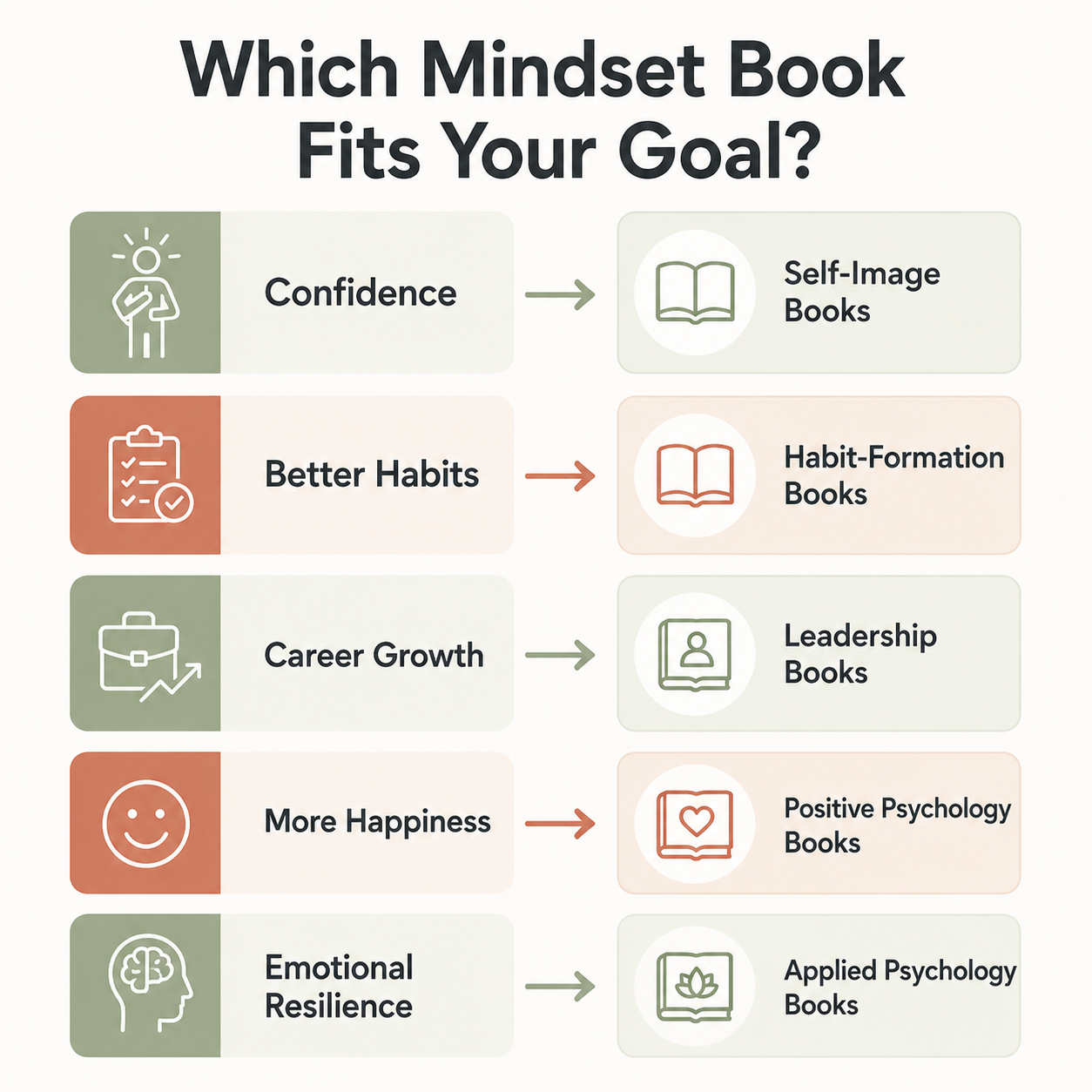
If You Want Greater Confidence
Books centered on self-image and belief systems, such as Psycho-Cybernetics, are most relevant, since they directly address how self-perception shapes behavior.
If You Want Better Habits
Habit-formation books such as Atomic Habits are the strongest fit, since they translate mindset shifts into concrete, repeatable systems.
If You Want Career Growth
Success-psychology and leadership-focused books, such as The 7 Habits of Highly Effective People, provide frameworks that connect mindset to professional decision-making.
If You Want More Happiness
Readers asking how to change your mindset to be happy are typically better served by books like The Happiness Advantage, which links positive mindset states to performance and wellbeing rather than treating happiness as a byproduct of success.
If You Want Emotional Resilience
Books addressing self-sabotage and present-moment awareness, such as The Mountain Is You and The Power of Now, are most useful for readers seeking the best book to change the way you think under stress or emotional strain.
Comparison of Popular Mindset Books
| Goal | Recommended Book Type | Primary Focus | Best For |
|---|---|---|---|
| Growth | Psychology / Self-Theory | Fixed vs. growth beliefs | Readers new to mindset concepts |
| Discipline | Behavioral Science | Consistency and accountability | Readers struggling with follow-through |
| Success | Success Philosophy | Achievement habits and ambition | Career-focused readers |
| Happiness | Positive Psychology | Wellbeing linked to performance | Readers seeking sustainable motivation |
| Resilience | Applied Psychology | Recovery from setbacks | Readers facing stress or self-sabotage |
| Productivity | Habit Formation | Small, compounding behavior change | Readers wanting practical systems |
Mindset Books vs. Strategy Books
Understanding the Difference
Mindset books and strategy books serve fundamentally different purposes, and readers researching what are the best books on strategy should understand this distinction before choosing between the two categories. Mindset books focus on internal thinking patterns, beliefs, and emotional responses, while strategy books focus on external planning, decision-making frameworks, and execution. Mindset work is closer to personal development, addressing how a person thinks and reacts; strategy work is closer to business decision-making, addressing what a person plans and executes. Mindset books are most useful when internal barriers — such as fear of failure or fixed beliefs — are limiting progress. Strategy books are most useful when the internal barriers are already addressed and the remaining challenge is execution or planning.
How to Read Mindset Books for Maximum Personal Growth
Read Actively Instead of Passively
Highlight key ideas, write margin notes, and pause to consider how each concept applies to a specific personal situation rather than reading straight through without reflection.
Apply One Lesson at a Time
Attempting to implement an entire book at once typically leads to abandonment. Selecting one concept and practicing it consistently produces more durable change.
Build New Habits Around Key Ideas
Convert abstract ideas into specific, repeatable actions — for example, turning a concept about self-talk into a daily journaling practice.
Review and Reflect Regularly
Revisit key ideas periodically rather than treating a single read-through as complete. Useful methods include:
- Note-taking during and after reading
- Journaling to track personal reactions and insights
- Habit tracking to measure consistency of applied lessons
- Accountability through a partner, coach, or community
- Weekly review sessions to reinforce key concepts
Common Mistakes People Make When Reading Self-Improvement Books
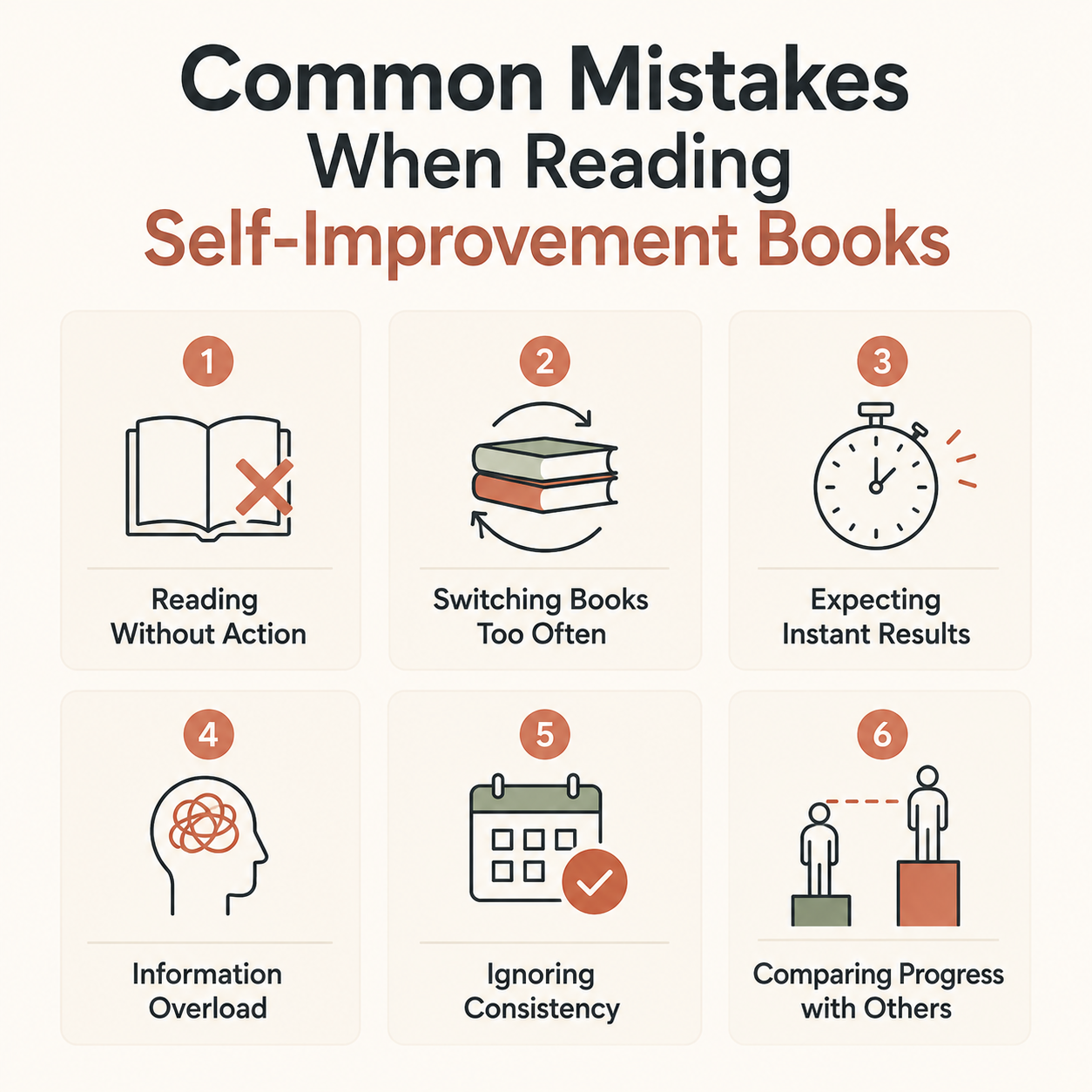
In our experience helping readers build better habits, most setbacks come from a small set of recurring mistakes rather than a lack of good information.
- Reading without action — Why it happens: information feels productive on its own. How to fix it: pair each reading session with one small applied action. How to prevent it: schedule implementation time immediately after reading.
- Switching books too frequently — Why it happens: new titles feel more motivating than finishing current ones. How to fix it: commit to applying one book’s core ideas before starting another. How to prevent it: set a completion goal before purchasing the next title.
- Expecting instant transformation — Why it happens: mindset shifts are often marketed as quick fixes. How to fix it: set realistic, incremental milestones. How to prevent it: track small wins rather than searching for dramatic change.
- Information overload — Why it happens: reading multiple books simultaneously blends concepts together. How to fix it: focus on one framework at a time. How to prevent it: limit active reading to one mindset book per period.
- Ignoring consistency — Why it happens: motivation fluctuates day to day. How to fix it: build systems that do not depend on motivation. How to prevent it: attach new habits to existing daily routines.
- Comparing progress with others — Why it happens: social comparison is a natural cognitive habit. How to fix it: measure progress against personal baselines. How to prevent it: track private, individual metrics rather than public benchmarks.
Difficulty and Time Investment
Mindset development varies in difficulty depending on prior familiarity with psychological concepts and the depth of behavior change required. Beginner-friendly books, such as Atomic Habits or The Magic of Thinking Big, use accessible language and concrete examples, making them suitable starting points. More advanced psychology-based books, such as Mindset or Think Again, benefit from prior exposure to behavioral science terminology. Average reading time for a typical mindset book ranges from four to eight hours, but the time required for practical implementation is substantially longer, often spanning several weeks to months of consistent practice. Factors affecting learning speed include prior self-awareness, existing habit structures, available time for reflection, and consistency of applied practice.
Results Timeline
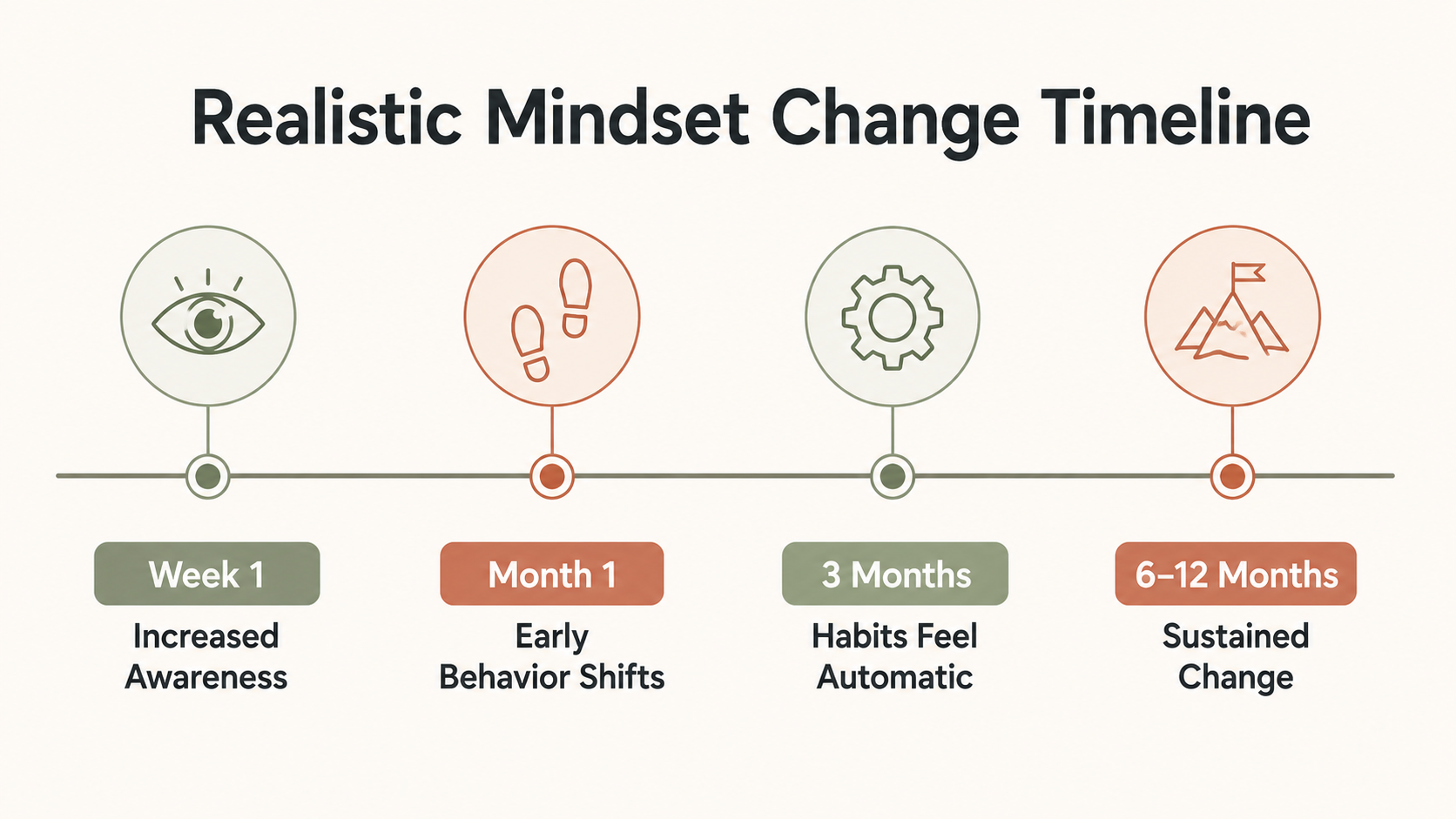
Readers should expect mindset development to follow a gradual, non-linear progression rather than a sudden shift.
- First week — Increased awareness of existing thought patterns and triggers.
- First month — Early behavioral adjustments become noticeable, though inconsistent.
- Three months — New thought patterns and habits begin to feel more automatic.
- Long-term development — Sustained mindset change typically solidifies over six months to a year of consistent practice.
Progress speed is influenced by practice frequency, consistency, environmental support, and the amount of reflection applied between reading sessions.
Practice Guide for Lasting Mindset Change
Daily Routine
Set aside a short, consistent daily reading or reflection window, paired with a single applied action related to that day’s material. If you’re starting from scratch, a structured approach like how to build good habits in 30 days can make early tracking easier to sustain.
Weekly Reflection
Review key takeaways from the week, noting which ideas were applied successfully and which require more attention.
Habit Tracking
Use a simple tracker to record whether target behaviors were practiced daily, which reinforces consistency and highlights gaps early.
Staying Motivated
Your Daily Thrive recommends connecting mindset practice to a specific, personally meaningful goal rather than relying on general motivation, since goal-linked practice tends to be more sustainable.
Long-Term Sustainability
Adjust practices for different life circumstances — students may benefit from shorter, more frequent sessions between study blocks, professionals may integrate reflection into commute or lunch breaks, and busy parents may favor audio formats or brief evening journaling to maintain consistency without adding significant time pressure.
Frequently Overlooked Factors That Influence Mindset Change
Several factors outside of reading itself significantly influence how effectively mindset change occurs, and these are often missing from surface-level guides:
- Sleep quality — poor sleep impairs emotional regulation and cognitive flexibility
- Stress management — chronic stress narrows thinking and reduces openness to new beliefs
- Social environment — surrounding relationships reinforce or undermine new thought patterns
- Limiting beliefs — unexamined assumptions can quietly block progress despite active effort
- Emotional regulation — the ability to manage reactive emotions supports consistent practice
- Continuous learning — ongoing exposure to new ideas prevents stagnation
- Lifestyle habits — diet, exercise, and daily structure influence mental clarity and consistency
Conclusion
Mindset shapes decision-making, resilience, learning, and long-term success, which is why selecting the right resource matters more than simply reading as many titles as possible. The best books on changing mindset are not interchangeable — some focus on growth and self-belief, others on discipline, success, happiness, or resilience — and matching a book to a specific personal goal produces far better outcomes than reading at random. As of 2026, behavioral science continues to reinforce a consistent finding: consistent, applied practice produces greater and more durable change than passive reading alone. Readers who combine the right book with active implementation, regular reflection, and attention to supporting factors like sleep and stress management are best positioned for lasting mindset change.
Frequently Asked Questions
What are the best books on changing mindset for beginners?
Beginner-friendly options include Atomic Habits and The Magic of Thinking Big, both of which use accessible language and concrete examples to introduce core mindset concepts without requiring prior psychology knowledge.
Which mindset books are best for achieving success?
The Magic of Thinking Big and Grit are commonly recommended for success-oriented readers, since both connect internal belief systems directly to ambition, persistence, and achievement.
Can reading mindset books actually change the way you think?
Reading can introduce new frameworks and awareness, but lasting change requires consistent application of the concepts through practice, reflection, and habit-building rather than reading alone.
How many mindset books should I read each year?
There is no fixed number; prioritizing depth of application over volume of reading typically produces better results than reading many books without implementation.
What is the difference between mindset books and psychology books?
Mindset books generally translate psychological research into practical, everyday guidance, while psychology books may focus more heavily on underlying theory, research methodology, and academic explanation.
Which books help build discipline and mental toughness?
Books focused on habit consistency, delayed gratification, and personal accountability — often falling under behavioral science or habit-formation categories — are most directly aligned with building discipline.
How long does it take to notice changes after reading mindset books?
Early awareness often develops within the first week, initial behavioral shifts within the first month, and more automatic, sustained change typically develops over three to twelve months of consistent practice.
Should I read multiple mindset books at the same time?
Reading one book at a time is generally more effective, since focusing on a single framework reduces information overload and supports more consistent application of its core ideas.