
Introduction
A jiu jitsu mindset is the set of mental habits — patience, adaptability, emotional control, and a willingness to keep learning — that allows a practitioner to improve steadily on the mats. In Brazilian Jiu-Jitsu (BJJ), technique matters, but mindset often determines who keeps training long enough to master it. Progress depends less on raw athleticism and more on discipline, the ability to adapt mid-roll, and consistent reflection after every session. A Brazilian Jiu-Jitsu mindset built around a growth mindset and a healthy competition mindset gives practitioners the mental tools to handle setbacks, plateaus, and pressure without losing motivation.
Quick Summary
- A strong jiu jitsu mindset emphasizes learning over winning and long-term improvement over short-term results.
- Developing a growth mindset helps practitioners adapt, overcome setbacks, and improve technical skills more effectively.
- Mental preparation is essential for training consistency, competition performance, and handling challenges on and off the mats.
- Daily habits, reflection, and resilience strengthen both athletic performance and personal development.
What Is a Jiu Jitsu Mindset?
A jiu jitsu mindset is the mental framework a practitioner uses to approach training, setbacks, and competition. It shapes how quickly someone learns, how they respond to being submitted, and how consistently they show up to train. Mental habits directly influence decision-making during live rolling, the speed at which new techniques are absorbed, and overall performance under pressure. This mindset is closely tied to discipline, patience, humility, and resilience — qualities that separate practitioners who plateau from those who keep progressing for years. A genuine Brazilian jiu jitsu mindset treats every roll, win or lose, as usable information rather than a verdict on ability.
Core Characteristics of a Strong Jiu Jitsu Mindset
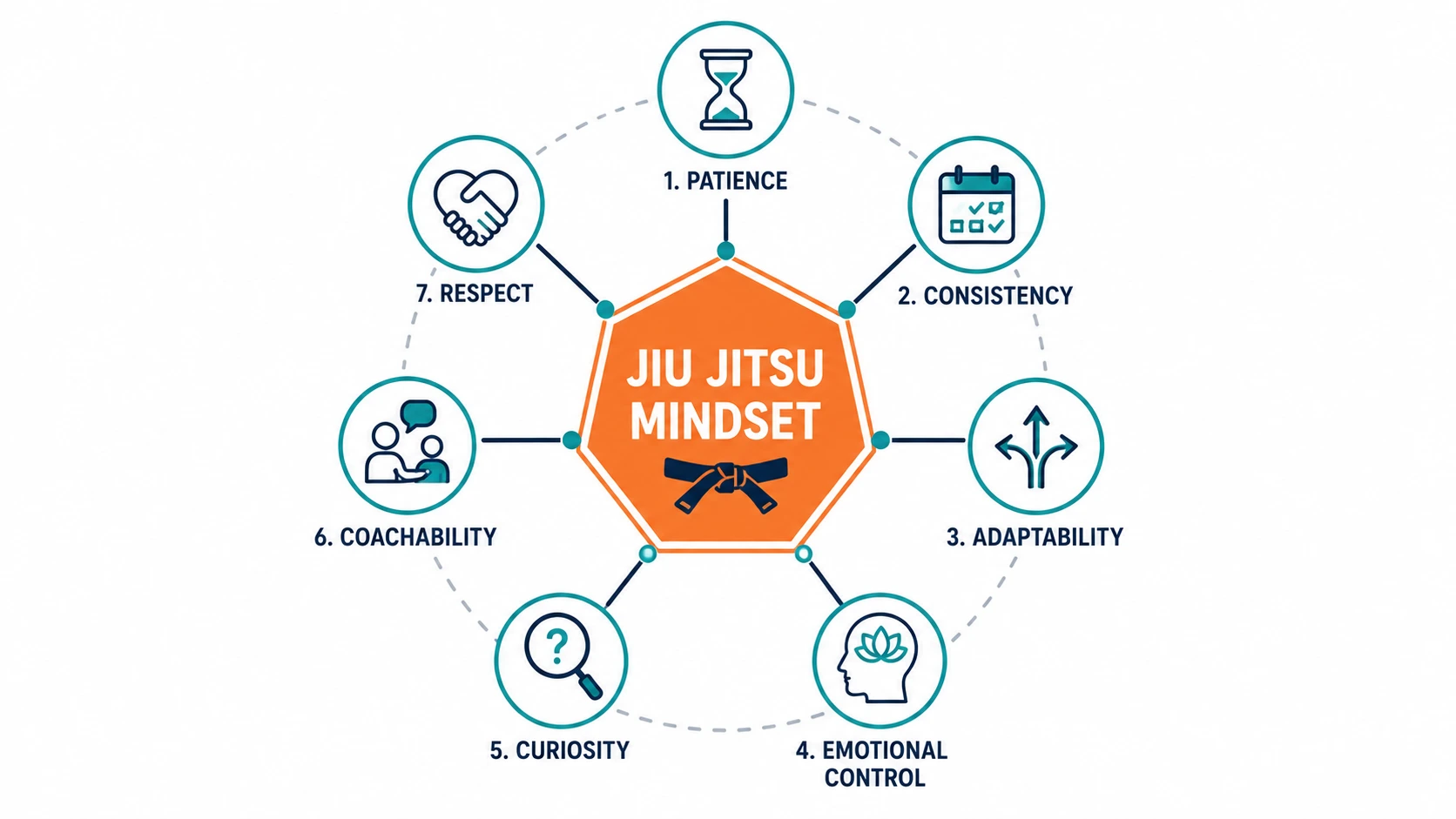
Practitioners with a strong mental approach tend to share several traits:
- Patience — accepting that technical mastery takes years, not weeks
- Consistency — training regularly even when motivation is low
- Adaptability — adjusting technique and strategy mid-roll
- Emotional control — staying calm when caught in a bad position
- Curiosity — asking why a technique works, not just how
- Coachability — accepting correction without defensiveness
- Respect for training partners — treating rolls as collaborative learning, not ego contests
In practice, this looks like:
- Learning before winning
- Long-term thinking over short-term wins
- Accepting mistakes as part of the process
- Continuous improvement instead of comparison
- Confidence without arrogance
Why Mindset Matters More Than Physical Ability
Beginners who eventually become skilled practitioners are rarely the most naturally athletic people in the room — they are usually the ones who persisted through early frustration. Physical talent can accelerate short-term results, but mental resilience determines whether someone stays on the mats long enough for technical development to compound. Since BJJ relies heavily on pattern recognition built over hundreds of repetitions, a practitioner’s ability to stay engaged and reflective during losses has a direct effect on long-term retention of technique. Physical talent can accelerate short-term results, but the same.Physical talent can accelerate short-term results, but the same athlete mindset principles that drive resilience in other sports determine whether someone stays on the mats long enough for technical development to compound.
How Mental Habits Affect Skill Development
Mental habits shape technical growth in several concrete ways:
- Focus during practice determines how much detail is absorbed from each repetition
- Decision-making under pressure improves when a practitioner has trained themselves to stay calm rather than panic
- Pattern recognition develops faster in practitioners who consciously reflect on why a technique succeeded or failed
- Confidence built through repetition replaces hesitation with fluid, trained responses
Understanding the Growth Mindset in Jiu Jitsu
A growth mindset jiu jitsu approach treats ability as something developed through effort and feedback, rather than a fixed trait someone either has or doesn’t. This concept, drawn from behavioral science, applies directly to martial arts, where technical skill is built almost entirely through iteration, correction, and repeated exposure to failure. This concept isn’t unique to martial arts — why a growth mindset is important applies across sports, careers, and personal development, but nowhere is it tested more directly than in live sparring.
Growth Mindset vs Fixed Mindset
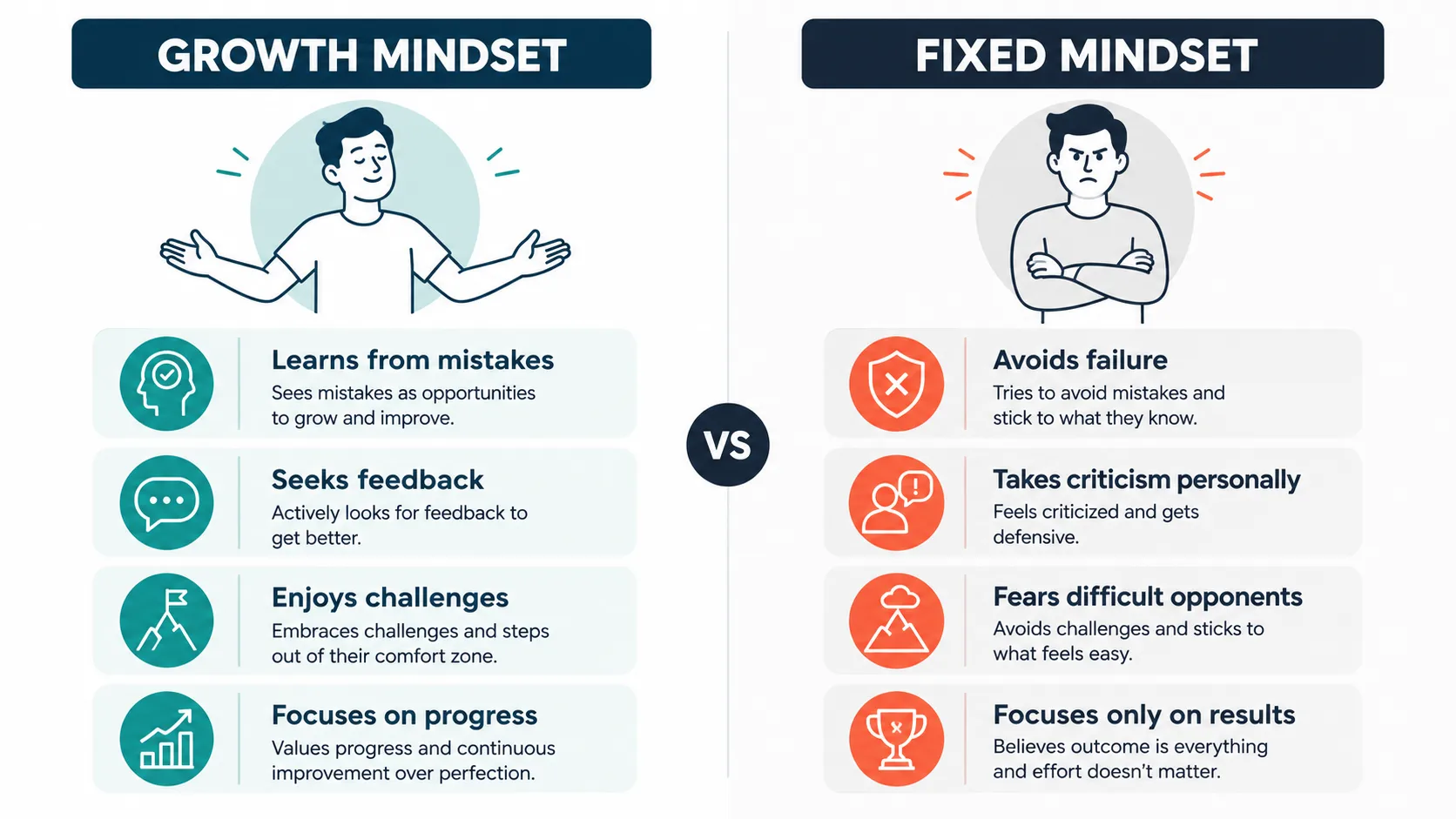
| Growth Mindset | Fixed Mindset |
|---|---|
| Learns from mistakes | Avoids failure |
| Seeks feedback | Takes criticism personally |
| Enjoys challenges | Fears difficult opponents |
| Focuses on progress | Focuses only on results |
In practice, a growth-minded practitioner who gets caught in the same submission repeatedly will ask a training partner or coach to explain the setup, while a fixed-minded practitioner may avoid rolling with that partner altogether to protect their ego.
How to Develop a Growth Mindset on the Mats
- Set specific learning goals for each session, not just outcome goals
- Reflect after every session on what worked and what didn’t
- Ask questions of coaches and higher belts
- Accept difficult rolls with more experienced partners
- Track improvement over weeks and months, not single sessions
Building a Brazilian Jiu-Jitsu Mindset for Long-Term Progress
Mastery in BJJ typically develops over years rather than weeks, which is why long-term mindset matters more than any single training block. Consistency and incremental improvement outperform sporadic intense effort, and lifelong learning remains necessary even at advanced levels, since the art continues to evolve. Handling plateaus — periods where progress feels invisible — is one of the clearest tests of a practitioner’s mental discipline.
Daily Habits That Strengthen Mental Performance
- Keeping a training journal
- Setting short-term and long-term goals
- Using visualization before sessions or competitions
- Prioritizing recovery between hard training days
- Maintaining consistent sleep habits
- Practicing positive self-talk after difficult rolls
In our experience helping readers build better habits, the practitioners who journal even briefly after each session tend to notice patterns in their mistakes far faster than those who rely on memory alone. If you’re unsure where to start, general journaling prompts for self growth can easily be adapted to track technical progress, emotional patterns, and recurring mistakes on the mats.
Developing the Right Jiu Jitsu Competition Mindset
A well-developed jiu jitsu competition mindset separates practitioners who perform close to their training level from those who freeze under pressure. This involves managing expectations, staying calm despite nerves, and competing without a fear of losing controlling every decision.
Before Competition
- Following a consistent preparation routine
- Using visualization to rehearse likely scenarios
- Practicing breathing exercises to manage nerves
- Building a tactical game plan based on known opponents or common patterns
During Competition
Staying present in the moment — rather than thinking ahead to the outcome — allows a competitor to react to what is actually happening. Managing emotions prevents a single mistake from cascading into a lost match, and adjusting strategy mid-match based on what an opponent is showing is often more valuable than sticking rigidly to a pre-match plan. Responding to setbacks, such as giving up an early advantage, with composure rather than panic is a defining trait of experienced competitors.
After Competition
- Reviewing performance objectively, separate from the emotional high or low of winning or losing
- Identifying specific lessons rather than general impressions
- Avoiding purely emotional reactions to a loss
- Planning concrete improvements for the next training cycle
Common Mental Challenges in Jiu Jitsu and How to Overcome Them
Fear of Losing
Fear of losing often develops from tying self-worth to outcomes rather than effort. It can be reduced by reframing rolls as data-gathering rather than competition, and by deliberately rolling with tougher partners in low-stakes training settings to normalize being submitted.
Training Plateaus
Plateaus are usually caused by repeating the same training patterns without targeted feedback. Signs include stagnant technique despite consistent attendance and recurring losses to the same setups. Practical solutions include seeking specific coaching feedback, drilling weak positions deliberately, and temporarily narrowing focus to one or two techniques.
Comparison With Other Practitioners
Healthy comparison focuses on tracking personal progress against past performance rather than against other students’ belt timelines. Measuring growth through skill acquisition — rather than promotions — helps avoid discouragement, since training partners often progress at different rates due to differing schedules, body types, and backgrounds.
Performance Anxiety
Common triggers include competing in front of an audience, facing a known tough opponent, or fear of embarrassment. Confidence-building techniques such as consistent competition simulation in training and pre-performance routines help reduce anxiety, while simple mental reset strategies — like focused breathing between points — can restore composure mid-match.
Beginner Mistakes That Limit Mindset Development
- Expecting rapid progress instead of gradual, compounding improvement
- Chasing belts instead of focusing on underlying skills
- Avoiding stronger training partners to protect the ego
- Ignoring recovery, which leads to burnout and injury
- Measuring success only by submissions rather than overall improvement
- Quitting after setbacks instead of treating them as normal parts of the process
Practical Ways to Strengthen Your Jiu Jitsu Mindset Every Week
Weekly Mental Training Routine
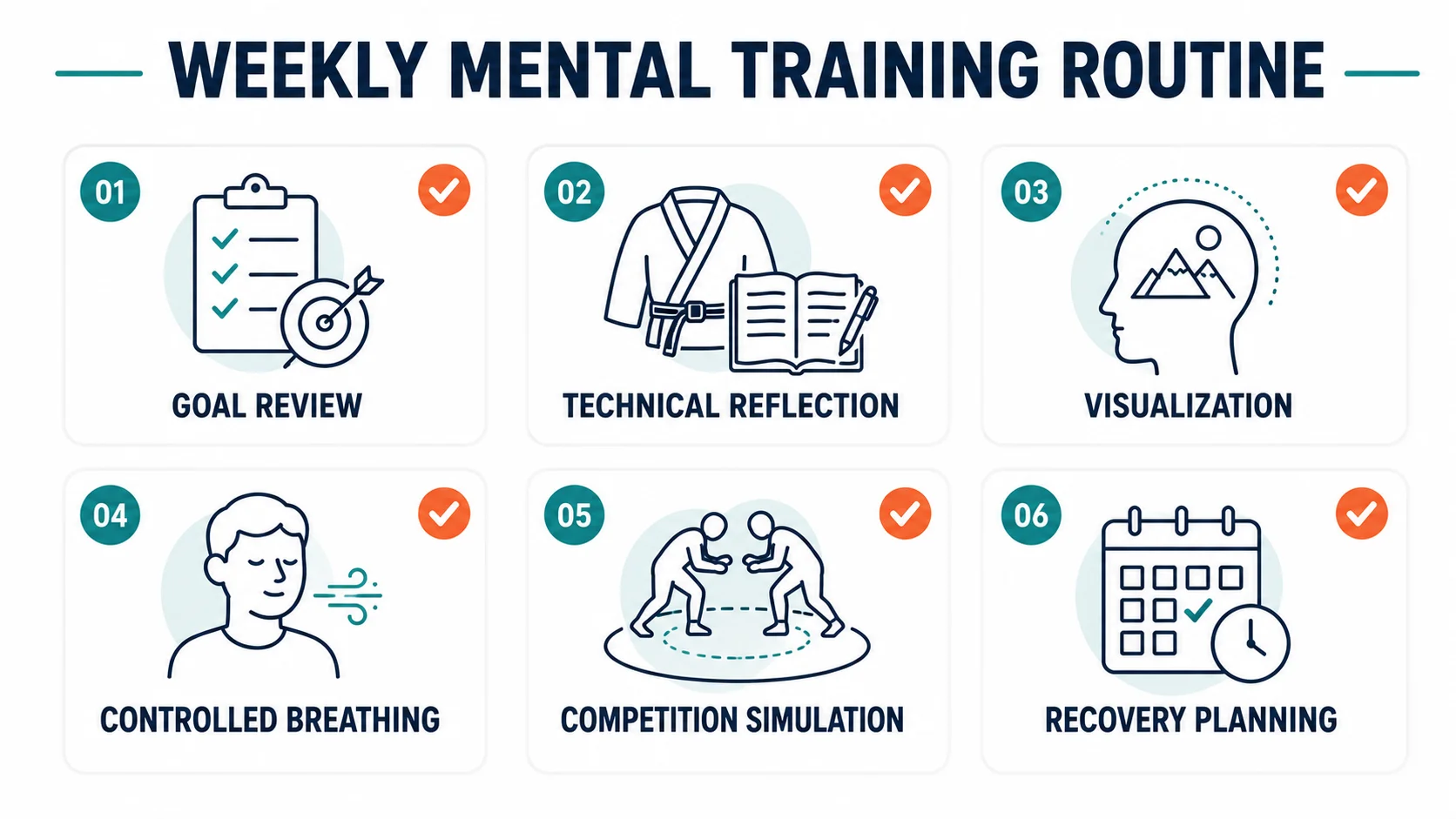
- Reviewing weekly goals
- Reflecting on technical progress
- Practicing visualization
- Doing controlled breathing exercises
- Running competition-style simulation rolls
- Planning recovery and rest
Measuring Mental Progress
Mental progress can be tracked through specific indicators:
- Better emotional control during difficult rolls
- Increased consistency in attendance and effort
- Improved confidence when facing tougher partners
- Faster recovery after mistakes, both mentally and technically
- Better focus and fewer distractions during sparring
Jiu Jitsu Mindset Compared With Other Martial Arts Mindsets
| Aspect | Brazilian Jiu-Jitsu | Wrestling | Judo | MMA |
|---|---|---|---|---|
| Learning pace | Gradual, technique-layered | Fast, physical-intensity driven | Moderate, throw-timing focused | Broad, multi-discipline pace |
| Strategic thinking | High — positional chess | High — control-based | High — timing and leverage | Very high — multi-range adaptation |
| Technical depth | Very deep, many variations | Deep in takedowns and control | Deep in throws and grip fighting | Broad across striking and grappling |
| Mental adaptability | Central to submission chains | Central to scrambles | Central to timing shifts | Central to range-switching |
Each discipline demands strong mental adaptability, though the specific mental skills emphasized differ based on the sport’s pace, rule set, and technical focus. No single approach is inherently superior — the mindset required simply reflects each art’s structure.
Difficulty & Time Investment
Building a strong jiu jitsu mindset is beginner-friendly in concept but requires sustained effort over time. Early progress often depends more on showing up consistently than on natural mental toughness, since resilience itself is trained through repeated exposure to difficult rolls. Developing genuine mental resilience typically takes months of consistent practice, and factors such as training frequency, coaching quality, and outside stressors all influence how quickly this happens. Consistency matters more than intensity — training moderately but regularly builds mental resilience faster than sporadic, high-intensity sessions.
Results Timeline
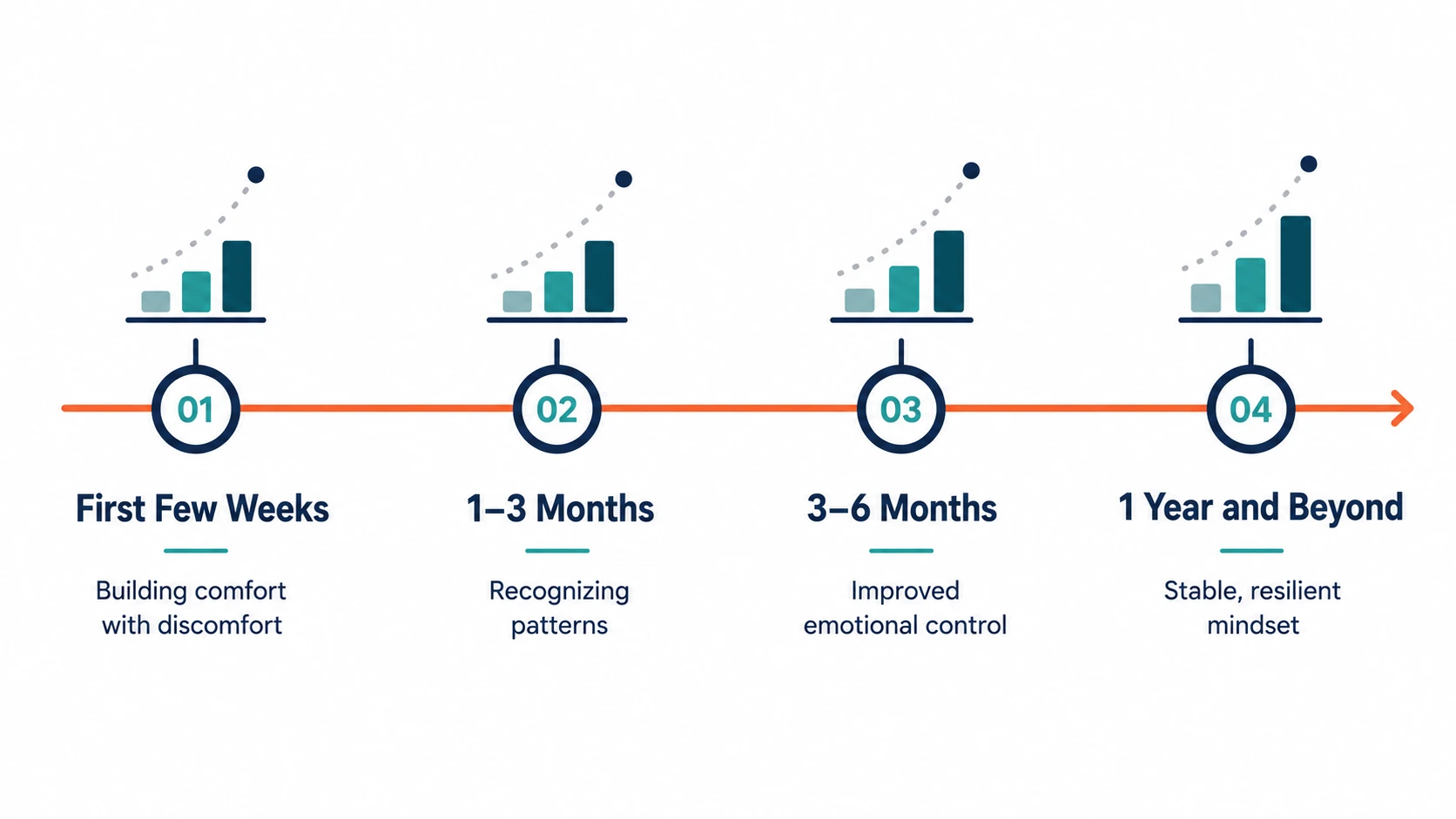
Mental improvement in jiu jitsu tends to follow a gradual pattern:
- First few weeks: Basic comfort with discomfort begins to form; early frustration is common
- 1–3 months: Practitioners start recognizing patterns in their own reactions to setbacks
- 3–6 months: Emotional control during rolls noticeably improves; plateaus become easier to tolerate
- 1 year and beyond: A stable, growth-oriented mindset becomes a consistent part of training identity
Results depend on training frequency, coaching quality, how consistently a practitioner reflects on sessions, and their existing mindset entering the sport. As of mid-2026, many coaches increasingly emphasize structured reflection — such as post-roll debriefs — as part of standard training, reflecting a broader shift toward treating mental training as seriously as technical drilling.
Practice Guide for Building a Strong Jiu Jitsu Mindset
Daily Practice
- Brief reflection on the previous session
- Gratitude for training opportunities and partners
- Short visualization of upcoming techniques or rolls
- Setting one specific learning goal for the day
Weekly Practice
- Reviewing recurring mistakes across the week
- Actively seeking feedback from coaches or higher belts
- Deliberately practicing uncomfortable or weak positions
Long-Term Sustainability
Avoiding burnout requires balancing training intensity with adequate recovery and respecting life responsibilities outside the gym. Maintaining motivation over years often depends on varying training goals — shifting focus between competition, technical refinement, and general fitness — rather than pursuing the same narrow goal indefinitely. Adapting goals over time, as life circumstances change, helps sustain long-term engagement with the sport.
Learning Resources That Can Support Your Jiu Jitsu Mindset
Practitioners looking to deepen their mental approach can draw on several categories of resources:
- Jiu jitsu mindset book titles focused on sports psychology, resilience, and mental performance offer structured frameworks for applying growth-mindset principles to training
- Jiu jitsu mindset podcast episodes featuring experienced practitioners and coaches provide real-world perspectives on handling plateaus, competition nerves, and long-term motivation
- Training journals and structured reflection methods help translate abstract mindset concepts into daily habits
- Direct coaching feedback and mentorship remain among the most effective ways to identify blind spots that self-reflection alone may miss
Your Daily Thrive recommends starting with one resource at a time and applying its concepts directly to weekly training rather than consuming material passively.
Conclusion
A strong jiu jitsu mindset is built through patience, consistent reflection, and a genuine commitment to learning over winning. Practitioners who adopt a growth mindset, prepare mentally for competition, and address common challenges like plateaus and performance anxiety tend to progress more steadily than those who focus on technique alone. Mental training is not separate from technical development — it is the foundation that makes long-term technical progress possible. The clearest takeaway: consistent mental habits, practiced daily and reviewed weekly, build the resilience needed to keep improving in Brazilian Jiu-Jitsu for years, not just weeks.
Frequently Asked Questions
What is a jiu jitsu mindset?
A jiu jitsu mindset is the combination of mental habits — including patience, adaptability, emotional control, and continuous learning — that allows a practitioner to improve steadily in Brazilian Jiu-Jitsu over time.
Why is mindset important in Brazilian Jiu-Jitsu?
Mindset is important because technical mastery in BJJ takes years to develop, and mental resilience determines whether a practitioner stays consistent long enough for that development to occur.
How does a growth mindset improve jiu jitsu performance?
A growth mindset improves performance by encouraging practitioners to treat mistakes and losses as learning opportunities, which speeds up technical adaptation and reduces fear of challenging training partners.
How can I develop a better jiu jitsu competition mindset?
A better competition mindset develops through consistent pre-competition routines, visualization, breathing exercises, and reviewing past performances objectively rather than emotionally.
What are the biggest mental mistakes beginners make in jiu jitsu?
Common mistakes include expecting rapid progress, avoiding tougher training partners, measuring success only through submissions, and quitting after early setbacks instead of treating them as normal.
How long does it take to develop a strong jiu jitsu mindset?
Most practitioners notice meaningful improvements in emotional control and consistency within three to six months of regular training, with a stable, resilient mindset typically forming over a year or more.
Can mental training improve my performance even if my technique is still developing?
Yes. Mental training improves focus, decision-making, and emotional control during rolls, all of which help practitioners absorb and apply technique more effectively, even at earlier stages of technical development.