
Introduction
A mindset is the set of beliefs, attitudes, and thought patterns that shape how a person interprets challenges, makes decisions, and responds to setbacks. It influences learning, confidence, relationships, and long-term success. The best books for mindset change combine psychology, behavioral science, and practical exercises to help readers replace limiting beliefs with more constructive thinking patterns. Rather than offering a simple ranked list, this guide explains what makes a mindset book effective, matches recommendations to specific goals, and outlines how to turn reading into lasting behavioral change.
Quick Summary
- Mindset books help readers develop healthier thinking patterns, stronger resilience, and better decision-making.
- Different books focus on different goals, including personal growth, psychology, success, business, and studying.
- The best mindset book depends on individual goals, learning style, and current challenges.
- Combining reading with consistent practice produces stronger long-term mindset changes.
What Is a Mindset and Why Does It Matter?
Definition of Mindset
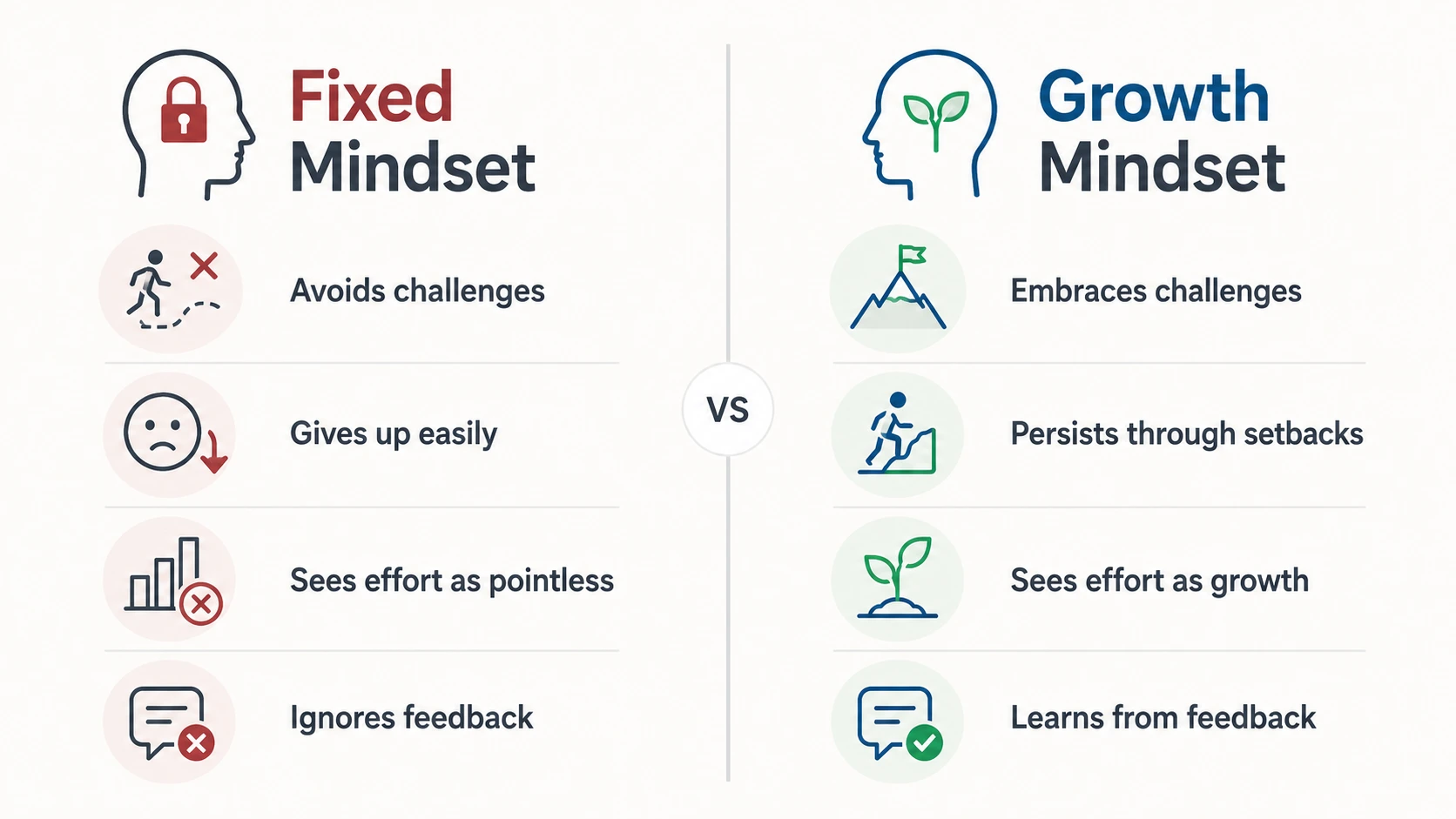
A mindset is a mental framework made up of beliefs, habits, attitudes, and cognitive patterns that determine how a person perceives and responds to life. Psychologist Carol Dweck’s research popularized the distinction between a fixed mindset, the belief that abilities are static, and a growth mindset, the belief that abilities can be developed through effort and learning. This distinction forms the psychological foundation for most mindset-focused books. Understanding this distinction matters because it directly shapes motivation and resilience — for a deeper look, see why is growth mindset important.
How Mindset Influences Everyday Life
Mindset shapes outcomes across nearly every area of life, including:
- Learning — willingness to embrace difficulty and persist through mistakes
- Confidence — self-perception and belief in one’s own capability
- Career — resilience in the face of setbacks and openness to feedback
- Relationships — communication patterns and conflict response
- Health — motivation to sustain healthy habits
- Financial decisions — risk tolerance and long-term planning
- Problem solving — flexibility versus rigidity in approach
Can Books Actually Change Your Mindset?
Books can support mindset change when their ideas are reinforced through repetition and practical application. This process draws on neuroplasticity, the brain’s ability to form new neural pathways through repeated thought and behavior. Books on how to change your mindset work best when paired with habit formation, cognitive restructuring, reflection, and consistent real-world application — not passive reading alone. This process ties closely into broader cognitive strategies — see our guide on how to change your thoughts for techniques that complement what you’ll learn from these books.
What Makes a Great Mindset Book?
Characteristics of Effective Mindset Books
The best mindset book shares several defining qualities:
- Research-backed psychological or behavioral concepts
- Practical exercises rather than abstract theory alone
- Actionable frameworks readers can apply immediately
- Real-life examples that illustrate core ideas
- Clear, accessible explanations
- Long-term applicability beyond a single read-through
Choosing the Right Book for Your Goals
Not every mindset book suits every reader. The best book for mindset depends on the specific outcome being pursued:
- Confidence — books focused on self-belief and identity
- Success — books on goal-setting and achievement psychology
- Business — books on leadership and strategic thinking
- Productivity — books on habits and consistency
- Learning — books on growth mindset and adaptability
- Emotional resilience — books on psychology and self-regulation
Best Books for Mindset Change (Core Book Recommendations)
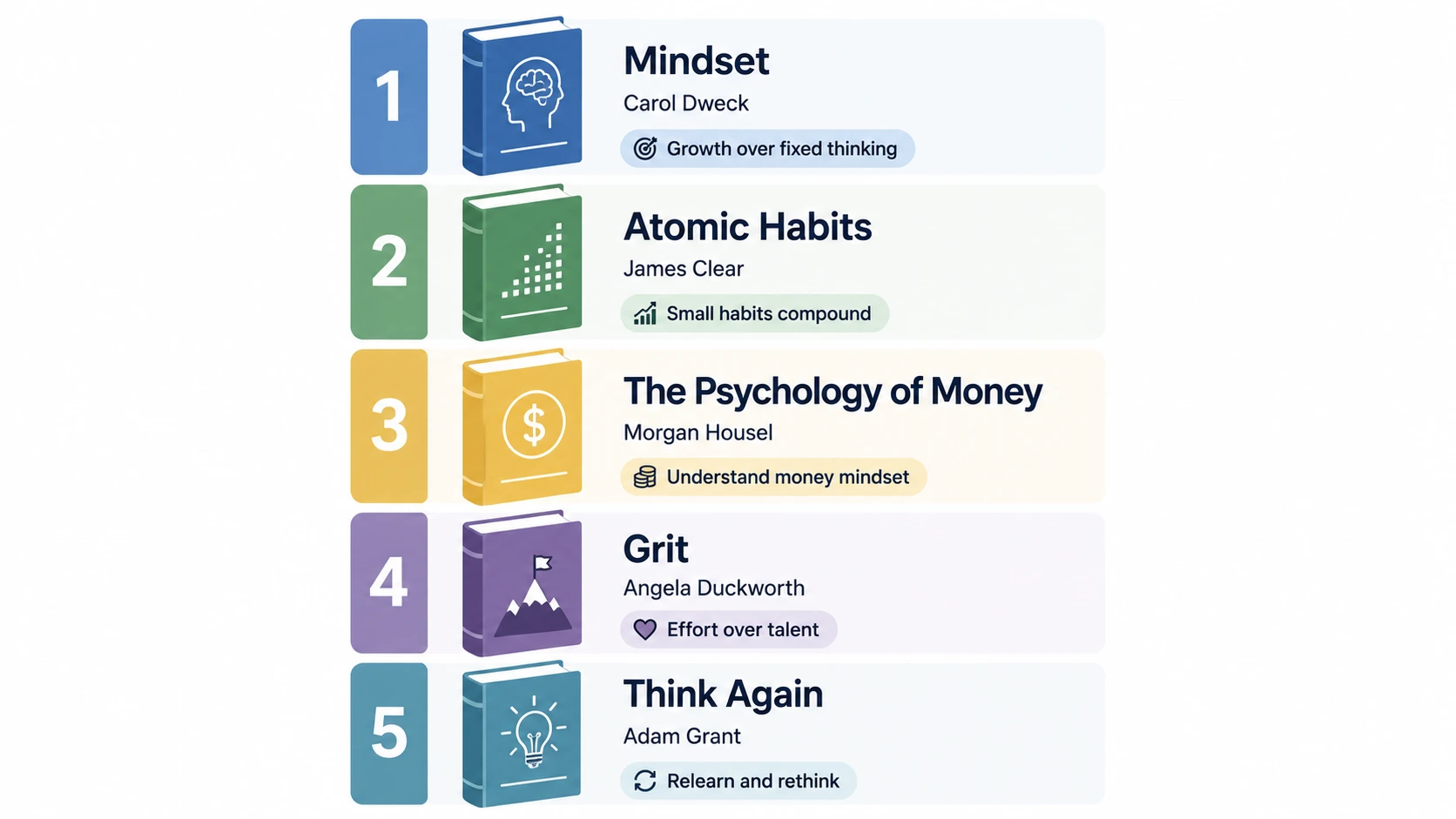
The following books are widely recognized among the best books for mindset change, each offering a distinct angle on how thinking patterns shape behavior.
- Mindset by Carol Dweck — Introduces the fixed vs. growth mindset framework. Best suited for readers seeking a foundational understanding of how beliefs about ability affect performance. Key takeaway: effort and strategy, not innate talent, drive long-term growth.
- Atomic Habits by James Clear — Explains how small, consistent habits compound into significant change. Best for readers who want practical systems for behavior change. Key takeaway: identity-based habits are more sustainable than outcome-based goals.
- The Psychology of Money by Morgan Housel — Explores how mindset and emotion, not just math, drive financial decisions. Best for readers working on financial mindset. Key takeaway: behavior matters more than intelligence in building wealth.
- The Mountain Is You by Brianna Wiest — Focuses on self-sabotage and emotional resilience. Best for readers working through internal barriers to growth. Key takeaway: self-awareness is the first step toward lasting change.
- The Power of Now by Eckhart Tolle — Centers on present-moment awareness and reducing overthinking. Best for readers seeking mental clarity. Key takeaway: reducing rumination improves emotional regulation.
- Grit by Angela Duckworth — Examines perseverance and passion as predictors of success. Best for readers pursuing long-term goals. Key takeaway: sustained effort often outweighs raw talent.
- The 7 Habits of Highly Effective People by Stephen Covey — Offers a principle-centered framework for personal and professional effectiveness. Best for readers seeking structured self-improvement. Key takeaway: proactive behavior and clear priorities drive results.
- Think Again by Adam Grant — Explores the value of rethinking beliefs and intellectual humility. Best for readers who want to challenge fixed assumptions. Key takeaway: the willingness to update beliefs is a strength, not a weakness.
- The Four Agreements by Don Miguel Ruiz — Presents a code of personal conduct rooted in self-respect and clear communication. Best for readers focused on emotional and relational mindset shifts. Key takeaway: personal freedom often begins with changing internal agreements.
- Can’t Hurt Me by David Goggins — Details overcoming extreme adversity through mental toughness. Best for readers seeking motivation to push past self-imposed limits. Key takeaway: discomfort tolerance can be deliberately trained.
Psychology Books That Help Change Your Mindset
Psychology Principles Behind Mindset Change
Mindset change is grounded in several psychological concepts:
- Cognitive biases — mental shortcuts that distort perception and decision-making
- Self-beliefs — internalized narratives about one’s own capability
- Motivation — the psychological drivers behind sustained effort
- Emotional regulation — the ability to manage internal responses to stress
- Behavioral psychology — the study of how reinforcement shapes habits
Recommended Psychology-Based Books
Among the strongest psychology best books for mindset change are Dweck’s Mindset, which grounds mindset theory in decades of research, and Housel’s The Psychology of Money, which applies behavioral psychology to decision-making. These titles prioritize evidence over motivation, making them well-suited for readers who want a research-based approach to change.
Best Books on Mindset and Success
How Mindset Contributes to Success
Success is closely tied to psychological factors such as goal clarity, consistency, resilience, sound decision-making, and delayed gratification. A success-oriented mindset treats setbacks as feedback rather than failure, which sustains motivation over time.
Recommended Success-Focused Mindset Books
For readers focused on books on mindset and success, Grit and The 7 Habits of Highly Effective People offer frameworks directly tied to career growth, entrepreneurship, and leadership. Both emphasize consistency and principle-driven decision-making over short-term motivation.
Growth Mindset Books Worth Reading
What Is a Growth Mindset?
A growth mindset is the belief that skills and intelligence can be developed through effort, strategy, and feedback. It contrasts with a fixed mindset, which assumes ability is static. Related concepts include a learning mindset, which prioritizes curiosity, and adaptability, the capacity to adjust approach based on new information.
Best Growth Mindset Books
- Students benefit most from Mindset, which directly addresses academic self-belief.
- Adults often find Think Again useful for reassessing long-held assumptions.
- Parents can apply Mindset to encourage effort-based praise in children.
- Professionals benefit from Atomic Habits for building sustainable growth-oriented routines.
Mindset Books for Business and Leadership
Why Entrepreneurs Benefit From Mindset Books
Entrepreneurs face constant uncertainty, making mindset a critical factor in long-term success. Mindset books support entrepreneurs by strengthening risk tolerance, leadership capability, innovative thinking, decision-making under pressure, and long-term strategic focus.
Recommended Business Mindset Books
For mindset books for business, The Psychology of Money strengthens wealth psychology and long-term financial thinking, while The 7 Habits of Highly Effective People provides a structured approach to leadership and strategic planning. Think Again supports innovation by encouraging leaders to question outdated assumptions.
Books That Help Students Develop a Better Mindset
How Mindset Affects Studying
A student’s mindset directly affects motivation, focus, exam anxiety, confidence, and the learning strategies they choose. Students with a growth mindset are more likely to view difficult material as a challenge rather than a threat.
Recommended Books for Students
For readers exploring how to change your mindset to study, Mindset by Carol Dweck remains the most directly applicable, since it was developed largely from research on students and learning. Grit also offers useful insight into sustaining long-term academic effort.
How to Apply Lessons From Mindset Books in Daily Life
Turning Reading Into Lasting Change
Reading alone rarely produces lasting mindset change. Practical implementation methods include:
- Reflection — reviewing key ideas after each reading session
- Journaling — recording thoughts, triggers, and progress
- Habit stacking — attaching new mindset practices to existing routines
- Goal tracking — measuring progress toward specific outcomes
- Self-assessment — periodically reviewing current thought patterns
- Accountability — sharing goals with others for consistency If you’re not sure where to start, these journaling prompts for self growth pair well with the reflection habit described above.
Creating a Personal Mindset Improvement Plan
In our experience helping readers build better habits, a simple improvement plan works best: select one book aligned with a specific goal, identify one core concept per week, apply it through a small daily action, and track progress through brief written reflection. This structured, incremental approach tends to outperform reading multiple books without implementation.
Comparison: Different Types of Mindset Books
| Category | Primary Focus | Best For | Typical Outcome |
|---|---|---|---|
| Psychology | Thinking patterns | Self-awareness | Better decisions |
| Success | Achievement | Professionals | Goal attainment |
| Habits | Daily routines | Beginners | Consistency |
| Business | Leadership | Entrepreneurs | Strategic thinking |
| Personal Growth | Self-improvement | General readers | Confidence |
Which Mindset Book Is Right for You?
| Reader Goal | Recommended Book Type |
|---|---|
| Confidence | The Mountain Is You, The Four Agreements |
| Career Growth | The 7 Habits of Highly Effective People |
| Business | The Psychology of Money, Think Again |
| Studying | Mindset by Carol Dweck |
| Productivity | Atomic Habits |
| Resilience | Grit, Can’t Hurt Me |
| Personal Growth | The Power of Now |
Common Mistakes When Trying to Change Your Mindset
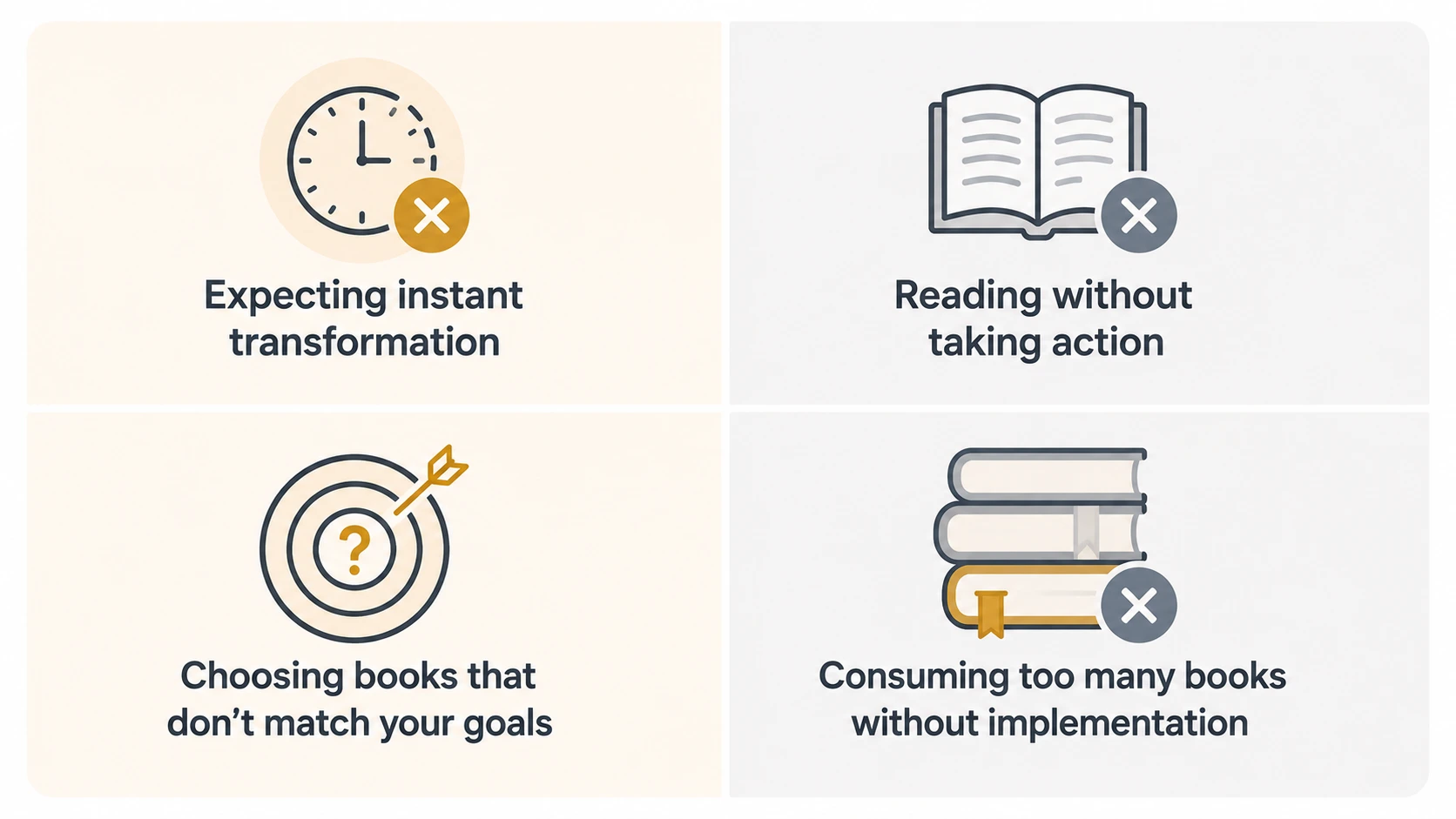
Expecting Instant Transformation
Mindset change is gradual and relies on repeated practice, not a single reading session. Readers who expect immediate results often abandon the process prematurely.
Reading Without Taking Action
Passive reading builds knowledge but not behavior. Without deliberate application, insights from mindset books rarely translate into lasting change.
Choosing Books That Don’t Match Personal Goals
Selecting a book based on popularity rather than personal relevance often leads to disengagement. Matching book selection to a specific goal improves both motivation and outcomes.
Consuming Too Many Books Without Implementation
Reading multiple mindset books in quick succession can create information overload. Your Daily Thrive recommends fully implementing lessons from one book before starting another.
Beginner Tips for Getting the Most From Mindset Books
- Read slowly and reflect on each section before moving forward
- Take notes on concepts that feel personally relevant
- Highlight key ideas for future reference
- Practice one concept at a time rather than attempting several simultaneously
- Revisit favorite chapters periodically to reinforce learning
- Discuss ideas with others to deepen understanding and accountability
How Long Does It Take to Change Your Mindset?
Mindset change is typically gradual because it requires forming new neural pathways and replacing established thought patterns. Several factors affect the pace of progress, including consistency of practice, the complexity of the belief being changed, and individual differences in learning style. Research on habit formation suggests that new behavioral patterns commonly take several weeks to months of consistent repetition to feel automatic, though timelines vary significantly between individuals.
Practical Weekly Routine for Mindset Development
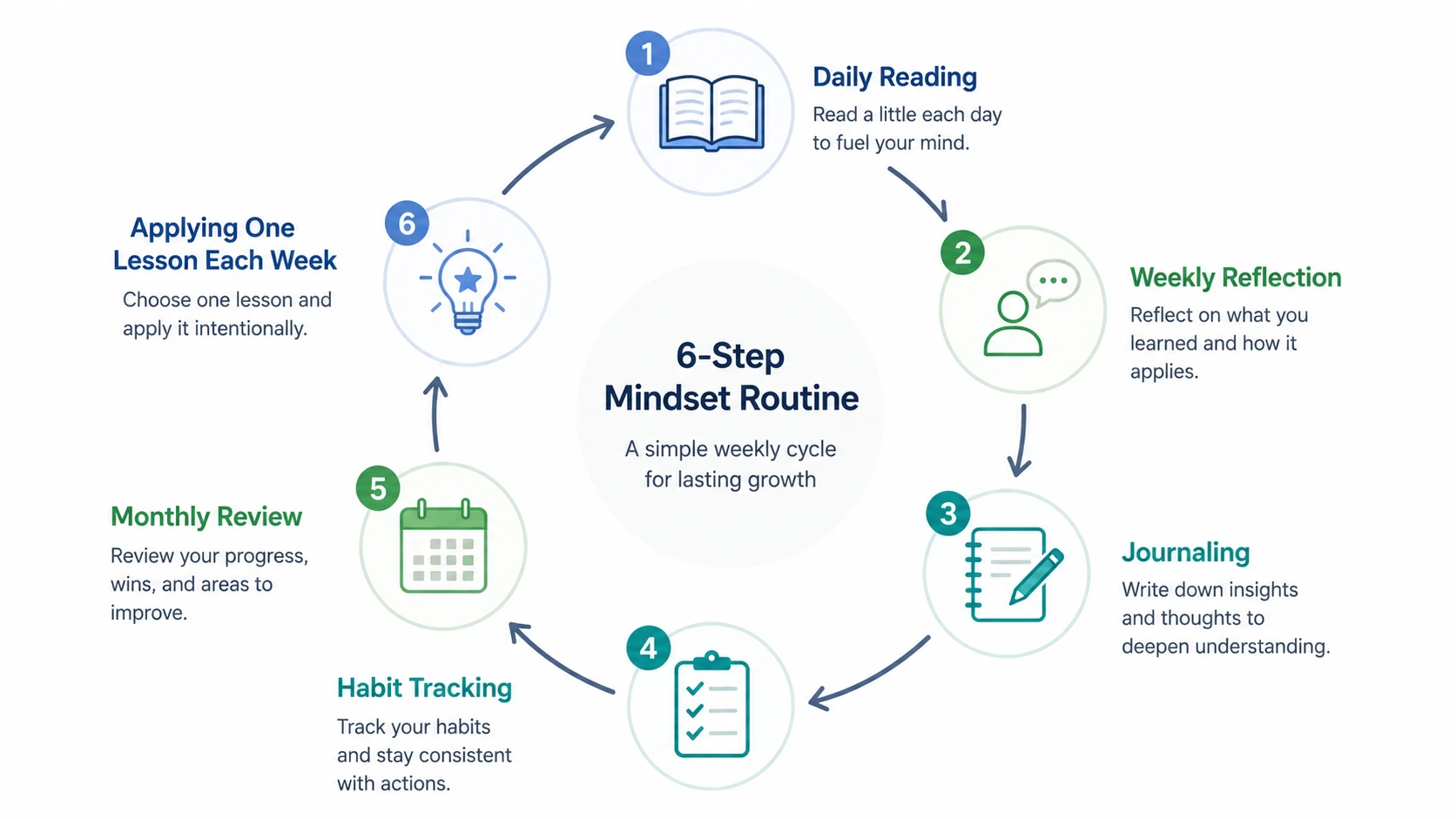
A simple, sustainable weekly routine supports long-term mindset change:
- Daily reading — 15–20 minutes focused on one book
- Weekly reflection — reviewing key takeaways from the week’s reading
- Journaling — recording personal insights and challenges
- Habit tracking — monitoring consistency of applied practices
- Monthly review — assessing overall progress and adjusting focus
- Applying one lesson each week — translating a single concept into action
As of 2026, many self-improvement practitioners emphasize combining reading with structured tracking tools, reflecting a broader shift toward measurable, habit-based approaches to personal growth rather than passive consumption of self-help content.
Conclusion
Mindset books offer valuable frameworks for understanding how beliefs, habits, and thought patterns shape everyday decisions and long-term outcomes. The best books for mindset change are not defined by popularity alone but by how well they align with a reader’s specific goals, whether that involves confidence, career growth, business leadership, or academic performance. Lasting change comes from combining focused reading with reflection, practice, and consistent application — not from reading volume alone. Readers who choose one relevant book, apply its lessons deliberately, and track their progress over time are best positioned for sustainable mindset development.
Frequently Asked Questions
What is the best book for mindset change?
Mindset by Carol Dweck is widely regarded as the most foundational book for mindset change, since it introduces the research-backed distinction between fixed and growth mindsets that underlies most modern self-improvement literature.
Which mindset book is best for beginners?
Atomic Habits by James Clear is well-suited for beginners because it offers clear, practical steps for building new habits without requiring prior knowledge of psychology or behavioral science.
Are psychology books better than motivational books for changing mindset?
Psychology-based books tend to offer more evidence-based, long-lasting insight, while motivational books can provide short-term inspiration; combining both approaches often produces the most balanced results.
Which books help build a growth mindset?
Mindset by Carol Dweck directly addresses growth mindset development, while Think Again by Adam Grant supports it by encouraging readers to regularly reassess their beliefs.
How many mindset books should I read at one time?
Reading one mindset book at a time and fully implementing its lessons before starting another typically produces better results than reading multiple books simultaneously.
Can reading books really change the way you think?
Yes, when reading is combined with reflection, repetition, and practical application, it can support genuine mindset change by reinforcing new thought patterns over time.
Which mindset books are best for business professionals?
The Psychology of Money, The 7 Habits of Highly Effective People, and Think Again are particularly useful for business professionals focused on leadership, financial decision-making, and strategic thinking.
How can students use mindset books to improve learning?
Students can use mindset books like Mindset by Carol Dweck to reframe academic setbacks as learning opportunities, which supports greater motivation, resilience, and long-term academic performance.