

Introduction
Growth mindset prompts are guided questions or writing exercises that encourage reflection, resilience, and continuous learning from everyday challenges. Rooted in the psychological concept of a growth mindset, these prompts help people move past fixed thinking patterns and build habits of self-awareness through consistent journaling. By pairing structured reflection with regular practice, growth mindset prompts make it easier to recognize limiting beliefs, process emotions, and turn setbacks into learning opportunities. This guide explains what growth mindset prompts are, why they work, and how to use them effectively for self-growth, self-discovery, and self-love.
Quick Summary
- Growth mindset prompts encourage reflective thinking that strengthens resilience and lifelong learning.
- Regular journaling can improve self-awareness, confidence, emotional regulation, and problem-solving.
- Different prompts serve different purposes, including self-growth, healing, self-love, and academic development.
- Consistency matters more than writing length, making journaling accessible for beginners.
What Are Growth Mindset Prompts?
Growth mindset prompts are structured journal questions designed to shift attention away from perfection and toward learning. Unlike general journaling writing prompts, which may simply ask someone to describe their day or feelings, growth mindset writing prompts are intentionally built around effort, progress, and lessons learned from setbacks.
The core purpose of these prompts for journal writing is to interrupt automatic, fixed-mindset thinking — such as “I’m not good at this” — and replace it with process-oriented thinking, such as “What can I learn from this attempt?” This distinction matters because it changes how a person interprets difficulty: as a threat to their identity, or as useful information for growth.
How Growth Mindset Prompts Encourage Learning
Growth mindset prompts support learning through several interconnected mechanisms:
- Reflection: Slowing down to examine a situation rather than reacting to it immediately.
- Self-awareness: Noticing recurring thought patterns, emotional triggers, and behaviors.
- Identifying limiting beliefs: Naming the assumptions (“I always fail at this”) that quietly shape decisions.
- Learning from mistakes: Reframing errors as data rather than evidence of personal inadequacy.
- Developing resilience: Building the mental flexibility to recover from setbacks more quickly over time.
Why Reflection Supports Personal Growth
Reflection works because it creates a feedback loop between experiences, thoughts, emotions, habits, and future behavior. An experience triggers a thought, which produces an emotion, which shapes a habitual response. Without reflection, this loop repeats automatically. Journaling interrupts the cycle by making each link visible, so a person can consciously choose a different response the next time a similar experience arises. Over time, this awareness becomes the foundation for lasting behavioral change.
The Science Behind a Growth Mindset
The concept of a growth mindset originates from behavioral science research contrasting two broad belief systems about ability: the idea that skills are fixed traits versus the idea that skills can be developed through effort and strategy. Growth mindset prompts are built on this foundation, using guided questions to reinforce the belief that abilities are trainable rather than static. .contrasting two broad belief systems about ability — work popularized by psychologist Carol Dweck, whose growth mindset quotes are still widely referenced today.
Fixed Mindset vs. Growth Mindset
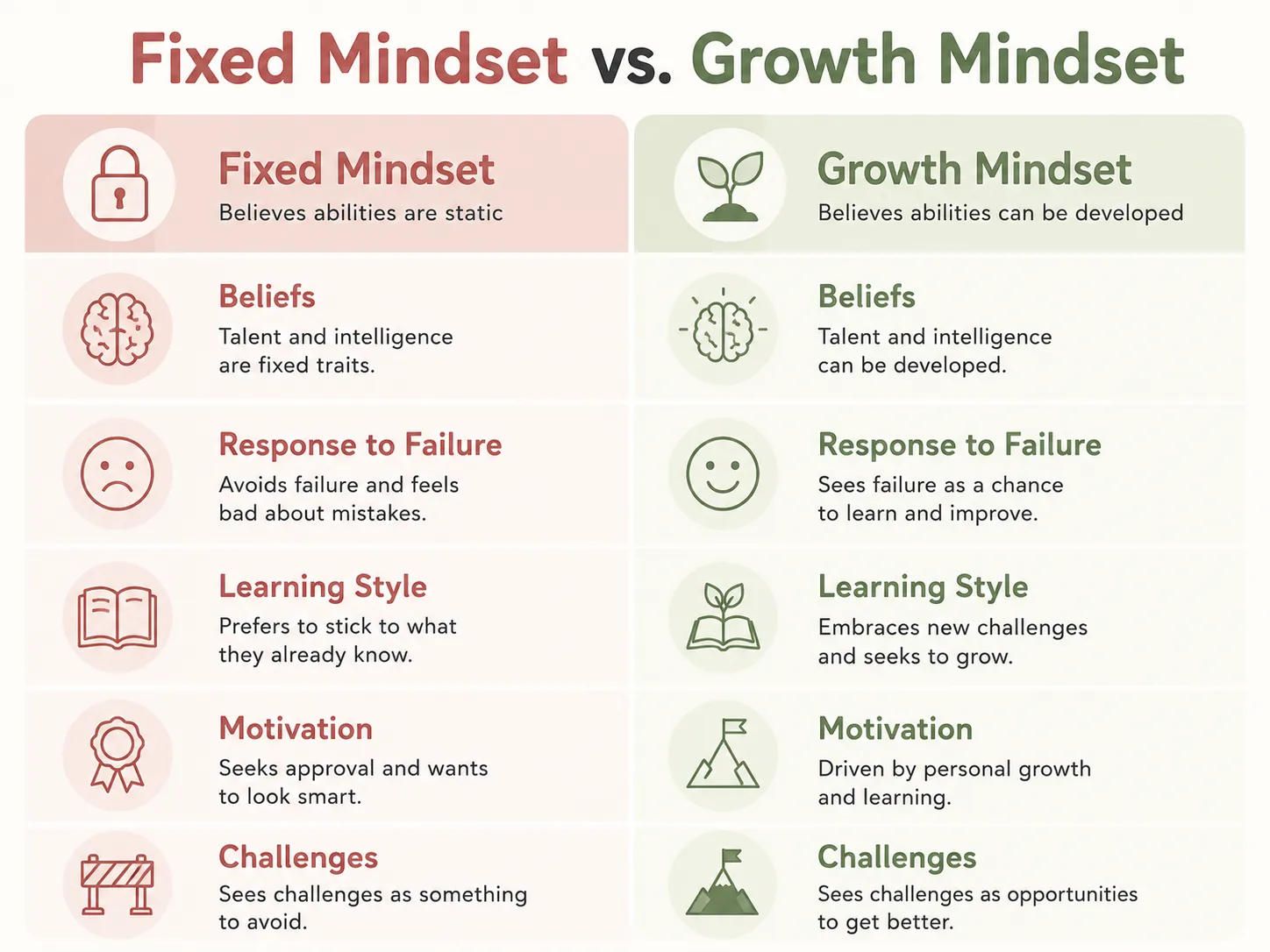
Understanding the difference between these two mindsets clarifies why growth mindset prompts are structured the way they are.
| Factor | Fixed Mindset | Growth Mindset |
|---|---|---|
| Beliefs | Abilities are static and unchangeable | Abilities can be developed through effort |
| Response to failure | Avoids failure; sees it as identity threat | Views failure as feedback for improvement |
| Learning style | Prefers tasks that confirm existing skill | Seeks challenges that build new skill |
| Motivation | Driven by proving competence | Driven by mastery and progress |
| Challenges | Avoided to prevent looking incapable | Embraced as growth opportunities |
| Long-term outcomes | Plateaued skill development | Continuous improvement over time |
Why Writing Reinforces Mindset Changes
Writing supports mindset change through several documented processes:
- Self-reflection: Putting thoughts into words slows down automatic reactions and encourages deeper analysis.
- Cognitive restructuring: Journaling makes it easier to identify distorted thinking patterns and reframe them more realistically.
- Emotional processing: Writing about difficult experiences helps regulate the emotional intensity attached to them.
- Habit reinforcement: Repeated writing routines strengthen new thought patterns through consistent practice, similar to how any skill improves with repetition.
Benefits of Using Growth Mindset Prompts Regularly
Consistent use of growth mindset prompts is associated with a range of practical, everyday benefits:
- Improved confidence in handling unfamiliar or difficult situations
- Greater resilience when facing setbacks or criticism
- Stronger emotional intelligence and regulation
- Better decision-making through clearer self-understanding
- Increased motivation to pursue long-term goals
- Sharper problem-solving skills through structured reflection
- Healthier self-talk and reduced harsh self-judgment
- A stronger foundation for lifelong learning
In our experience helping readers build better habits, the biggest shift usually isn’t dramatic — it’s a gradual change in how someone talks to themselves after a mistake.
Different Types of Growth Mindset Prompts
Not all prompts serve the same purpose. Choosing the right category depends on what a person is trying to work through.
Self-Reflection Prompts
These prompts for journal writing focus on examining a specific experience, decision, or emotional reaction in detail. They typically ask what happened, how it felt, and what could be done differently next time.
Self-Growth Journal Prompts
Journal prompts for self growth and healing focus on long-term development — identifying patterns that no longer serve a person and replacing them with healthier habits. Many readers look for a journal prompts for self growth pdf to keep a structured list on hand for daily or weekly use.
Self-Discovery Prompts
Self-discovery prompts, such as those found in collections like 365 journal prompts for self-discovery, explore deeper questions of identity, values, purpose, and personal strengths. These prompts help people clarify who they are beyond external expectations. For a deeper dive, explore this full list of journal prompts for self discovery covering identity, values, purpose, and strengths.
Self-Love Journal Prompts
Journal prompts for self-love and journaling prompts for self love center on self-compassion, confidence, and acceptance. Journaling for self love often involves reframing harsh internal criticism into more supportive, realistic language.
Uplifting Writing Prompts
Uplifting writing prompts focus on gratitude, optimism, hope, and positive reframing. These are especially useful during difficult periods when motivation is low and a gentler entry point into journaling is needed.
Growth Mindset Writing Prompts by Purpose
Different life situations call for different prompt categories.
Prompts for Overcoming Failure
Example prompts: “What did this setback teach me that success couldn’t?” “What would I tell a friend going through this same situation?” These prompts aim to separate self-worth from outcomes.
Prompts for Building Confidence
Example prompts: “What is a recent challenge I handled better than I expected?” “What strengths have helped me before that I can use now?” These build a track record of evidence for self-trust.
Prompts for Learning New Skills
Example prompts: “What is one small step I can take today toward this skill?” “What mistake taught me the most this week?” These reinforce a process-based approach to skill-building.
Prompts for Setting Goals
Example prompts: “What does progress look like in the next 30 days?” “What obstacle is most likely to slow me down, and how will I respond?” These prompts connect goals to realistic action steps.
Prompts for Developing Resilience
Example prompts: “When have I recovered from something difficult before?” “What resources or people can support me through this?” These prompts strengthen a person’s sense of capability under stress.
Prompts for Gratitude and Positivity
Example prompts: “What is something small that went well today?” “Who or what am I grateful for right now, and why?” These prompts build a habit of noticing positive experiences that might otherwise go unrecognized.
Growth Mindset Writing Prompts for Students
Growth mindset writing prompts for students are widely used in classroom and home settings to help young people reframe academic challenges as learning opportunities rather than failures.
Elementary Students
Prompts focus on simple concepts like effort and trying again: “What did I get better at today?” “What is something hard that I want to practice more?”
Middle School Students
Prompts address early academic pressure and social comparison: “What mistake helped me learn something new this week?” “How did I handle a disagreement with a friend?”
High School Students
Prompts target exam stress, confidence, and study habits: “What study strategy worked best for me this week, and why?” “How did I respond when a grade wasn’t what I hoped for?”
College Students
Prompts address independence, workload management, and long-term goals: “What academic challenge taught me the most about myself this semester?” “How am I balancing short-term deadlines with long-term goals?”
Across all age groups, the goal is the same: treating mistakes as learning opportunities rather than evidence of fixed ability, and building confidence through consistent, low-pressure reflection.
How to Create Your Own Growth Mindset Prompts
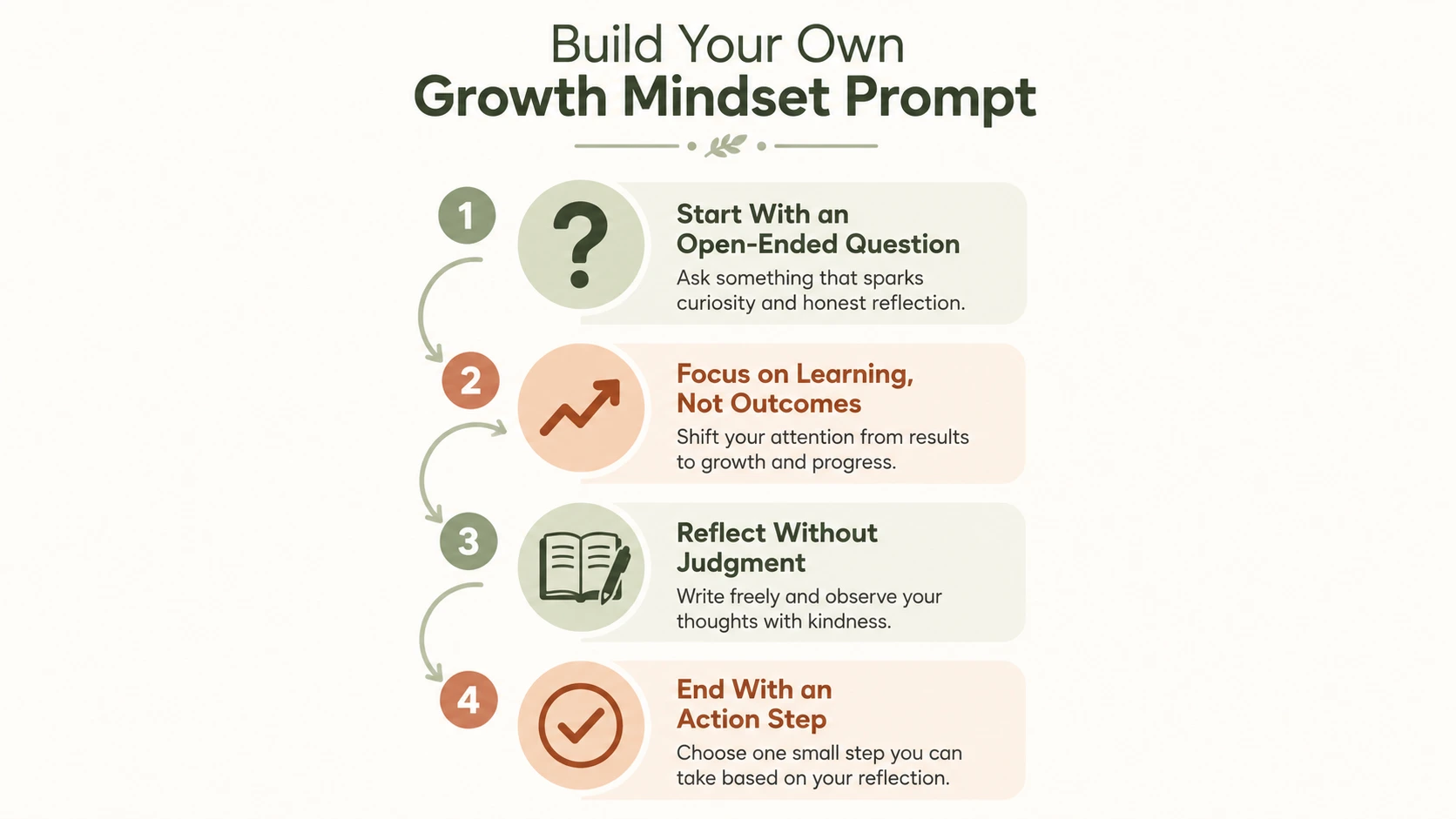
Writing personalized prompts is straightforward once the underlying framework is clear.
Start with Open-Ended Questions
Avoid yes/no questions. Use prompts that begin with “what,” “how,” or “why” to encourage deeper thinking.
Focus on Learning Instead of Outcomes
Frame questions around effort and process rather than success or failure alone.
Encourage Reflection Rather Than Judgment
Word prompts neutrally so they invite curiosity instead of self-criticism.
End with an Action Step
Close each prompt with a small, practical next step to translate insight into behavior.
A simple framework for building a prompt:
- Choose a recent experience or challenge.
- Ask an open-ended question about what happened.
- Ask what was learned from it.
- Ask what action could follow from that lesson.
Choosing the Right Journal Format

The format of a journal can affect how consistently someone uses growth mindset prompts.
Guided Journals
Pre-structured journals with built-in prompts remove the guesswork of what to write about each day.
Blank Journals
Open-format journals offer flexibility for people who prefer to choose their own prompts or write freely.
Printable Worksheets
Printable prompt sheets are useful for classroom settings, workshops, or people who prefer a low-tech, one-page format.
Digital Journals
Apps and digital journals offer convenience, searchability, and reminders, making them a practical option for people who journal on the go.
| Format | Best For | Advantages | Limitations |
|---|---|---|---|
| Guided Journals | Beginners who want structure | Removes decision fatigue; built-in prompts | Less flexibility for personal topics |
| Blank Journals | Experienced Journalers | Full creative freedom | Requires self-generated prompts |
| Printable Worksheets | Classrooms and workshops | Easy to distribute; low-tech | Not easily searchable or archived |
| Digital Journals | On-the-go journaling | Reminders, search, portability | Requires a device; less tactile |
How Often Should You Use Growth Mindset Prompts?
Consistency matters more than frequency or writing length. A short, regular entry is more effective than a long entry written sporadically.
- Daily journaling: A few minutes each day using a single prompt keeps reflection habitual and low-pressure.
- Weekly reflection: A longer session reviewing the week’s challenges and lessons works well for busy schedules.
- Monthly review: Looking back over multiple entries helps identify broader patterns and measure progress over time.
A practical schedule might involve a two-minute daily prompt on weekdays, paired with a 15-minute weekly reflection on weekends to review recurring themes.
Common Beginner Mistakes When Using Growth Mindset Prompts
Several patterns commonly interfere with the effectiveness of journaling for beginners.
Writing what sounds “correct”: This happens when someone writes what they think they should say rather than what they actually feel. It can be prevented by reminding yourself that the journal is private and unfiltered honesty is more useful than a polished response.
Judging yourself while writing: Self-criticism during journaling often stems from old fixed-mindset habits. It can be addressed by writing in a neutral, observational tone, as if describing someone else’s situation.
Expecting immediate transformation: This mistake happens when people compare journaling to a quick fix rather than a gradual process. Setting realistic expectations — weeks or months, not days — helps sustain motivation.
Skipping difficult questions: Avoidance is a natural response to uncomfortable prompts. Breaking a difficult question into smaller, more specific sub-questions makes it easier to approach.
Inconsistency: Irregular journaling often results from relying on motivation rather than routine. Anchoring journaling to an existing daily habit, such as morning coffee, helps build consistency.
Focusing only on positive experiences: Avoiding difficult topics limits the depth of self-awareness gained. Balancing prompts that address both challenges and successes leads to more complete reflection.
Practical Tips for Making Journaling a Sustainable Habit
- Create a routine: Journal at the same time each day to build automaticity.
- Use habit stacking: Attach journaling to an existing habit, such as brushing teeth or having morning tea.
- Reduce writing pressure: Short, imperfect entries are more sustainable than long, polished ones.
- Use reminders: Set a daily notification or keep the journal somewhere visible.
- Track progress: Note completed entries on a calendar or habit tracker to reinforce consistency.
- Review previous entries: Periodically reread past reflections to notice growth over time.
- Celebrate small improvements: Acknowledge progress, even minor shifts in perspective, to reinforce the habit.
Growth Mindset Prompts vs. General Journal Prompts
While both approaches involve writing, they differ in focus and intended outcome.
| Factor | Growth Mindset Prompts | General Journal Prompts |
|---|---|---|
| Primary goal | Build resilience and learning from challenges | Record thoughts, feelings, or daily events |
| Writing style | Structured, question-driven | Open-ended or free-form |
| Emotional focus | Processing setbacks constructively | Expressing emotions broadly |
| Learning focus | Strong emphasis on lessons and growth | Minimal or optional |
| Best use cases | Skill development, resilience building, goal setting | General emotional processing, memory-keeping |
Growth mindset prompts are best suited for people actively working on a specific challenge, skill, or habit change. General journal prompts work well for broader emotional expression or simply keeping a record of daily life.
Growth Mindset Statement Examples
Growth mindset statement examples are short, affirming phrases that reinforce process-oriented thinking. An effective growth mindset statement focuses on effort, learning, and progress rather than fixed traits or guaranteed outcomes. If you’d rather use short daily affirmations instead of full journal entries, this collection of growth mindset affirmations offers ready-to-use statements for the same purpose.
- For school: “I haven’t mastered this yet, but I’m improving with practice.”
- For work: “This project taught me a new skill I can apply next time.”
- For personal development: “Setbacks are information, not failure.”
- For relationships: “I can learn from this disagreement and communicate better next time.”
Difficulty & Time Investment
Growth mindset journaling is considered beginner-friendly and requires minimal equipment — just a notebook or app and a few uninterrupted minutes.
- Beginner difficulty: Low; no prior journaling experience needed.
- Average writing time: 5–15 minutes per session.
- Daily vs. weekly commitment: Either works; daily builds habit strength faster, while weekly suits busier schedules.
- Factors affecting consistency: Time availability, emotional readiness, and access to a quiet space.
- Adapting to different schedules: Shorter, single-question entries work well for busy periods, while longer reflective sessions suit weekends or slower weeks.
Results Timeline
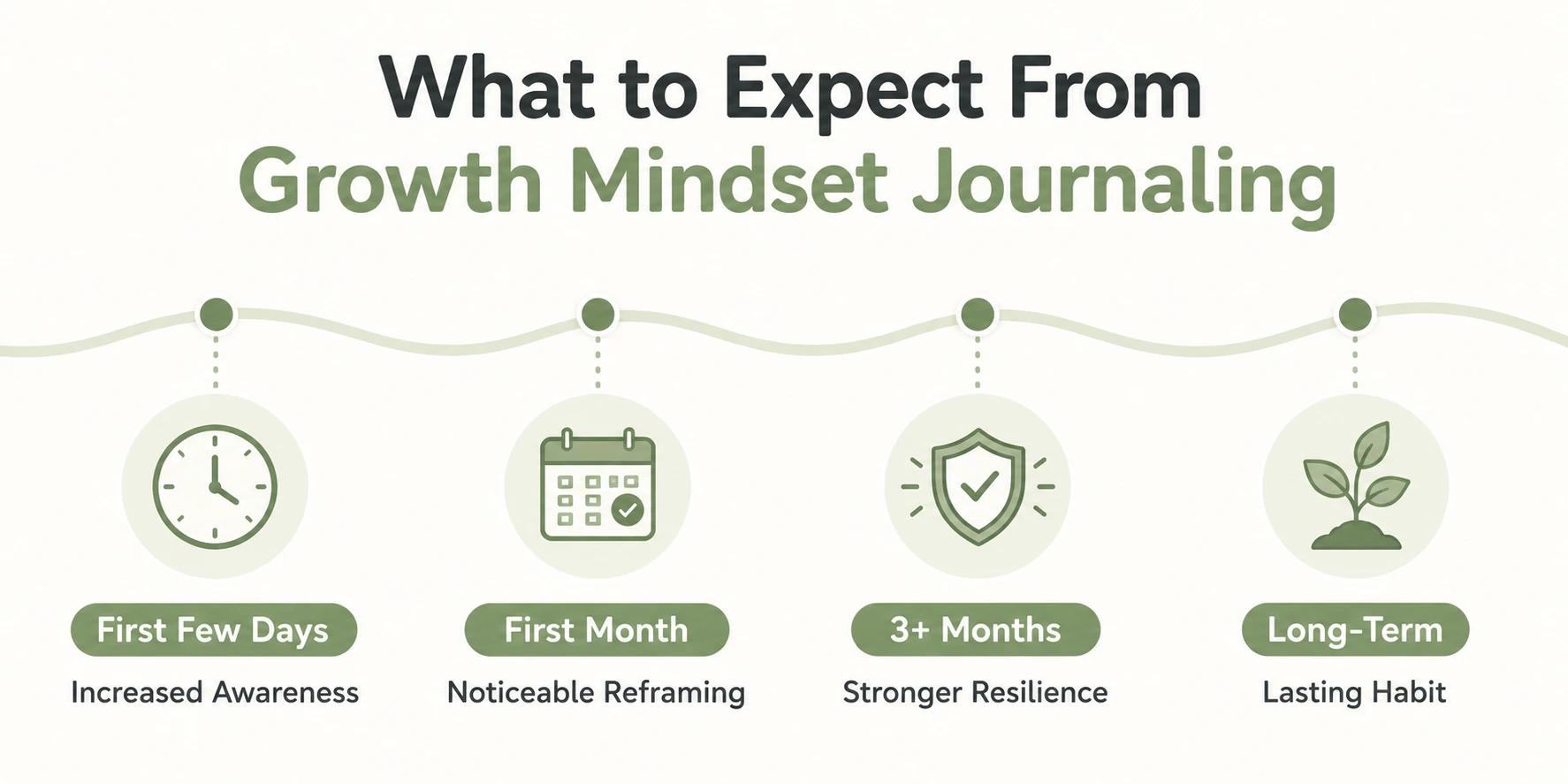
Progress from growth mindset journaling tends to follow a gradual, cumulative pattern rather than a sudden shift.
- First few days: Increased awareness of thought patterns; journaling may feel unfamiliar or effortful.
- First month: Noticeable improvement in recognizing limiting beliefs and reframing setbacks more constructively.
- Long-term habit formation: Sustained practice over several months often leads to measurable gains in resilience, confidence, and emotional regulation.
- Individual differences: Progress speed varies based on consistency, prior self-awareness, and the complexity of personal challenges being addressed.
- Factors influencing results: Regularity of practice, honesty in writing, and willingness to engage with difficult topics.
Practice Guide
Daily Routine
Use one short prompt each day, ideally at a consistent time, focusing on a single recent experience or lesson.
Weekly Reflection
Set aside 10–15 minutes to review the week’s entries, identify patterns, and note one key takeaway.
Monthly Review
Look back across a full month of entries to track recurring themes, measure progress, and adjust prompt focus as needed.
Tracking Personal Growth
Use a simple habit tracker or journal index to log entry dates and revisit earlier reflections for comparison.
Staying Motivated
Maintain accountability through a journaling partner, app reminders, or a visible habit tracker. Keep the routine flexible enough to adjust during busy or difficult periods, and celebrate consistency over perfection.
Frequently Asked Questions
What are growth mindset prompts?
Growth mindset prompts are guided journal questions designed to encourage reflection on effort, learning, and resilience rather than fixed ability or perfection.
How do growth mindset prompts improve personal development?
They improve personal development by building self-awareness, reframing setbacks as learning opportunities, and reinforcing process-oriented thinking through regular written reflection.
How often should I use growth mindset writing prompts?
Daily use for a few minutes builds habit strength quickly, while weekly reflection works well for people with limited time. Consistency matters more than frequency.
Are growth mindset prompts suitable for students?
Yes. Growth mindset writing prompts for students are commonly used from elementary through college levels to build confidence, reduce exam stress, and reframe academic setbacks as learning opportunities.
Can journaling improve confidence and resilience?
Yes. Regular reflective journaling helps people recognize patterns of success in overcoming past challenges, which reinforces confidence and strengthens resilience over time.
What’s the difference between self-growth and self-love journal prompts?
Self-growth prompts focus on identifying patterns and building new habits for development, while self-love prompts focus on self-compassion, confidence, and acceptance of oneself as they are.
Do growth mindset prompts work for adults as well as children?
Yes. While the specific prompts differ by age and life stage, the underlying framework of reflection, learning from setbacks, and building resilience applies to both adults and children.
Can digital journaling be as effective as paper journaling?
Yes. Both formats support reflection equally well; the more important factor is consistency of use rather than whether the journal is digital or paper-based.
Conclusion
Growth mindset prompts are structured journal questions that turn everyday challenges into opportunities for reflection and learning. By focusing on effort, process, and resilience rather than fixed ability, these prompts help readers recognize limiting beliefs, build self-awareness, and develop healthier thinking patterns over time. Whether the goal is self-growth, self-discovery, self-love, or academic development, choosing prompts that match specific goals — and using them consistently, even briefly — is what drives lasting change. Growth mindset prompts work best as an ongoing habit rather than a one-time exercise, so the most effective approach is simply to start small and stay consistent.