
Introduction
Lack of accountability in relationships refers to a pattern where one or both partners avoid taking responsibility for their actions, emotional impact, or repeated behaviors. Instead of acknowledging mistakes and working toward repair, they may shift blame, deny responsibility, or minimize harm.
Accountability is a foundation of trust, emotional safety, and long-term stability in relationships. When it is missing, communication becomes defensive, intimacy weakens, and unresolved conflict accumulates over time.
Avoiding responsibility also disrupts emotional connection and problem-solving. Over time, partners may feel unheard, emotionally unsafe, or disconnected.
Accountability is not an innate trait but a learned behavioral skill tied to emotional maturity, self-awareness, and regulation.
Quick Summary
- Lack of accountability in relationships happens when someone avoids responsibility for their actions or emotional impact.
- Signs include blame-shifting, defensiveness, broken promises, and refusal to acknowledge mistakes.
- Accountability strengthens trust, emotional safety, and long-term relationship stability.
- It requires emotional maturity, honesty, and consistent behavioral change.
What Does Accountability in Relationships Mean?
Accountability in relationships means taking ownership of your behavior, emotional reactions, and impact on your partner. It involves recognizing when harm has occurred and responding with responsibility instead of deflection.
It is not the same as guilt or punishment. Accountability focuses on repair and improvement, while guilt focuses on self-blame and emotional distress.
Emotional responsibility means understanding how your actions affect another person and choosing corrective behavior instead of avoidance.
Healthy Accountability vs Toxic Blame
Healthy accountability focuses on repair, while toxic blame focuses on shifting responsibility.
Healthy Accountability:
- Acknowledges mistakes clearly
- Focuses on repair
- Validates emotions
Toxic Blame:
- Deflects responsibility
- Uses excuses or accusations
- Invalidates emotions
Why Accountability Builds Trust
Accountability builds trust through consistency and reliability.
- Accountability → Reliability → Emotional Safety → Deeper Connection
When partners consistently own their actions, trust strengthens. When they avoid responsibility, trust weakens due to unpredictability.
Signs of Lack of Accountability in Relationships
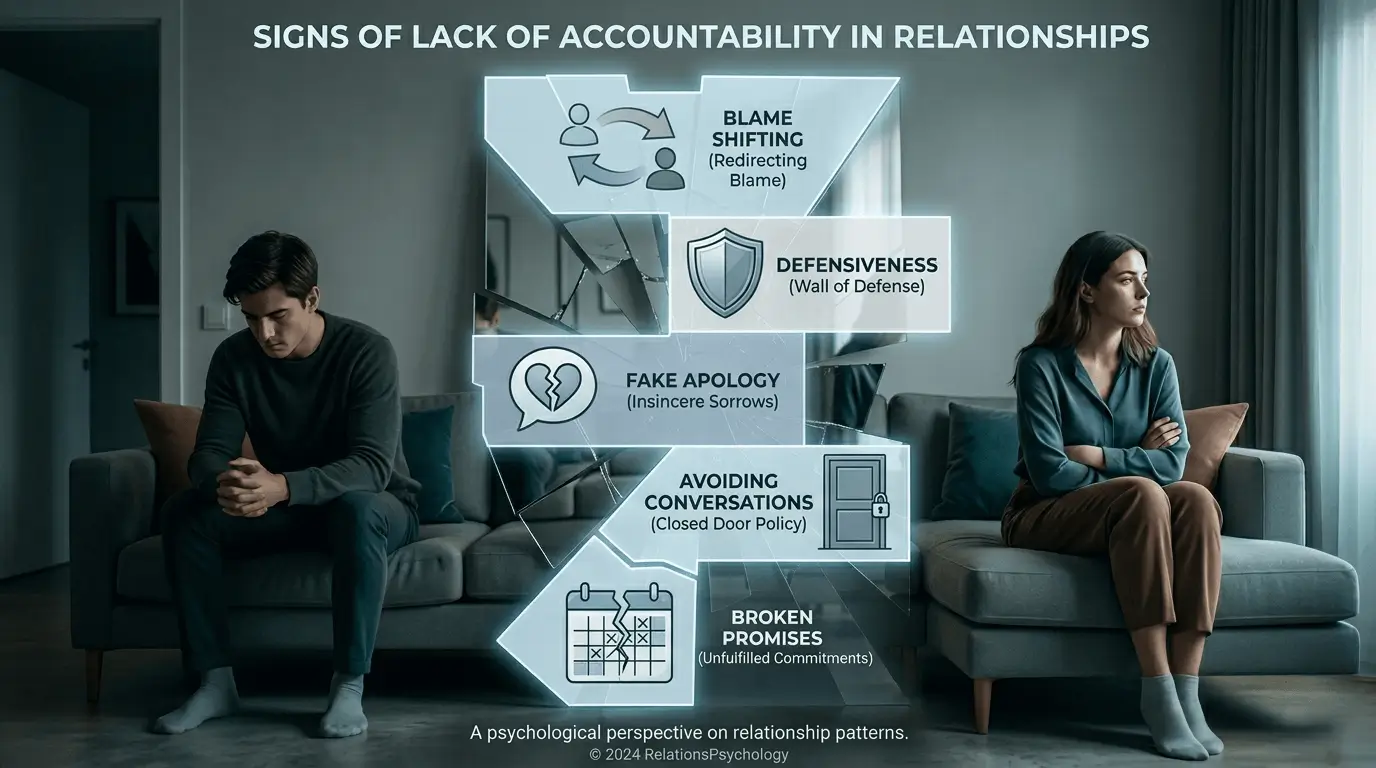
Lack of accountability appears through repeated behavioral patterns that damage communication and trust.
Common Signs
- Blaming others for personal actions
- Refusing to apologize sincerely
- Making repeated excuses
- Deflecting criticism
- Minimizing emotional harm
- Breaking promises without change
- Gaslighting or rewriting events
- Avoiding difficult conversations
- Playing the victim during conflict
- Repeating harmful behavior without improvement
Emotional Signs You Are Dealing With an Unaccountable Partner
- Walking on eggshells during conversations
- Feeling emotionally dismissed
- Confusion after arguments
- Emotional exhaustion
- Decreasing trust over time
Subtle Forms of Avoiding Accountability
- Passive avoidance of discussions
- Silent treatment after conflict
- Fake apologies
- Temporary change without consistency
- Weaponized incompetence
- Manipulative vulnerability
What Causes Lack of Accountability in Relationships?
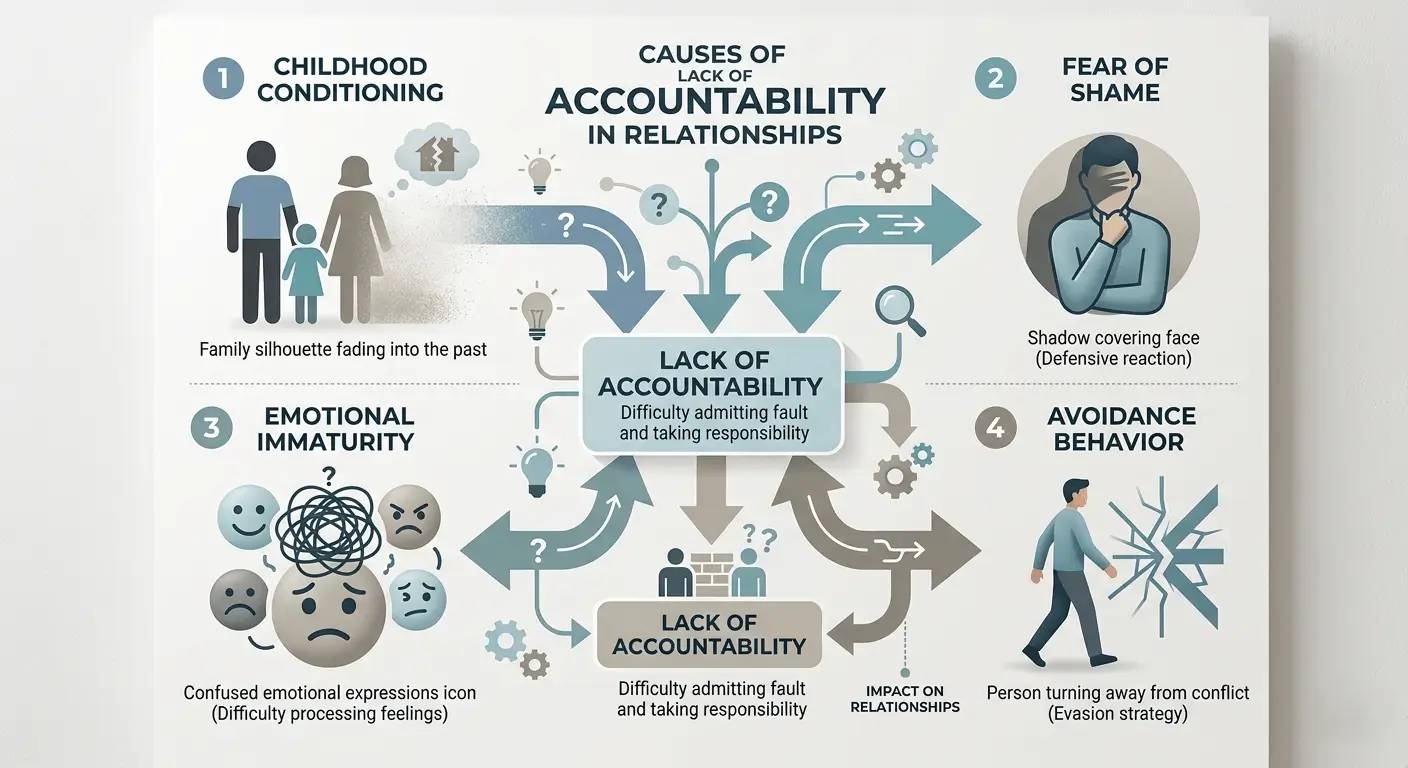
Lack of accountability is often shaped by psychological patterns, emotional development, and learned behavior.
Childhood Conditioning and Learned Behaviors
- Fear-based communication in childhood
- Lack of emotional role models
- Conditional love and approval systems
- Avoidance patterns learned in family environments
Fear of Failure, Shame, and Vulnerability
Some people avoid accountability to protect their self-image.
- Denial
- Projection
- Rationalization
These defense mechanisms reduce emotional discomfort but damage relationships.
These emotional patterns are often linked to deeper psychological avoidance behaviors and can also appear in conditions like emotional overwhelm or ADHD-related anxiety in daily life.
Emotional Immaturity and Low Self-Awareness
- Poor emotional regulation
- Impulsive reactions
- Avoidance of discomfort
- Limited awareness of emotional impact
Why Some People Repeat the Same Harmful Patterns
- Temporary guilt without change
- Comfort in familiar reactions
- Lack of consequences
- Enabling relationship dynamics
How Lack of Accountability Damages Relationships
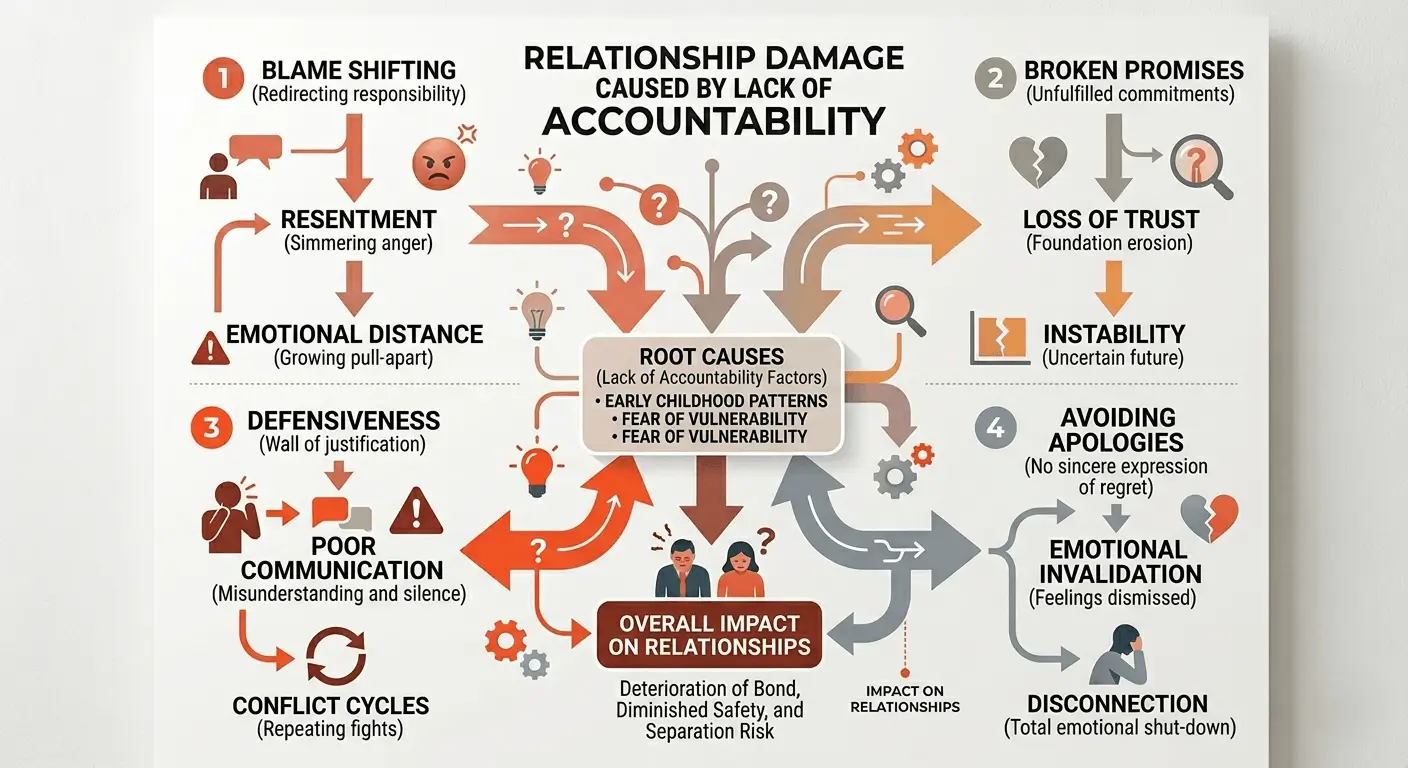
Lack of accountability gradually weakens emotional connection, trust, and communication.
| Behavior | Emotional Impact | Outcome |
|---|---|---|
| Blame shifting | Resentment | Emotional distance |
| Broken promises | Loss of trust | Instability |
| Defensiveness | Poor communication | Frequent conflict |
| Avoiding apologies | Emotional invalidation | Reduced intimacy |
| Repeated excuses | Frustration | Relationship burnout |
The Connection Between Accountability and Emotional Safety
Emotional safety depends on consistency and predictability. Without accountability, partners may experience:
- Anxiety
- Hypervigilance
- Emotional withdrawal
Why Relationships Fail Without Accountability
- Unresolved conflict accumulation
- Emotional disconnection
- Communication breakdown
- Resentment cycles
- Lack of growth
How to Take Accountability in a Relationship
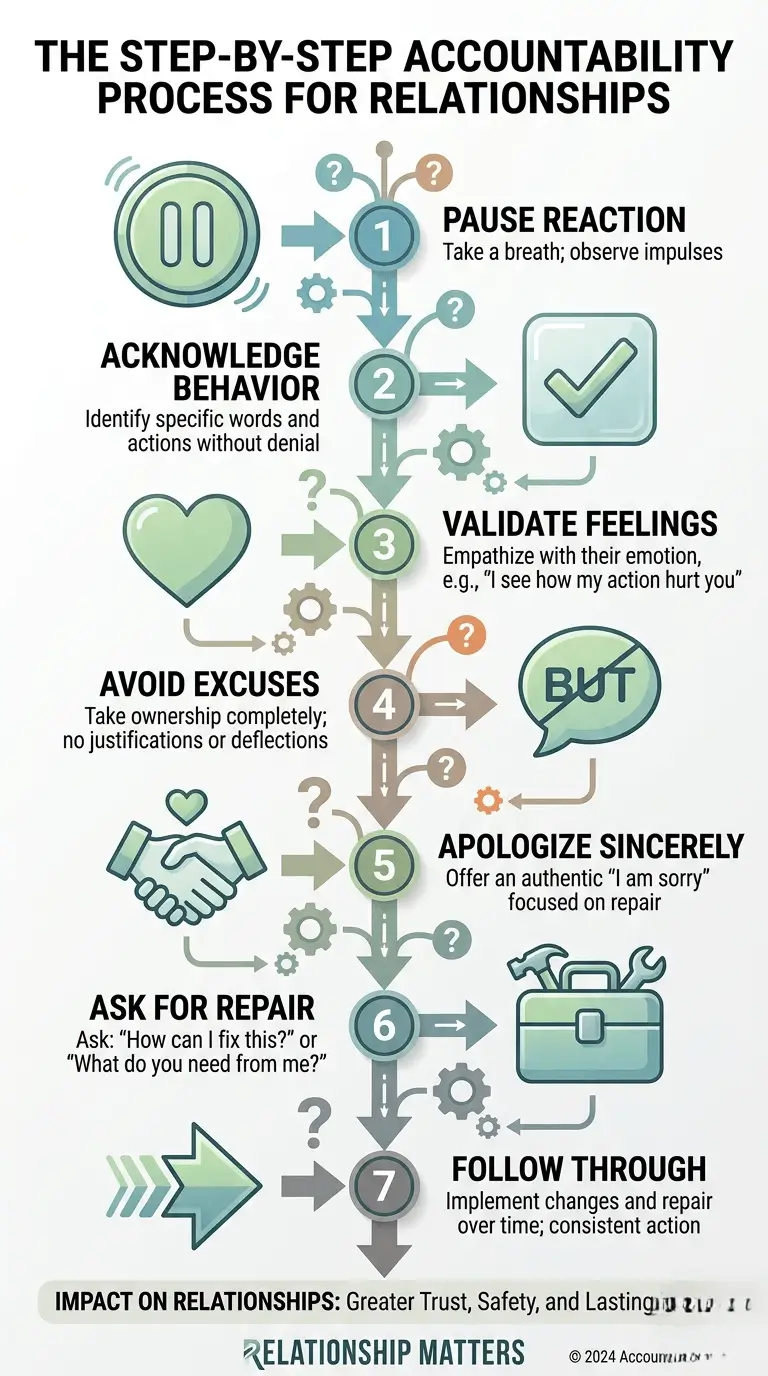
Taking accountability requires emotional awareness and consistent behavioral change.
- Pause before reacting defensively
- Acknowledge specific behavior
- Validate the other person’s feelings
- Avoid excuses
- Apologize sincerely
- Ask for repair expectations
- Follow through with change
- Reflect after conflicts
What a Genuine Apology Looks Like
Weak apology:
- “I’m sorry you feel that way.”
Genuine apology:
- “I interrupted you and dismissed your concern. That was wrong, and I understand how it hurt you.”
A real apology includes ownership, clarity, and behavioral intention.
Building Accountability Habits Daily
Developing accountability is closely tied to structured routines, journaling practices, and self-reflection habits that support long-term personal growth.
- Self-reflection routines
- Conflict journaling
- Emotional awareness practice
- Active listening
- Weekly relationship check-ins
How to Deal With Lack of Accountability in Relationships
Dealing with lack of accountability requires boundaries and emotional clarity.
Setting Healthy Boundaries
- Communicate expectations clearly
- Define consequences
- Avoid enabling repeated behavior
- Prioritize emotional safety
When Communication Stops Working
- Repeated unresolved conflicts
- Emotional burnout
- Cyclical arguments
- No behavioral change
What You Can and Cannot Control
You can:
- Set boundaries
- Communicate needs
- Observe behavior
You cannot:
- Force accountability
- Control emotional maturity
- Change someone’s patterns alone
Accountability vs Defensiveness in Relationships
| Accountability | Defensiveness |
|---|---|
| Accepts responsibility | Avoids responsibility |
| Focuses on repair | Focuses on self-protection |
| Listens openly | Interrupts or argues |
| Builds trust | Creates distance |
| Encourages growth | Repeats patterns |
Why Defensiveness Blocks Emotional Growth
Defensiveness protects ego but blocks learning and emotional reflection. It prevents repair and keeps conflict cycles active.
Common Myths About Accountability in Relationships
- Apologizing means weakness
- Good intentions remove responsibility
- Love means tolerance of everything
- One apology fixes everything
- Accountability equals self-blame
What Actually Works in Healthy Relationships
- Consistency over promises
- Repair over perfection
- Honest communication
- Mutual effort
- Behavioral change over time
Real-Life Examples of Lack of Accountability in Relationships
- Repeatedly breaking commitments and blaming stress
- Dismissing emotional concerns
- Fake apologies followed by repetition
- Avoiding emotional conversations
- Counter-blaming during criticism
Healthy Response vs Unhealthy Response
Unhealthy:
- “You’re overreacting again.”
Healthy:
- “I understand how my actions affected you, and I want to improve.”
Why People Struggle With Consistency and Accountability
Consistency requires emotional regulation and discomfort tolerance.
The Psychology of Avoidance
- Fear of shame
- Fear of rejection
- Cognitive dissonance
- Short-term relief seeking
Identity-Based Change and Emotional Growth
Accountability is a skill developed through:
- Repeated behavior change
- Emotional awareness
- Self-reflection
Conclusion
Lack of accountability in relationships leads to emotional distance, trust issues, and repeated unresolved conflict. It is driven by emotional immaturity, fear, and learned behavior patterns.
Healthy relationships require consistent ownership, emotional honesty, and behavioral repair. Accountability is not about blame—it is about growth, responsibility, and emotional repair.
FAQ Section
Why do people avoid accountability in relationships?
People avoid accountability due to shame, fear of rejection, emotional immaturity, and defensive coping mechanisms.
What are the biggest signs of lack of accountability in relationships?
Blame-shifting, defensiveness, fake apologies, repeated excuses, and refusal to change behavior.
Can a relationship survive without accountability?
Long-term survival is difficult because unresolved conflict and trust erosion weaken emotional connection.
How do I encourage accountability in my partner?
Use clear communication, boundaries, and observe actions rather than relying on promises.
What does healthy accountability look like in a relationship?
Ownership of mistakes, sincere apologies, emotional validation, and consistent behavioral change.
Why do I struggle to take accountability myself?
It often comes from fear of criticism, shame responses, and low emotional regulation skills.
What is the difference between accountability and blame?
Accountability focuses on growth and repair, while blame focuses on punishment and criticism.
How long does it take to build accountability habits?
It depends on consistency, self-awareness, and long-term behavioral change over time.