
Introduction
A daily routine for self improvement student is a structured system of habits, study patterns, and lifestyle behaviors designed to improve productivity, focus, discipline, emotional balance, and academic performance. A well-planned routine helps students manage time effectively while reducing stress and mental fatigue. The perfect daily routine for students is not based on extreme productivity or strict perfection. Instead, it focuses on consistency, sustainability, and gradual improvement over time. Many students struggle to maintain routines despite strong intentions because of procrastination, distractions, inconsistent motivation, and poor energy management. Understanding habit formation, self-discipline, consistency, and recovery helps students create a practical daily routine of a student at home that supports long-term growth and self-improvement.
Quick Summary
- A self-improvement routine helps students manage time, improve focus, and build healthy habits.
- The best student routines balance study, sleep, exercise, breaks, and personal growth.
- Consistency matters more than following a “perfect” schedule.
- Small daily habits create long-term academic and personal improvement.
Why a Daily Routine Matters for Student Self Improvement
A daily routine improves focus, discipline, emotional balance, and productivity by creating structure and reducing mental overload.
How routines affect focus, discipline, and academic performance
Structured schedules reduce decision fatigue. When students already know what tasks need to be completed and when to complete them, the brain wastes less energy making constant decisions. This improves concentration and mental clarity.
Daily routines also improve discipline because repeated actions eventually become automatic habits. Students who consistently follow routines often experience:
- Better academic performance
- Improved time management
- Reduced procrastination
- Higher emotional stability
- Better concentration during self-study sessions
A daily routine for healthy body and mind also improves learning ability because the brain performs better under predictable conditions.
The connection between habits and long-term success
Long-term success is strongly connected to consistent habits rather than temporary motivation. Small actions repeated daily gradually create powerful results.
Examples of productive habits include:
- Reviewing notes daily
- Reading consistently
- Sleeping on time
- Exercising regularly
- Planning tasks before studying
These behaviors support self study improvement by creating sustainable systems instead of relying on emotional motivation.
Why unstructured days lead to procrastination and stress
Unstructured schedules often create confusion, stress, and distraction. Without clear priorities, students spend excessive time on low-value activities like scrolling social media or delaying important work.
Common effects of unstructured days include:
- Increased procrastination
- Mental exhaustion
- Last-minute studying
- Irregular sleep patterns
- Higher stress levels
Structured routines improve motivation indirectly because they reduce uncertainty and make productive actions easier to repeat.
The Core Elements of an Effective Student Daily Routine
Sleep and recovery
Sleep is one of the most important parts of a student routine because it directly affects concentration, memory, emotional control, and learning ability. During sleep, the brain processes and stores information learned during the day.
Poor sleep often causes:
- Brain fog
- Low concentration
- Mood swings
- Reduced motivation
- Poor memory retention
The perfect daily routine for students always includes proper recovery and consistent sleep timing.
Study blocks and deep focus sessions
Deep focus sessions improve learning efficiency by reducing distractions. Short, highly focused study sessions are more effective than long distracted study hours.
Effective study block methods include:
- Studying for 45–90 minutes
- Taking short recovery breaks
- Turning off phone notifications
- Studying one subject at a time
Deep work improves retention and supports self study improvement.
Physical activity and mental health
Exercise improves blood flow, cognitive function, and emotional regulation. Physical movement also helps reduce stress hormones and improves energy levels.
Simple exercise habits include:
- Walking
- Stretching
- Home workouts
- Sports activities
- Light cardio sessions
A daily routine for healthy body and mind should include consistent movement to support both physical and mental health.
Breaks, relaxation, and digital balance
Breaks are necessary for recovery and focus restoration. Constant studying without mental recovery reduces productivity and increases burnout risk.
Students should avoid:
- Continuous screen exposure
- Multitasking during study sessions
- Excessive social media scrolling
Phone distractions overstimulate dopamine systems and reduce attention span over time.
Reflection and personal growth habits
Self-reflection helps students improve awareness, discipline, and emotional clarity.
Students interested in deeper self-awareness can learn practical reflection techniques in “how to journal for self-growth.
Helpful reflection habits include:
- Journaling
- Gratitude writing
- Goal reviews
- Progress tracking
- Daily planning
These habits support long-term self-improvement and emotional stability.
Example Daily Routine for Students (Morning to Night)
Morning routine for productivity and focus
Morning routines influence energy, attention, and mental clarity throughout the day.
Daily routine sample for mornings
| Time | Activity |
|---|---|
| 6:30 AM | Wake up and hydrate |
| 6:45 AM | Exercise or stretching |
| 7:15 AM | Healthy breakfast |
| 7:45 AM | Planning and review |
| 8:00 AM | Deep study session |
This my daily routine example supports productivity without creating overwhelm.
Afternoon study and energy management
Afternoon schedules should balance productivity and recovery.
Example afternoon structure
- Lunch and relaxation
- Focused study block
- Practice exercises
- Movement breaks
- Revision sessions
Daily routine examples should remain flexible according to energy levels and academic demands.
Evening routine for recovery and planning
Evening habits should reduce stress and prepare students for recovery.
Helpful evening activities include:
- Light revision
- Reading
- Reflection journaling
- Family time
- Preparing tasks for tomorrow
Night habits that improve sleep and consistency
Night habits strongly affect sleep quality and next-day performance.
Healthy night habits include:
- Reducing screen exposure before bed
- Sleeping at fixed times
- Avoiding caffeine late at night
- Keeping the room calm and dark
These example daily routines improve consistency and emotional balance.
Sample 24-Hour Daily Routine for Students
Balanced weekday routine
A balanced 24 hour daily routine for students includes focused study, movement, sleep, recovery, and personal growth.
Example weekday structure
| Time | Activity |
|---|---|
| 6:30 AM | Wake up |
| 7:00 AM | Exercise |
| 8:00 AM | Study or school |
| 1:00 PM | Lunch and rest |
| 2:00 PM | Homework or self-study |
| 5:00 PM | Exercise or break |
| 7:00 PM | Revision |
| 9:00 PM | Reflection and preparation |
| 10:00 PM | Sleep |
Weekend self-improvement routine
Weekend schedules should focus on recovery and skill development.
Helpful weekend activities include:
- Reading
- Planning the next week
- Exercise
- Learning new skills
- Reflection and journaling
Flexible routine for exam periods
Exam routines should prioritize focus and energy management.
Students should:
- Increase deep study sessions
- Protect sleep quality
- Reduce distractions
- Use strategic breaks
Avoid over-scheduling during exams because mental recovery is essential for performance.
Healthy Student Daily Routine Framework
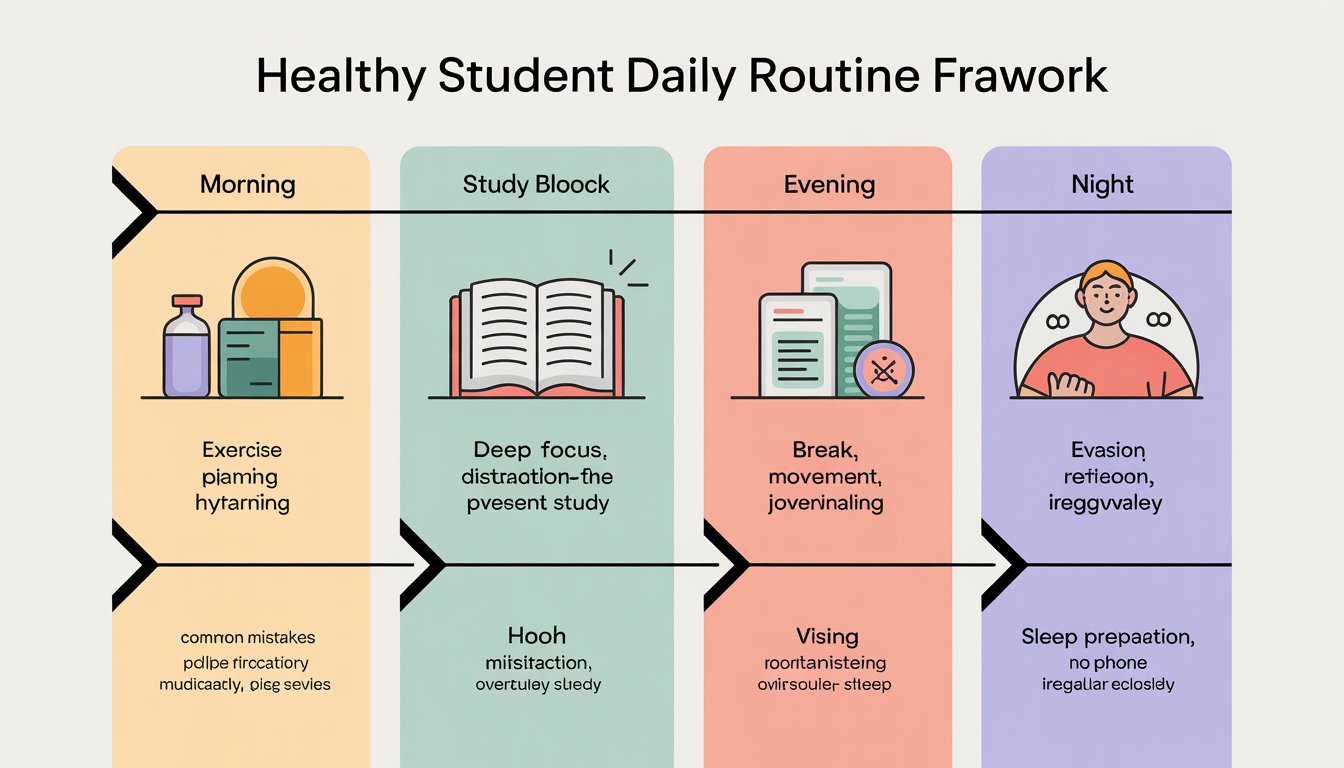
| Time | Activity | Purpose | Common Mistake |
|---|---|---|---|
| Morning | Exercise + planning | Mental clarity | Checking phone immediately |
| Study Block | Deep focus session | Better retention | Multitasking |
| Afternoon | Break + movement | Energy recovery | Overstudying |
| Evening | Revision + reflection | Consistency | Late-night distractions |
| Night | Sleep preparation | Brain recovery | Irregular sleep timing |
Routines often fail when students ignore recovery and emotional balance. Sustainable schedules work better than unrealistic productivity systems because they match human energy patterns.
Behavior triggers also affect routine consistency. For example:
| Trigger | Outcome |
|---|---|
| Phone beside bed | Morning distraction |
| Fixed study desk | Improved focus |
| Consistent sleep time | Better energy |
| Study planning | Reduced procrastination |
Motivation vs Discipline in Daily Self Improvement
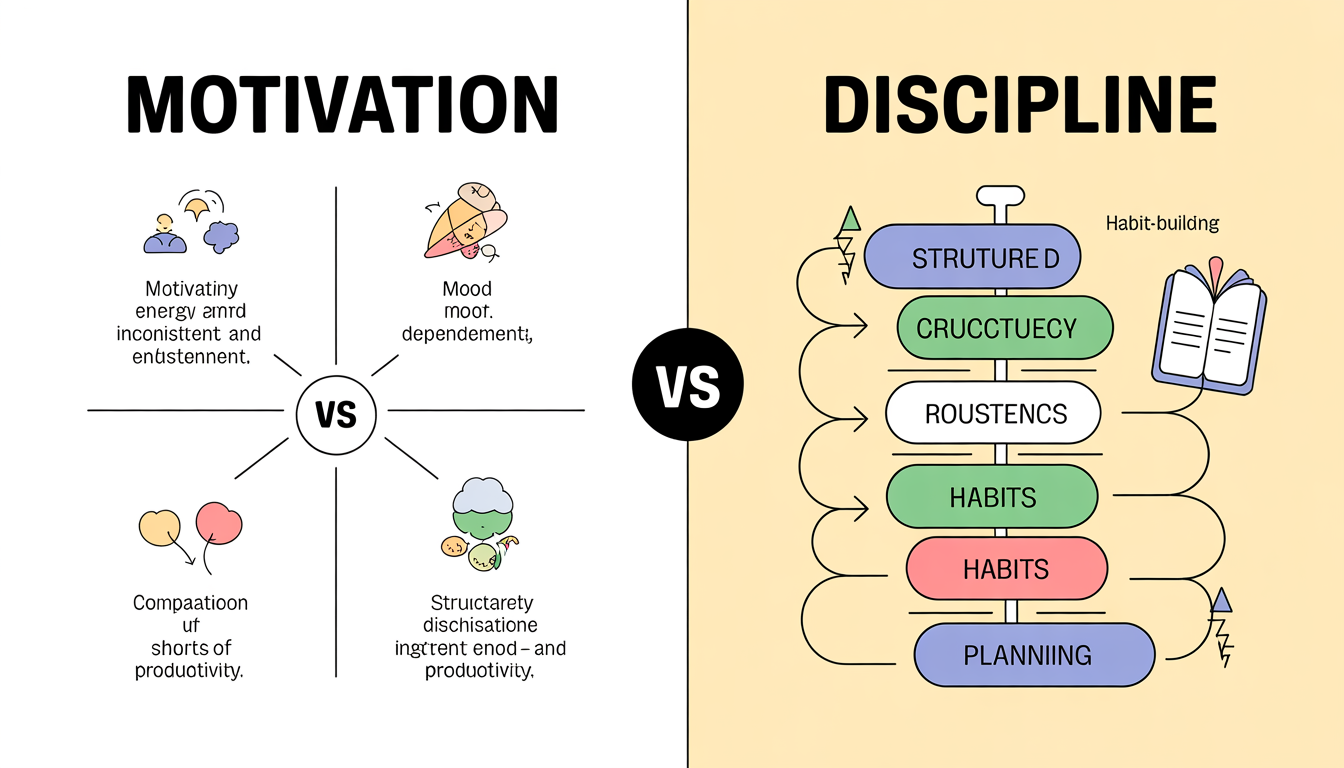
| Motivation | Discipline |
|---|---|
| Temporary emotional drive | Consistent action system |
| Depends on mood | Depends on habits |
| Unpredictable | Sustainable |
| Short-term excitement | Long-term growth |
Motivation naturally changes from day to day. Discipline creates stability because it depends on systems and routines rather than emotions.
Students who rely only on motivation often struggle with consistency. Habit stacking methods improve discipline by connecting new behaviors to existing routines.
Examples include:
- Study after breakfast
- Journal before sleep
- Stretch after waking up
Students searching for self improvement tips in Urdu or self improvement in Urdu often struggle more with consistency than information because knowledge alone does not create behavioral change.
Students who struggle with consistency can also explore practical systems in “how to build discipline without motivation” to understand how routines reduce dependence on temporary motivation.
Why Students Struggle to Follow a Daily Routine
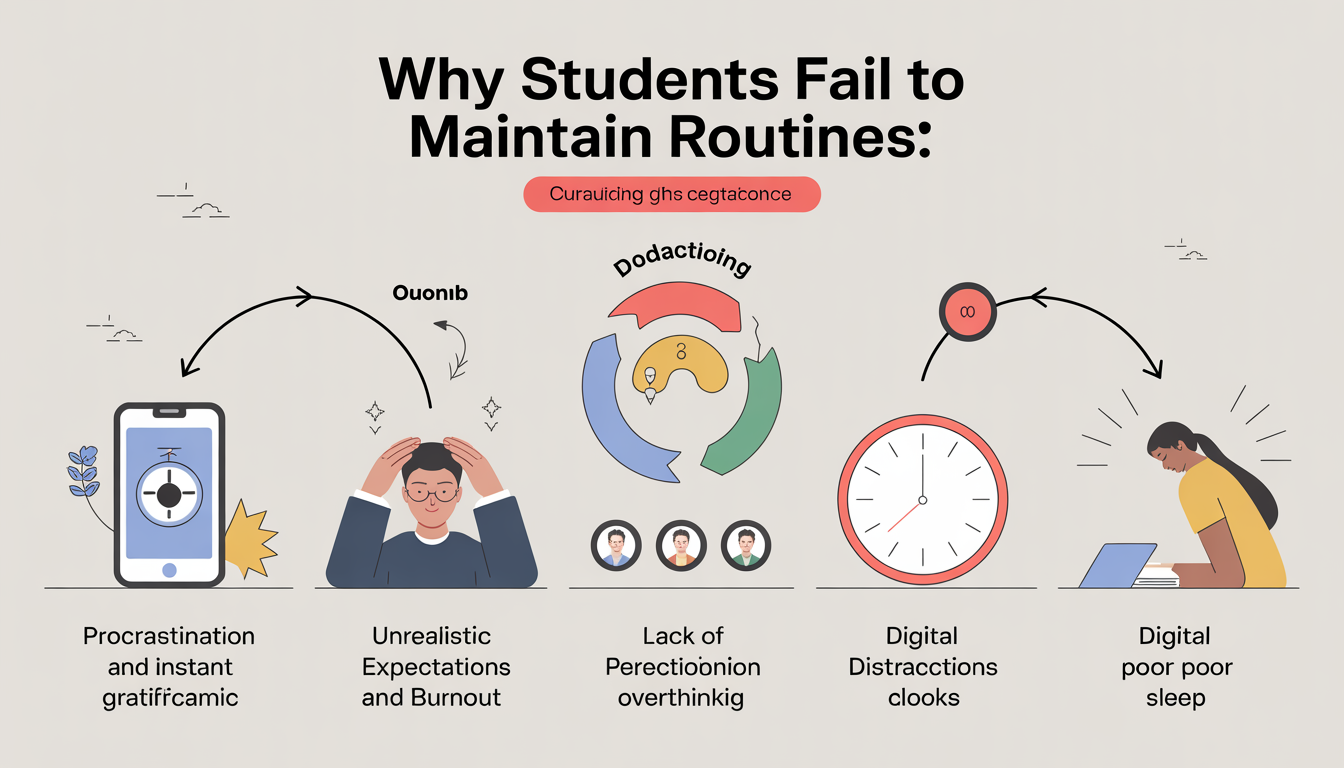
Procrastination and instant gratification
Social media, entertainment, and digital distractions provide fast dopamine rewards, making difficult tasks feel less appealing.
Unrealistic expectations and burnout
Many students attempt extreme productivity routines that are impossible to sustain long term.
Lack of clear priorities
Without clear goals, students spend energy on unimportant tasks while delaying meaningful work.
Overthinking and perfectionism
Perfectionism creates fear of failure and often leads to delayed action.
Digital distractions and poor sleep habits
Late-night screen exposure negatively affects sleep quality, focus, and emotional regulation.
Extreme routines often fail because they ignore human limitations, recovery needs, and emotional resistance to change.
How to Build a Daily Routine That Actually Works
Start with small habits
Small habits are easier to maintain consistently.
Examples include:
- Reading for 10 minutes daily
- Studying one topic consistently
- Sleeping 15 minutes earlier
Use habit stacking and triggers
Habit stacking connects new behaviors with existing routines.
Examples:
- Review notes after dinner
- Exercise after waking up
- Journal before bed
Focus on systems instead of goals
Systems create long-term progress because they focus on repeated behavior rather than temporary outcomes.
Track consistency instead of perfection
Habit tracking improves accountability and awareness.
Students can track:
- Study sessions
- Sleep timing
- Exercise consistency
- Reading habits
Adjust routines based on real life
Flexible routines are more sustainable than rigid schedules because real-life responsibilities and energy levels constantly change.
These methods support self study improvement and sustainable growth.
Healthy Habits That Improve Student Life
Reading and learning habits
Reading improves concentration, vocabulary, critical thinking, and cognitive flexibility.
Exercise and movement routines
Exercise improves emotional regulation, energy levels, and mental resilience.
Mindfulness and stress management
Mindfulness practices help reduce anxiety and improve emotional awareness.
Limiting social media consumption
Reducing screen time improves attention span and mental clarity.
Daily reflection and gratitude practices
Reflection and gratitude strengthen confidence, emotional stability, and self-awareness.
Common Daily Routine Mistakes Students Should Avoid
Following unrealistic schedules
Strict routines often fail because they ignore recovery and flexibility.
Ignoring rest and recovery
Without proper rest, concentration and memory decline significantly.
Trying to change everything at once
Gradual improvement creates more sustainable behavior change.
Depending only on motivation
Motivation fades quickly without systems and habits.
Comparing routines with others
Students have different lifestyles, responsibilities, personalities, and energy patterns.
Sustainable habits outperform extreme productivity methods because they are easier to maintain over time.
Real-Life Self Improvement Routine Examples
Beginner student routine
A beginner routine should focus on:
- Consistent sleep timing
- One deep study session daily
- Basic exercise habits
- Reduced phone distractions
Busy student with limited time
Busy students should prioritize:
- Short focused study blocks
- Task prioritization
- Flexible scheduling
- Efficient recovery habits
High-performance study routine
High-performing students often use:
- Time blocking
- Deep work systems
- Structured revision schedules
- Distraction-free environments
Home-study routine for online learners
A daily routine of a student at home should separate relaxation spaces from study spaces to improve concentration and consistency.
Morning-focused students may perform best early in the day, while night-focused students may prefer later study sessions. Personalization improves long-term sustainability.
Science-Backed Habits That Support Self Improvement
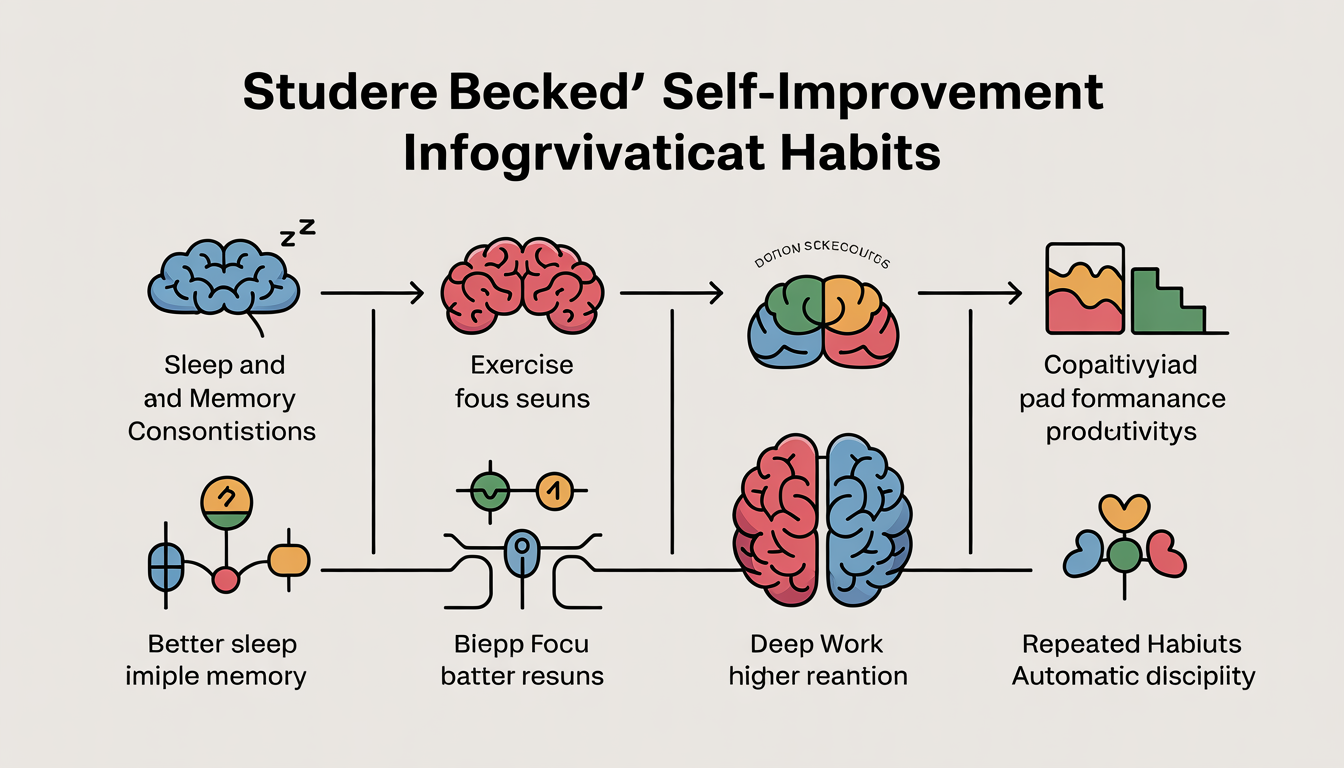
Sleep and memory consolidation
Sleep strengthens memory formation and learning retention by helping the brain organize information.
Exercise and cognitive performance
Exercise improves blood circulation, focus, mood, and stress management.
Deep work and concentration
Focused attention improves productivity and reduces cognitive overload.
Habit loops and behavioral psychology
Habit formation follows a cue-routine-reward cycle. Repetition strengthens neural pathways and makes behaviors more automatic over time.
Brain chemistry also affects habits. Dopamine-driven distractions reduce attention span and increase impulsive behavior when students constantly switch between tasks.
What Actually Works in Self Improvement Routines
Consistency over intensity
Small actions repeated daily create long-term improvement more effectively than extreme short-term effort.
Systems over motivation
Systems reduce dependence on fluctuating emotions and improve consistency.
Simplicity over perfection
Simple routines are easier to follow and maintain long term.
Long-term sustainability over quick results
Balanced routines support emotional health, productivity, and academic performance without causing burnout.
Viral productivity advice often promotes unrealistic discipline systems that ignore recovery and mental health. Practical routines work better because they focus on sustainable consistency rather than temporary intensity.
Conclusion
A daily routine for self improvement student supports productivity, academic growth, emotional balance, discipline, and long-term personal development. Effective routines improve focus, reduce stress, and strengthen healthy habits through consistency and structure. Students do not need perfect schedules to improve their lives. Sustainable routines built around sleep, focused study, exercise, recovery, and self-reflection create meaningful long-term results. Instead of chasing perfection, students should focus on gradual improvement, realistic systems, and self-awareness. Small daily habits repeated consistently over time create lasting transformation in both academic and personal life.
FAQ Section
Why do students struggle to stay consistent with a daily routine?
Students often struggle because of procrastination, unrealistic goals, distractions, poor sleep, and lack of habit systems. Many routines fail because they depend too heavily on temporary motivation instead of consistent behavioral systems.
What is the best daily routine for self improvement students?
The best routine balances study, sleep, exercise, breaks, recovery, and personal growth habits. Sustainable routines focus on consistency rather than extreme productivity.
How long does it take to build a consistent routine?
Habit formation varies from person to person, but consistency over several weeks helps behaviors become more automatic. Repetition and environmental design improve long-term consistency.
What should students do when they lose motivation?
Students should rely on systems instead of emotions. Small actions, habit triggers, accountability systems, and structured routines help maintain progress during low motivation periods.
How can students avoid burnout while following a strict routine?
Students can avoid burnout by prioritizing sleep, recovery, flexibility, realistic expectations, and balanced workloads. Rest is essential for sustainable productivity.
Is studying for more hours always better?
No. Deep focus sessions are usually more effective than long distracted study hours. Quality of concentration matters more than total time spent studying.
How can students improve self-discipline naturally?
Students can improve discipline by reducing distractions, building supportive environments, repeating small habits consistently, and focusing on identity-based behavior change.
What are the most important habits for student self improvement?
The most important habits include proper sleep, focused study, exercise, reflection, digital control, healthy eating, and consistent planning.