

Introduction
Changing your mindset means shifting the underlying beliefs, assumptions, and interpretive habits that shape how you respond to challenges — it is different from simply feeling more motivated for a day or two. The best books to read to change your mindset work by introducing new mental models, challenging existing assumptions, and giving readers language for patterns they had not previously noticed in their own thinking. Books can influence self-awareness, decision-making, habit formation, resilience, and how a person interprets failure and success. This guide organizes recommendations by the specific mindset shift a reader is trying to make, since the most useful book depends on a person’s current challenge, age, goals, and preferred reading style — not on a single universal “best” title.
Quick Summary
- The best mindset books challenge existing assumptions and provide ideas that can be applied to everyday decisions and behavior.
- Different books are useful for different goals, including developing a growth mindset, building discipline, improving resilience, or changing how you approach success.
- Fiction can also influence mindset by encouraging empathy, perspective-taking, reflection, and new ways of interpreting human behavior.
- Reading alone rarely creates lasting change; applying and revisiting useful ideas is what turns insight into a changed mindset.
What Makes a Book Effective for Changing Your Mindset?
A mindset book is genuinely effective when it goes beyond inspiration and gives readers a framework they can test against their own behavior. Effective mindset books typically combine research or evidence, practical exercises, memorable mental models, and clear paths to behavioral application. A book that only motivates without offering a mechanism for change tends to produce a short-lived emotional lift rather than a lasting shift in thinking.
Because mindset change is personal, the “best” book is subjective. A book that transforms one reader’s relationship with failure may feel irrelevant to a reader who is instead struggling with procrastination or self-doubt. Matching the book to the specific mindset challenge is more important than chasing bestseller rankings.
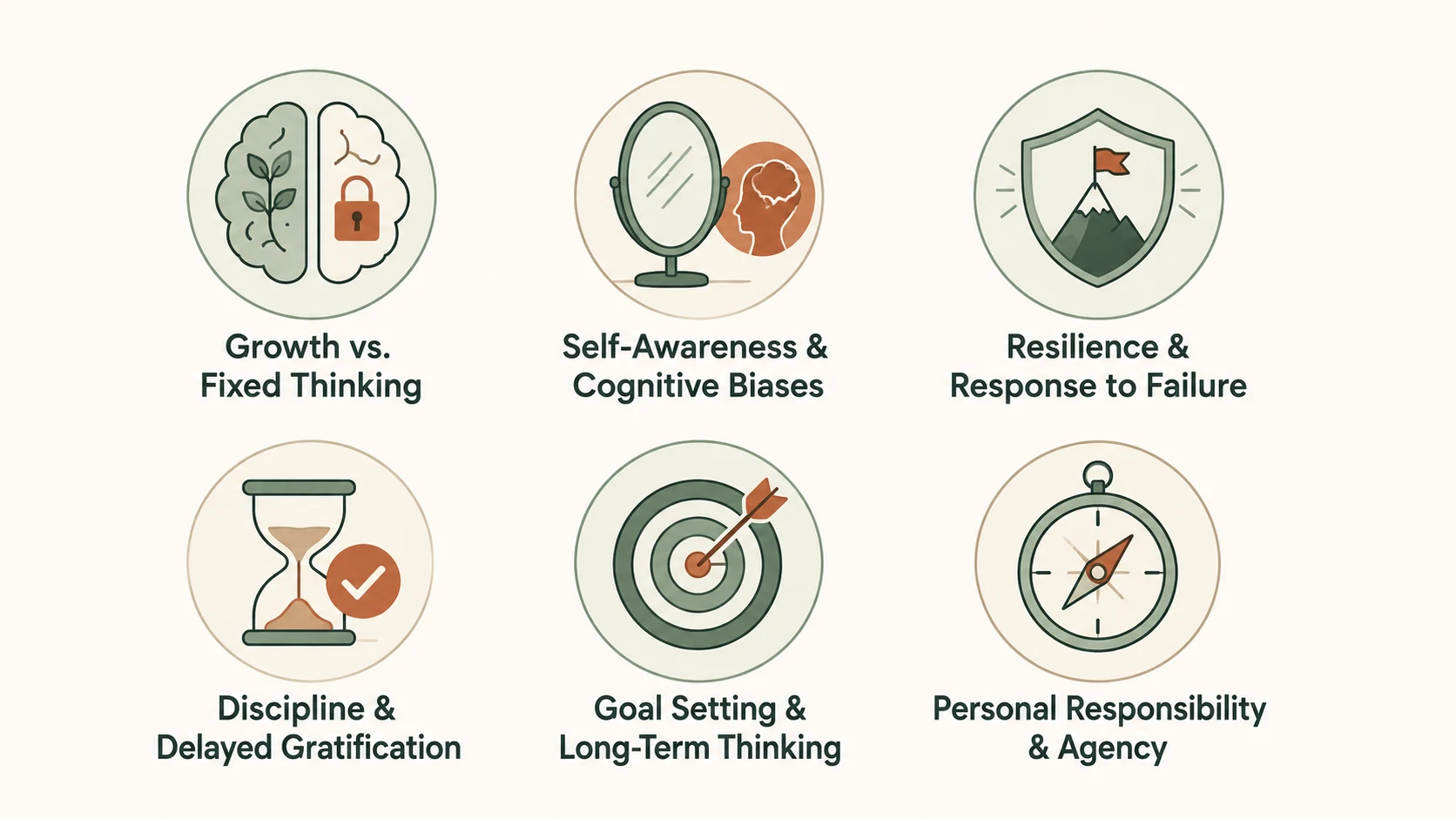
Mindset concepts worth looking for in a book
- Growth vs. fixed thinking
- Self-awareness and cognitive biases
- Resilience and responses to failure
- Discipline and delayed gratification
- Goal setting and long-term thinking
- Personal responsibility and agency
Inspiration vs. lasting mindset change
Motivation is a temporary emotional state, while mindset change is a durable shift in belief and interpretation. Motivational content often produces a short burst of energy that fades once the initial excitement wears off, while books that create lasting change give readers actionable ideas, models, or exercises they can return to. A useful test is whether a book leaves the reader with something to do differently, not just something to feel differently for a day.
Best Books to Read to Change Your Mindset by Goal
Rather than presenting an undifferentiated ranking, the most useful way to choose among good books to read to change your mindset is to organize them by the specific transformation each category supports. Books work differently depending on whether a reader wants to build a growth mindset, strengthen discipline, pursue success, become more resilient, or change how they see their own potential.
Books for developing a growth mindset
Growth mindset books focus on the idea that abilities can be developed through effort, strategy, and learning from mistakes, rather than viewed as fixed traits. This concept differs from simply “thinking positively” — it is specifically about how a person interprets challenges, setbacks, and effort. Books in this category typically explain how framing a difficulty as a learning opportunity, rather than a threat to self-image, changes both motivation and long-term performance. Readers searching for growth mindset books or books on a growth mindset are usually looking for this reframe: treating ability as something built over time rather than something a person either has or lacks.
Books for building discipline and consistency
Books on mindset and discipline explore self-control, routine design, delayed gratification, and the psychology of consistent behavior. A recurring theme across this category is that discipline is less about raw willpower and more about designing an environment and set of systems that make the desired behavior easier to repeat. These books often connect mindset shifts — such as viewing consistency as identity-based rather than motivation-based — with concrete behavior-change strategies.
Books for developing a success-oriented mindset
Books on mindset and success examine ambition, persistence, decision-making, and long-term thinking. “Success” in this context is not limited to career achievement; it can also mean financial independence, meaningful work, or personal fulfillment. This category often emphasizes that a success-oriented mindset involves tolerating short-term discomfort, taking calculated risks, and maintaining focus on long-term outcomes even when immediate results are unclear.
Books for becoming more resilient and mentally strong
Resilience-focused books address adversity, setbacks, uncertainty, and perseverance. A genuinely strong mindset is not the same as suppressing emotions or refusing to acknowledge difficulty — it involves processing setbacks honestly while maintaining the capacity to keep moving forward. Books in this category typically distinguish between avoidance and adaptive coping, offering frameworks for facing hardship without becoming overwhelmed by it.
Books for changing how you think about yourself and your potential
This category of books to change your mindset addresses self-belief, identity, limiting assumptions, and personal agency. Readers exploring books on how to change your mindset or books about mindset in this sense are usually examining internal narratives — the stories a person tells themselves about what they are capable of — and learning to question assumptions that no longer serve them.
Fiction Books to Read to Change Your Mindset
Fiction can change perspective even when it is not explicitly framed as self-improvement content. Novels influence mindset through character identification, emotional engagement, exposure to unfamiliar experiences, moral and philosophical questions, and perspective-taking that nonfiction rarely replicates as vividly.
How fiction changes perspective differently from nonfiction
- Character identification: readers experience decisions and consequences through another person’s internal logic.
- Emotional engagement: stories create emotional investment that can make abstract ideas feel personally relevant.
- Exposure to unfamiliar experiences: fiction allows readers to encounter circumstances outside their own life.
- Moral and philosophical questions: many novels raise dilemmas without offering easy answers, encouraging independent reflection.
- Perspective-taking: following a character’s viewpoint builds the habit of considering situations from angles other than one’s own.
What types of fiction are most useful for mindset change?
Literary fiction, coming-of-age stories, psychological fiction, philosophical fiction, dystopian fiction, and narratives centered on resilience or transformation tend to be the most useful for mindset change. The value of fiction books to read to change your mindset comes from the ideas and perspectives a story provokes, not from its genre label — a well-constructed story in any genre can prompt meaningful reflection if it challenges assumptions or illustrates consequences clearly.
Books to Read to Change Your Mindset for Adults
Adult readers are typically navigating work, relationships, financial responsibility, uncertainty, and long-term goals — needs that differ from those of a student or teenager. A book that resonates strongly with a younger reader may not address the complexity an adult is managing in a career, family, or life-transition context.
Books for adults facing career or life transitions
Books addressing adaptability, uncertainty, reinvention, and continuous learning are particularly relevant for adults navigating a career change, relocation, or major life shift. These books often connect mindset change directly with practical decision-making under uncertainty.
Books for adults struggling with motivation or consistency
For adults who struggle with follow-through, the most useful books distinguish between a genuine lack of motivation, unclear goals, unrealistic expectations, and poor systems. Rather than framing inconsistency as a personal failing, these books connect mindset shifts with practical habit formation and sustainable behavior design.
Books for adults seeking greater perspective and emotional resilience
This category covers acceptance, setbacks, relationships, uncertainty, and meaning. Effective books here present resilience as an active, adaptive process — not as emotional suppression or simply “toughing it out.”
Mindset Books Compared: Which Type Should You Choose?
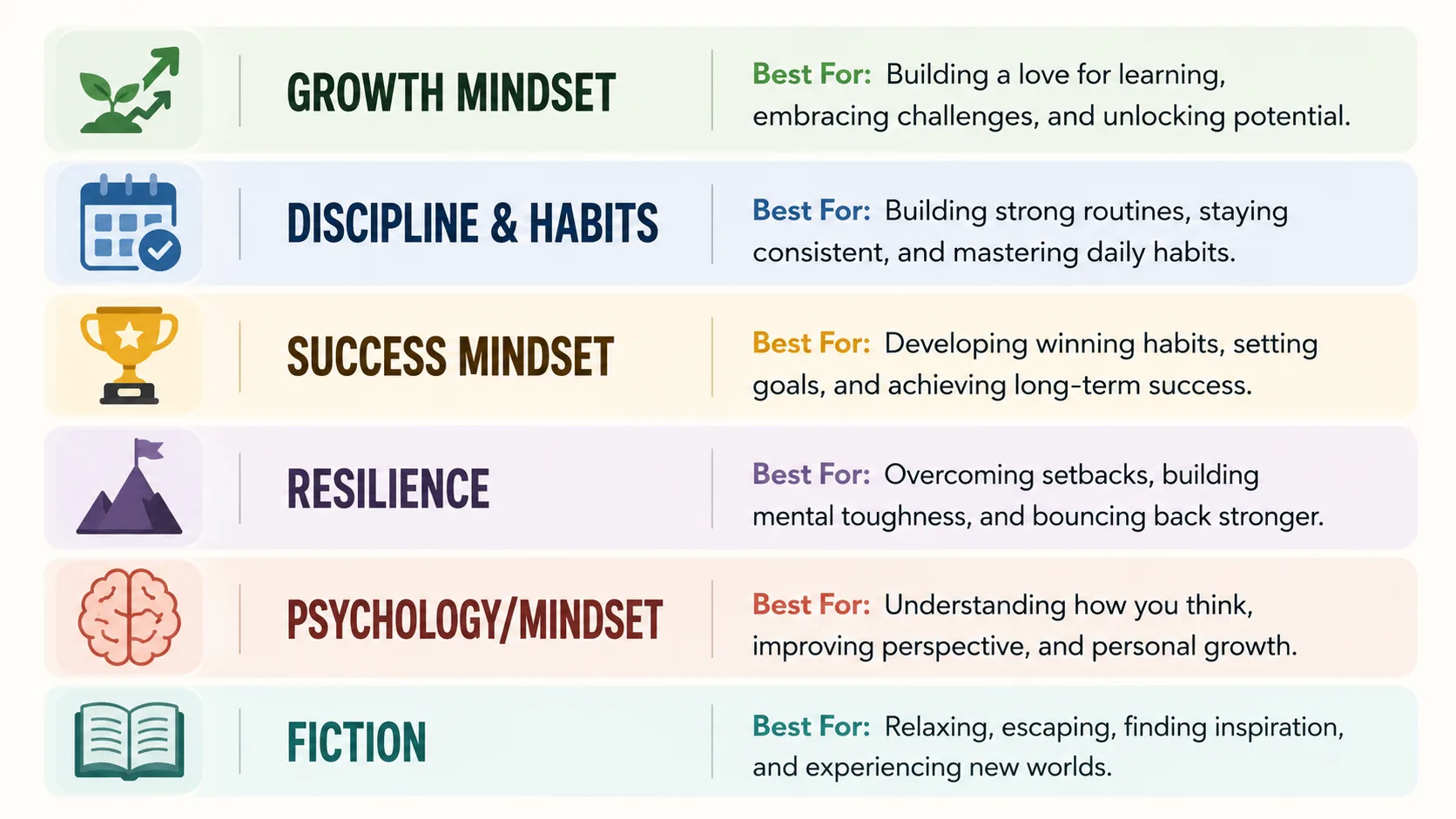
| Book Type | Primary Focus | Best For | What It Can Help With |
|---|---|---|---|
| Growth mindset | Learning and adaptability | Readers afraid of failure | Viewing challenges as opportunities to learn |
| Discipline and habits | Consistency and behavior | Readers struggling to follow through | Building sustainable routines |
| Success mindset | Achievement and long-term goals | Goal-oriented readers | Persistence, ambition, and strategic thinking |
| Resilience | Adversity and setbacks | Readers facing difficult periods | Coping with failure and uncertainty |
| Psychology/mindset | Self-awareness and thinking patterns | Readers wanting deeper understanding | Recognizing assumptions and cognitive patterns |
| Fiction | Perspective and empathy | Readers who prefer stories | Seeing people and situations differently |
Mindset books vs. books about habits
Mindset and habits overlap significantly: beliefs shape the behaviors a person is willing to attempt, and repeated behavior can, in turn, reinforce new beliefs. A reader needs a mindset-focused book when the core obstacle is how they think about a challenge; a habits-focused book is more useful when the obstacle is a practical behavior-change framework — the “how” rather than the “why.”
Growth mindset vs. discipline-focused books
Adaptability and persistence complement each other but are not identical. A growth mindset helps a person view setbacks as informative rather than final, but it does not automatically create disciplined behavior. Discipline-focused books address the systems and habits needed to act consistently on a growth-oriented belief, which is why readers often benefit from combining both categories.
How to Choose the Right Mindset Book for Your Current Situation
Choosing a mindset book works best as a decision process rather than a single universal recommendation. The right choice depends on the reader’s primary problem, preferred learning style, available time, and desired outcome.
Start with the mindset problem you want to change
- Fear of failure
- Procrastination
- Low confidence
- Lack of consistency
- Negative thinking
- Difficulty handling setbacks
- Unclear goals
- Resistance to change
Choose between practical, psychological, philosophical, and story-driven books
Practical books offer direct frameworks and exercises, psychological books explain underlying mechanisms of thought and behavior, philosophical books encourage deeper reflection on values and meaning, and story-driven books build perspective through narrative. Each approach has strengths and limitations, and matching the format to a reader’s learning style improves the likelihood the ideas will actually be absorbed and applied.
Consider your reading level and available time
Concise, practical books suit readers who want quickly applicable ideas, while more theoretical or philosophical works suit readers who want deeper conceptual understanding and have more time to engage with denser material. In our experience helping readers build better habits, the most useful book is consistently the one a reader will actually finish and apply — not necessarily the most highly rated title.
How to Read Mindset Books So They Actually Change Your Thinking
Reading alone does not guarantee mindset change; how a book is read matters as much as which book is chosen. you want a structured way to capture these insights, our guide on how to journal for self-growth walks through prompts designed specifically for this kind of reflection.
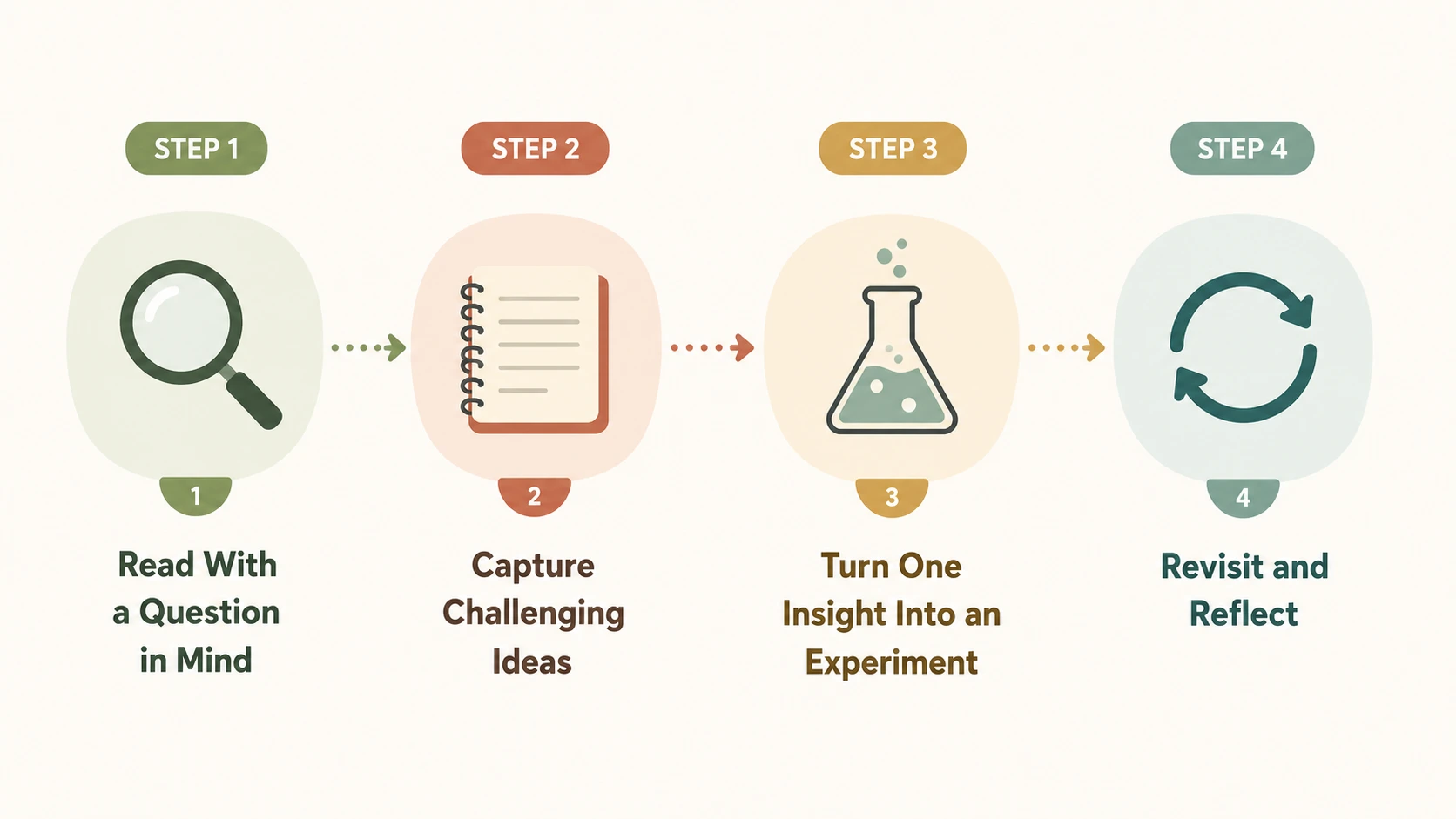
Read with one specific question in mind
Before starting, identify the specific belief, habit, or behavior you want to examine. Reading with a defined question keeps attention focused on relevant ideas rather than passively absorbing general content.
Capture ideas that challenge your existing beliefs
- Record surprising ideas as you encounter them.
- Note assumptions that the book challenges directly.
- Compare new concepts with your own past experiences.
- Identify ideas that could change a specific decision or behavior.
Turn one insight into an experiment
Your Daily Thrive recommends testing a book’s ideas through one small, specific behavioral change rather than attempting to implement an entire book’s framework at once. A single, testable experiment makes it easier to evaluate whether an idea actually works in practice.
Revisit useful ideas instead of constantly starting new books
Rereading, reflecting on, and applying ideas from a smaller number of books is often more valuable than maximizing the total number of books completed. Mindset change tends to come from depth of application, not breadth of consumption.
Common Mistakes People Make When Using Mindset Books
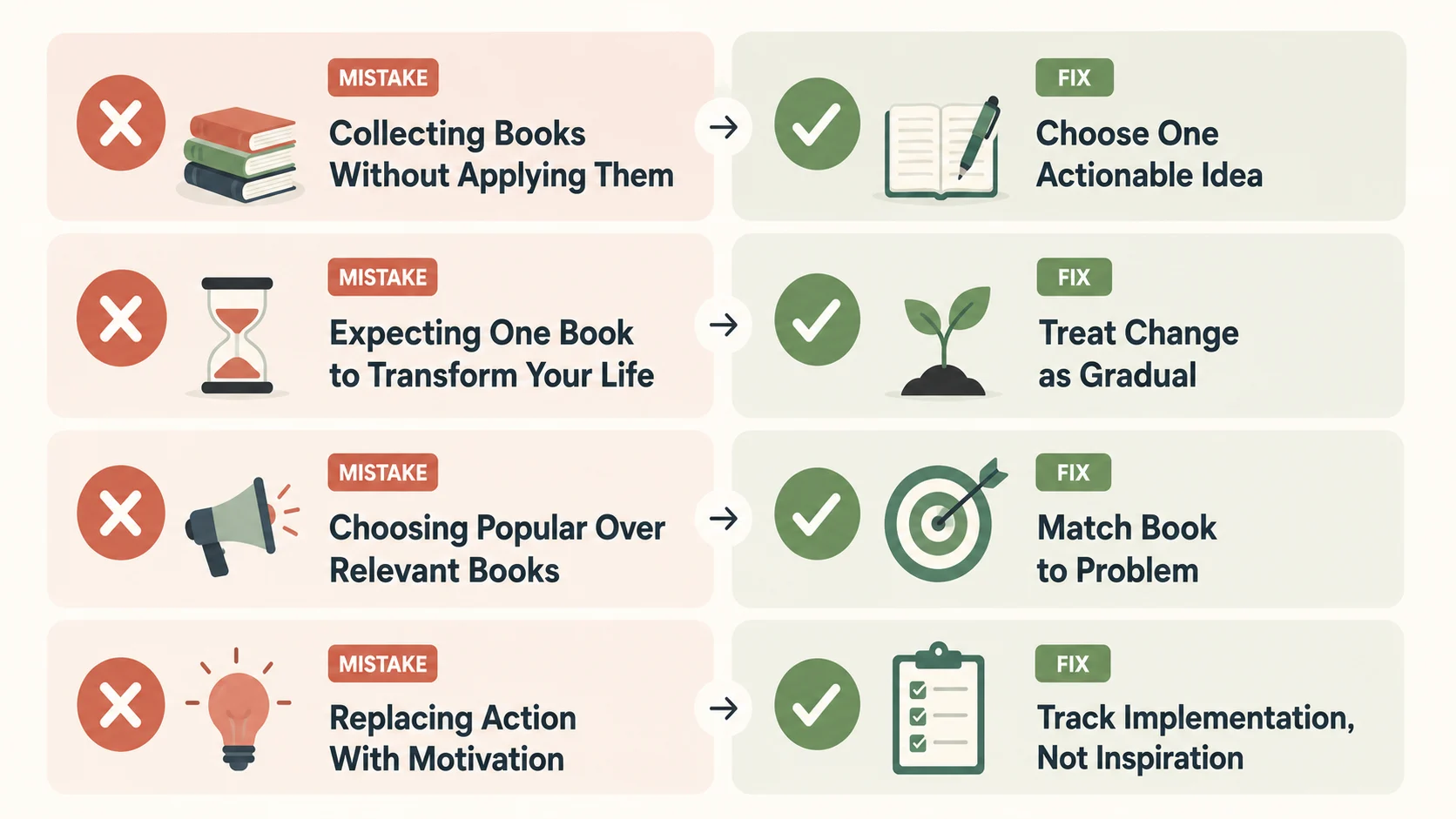
Collecting books without applying them
This happens because consuming information can feel like progress even when no behavior has changed. The fix is to choose one actionable idea from each book, and the best prevention is defining an application goal before reading begins.
Expecting one book to completely transform your life
This mistake stems from exaggerated expectations common in personal development marketing. Treating mindset change as a gradual process of learning and behavior change, and measuring progress through actual decisions and habits rather than emotional excitement, helps set more realistic expectations.
Choosing books because they are popular rather than relevant
Popularity is often mistaken for personal suitability. Matching a book’s subject to the specific problem being addressed, using a goal-based selection framework like the one outlined above, helps readers avoid this trap.
Replacing action with motivation
Motivational content creates an immediate emotional response that can feel like meaningful progress on its own. Converting insights into specific behaviors, and tracking implementation rather than inspiration, helps ensure the reading translates into real change.
Can Reading Books Really Change Your Mindset?
Yes — books can genuinely change your mindset by introducing new mental models, information, and interpretations, but lasting change depends on reflection and consistent behavioral application rather than reading alone. Books provide raw material for belief revision; whether that material produces lasting change depends on how deliberately a reader engages with and tests the ideas presented. For a deeper look at this process, see our related guide on how to change your thoughts.
It is important to distinguish knowledge acquisition from internalization. A reader can understand a concept intellectually without it changing how they actually behave. Individual results vary significantly based on context, openness to change, pre-existing beliefs, and the consistency with which new ideas are applied in daily life.
What changes first: beliefs, thoughts, or behavior?
Mindset change typically begins with exposure to a new idea, followed by reflection, partial belief revision, and behavioral experimentation that either reinforces or challenges the new belief. This process is rarely linear — a person may adopt a new belief intellectually well before their behavior consistently reflects it, and small behavioral experiments often do more to solidify a belief than reading alone.
How Mindset Reading Connects With Goal Setting, Habits, and Productivity
Mindset and goal setting
Beliefs directly influence which goals a person considers realistic or worth pursuing. Even well-chosen, realistic goals require persistence to achieve, and flexible thinking helps readers adjust goals when circumstances change without abandoning long-term direction. To see how small identity shifts translate into real behavior change, read small habits that changed my life.
Mindset and habit formation
Beliefs about identity — such as seeing oneself as “a disciplined person” rather than simply “trying to be disciplined” — strongly influence behavior. Environment and consistency matter more than motivation, which tends to be unreliable as a long-term driver of habitual behavior.
Mindset and productivity
Mindset shapes prioritization, focus, and the ability to delay gratification. It also affects how a person manages setbacks without abandoning long-term goals, which is often the difference between sustained productivity and repeated restarts.
Mindset and resilience
Resilience connects closely with how a person learns from failure, recovers from setbacks, and maintains perspective during difficult periods. Books that build resilience often reinforce the broader mindset concepts covered throughout this guide, including growth-oriented thinking and personal agency.
Frequently Asked Questions About Books to Read to Change Your Mindset
What are the best books to read to change your mindset?
The best books depend on whether the reader wants to build a growth mindset, strengthen discipline, improve resilience, pursue success, deepen self-awareness, or change their broader perspective — there is no single universal answer.
Can fiction books really change your mindset?
Yes, fiction can change mindset by building empathy, encouraging perspective-taking, and prompting readers to question their own assumptions about human behavior through character experiences.
What books help develop a stronger mindset?
Books addressing resilience, discipline, adaptability, and constructive responses to adversity are the main categories that help readers develop a stronger, more capable mindset.
What are good mindset books for adults?
Good mindset books for adults typically address career transitions, personal responsibility, uncertainty, consistency, relationships, and long-term goal setting rather than general motivational content.
Which books help with mindset and discipline?
Books that connect mindset with habits, consistency, environment design, and delayed gratification are most useful for readers focused specifically on discipline.
How many mindset books should I read to change my thinking?
There is no fixed number — depth of understanding and consistent application of ideas matter far more than the total number of books completed.
How should I read a mindset book if I want lasting change?
Identify a specific problem before reading, extract ideas relevant to that problem, test one idea as a small experiment, reflect on the results, and revisit the book’s core concepts rather than immediately moving to a new title.
Conclusion — Choosing Books That Actually Change How You Think
The most effective books to read to change your mindset are the ones that address a specific mental or behavioral challenge rather than offering generic inspiration. Growth mindset, discipline, resilience, success, habits, and perspective are closely interconnected, which is why a goal-based approach to choosing books tends to work better than chasing a single “best” title. As of 2026, readers increasingly favor books that combine research-backed frameworks with practical application over purely motivational content, reflecting a broader shift toward evidence-based personal development. The clearest takeaway is straightforward: choose one relevant book, identify one idea worth testing, and turn that idea into a concrete action.