

Introduction
Volleyball mindset is the mental approach that shapes how a player makes decisions, handles pressure, and recovers from mistakes on the court. It governs confidence before a serve, focus during a rally, and composure after an error. Physical skills like passing, setting, and hitting only tell part of the story; a player’s mental habits determine whether those skills show up consistently when it matters most.
Mindset matters at every stage of a volleyball career. Beginners use it to build confidence while learning fundamentals. Developing players rely on it to push through plateaus. Experienced athletes depend on it to stay composed in high-pressure matches. Concepts such as volleyball mindset psychology, volleyball player mindset, and volleyball growth mindset all describe different pieces of this same mental framework, and volleyball mindset training is the practice of strengthening that framework over time.
Quick Summary
- A strong volleyball mindset combines confidence, focus, emotional control, and continuous learning.
- Mental skills can be trained just like physical volleyball skills.
- Growth mindset helps players recover from mistakes and improve faster.
- Consistent routines before, during, and after games build long-term mental toughness.
What Is a Volleyball Mindset?
Definition of a Volleyball Mindset
A volleyball mindset is the set of thought patterns, beliefs, and emotional responses a player relies on to perform effectively under competitive conditions. In sports psychology, mindset refers to the mental lens through which an athlete interprets challenges, mistakes, and opportunities. In volleyball, this lens directly influences movement, reaction speed, and decision-making, because thoughts shape actions before the body ever responds.
Talent and mindset are not the same thing. Talent describes a player’s raw physical ability, while mindset describes how consistently and effectively that talent is expressed during competition. Two players with similar skill levels can perform very differently depending on their mental approach.
Why Mindset Matters More Than Many Players Realize
Mindset plays a measurable role in four areas of performance:
- Confidence under pressure: Players with a stable mindset are less likely to hesitate during high-stakes rallies.
- Faster recovery from mistakes: A resilient mindset shortens the time between an error and the next focused play.
- Better communication: Emotionally regulated players communicate more clearly with teammates.
- Consistent performance: Mental stability reduces the gap between a player’s practice performance and their game performance.
These effects connect directly to volleyball mindset psychology, volleyball player mindset, and what is often described as a volleyball pro mindset — the mental consistency that separates high-level athletes from equally skilled peers.
The Psychology Behind Volleyball Mindset
How Thoughts Influence Performance
Self-talk, confidence, attention control, and emotional regulation all shape how a volleyball player performs in real time. Negative self-talk after a missed serve can narrow attention and slow reaction time, while constructive self-talk helps a player reset quickly. Confidence affects willingness to take risks, such as attacking a difficult set instead of playing it safe. Attention control determines whether a player is focused on the current rally or distracted by the previous point.
The Connection Between Brain and Body During Competition
During competition, mental state and physical performance are tightly linked. Decision-making speed depends on how calmly the brain processes information under time pressure. A player’s stress response can either sharpen focus or trigger tension that slows reaction time. Motor performance, including footwork and arm swing timing, becomes less efficient when a player is mentally overloaded. Sustained focus during rallies allows athletes to track the ball, read the opposing team, and execute technique without hesitation.
Fixed Mindset vs Growth Mindset in Volleyball
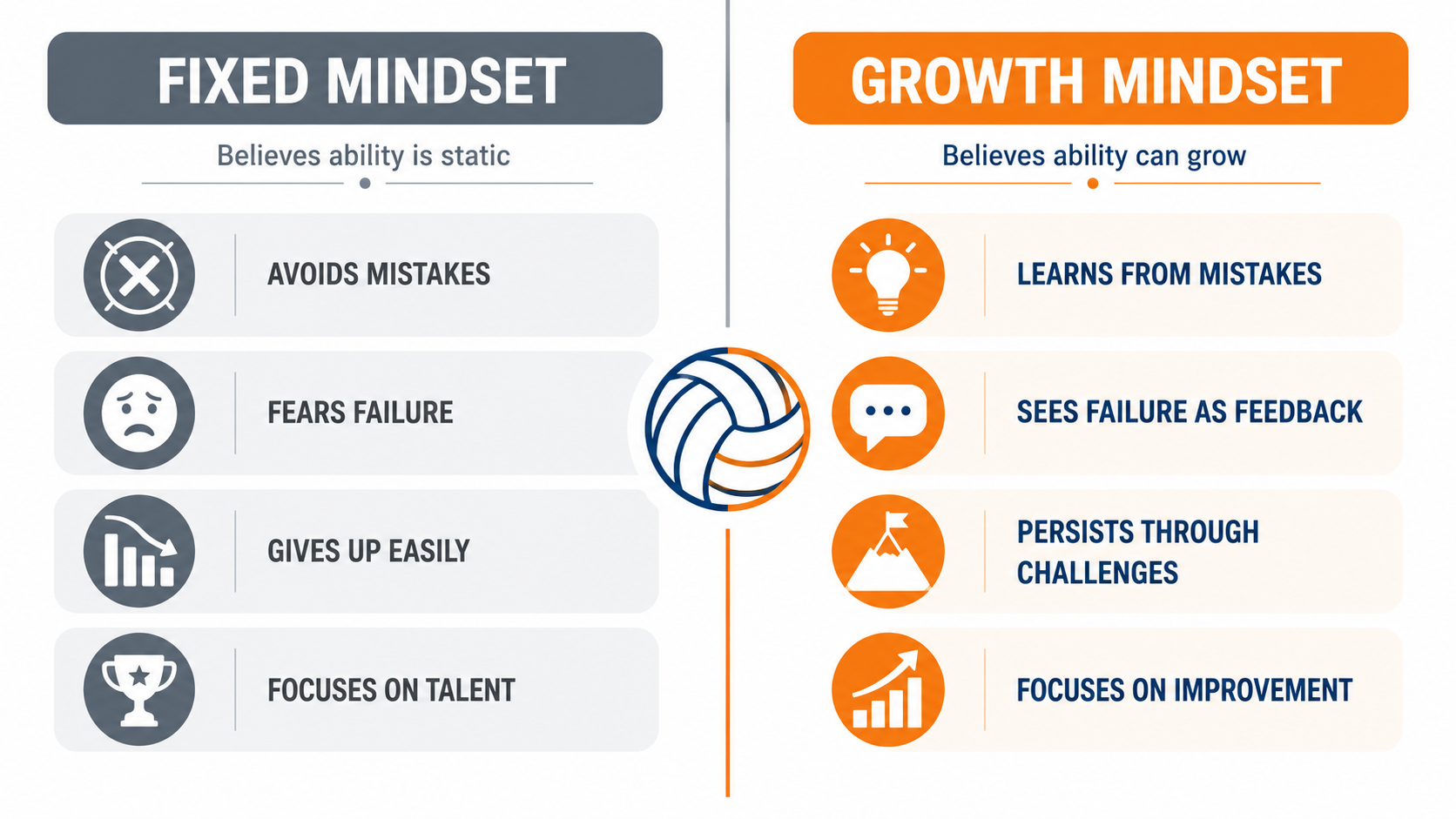
A growth mindset, a concept developed in behavioral psychology, describes the belief that ability can improve through effort and practice. A fixed mindset assumes ability is static. In volleyball, this distinction shapes how players respond to mistakes and challenges. This distinction isn’t unique to sports — understanding why a growth mindset is important can reshape how you approach challenges in every area of life, not just on the court.
| Fixed Mindset | Growth Mindset |
|---|---|
| Avoids mistakes | Learns from mistakes |
| Fears failure | Sees failure as feedback |
| Gives up easily | Persists through challenges |
| Focuses on talent | Focuses on improvement |
Players who adopt a volleyball growth mindset tend to recover from errors more quickly and show steadier long-term improvement, which is a core principle in volleyball mindset psychology.
Core Characteristics of a Strong Volleyball Mindset
Confidence Without Overconfidence
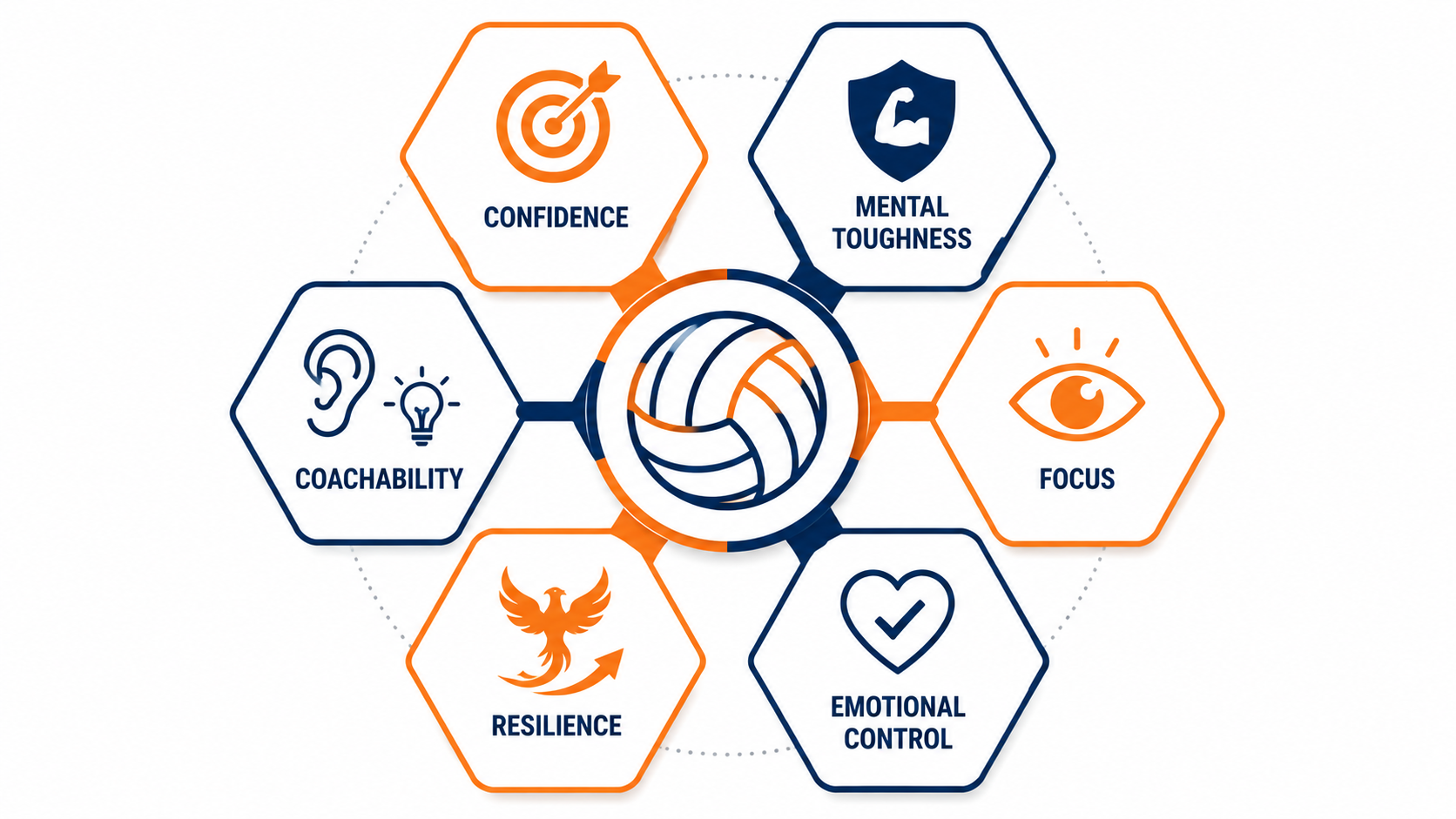
Confidence allows a player to trust their training and execute skills decisively. Overconfidence, by contrast, can lead to careless errors or poor shot selection. Balanced confidence develops through consistent practice and honest self-assessment, not through ignoring weaknesses.
Mental Toughness
Mental toughness is the ability to maintain effort and composure despite fatigue, pressure, or setbacks. It develops gradually through repeated exposure to challenging situations in practice and competition, and it is commonly misunderstood as simply “not showing emotion,” when it actually means managing emotion effectively.
Focus During Every Rally
Point-to-point focus means giving full attention to the current play rather than the score, a previous mistake, or the crowd. This skill strengthens with deliberate practice, such as using a physical or verbal cue between points. Much of this skill comes down to learning to focus on what you can control — the next play, your effort, and your reaction — rather than the scoreboard or an opponent’s actions.
Emotional Control
Emotional control allows players to experience frustration, excitement, or anxiety without letting those emotions disrupt performance. A common misconception is that emotional control means suppressing emotion entirely; in practice, it means acknowledging the emotion and choosing a productive response.
Resilience After Errors
Resilience is the ability to let go of a mistake and refocus on the next play. It develops through repetition of recovery routines, such as a brief breathing reset or a predetermined focus word.
Coachability and Learning
Coachable players actively seek feedback and apply it without defensiveness. This trait is closely tied to a growth mindset and tends to accelerate skill development over time.
How Volleyball Mindset Changes at Different Skill Levels
Volleyball Mindset for Beginners
For players just learning volleyball, mindset priorities center on confidence-building and reducing fear of mistakes. Someone new to volleyball for beginners or exploring how volleyball is played benefits most from a mindset focused on effort and enjoyment rather than perfection. As players move from learning volleyball basics to more structured play, mental focus should shift gradually from “doing it correctly” to “reading the game,” which supports long-term development in how to play volleyball with confidence.
Intermediate Players
Intermediate players begin balancing technical consistency with tactical awareness. Mindset priorities shift toward maintaining focus across longer matches and managing frustration as competition increases.
Competitive Athletes
Competitive athletes face higher-stakes pressure, requiring stronger emotional regulation and pre-match mental preparation. Mindset training becomes more structured, often including visualization and goal setting.
Elite and Professional Players
At the elite level, mental priorities evolve toward maintaining composure across long tournaments, managing external pressure, and sustaining motivation over a full season. A volleyball pro mindset typically reflects years of deliberate mental training layered on top of physical skill. This mental consistency reflects a broader athlete mindset that top competitors across every sport, not just volleyball, work deliberately to build
Position-Specific Mindsets in Volleyball
Volleyball Setter Mindset
The volleyball setter mindset centers on rapid decision-making, since setters must read the court and choose the best attacking option within a fraction of a second. Communication and composure under pressure are essential, as setters often direct the offense verbally.
Outside Hitters
Outside hitters need consistent confidence, since they are frequently asked to attack under pressure. Mental resilience after a blocked or out-of-bounds hit is especially important for this position.
Liberos
Liberos rely on focus and composure, since their role involves repeated defensive reactions where consistency matters more than aggression. Emotional steadiness after a missed dig supports continued defensive reliability.
Middle Blockers
Middle blockers depend on quick anticipation and decisiveness, requiring a mindset that supports fast read-and-react decisions at the net.
Opposites
Opposites often balance both attacking and blocking responsibilities, requiring adaptable focus and the ability to shift mentally between offensive and defensive roles within the same rally.
Across all positions, decision-making, communication, leadership, and responsibility under pressure define how mindset translates into performance.
How to Develop a Strong Volleyball Mindset
Goal Setting
Specific, measurable goals give players a clear direction for both physical and mental development, and they make progress easier to track over time.
Visualization
Visualization involves mentally rehearsing successful plays before they happen. This technique, widely used in sports psychology, helps reinforce confidence and prepares the brain for real competitive scenarios.
Positive Self-Talk
Replacing critical inner dialogue with constructive self-talk helps players stay composed after mistakes and maintain focus during difficult stretches of a match.
Reflection After Practice
Brief post-practice reflection helps players identify what worked, what didn’t, and what to adjust, reinforcing a growth mindset.
Building Productive Habits
Consistent pre-practice and pre-match routines reduce anxiety and create a sense of mental readiness before competition begins.
Handling Pressure During Matches
Daily mental exercises, structured match preparation, and post-match recovery routines all contribute to long-term consistency. In our experience helping readers build better habits, small daily mental routines tend to produce more lasting improvement than occasional, high-intensity mental training sessions.
Volleyball mindset training works best when treated as an ongoing practice, not a one-time fix.
Practical Mindset Training Exercises
Pre-Practice Routine
A short pre-practice routine, such as light movement paired with a focus-setting statement, helps transition players into a training mindset.
Match-Day Mental Routine
A structured match-day routine, including visualization and breathing exercises, helps reduce pre-game anxiety and build confidence.
Between-Point Reset Routine
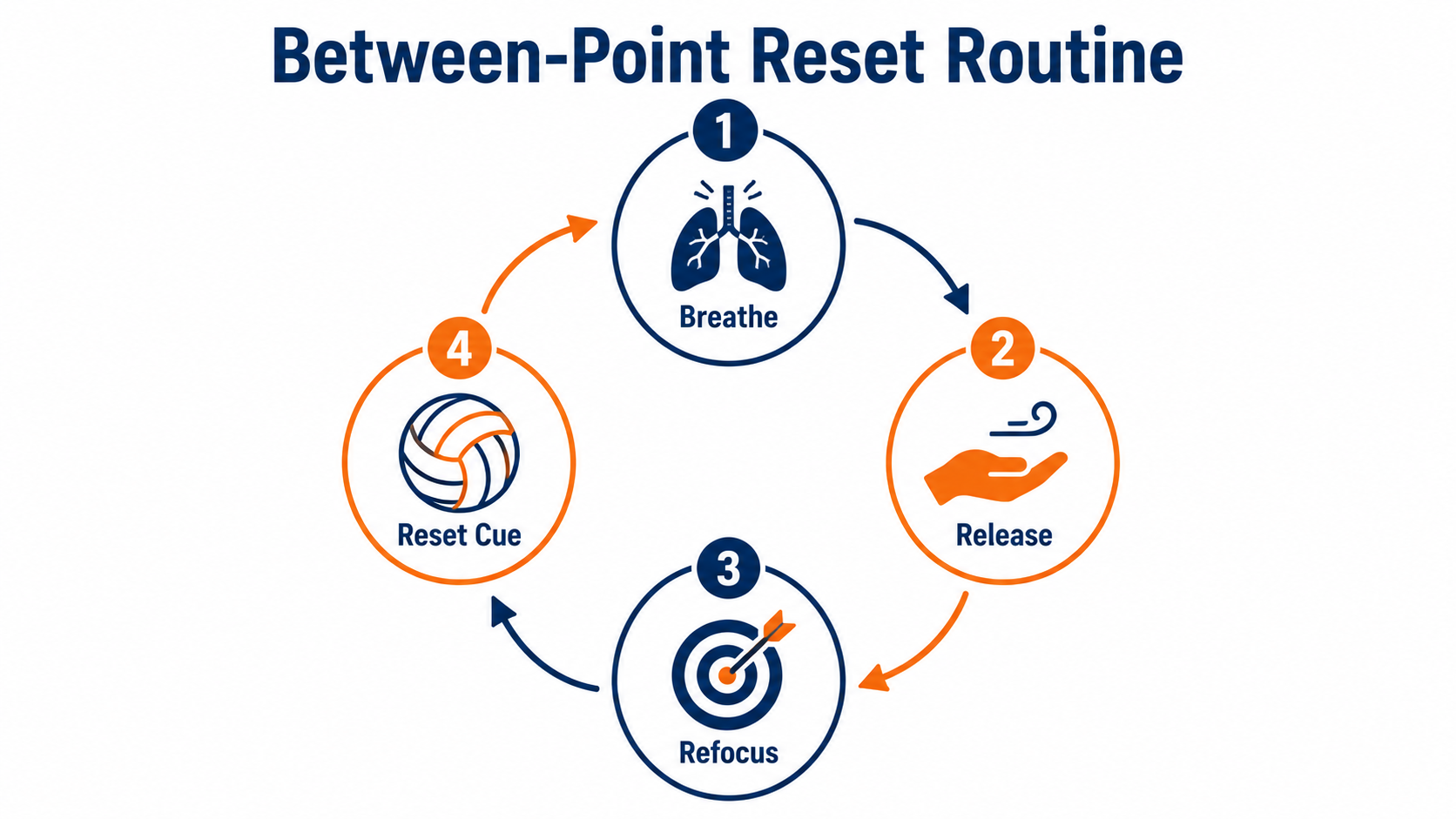
A brief reset between points, such as a breath cycle or physical cue, helps players let go of the previous play and refocus.
Post-Game Reflection
Reflecting after a game, win or lose, helps reinforce lessons learned and supports continuous improvement.
Suggested drills for volleyball mindset training include:
- Breathing exercises
- Visualization
- Confidence journaling
- Focus cues
- Reflection questions
Common Mindset Mistakes Volleyball Players Make
Fear of Making Mistakes
This mistake happens when players prioritize avoiding errors over playing confidently. It can be addressed by reframing mistakes as feedback rather than failure, and prevented through consistent exposure to low-pressure practice reps that build comfort with risk.
Comparing Yourself With Others
Constant comparison often stems from focusing on outcomes rather than personal progress. Fixing it involves setting individual improvement goals, and prevention comes from tracking personal metrics instead of ranking against teammates.
Losing Confidence After One Bad Play
This often happens when a single error is allowed to define an entire mindset. A quick reset routine can fix it in the moment, and regular resilience practice helps prevent it from recurring.
Chasing Perfection
Perfectionism usually stems from fear of judgment or failure. It can be addressed by focusing on effort-based goals, and prevented by setting realistic, process-oriented expectations.
Ignoring Recovery and Rest
Skipping recovery often happens when players equate rest with a lack of dedication. Prioritizing sleep and downtime fixes the issue, and scheduling recovery as part of training prevents burnout.
Volleyball Mindset During Tryouts
Preparing Mentally Before Tryouts
Mental preparation before tryouts includes visualization, realistic goal setting, and reviewing fundamentals to build confidence going in.
Staying Calm Under Evaluation
Staying calm during mindset volleyball tryouts situations relies on controlled breathing and focusing on individual plays rather than the overall outcome.
Recovering After Mistakes
Quick recovery after a tryout mistake demonstrates resilience, which evaluators often value as much as technical skill.
Standing Out Through Attitude
Confidence, communication, coachability, and composure often stand out to coaches as much as raw ability, since these traits signal how a player will fit into a team environment.
Mental Skills vs Physical Volleyball Skills
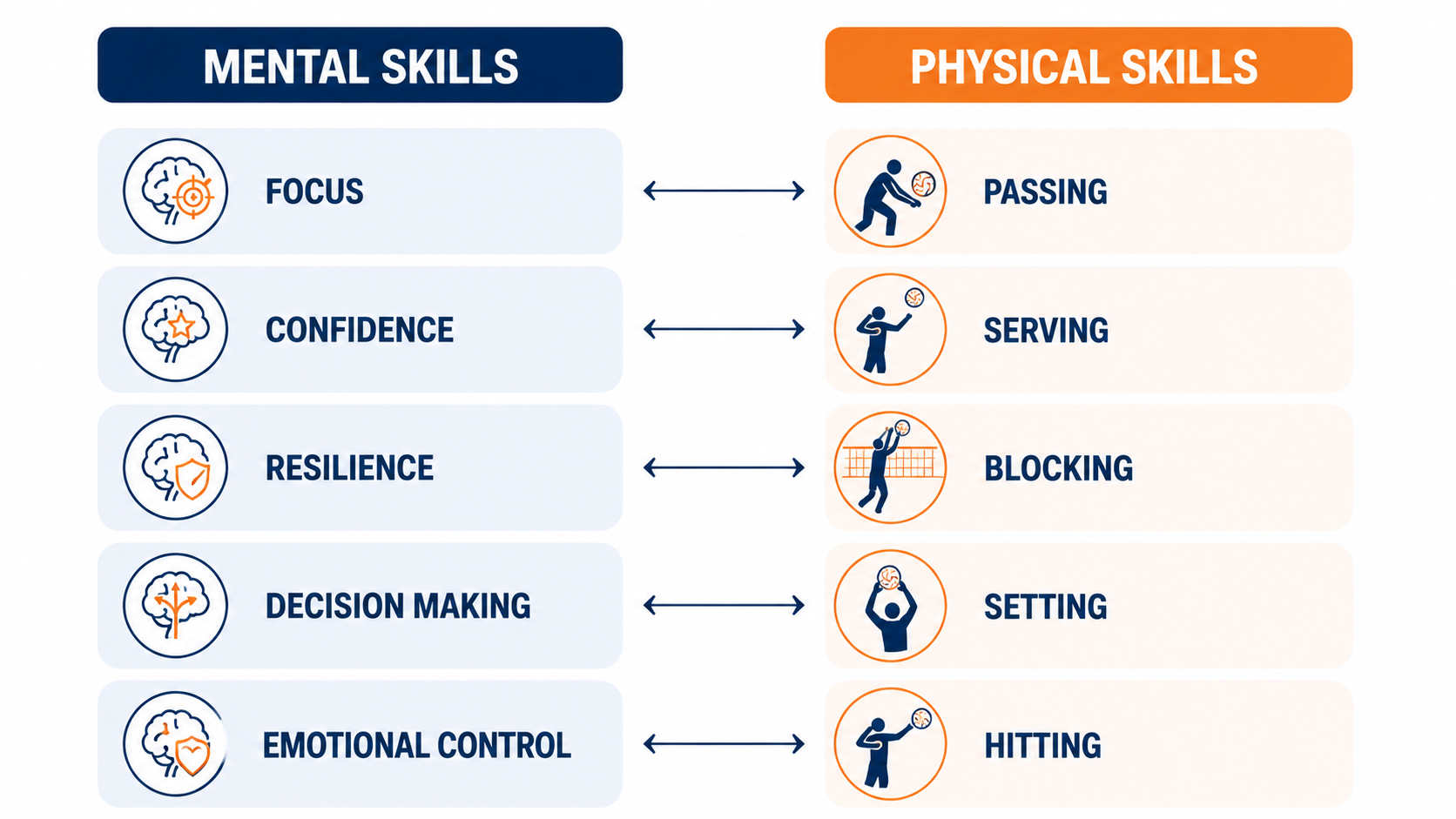
Mental and physical skills work together rather than competing for priority. Strong volleyball fundamentals and techniques of volleyball, from serving to blocking, still require mental focus and composure to execute consistently.
| Mental Skills | Physical Skills |
|---|---|
| Focus | Passing |
| Confidence | Serving |
| Resilience | Blocking |
| Decision Making | Setting |
| Emotional Control | Hitting |
Effective volleyball coaching techniques and athlete training programs typically pair physical skill development, such as volleyball moves and techniques, with intentional mindset work. Players who understand both the skills in volleyball and the mental side of the game tend to progress faster than those who train only one dimension. Common tips for playing volleyball almost always include some element of mental preparation alongside physical drills.
How Coaches Can Build a Strong Team Mindset
Creating a Growth-Oriented Culture
Coaches build a growth-oriented culture by normalizing mistakes as part of the learning process and celebrating effort alongside outcomes.
Giving Effective Feedback
Specific, actionable feedback delivered constructively helps players improve without damaging confidence.
Encouraging Accountability
Holding players accountable for effort and preparation, rather than only results, builds a stronger sense of ownership within the team.
Building Trust Between Players
Trust develops through consistent communication, shared goals, and coaches who model composure under pressure. Strong leadership and team confidence often start with how coaches respond to team-wide mistakes.
Recommended Learning Resources for Volleyball Mindset
Books That Teach Mental Performance
Books focused on volleyball mental toughness, including titles sometimes referred to as a volleyball mindset book, cover topics like confidence building, focus training, and recovering from setbacks. The Art of the Game volleyball mindset resources are among the materials athletes use to deepen their mental approach.
Workbooks for Reflection and Practice
A volleyball mindset workbook typically offers structured exercises, such as guided journaling prompts and goal-setting templates, that help players apply mental training concepts consistently.
Inspirational Quotes and Daily Motivation
Volleyball mindset quotes can serve as short daily reminders that reinforce key mental principles, such as resilience and focus, without requiring extensive reading time.
Difficulty & Time Investment
Volleyball mindset training is beginner-friendly and does not require prior psychological expertise. Most exercises, such as breathing techniques or brief reflection, take only a few minutes daily. Weekly commitment can range from short daily check-ins to more structured 20–30 minute sessions for competitive athletes. Difficulty and consistency needed depend on individual factors such as competition level, personal discipline, and access to coaching support. Short-term commitment might involve building a single pre-match routine, while long-term commitment involves sustaining mental training habits across an entire season or career.
Results Timeline
Some mental shifts, such as reduced pre-match anxiety from a new breathing routine, can appear within days. Improvements in focus and emotional control during rallies typically develop over several weeks of consistent practice. Long-term traits, such as sustained mental toughness and resilience under high-pressure competition, generally take months of continued training to fully develop. Individual progress varies based on prior experience, consistency of practice, and the level of competition a player faces.
Practice Guide
Daily Mental Routine
A short daily routine, such as a few minutes of visualization or journaling, helps reinforce mindset skills consistently.
Weekly Review
A weekly review session allows players to assess progress, identify recurring challenges, and adjust upcoming goals.
Tracking Progress
Simple tracking methods, such as a confidence journal or practice log, help players see mental growth over time, similar to how physical skills are tracked.
Staying Motivated
Motivation is easier to sustain when goals are specific, progress is visible, and setbacks are treated as feedback rather than failure.
Adapting Training to Different Schedules
Mental training can be adapted to fit tight schedules by shortening exercises, such as using a two-minute breathing routine instead of a longer session, without losing effectiveness.
Sustainable mindset practice often includes journaling, visualization, goal tracking, accountability check-ins, recovery time, and habits that fit realistically into a player’s schedule.
Frequently Overlooked Factors Affecting Volleyball Mindset
Sleep and Recovery
Poor sleep reduces focus, emotional regulation, and reaction time, all of which directly affect on-court mental performance.
Nutrition and Hydration
Inconsistent nutrition and hydration can contribute to fatigue and reduced concentration during long matches or practices.
Communication With Teammates
Open communication reduces misunderstandings and supports collective confidence, especially during high-pressure moments.
Coaching Environment
A supportive coaching environment reinforces a growth mindset, while an overly critical environment can increase fear of mistakes.
Family and Social Support
Encouragement from family and social circles can influence a player’s confidence and motivation, particularly for younger or developing athletes.
Conclusion
A strong volleyball mindset combines confidence, focus, emotional control, resilience, and a willingness to learn from mistakes. These mental skills work alongside physical training, not separately from it, and they can be developed through consistent, intentional practice at any skill level. Whether a player is just learning volleyball or competing at an elite level, building a reliable volleyball mindset supports steadier performance, faster recovery from setbacks, and long-term growth. Combining mindset development with technical training gives players the most complete path toward consistent, confident performance on the court.
Frequently Asked Questions
What is a volleyball mindset?
A volleyball mindset is the combination of thoughts, beliefs, and emotional responses that shape how a player performs, communicates, and recovers from mistakes during competition.
How can I improve my volleyball mindset?
Improving a volleyball mindset involves consistent practice of mental skills such as visualization, positive self-talk, goal setting, and structured pre- and post-match routines.
What is the difference between a growth mindset and a fixed mindset in volleyball?
A growth mindset views mistakes as opportunities to improve, while a fixed mindset treats ability as unchangeable and often leads to fear of failure.
Why is mental toughness important in volleyball?
Mental toughness allows players to maintain focus and composure under pressure, helping them perform consistently even during high-stakes or difficult moments in a match.
How do volleyball players stay confident after making mistakes?
Players stay confident after mistakes by using quick reset routines, such as controlled breathing or a focus cue, and by reframing errors as feedback rather than failure.
Can beginners develop a strong volleyball mindset quickly?
Beginners can start building a stronger mindset quickly through simple habits like positive self-talk and short reflection routines, though deeper mental toughness typically develops over weeks and months of consistent practice.
What mental habits do professional volleyball players practice?
Professional players commonly practice visualization, structured pre-match routines, emotional regulation techniques, and consistent post-match reflection to maintain a stable, high-performing mindset.
How can coaches help athletes build a stronger volleyball mindset?
Coaches can support mindset development by creating a growth-oriented team culture, giving specific and constructive feedback, encouraging accountability, and building trust through consistent communication.