

Introduction
A tunnel vision mindset is a pattern of thinking in which a person’s attention narrows so tightly on one idea, outcome, or worry that other options, facts, or perspectives become difficult to see. The term borrows from the physical condition of tunnel vision, where peripheral sight is lost, but in psychology it describes a mental narrowing rather than a visual one. This article focuses on the psychological mindset — how it forms, why it matters, and how it can be reduced — while briefly distinguishing it from the literal medical condition. Understanding this pattern matters because it quietly shapes decisions at work, in relationships, and during high-pressure moments, often without the person realizing it is happening.
Quick Summary
- Tunnel vision mindset is a pattern of overly narrow thinking that limits awareness of alternative perspectives.
- It commonly appears during stress, anxiety, emotional conflict, high-pressure situations, and goal pursuit.
- Psychology recognizes tunnel vision as a form of cognitive narrowing that can contribute to thinking errors and poor decisions.
- Developing cognitive flexibility helps reduce tunnel vision and improves problem-solving and relationships.
What Is a Tunnel Vision Mindset?
Tunnel Vision Mindset Meaning
Tunnel vision mindset meaning refers to a state of mental focus so narrow that a person stops registering information outside their immediate concern. Attention becomes fixed on one goal, fear, or outcome, while surrounding context, alternative solutions, and conflicting evidence fade into the background. This differs from ordinary concentration: healthy focus can be redirected when new information appears, while tunnel vision resists that redirection. Temporary focus — such as concentrating on a task for an hour — is normal and useful. Unhealthy mental narrowing becomes a problem when it persists across situations, blocks reconsideration, and leads to consistently one-sided judgments.
What Does Tunnel Vision Mean in Everyday Life?
In everyday language, “tunnel vision” describes someone who is so fixated on one thing that they overlook everything else around them. At work, it might mean chasing one project while ignoring team feedback. In education, a student may fixate on a single grading outcome rather than the broader learning process. In sports, an athlete may focus so intensely on winning that they miss teammates’ cues. In parenting, a parent might narrow in on one behavior issue and lose sight of a child’s overall development. People also use the phrase metaphorically to describe anyone who is “locked in” on a single goal to the exclusion of context — a workplace deadline, a personal ambition, or a relationship conflict.
Tunnel Vision in Psychology
How Psychology Explains Tunnel Vision
Psychology explains tunnel vision through the concept of selective attention — the brain’s tendency to prioritize certain stimuli while filtering out others. Under stress or emotional intensity, this filtering becomes exaggerated, a process often described as cognitive narrowing. Emotional states such as fear or anger further shape perception, making threatening or emotionally charged information more prominent while neutral or contradictory details are suppressed. Executive functioning — the brain’s system for planning, weighing options, and shifting attention — normally counteracts this narrowing. When executive control weakens under pressure, cognitive flexibility (the ability to shift perspective and consider alternatives) declines, and tunnel vision becomes more likely. This process is a well-documented part of broader mindset psychology, which explores how attention, emotion, and belief systems shape the way people interpret situations.
Tunnel Vision vs Healthy Focus
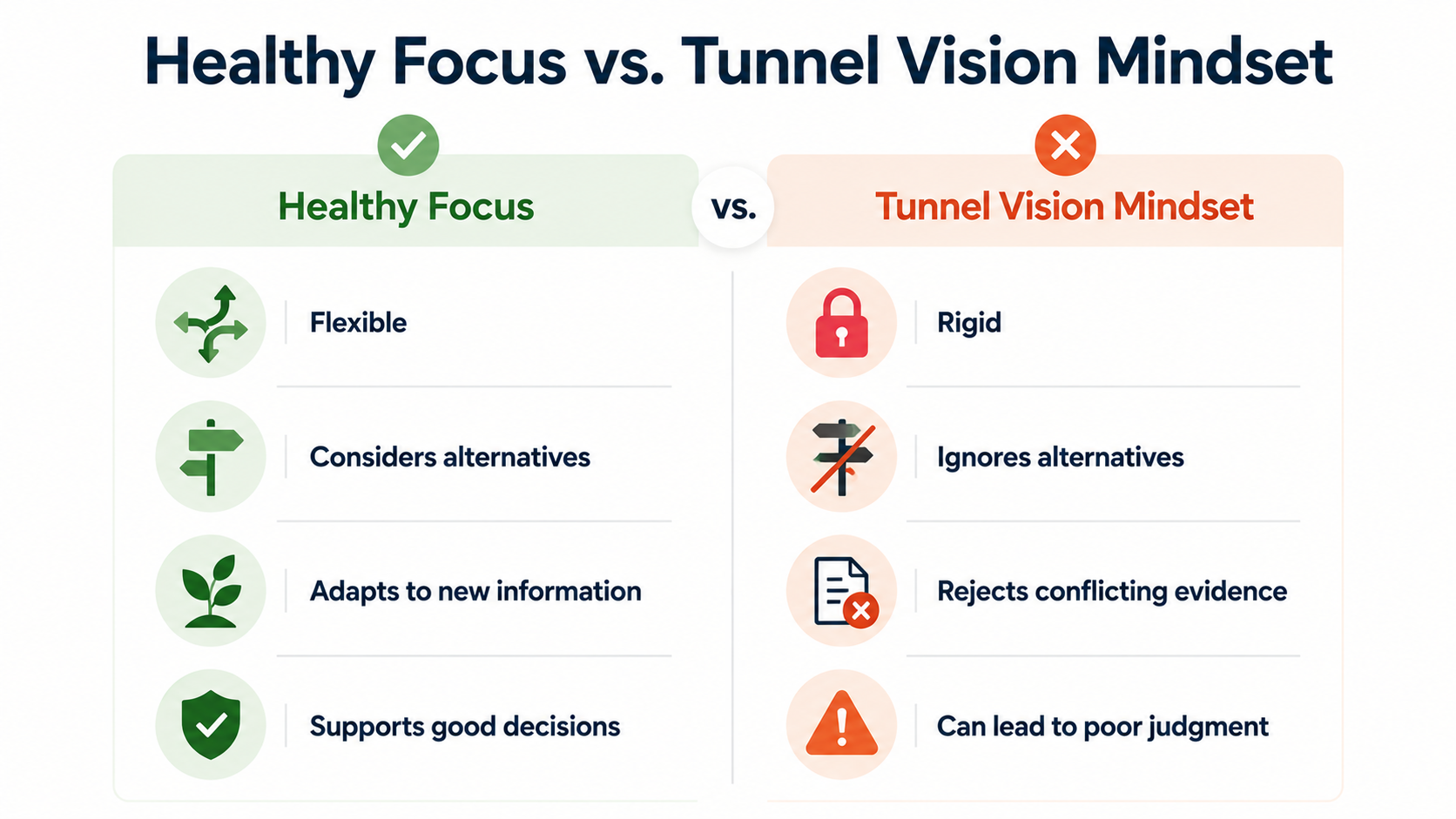
Focus itself is beneficial — it allows deep work, skill development, and follow-through on goals. The distinction lies in whether that focus remains adaptable. Healthy focus narrows attention temporarily but stays open to new information. Tunnel vision mindset becomes rigid, filtering out anything that challenges the current view.
| Healthy Focus | Tunnel Vision Mindset |
|---|---|
| Flexible | Rigid |
| Considers alternatives | Ignores alternatives |
| Adapts to new information | Rejects conflicting evidence |
| Supports good decisions | Can lead to poor judgment |
What Causes a Tunnel Vision Mindset?
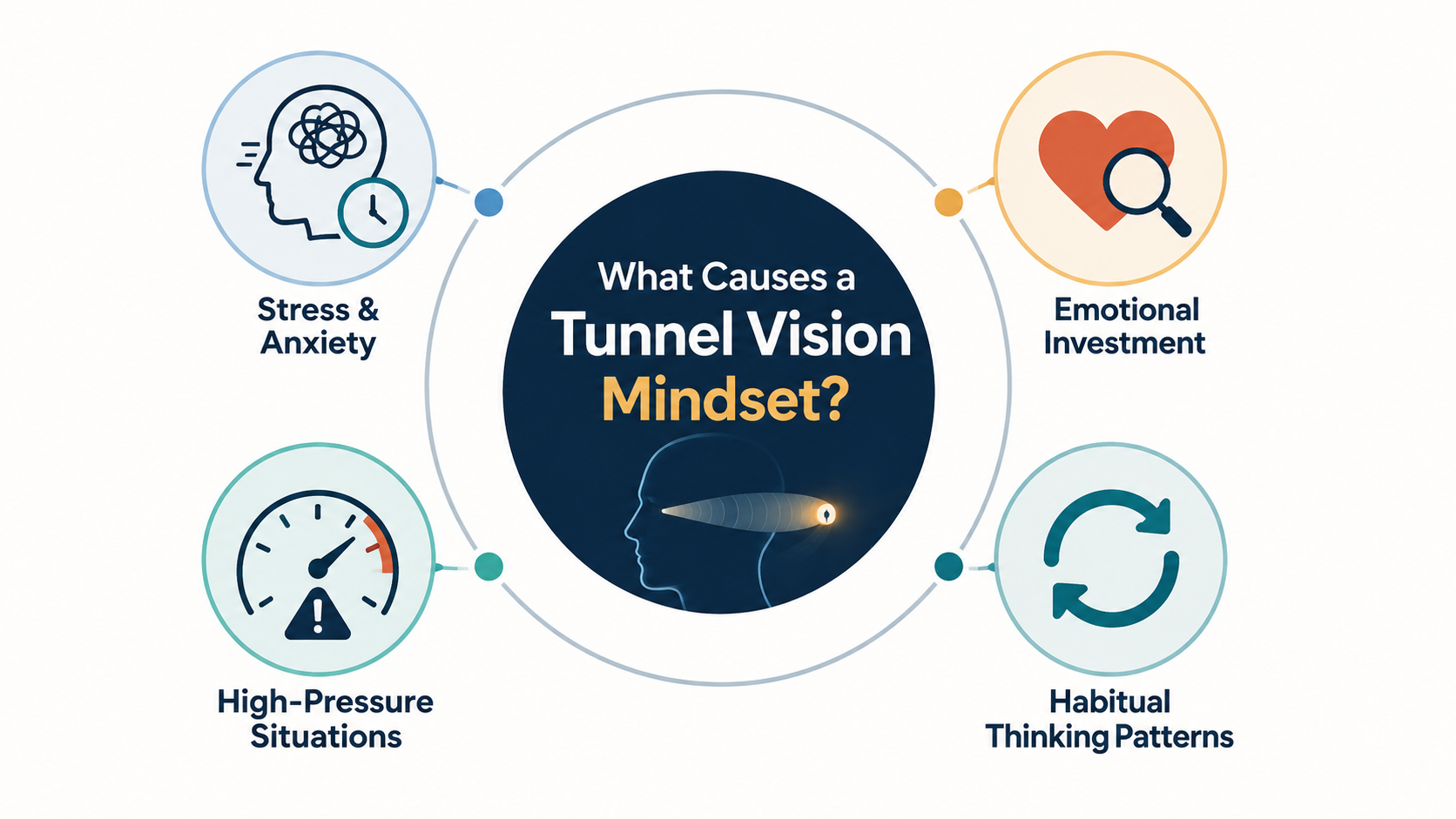
Stress and Anxiety
Stress activates survival-oriented responses that prioritize immediate threats over broader context. This is adaptive in genuine emergencies, but in everyday stress or tunnel vision anxiety mindset situations, it narrows perspective unnecessarily — reducing the brain’s capacity to weigh long-term consequences or alternative solutions.
Emotional Investment
Strong emotional attachment to an outcome — driven by fear, perfectionism, or confirmation bias — makes it harder to consider evidence that contradicts a preferred belief or desired result.
High-Pressure Situations
Tunnel vision frequently intensifies during:
- Tight deadlines
- Emergencies requiring fast decisions
- Competitive environments
- Personal conflict with high emotional stakes
Habitual Thinking Patterns
Repeated mental shortcuts, automatic thinking, and long-held beliefs can create default narrow perspectives that activate without conscious awareness, reinforcing a limited view over time.
Tunnel Vision Thinking Errors
What Is the Tunnel Vision Thinking Error?
The tunnel vision thinking error is a cognitive distortion in which a person treats one interpretation, outcome, or piece of evidence as the complete picture. It limits reasoning by discouraging consideration of alternative explanations, which can lead to flawed conclusions and repeated mistakes in judgment.
Tunnel Vision in CBT
Cognitive Behavioral Therapy (CBT) identifies tunnel vision as a distorted thinking pattern related to selective abstraction — focusing on one detail while ignoring the broader context. CBT addresses this through reframing techniques: identifying the narrowed thought, examining supporting and contradicting evidence, and consciously generating alternative interpretations to restore balanced thinking.
Common Examples of a Tunnel Vision Mindset
Workplace Examples
An employee fixated on a single metric may overlook team morale, long-term strategy, or client relationships that matter just as much to overall success.
Academic Examples
A student overly focused on one exam grade may ignore broader learning goals, feedback from instructors, or alternative study approaches that would serve them better long-term.
Relationship Examples
Tunnel vision mindset in relationships often appears as miscommunication, where one partner assumes intent based on limited information, reacts emotionally, and fails to consider the other person’s perspective.
Personal Growth Examples
Someone pursuing a single self-improvement goal — such as weight loss or a promotion — may ignore other important areas of life, including rest, relationships, or mental health.
Decision-Making Examples
Tunnel vision mindset examples in decision-making include narrowing choices prematurely, ignoring available evidence, and relying on emotional reasoning rather than a full evaluation of options.
The Tunnel Vision Trap: Why Narrow Thinking Can Become a Cycle
The tunnel vision trap describes how narrow thinking reinforces itself over time. A fixed belief leads to selectively noticing confirming evidence (confirmation bias), which strengthens the belief further. This reduces learning opportunities, since contradictory feedback is dismissed rather than absorbed. Poor decision loops form as the same narrow strategy is repeated despite weak results, and opportunities outside the narrow focus are consistently missed. Breaking this cycle requires deliberately introducing new information and perspectives.
Signs You May Have a Tunnel Vision Mindset
Common Behavioral Indicators
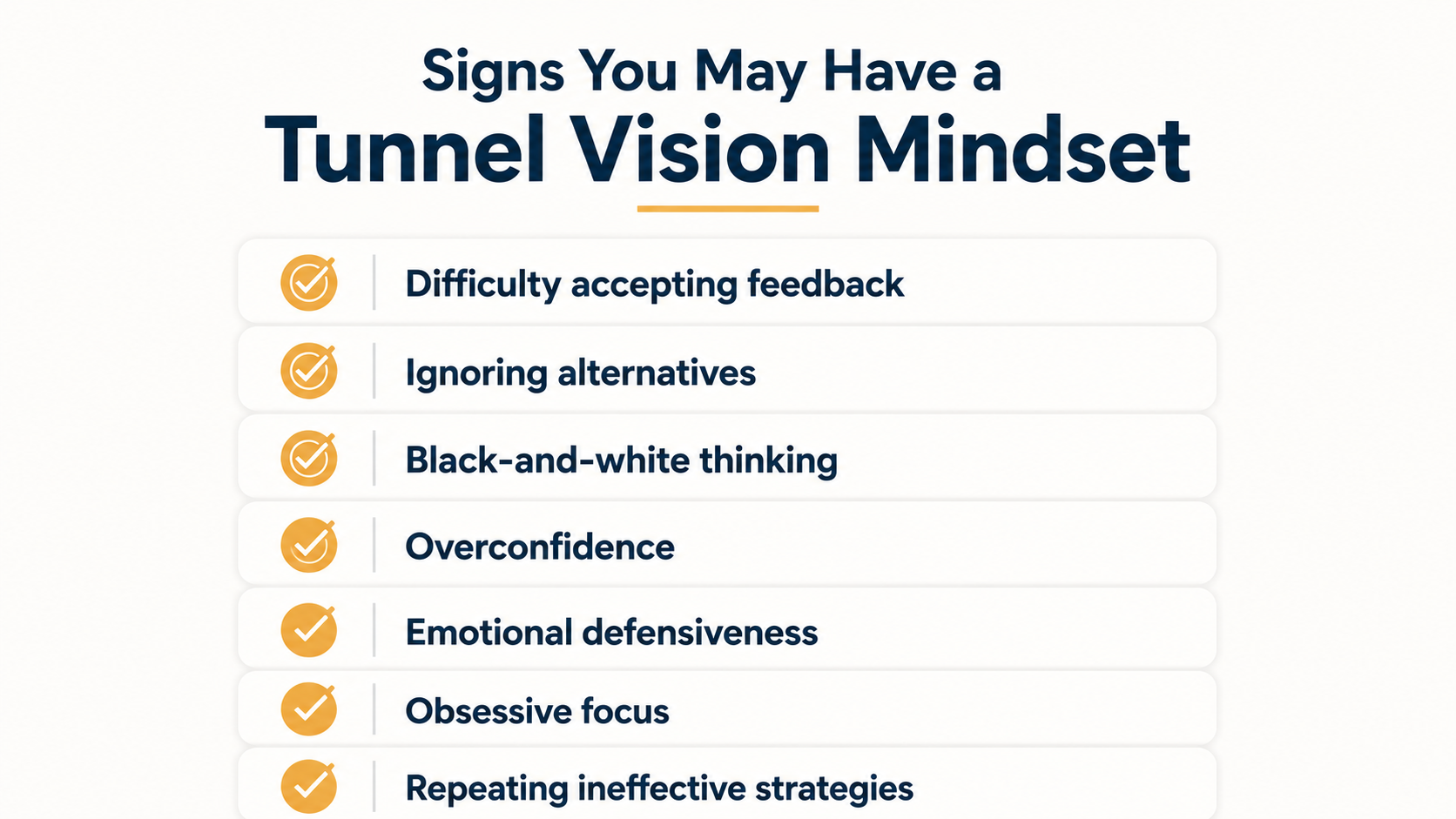
- Difficulty accepting feedback
- Ignoring alternatives or dismissing them quickly
- Black-and-white thinking
- Overconfidence in one interpretation
- Emotional defensiveness when challenged
- Obsessive focus on a single outcome
- Repeating ineffective strategies despite poor results
Can a Tunnel Vision Mindset Test Help?
An informal tunnel vision mindset test can offer a starting point for self-reflection by highlighting patterns such as rigidity or resistance to feedback. However, online quizzes have real limitations: they cannot diagnose a condition, account for context, or replace professional evaluation. They are best used as a prompt for honest reflection rather than a definitive assessment.
How to Stop Tunnel Vision Mentality
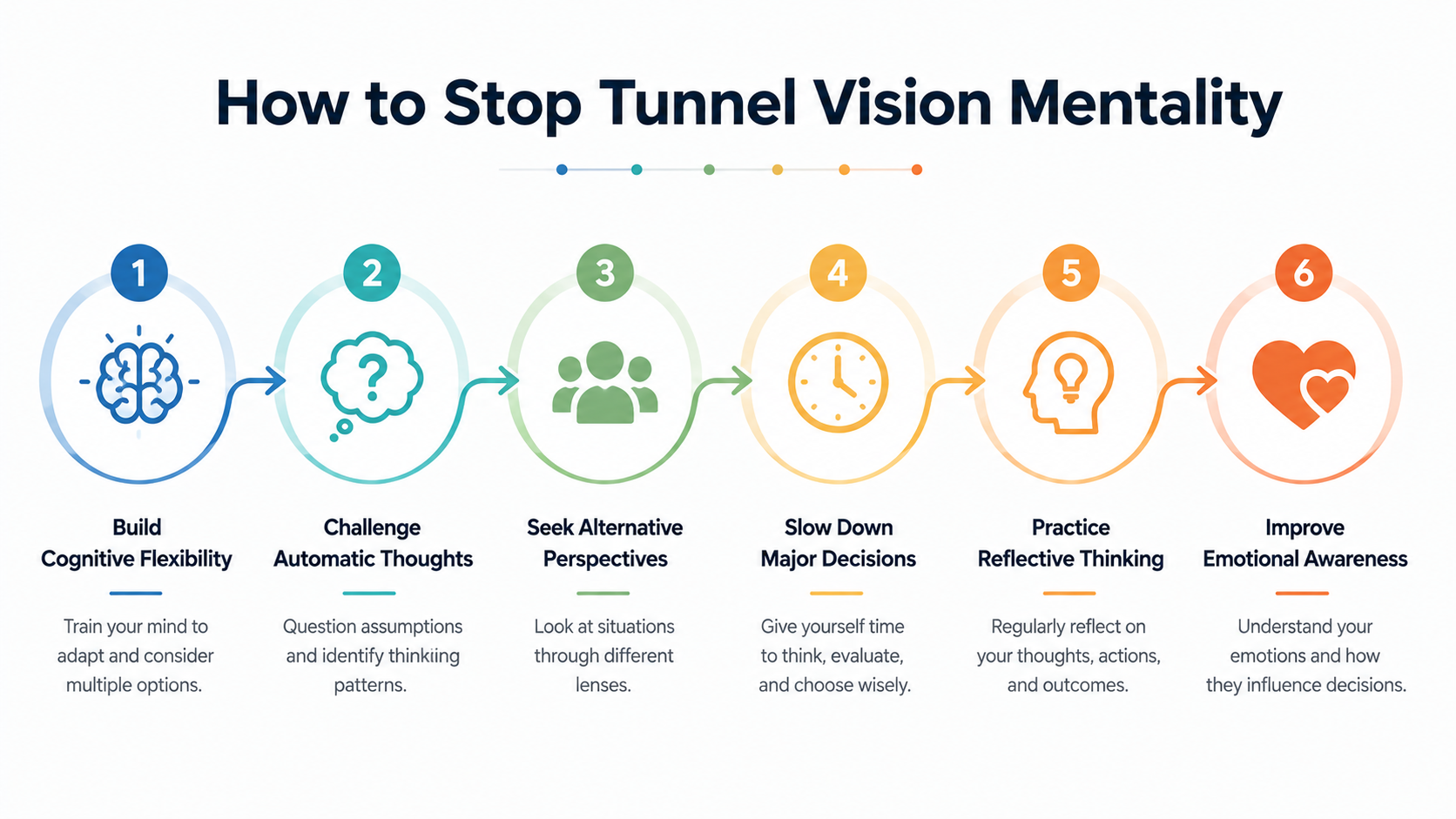
Learning how to stop tunnel vision mentality involves building habits that restore flexibility to attention and judgment.
Build Cognitive Flexibility
- Practice deliberately switching between tasks or viewpoints
- Ask “what else could explain this?” before concluding
Challenge Automatic Thoughts
- Pause before accepting the first interpretation of a situation
- Write down the automatic thought and test it against evidence Learning how to change your thoughts is one of the most effective ways to interrupt automatic, narrowed thinking before it hardens into a fixed belief.
Seek Alternative Perspectives
- Ask trusted colleagues, friends, or mentors for their view
- Actively read or listen to opinions that differ from your own
Slow Down Major Decisions
- Introduce a waiting period before finalizing important choices
- List at least two alternative options before deciding
Practice Reflective Thinking
- Set aside time to review recent decisions and their reasoning
- Identify moments where perspective may have narrowed
Improve Emotional Awareness
- Notice when strong emotions are influencing focus
- Use brief grounding techniques to reduce reactive narrowing before making decisions
Tunnel Vision in Different Contexts
Relationships
Tunnel vision in relationships often centers on assumptions about a partner’s intentions, making perspective-taking essential for resolution.
Career
In careers, tunnel vision can mean over-prioritizing one project or metric at the expense of broader professional development.
Leadership
Leaders with tunnel vision may over-focus on a single strategy, missing team input or market signals that suggest a different direction.
Learning
In learning environments, tunnel vision can narrow a student’s approach to one method of studying, reducing overall understanding.
Gaming
Tunnel vision gaming refers to a player becoming so absorbed in one objective — such as an enemy or target — that situational awareness of the broader game environment drops. This usage overlaps with, but is somewhat distinct from, the psychological mindset discussed throughout this article, since it is often tied to attentional load rather than emotional narrowing. Reducing it typically involves practicing peripheral awareness drills and intentionally scanning surroundings.
Related Terms and Similar Concepts
| Term | Meaning | Difference from Tunnel Vision |
|---|---|---|
| Selective attention | The brain’s process of prioritizing certain stimuli over others | A broader cognitive mechanism; tunnel vision is an exaggerated form of it |
| Confirmation bias | The tendency to favor information that confirms existing beliefs | Focuses on belief reinforcement rather than general attentional narrowing |
| Cognitive distortion | An inaccurate or exaggerated thinking pattern | A wider category of thinking errors; tunnel vision is one specific type |
| Mental fixation | A persistent, hard-to-shift focus on one idea | Emphasizes persistence over time rather than narrowed awareness in the moment |
| Narrow thinking | A general term for limited perspective-taking | Tunnel vision mindset is a specific, more intense form of narrow thinking |
Related phrasing such as “tunnel thinking,” “tunnel visioned,” and “tunnelled vision” all describe variations of this same narrowed attentional pattern.
Common Misconceptions About Tunnel Vision
- Myth: Tunnel vision always means poor focus. In reality, it involves strong focus that has become too rigid, not an absence of focus.
- Myth: Highly focused people always have tunnel vision. Healthy focus remains adaptable; tunnel vision specifically involves resistance to new information.
- Myth: Tunnel vision only happens during anxiety. It can also occur during excitement, ambition, or overconfidence, not only negative emotional states.
- Myth: It is a permanent personality trait. Tunnel vision is a situational thinking pattern that can change with awareness and practice.
- Myth: It always indicates a mental health disorder. While it can appear alongside certain conditions, tunnel vision mindset is a common thinking pattern that most people experience at times, not necessarily a clinical symptom.
Beginner Mistakes When Trying to Overcome Tunnel Vision
- Trying to force positive thinking, which can suppress rather than genuinely reframe narrow thoughts
- Ignoring emotional triggers that caused the narrowing in the first place
- Seeking only confirming opinions from others instead of genuinely differing perspectives
- Making rushed decisions to escape discomfort rather than slowing down to reassess
- Expecting immediate change, which can lead to discouragement when flexibility takes consistent practice to build
Practical Strategies for Building a More Flexible Mindset
Daily Reflection Habits
Spend a few minutes each day reviewing decisions and noting where perspective may have narrowed.
Journaling Questions
Useful prompts include: “What am I not considering right now?” and “What would someone with a different view say about this situation?” For a deeper starting point, explore these journaling prompts for self growth, which can help surface blind spots that a narrowed mindset tends to overlook.
Perspective-Taking Exercises
Deliberately argue the opposing side of a belief or decision to surface overlooked considerations.
Decision Review Checklist
Before finalizing a decision, confirm that alternatives were considered, evidence was reviewed objectively, and emotional influence was accounted for.
Building Better Thinking Habits
Consistency matters more than intensity. Small, repeated practices — such as regularly seeking outside input — build lasting cognitive flexibility over time.
Difficulty & Time Investment
For most people, reducing a tunnel vision mindset is a beginner-friendly practice that does not require specialized training, though it does require consistent self-awareness. Typical effort involves short daily reflection habits rather than intensive time commitments. More advanced variations, such as structured CBT-based reframing, may involve guided practice with a therapist. Personal factors — including baseline stress levels, emotional intensity of triggering situations, and existing self-awareness skills — influence how much effort the process takes for a given individual.
Results Timeline
Early improvements, such as noticing narrowed thinking in the moment, often appear within days to a few weeks of consistent practice. Medium-term changes — including more consistent perspective-taking and reduced emotional reactivity — tend to develop over several weeks to a few months. Long-term cognitive flexibility, where broader thinking becomes a more automatic default, typically develops over months of sustained practice. Progress pace varies based on stress levels, life circumstances, and how consistently reflection habits are maintained.
Practice Guide
In our experience helping readers build better habits, the most effective approach to reducing tunnel vision combines a few core elements:
- Daily routine: A brief daily check-in reviewing one decision or reaction for signs of narrowed thinking
- Weekly review: A longer weekly reflection identifying recurring patterns or triggers
- Tracking mindset shifts: Keeping a simple journal or log to track when flexibility was practiced successfully
- Accountability methods: Sharing goals with a trusted friend, mentor, or coach who can offer outside perspective
- Long-term maintenance: Revisiting the practice periodically, especially during high-stress periods when tunnel vision is more likely to resurface
- Adapting practices for different lifestyles: Busy schedules may call for shorter, more frequent check-ins, while those with more available time may benefit from deeper weekly reflection sessions
Your Daily Thrive recommends starting with just one habit — such as a two-minute daily reflection — rather than attempting to implement every strategy at once, since sustainable change tends to come from small, consistent practices rather than large initial efforts.
Conclusion
A tunnel vision mindset is a pattern of narrowed thinking that limits awareness of alternatives, often triggered by stress, strong emotions, or high-pressure situations. Psychology explains this through selective attention, cognitive narrowing, and reduced cognitive flexibility, and recognizes it as a thinking error that can contribute to poor decisions when left unaddressed. Practical strategies — including challenging automatic thoughts, seeking alternative perspectives, and building consistent reflection habits — can meaningfully reduce tunnel vision over time. Developing a more flexible, tunnel-vision-aware mindset supports better decision-making, stronger relationships, greater emotional resilience, and long-term personal growth.
Frequently Asked Questions (FAQs)
What is a tunnel vision mindset?
A tunnel vision mindset is a pattern of narrow thinking in which a person becomes so focused on one idea or outcome that they lose awareness of alternative perspectives, evidence, or options.
What causes tunnel vision in psychology?
Tunnel vision in psychology is commonly caused by stress, strong emotional investment, high-pressure situations, and habitual thinking patterns that reduce cognitive flexibility.
Is tunnel vision related to anxiety?
Yes, anxiety is a common trigger for tunnel vision mindset, since heightened stress responses tend to narrow attention onto perceived threats while filtering out broader context.
What is the difference between tunnel vision and healthy focus?
Healthy focus remains adaptable and open to new information, while tunnel vision mindset becomes rigid and resists reconsidering alternatives even when evidence suggests they matter.
Can Cognitive Behavioral Therapy help with tunnel vision?
Yes, CBT helps by identifying tunnel vision as a distorted thinking pattern and using reframing techniques to encourage more balanced, evidence-based interpretations.
How do I stop tunnel vision mentality?
Stopping tunnel vision mentality involves building cognitive flexibility, challenging automatic thoughts, seeking alternative perspectives, slowing down major decisions, and improving emotional awareness.
Is tunnel vision common in relationships?
Yes, tunnel vision mindset in relationships is common and often shows up as assumptions about a partner’s intentions without considering their actual perspective.
Why do gamers experience tunnel vision?
Gamers experience tunnel vision when intense focus on one objective reduces situational awareness of the broader game environment, which relates to attentional load as much as psychological narrowing.