
Introduction
A coding mindset is the way a programmer thinks through problems, not just the syntax they know. It is the combination of logical reasoning, structured problem-solving, and continuous learning that allows a developer to approach unfamiliar challenges with confidence. Programming success depends less on memorizing every command in a language and more on building habits that make code easier to plan, debug, and improve. This distinguishes a coding mindset from technical programming skills, which are language-specific and tool-based, while a mindset transfers across every project and platform a developer touches.
Quick Summary
- A coding mindset is a structured way of thinking that emphasizes problem-solving, logical reasoning, and continuous learning.
- Strong programmers rely on good coding practices, organized code, and iterative improvement—not just programming languages.
- Developing a coding mindset requires consistent practice, debugging experience, and applying programming best practices.
- Anyone can strengthen a coding mindset through deliberate learning and reflection.
What Is a Coding Mindset?
Coding Mindset Meaning Explained
The coding mindset meaning centers on how a person approaches a problem before writing a single line of code. It reflects computational thinking: breaking a task into smaller parts, spotting patterns, and designing a logical sequence of steps to reach a solution. In Indonesian search contexts, this concept is often searched as coding mindset adalah, referring to the same underlying idea—a way of thinking, not a specific skill set. This mindset underlies every stage of software development, from initial planning through testing and maintenance, and it applies regardless of which programming language or framework a developer eventually uses.
Why Mindset Matters More Than Memorizing Syntax
Experienced developers focus on reasoning because syntax details change constantly across languages, versions, and frameworks, while problem-solving logic does not. A developer who understands how to decompose a problem can pick up a new language in weeks, while someone who only memorizes commands struggles the moment the environment changes. This transferable thinking is why senior engineers often describe switching languages as “learning new vocabulary” rather than “learning a new skill”—the underlying grammar of logic stays the same.
What Are the Attributes of a Coding Mindset?
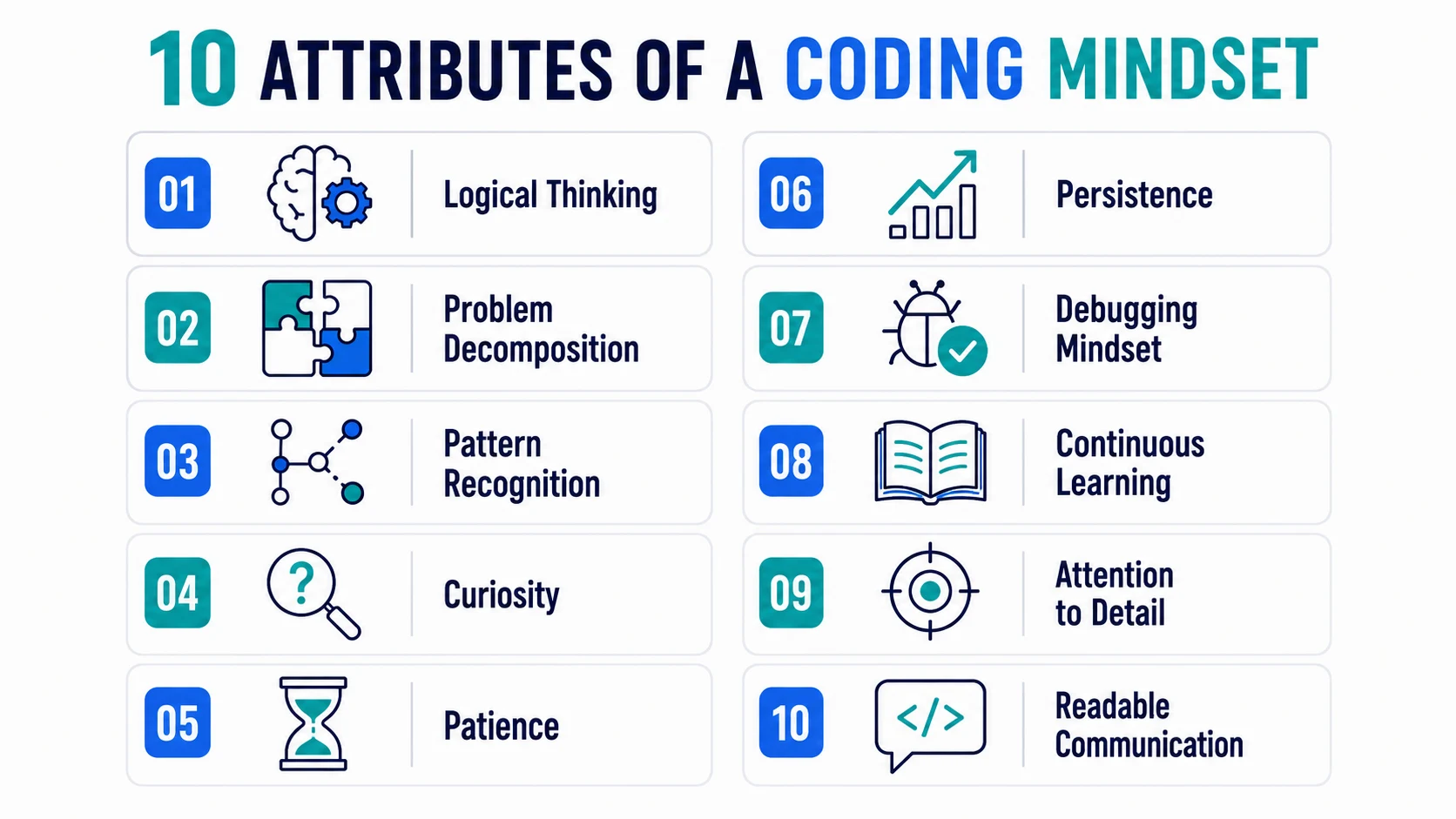
The attributes of a coding mindset include logical thinking, problem decomposition, and a willingness to learn continuously. Each trait supports a different part of the development process, from initial planning to long-term code maintenance.
- Logical thinking — structuring steps in a clear, cause-and-effect sequence.
- Problem decomposition — breaking large problems into smaller, manageable pieces.
- Pattern recognition — identifying recurring structures across different problems.
- Curiosity — exploring why something works, not just that it works.
- Patience — accepting that solutions often take multiple attempts.
- Persistence — continuing through errors instead of abandoning a task.
- Debugging mindset — treating errors as diagnostic information.
- Continuous learning — staying current with evolving tools and practices.
- Attention to detail — catching small errors before they become larger issues.
- Readable communication through code — writing code other people (and future you) can understand.
How to Develop a Coding Mindset
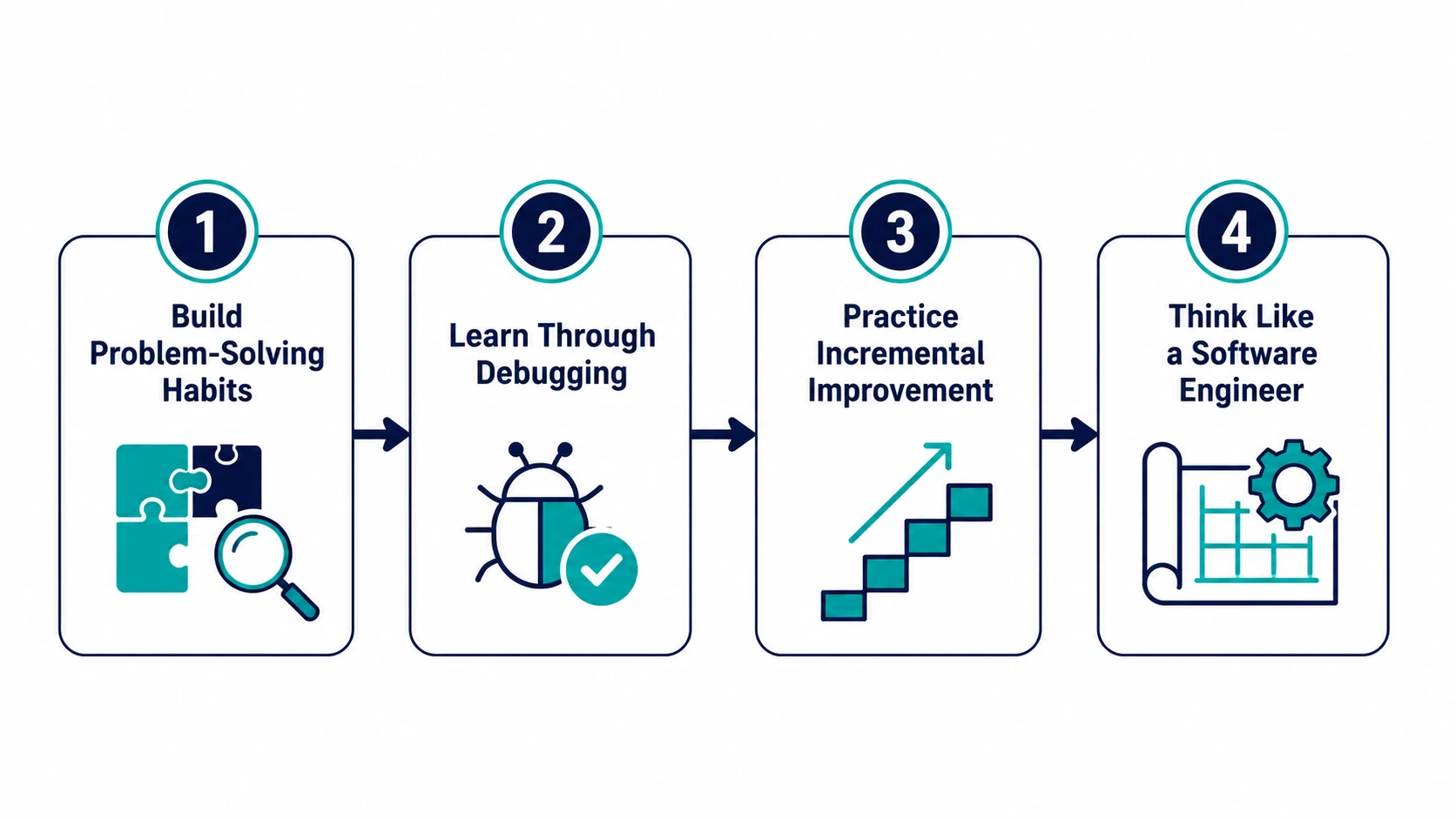
Learning how to develop a coding mindset involves consistent practice across four areas: problem-solving habits, debugging exposure, incremental improvement, and engineering-level thinking. In our experience helping readers build better habits, the developers who progress fastest are the ones who treat each of these as a daily practice rather than a one-time lesson.
Build Strong Problem-Solving Habits
Strong problem-solvers break large problems into smaller components before writing code. This includes thinking through the logic first, planning an algorithm on paper or in pseudocode, and only then translating that plan into a programming language. This sequence prevents wasted effort on code that solves the wrong problem.
Learn Through Debugging
Debugging improves reasoning because it forces a developer to trace logic step by step and compare expected behavior against actual behavior. Viewing bugs as feedback rather than failure keeps motivation intact and turns every error message into a learning opportunity instead of a setback.
Practice Incremental Improvement
Writing simple, working code first—then refactoring it later—is more effective than trying to write perfect code on the first attempt. Your Daily Thrive recommends treating early drafts as functional prototypes: get something working, then improve structure, naming, and efficiency in later passes. This iterative approach mirrors how professional software is actually built.
Think Like a Software Engineer
Mastering the coding mindset at a professional level means designing solutions that are maintainable, not just functional. This includes considering scalability (will this still work as the project grows?) and readability (will another developer understand this in six months?) before finalizing any implementation.
Coding Mindset Examples in Real Programming Situations
Concrete coding mindset examples show how the same principles apply at every skill level, from a first project to a production system.
Beginner Example
A beginner building a simple calculator or guessing game practices core logic: taking input, applying conditional rules, and producing output. The coding mindset here shows up in how the beginner handles unexpected input, such as a user entering text instead of a number.
Intermediate Example
An intermediate developer refactoring repetitive code into reusable functions demonstrates pattern recognition and the DRY (Don’t Repeat Yourself) principle in action, turning duplicated logic into a single, maintainable function.
Professional Example
A professional designing maintainable systems weighs trade-offs before implementation—balancing performance, cost, team familiarity, and long-term maintainability rather than choosing the first solution that works.
Coding Practices That Reinforce a Strong Programming Mindset
Daily coding practices reinforce mindset traits by turning abstract principles into concrete habits.
Write Readable Code
Readable code relies on clear naming conventions, consistency across a codebase, and simplicity over cleverness. A variable named userAge communicates intent instantly, while a variable named x does not.
Code Organization Principles
Code organization involves structuring files and modules logically, separating responsibilities so each file or function handles one concern, and maintaining a predictable folder structure. This reduces the time needed to locate and update specific functionality as a project grows.
Programming Best Practices and Principles Every Developer Should Know
Programming best practices and principles outlast individual languages because they describe how to structure logic well, not how to write specific syntax. A principle learned in one language remains useful even after switching to another.
- DRY (Don’t Repeat Yourself) — avoid duplicating logic across a codebase.
- KISS (Keep It Simple, Stupid) — favor straightforward solutions over unnecessary complexity.
- SOLID — a set of five design principles (Single Responsibility, Open/Closed, Liskov Substitution, Interface Segregation, Dependency Inversion) that guide maintainable object-oriented design.
- YAGNI (You Aren’t Gonna Need It) — avoid building features before they’re actually needed.
- Separation of concerns — keep different responsibilities in distinct parts of the code.
- Single responsibility — each function or module should do one thing well.
Coding Standards and Code Documentation
Why Coding Standards Improve Team Collaboration
A coding standards document creates consistency across a project, which makes code easier to maintain and reduces onboarding time for new team members. When every developer follows the same formatting and naming conventions, code reviews move faster and fewer misunderstandings occur.
Commenting Code Best Practices
Commenting code best practices center on explaining why code does something, not restating what it does. Comments help when they clarify intent, edge cases, or non-obvious decisions. They become harmful when they restate obvious code or go out of date after edits. Self-documenting code—achieved through clear naming and structure—often reduces the need for comments, while API documentation remains essential for describing how external functions should be used.
Coding Mindset vs Technical Skills
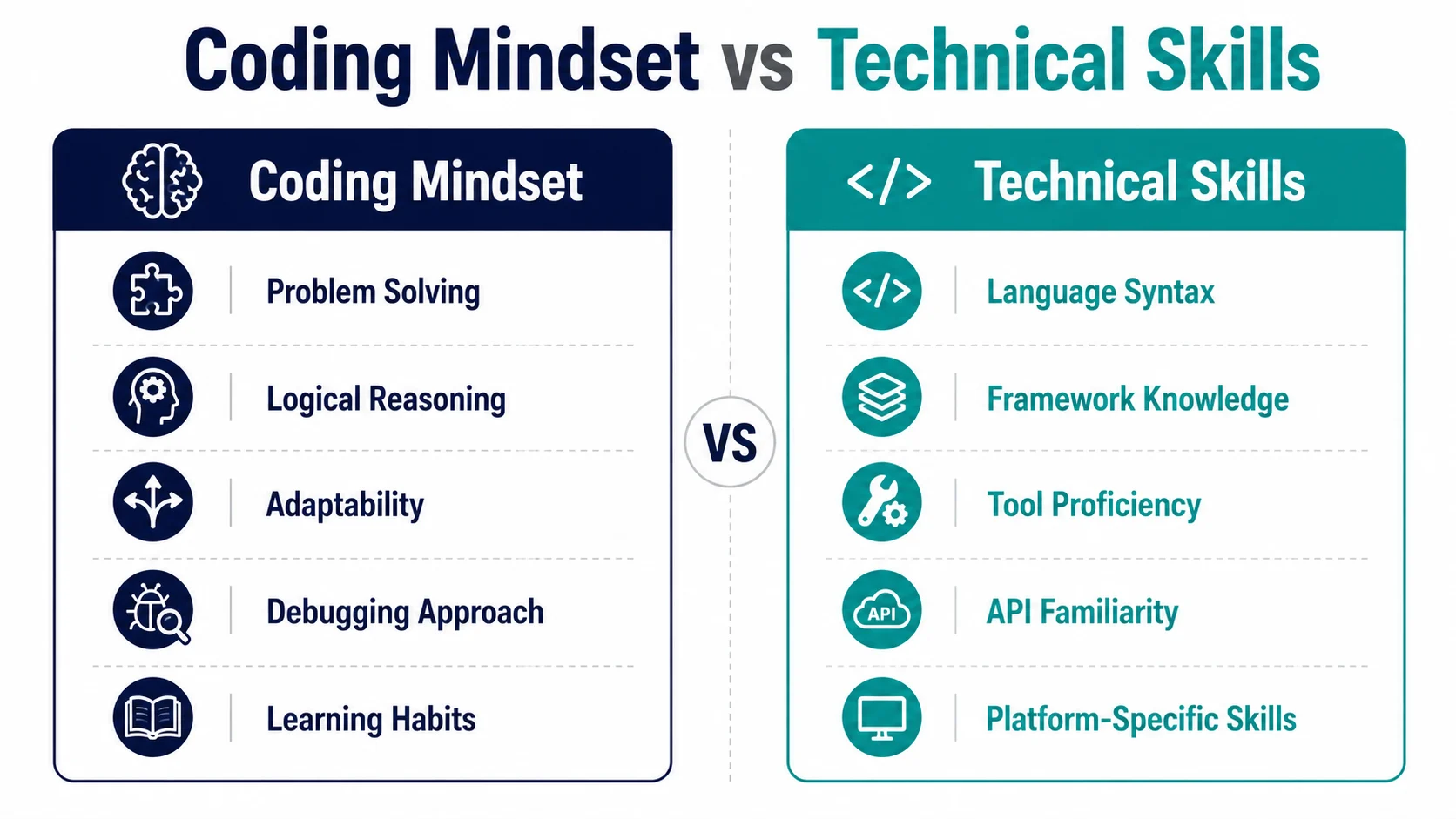
| Coding Mindset | Technical Skills |
|---|---|
| Problem solving | Language syntax |
| Logical reasoning | Framework knowledge |
| Adaptability | Tool proficiency |
| Debugging approach | API familiarity |
| Learning habits | Platform-specific skills |
Both are essential, but they serve different purposes. Technical skills let a developer use a specific tool; a coding mindset determines how effectively that tool is applied to solve real problems. A developer with strong technical skills but a weak mindset may struggle with unfamiliar problems, while a developer with a strong mindset but limited technical skills can often learn new tools quickly.
Traditional Coding Mindset vs “Vibe Coding” Mindset
The vibe coding mindset refers to an approach that relies heavily on AI-assisted or intuition-driven development, where a developer describes an outcome and lets an AI tool generate the implementation. This differs from the traditional coding mindset, which emphasizes deliberate, step-by-step reasoning through each part of a solution.
Vibe coding can speed up prototyping and reduce repetitive work, but it carries limitations: generated code may contain subtle errors, inefficient logic, or security gaps that go unnoticed without review. Verification, testing, and genuinely understanding generated code remain essential regardless of how the code was produced. As of 2026, most experienced developers treat AI-assisted code as a starting draft rather than a finished solution, reviewing and testing it with the same rigor applied to hand-written code.
Books and Learning Resources for Developing a Programming Mindset
Recommended Programming Mindset Books
A useful programming mindset book explains reasoning and design decisions, not just syntax. Look for resources that walk through the thought process behind a solution, cover debugging strategies, and discuss code design principles like the ones outlined earlier in this article. A strong coding mindset book typically combines practical exercises with explanations of why certain approaches work better than others, helping readers internalize the reasoning rather than just copying examples.
Common Beginner Mistakes That Slow Coding Growth
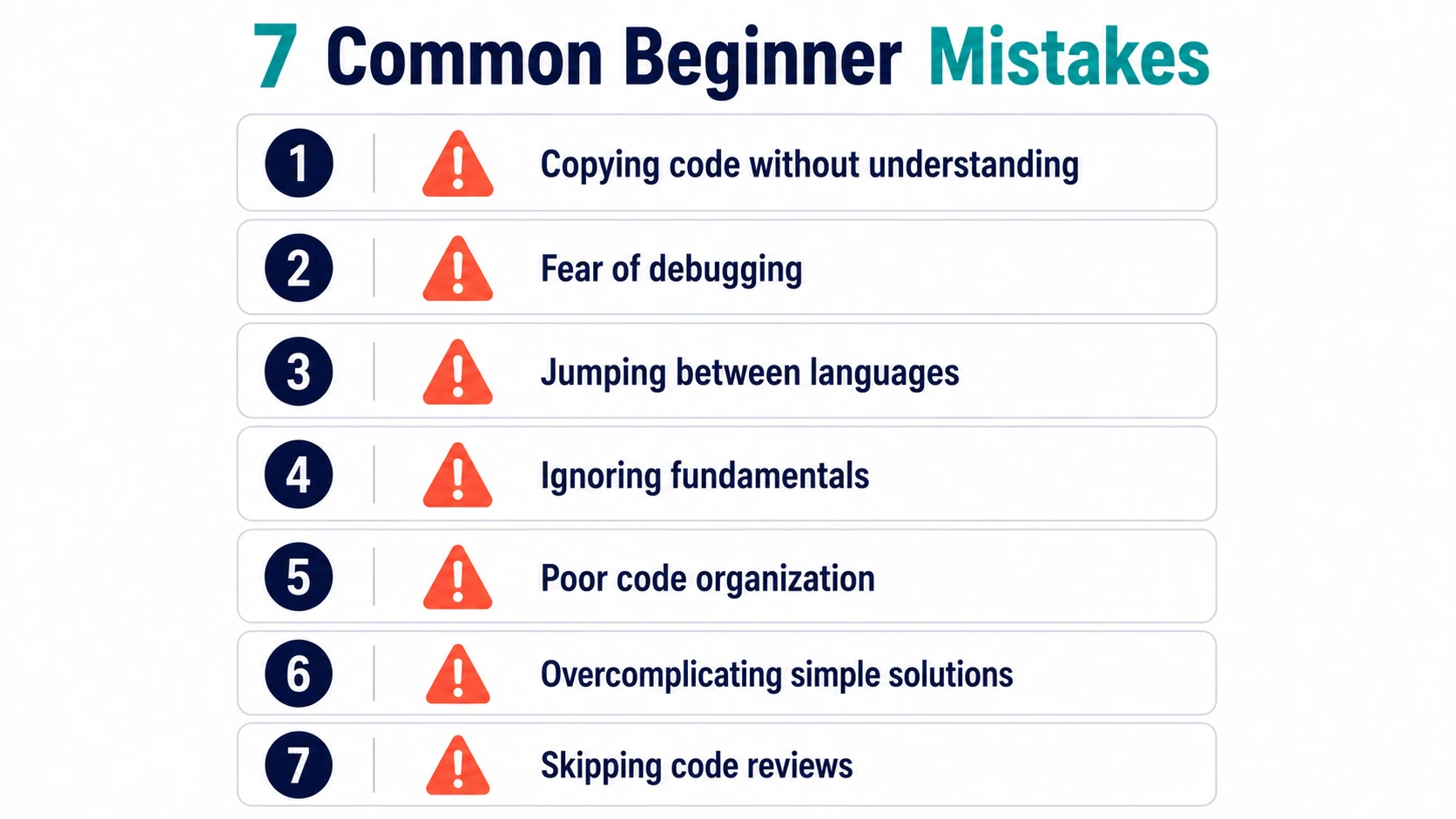
- Copying code without understanding — happens when deadlines feel urgent; fix it by rewriting the code from memory afterward to confirm understanding.
- Fear of debugging — often stems from treating errors as personal failure; reframing bugs as normal feedback reduces this fear over time.
- Jumping between languages — usually driven by trend-chasing; committing to one language until fundamentals are solid prevents shallow knowledge.
- Ignoring fundamentals — occurs when beginners rush to build projects; revisiting core concepts like data structures and control flow closes these gaps.
- Poor code organization — often the result of not planning file structure in advance; adopting a consistent folder convention from the start prevents this.
- Overcomplicating simple solutions — happens when beginners try to demonstrate advanced knowledge; applying KISS keeps solutions proportional to the problem.
- Skipping code reviews — common among self-taught developers working alone; seeking feedback from peers or online communities builds the habit early.
Practical Daily Habits to Strengthen Your Coding Mindset
Daily Practice Routine
- Short, focused coding sessions rather than infrequent long ones.
- Reading quality code written by experienced developers.
- Solving small programming challenges to reinforce logic.
- Reflecting briefly after each project on what worked and what didn’t.
Weekly Improvement Checklist
- Refactoring exercises on older code.
- Reviewing previous projects for outdated patterns.
- Learning one new concept or technique.
- Seeking feedback from peers, mentors, or online communities.
Difficulty and Time Investment
Developing a coding mindset is beginner-friendly, but it does involve a learning curve. Early progress often feels slow because foundational concepts—variables, control flow, functions—require repetition before they become intuitive. Factors affecting progress include prior exposure to logical or mathematical thinking, the amount of consistent practice time available, and access to feedback from more experienced developers. Consistency matters more than intensity: shorter, regular practice sessions build mindset habits more reliably than occasional long sessions followed by extended breaks.
Results Timeline
Early improvements in logical thinking often appear within the first few weeks of consistent practice, as beginners start recognizing common problem patterns. Medium-term gains in debugging speed and code quality typically develop over several months, as repeated exposure to errors builds pattern recognition. Long-term development of engineering judgment—the ability to weigh trade-offs and design maintainable systems—usually takes a year or more of applied experience. Factors that influence learning speed include practice frequency, exposure to real projects, and willingness to review and refactor past work.
Troubleshooting Common Challenges
Feeling Stuck During Problem Solving
Feeling stuck usually happens when a problem hasn’t been broken into small enough steps. Practical recovery strategies include restating the problem in plain language, working through a smaller version of it first, or stepping away briefly before returning with fresh perspective.
Losing Motivation
Motivation dips are common in any long-term skill. Maintaining momentum works best through small, achievable goals and visible progress tracking, while building sustainable habits—like a fixed daily practice window—reduces reliance on motivation alone.
Tutorial Dependency
Relying heavily on tutorials can delay independent problem-solving skills. Transitioning to independent projects, even small ones without a guide, builds the confidence and troubleshooting skills that tutorials alone cannot provide.
Frequently Confused Concepts
| Concept | Focus |
|---|---|
| Coding mindset | Thinking process |
| Coding practices | Daily implementation |
| Coding standards | Team consistency |
| Programming principles | Design philosophy |
| Code organization | Project structure |
Is Coding Profitable?
Is coding profitable depends on the specific skills, specialization, experience level, and market demand involved—not on coding ability alone. Developers with in-demand specializations, such as backend systems or applied AI, often see stronger earning potential than generalists. Employment offers stability and structured growth, freelancing offers flexibility with variable income, and entrepreneurship or product development carries higher risk alongside higher potential upside. Profitability in each path depends heavily on the individual’s skill depth and how well they match current market needs.
Conclusion
A coding mindset is the combination of logical thinking, structured problem-solving, and continuous learning that allows a developer to work effectively across any language or project. Technical skills matter, but they support the mindset rather than replace it—syntax changes, while sound reasoning and disciplined practices remain constant. Building this mindset takes consistent daily habits: breaking problems into smaller steps, learning from debugging, refactoring code over time, and applying established programming principles. Readers looking to grow as programmers benefit most from focusing on these lasting problem-solving abilities rather than memorizing every command a language offers—the mindset carries forward, even when the tools change.
Frequently Asked Questions
What is a coding mindset?
A coding mindset is a structured way of thinking that emphasizes problem-solving, logical reasoning, and continuous learning, applied consistently across programming tasks and languages.
Why is a coding mindset important for beginners?
It helps beginners approach unfamiliar problems methodically instead of relying on memorization, making it easier to adapt as languages, tools, and project requirements change.
How long does it take to develop a coding mindset?
Early improvements in logical thinking often appear within weeks, medium-term debugging skills develop over several months, and engineering-level judgment typically takes a year or more of consistent practice.
Can someone improve their coding mindset without a computer science degree?
Yes. A coding mindset develops through deliberate practice, debugging experience, and reflection, all of which can be built independently through self-study and applied projects.
What is the difference between coding practices and programming principles?
Coding practices are daily implementation habits, such as naming conventions and code organization, while programming principles are broader design philosophies, such as DRY, KISS, and SOLID, that guide how those practices are applied.
Does reading programming books improve coding mindset?
Yes, when the book explains the reasoning behind design decisions rather than only listing syntax, since understanding why an approach works reinforces logical thinking and problem-solving habits.
How does code organization affect software quality?
Well-organized code with clear file structure and separated responsibilities is easier to maintain, debug, and scale, while poor organization increases the time needed to locate and fix issues as a project grows.
Should developers comment every line of code?
No. Comments are most useful when they explain the reasoning behind non-obvious decisions; over-commenting obvious code adds clutter and can become outdated as the code changes.