

Introduction
Relationship mindset refers to the set of beliefs, expectations, and mental frameworks that shape how people approach romantic relationships, communication, conflict, and personal growth with a partner. It determines whether challenges are seen as opportunities to learn or as signs of incompatibility. This distinction closely mirrors the psychology of growth mindset and fixed mindset, concepts originally studied in education and achievement but now widely applied to relationship psychology. A person’s relationship mindset directly influences satisfaction, trust, and resilience over time. Understanding this mindset gives couples a practical framework for building stronger, more adaptable partnerships.
Quick Summary
- A relationship mindset influences how people interpret challenges, communication, trust, and long-term compatibility.
- A growth mindset encourages learning, adaptability, and stronger relationship resilience.
- Fixed relationship beliefs can increase conflict, misunderstandings, and emotional distance.
- Understanding your relationship mindset can help improve communication, emotional well-being, and relationship satisfaction.
What Is a Relationship Mindset?
Relationship Mindset Definition
A relationship mindset is the underlying set of beliefs a person holds about how relationships function, grow, and endure. It includes assumptions about compatibility, effort, communication, and whether problems can be solved through change or should be treated as fixed traits. Relationship mindset psychology examines how these beliefs form, why they differ between individuals, and how they predict relational outcomes such as satisfaction and longevity. In practical terms, mindset acts as a filter: two people can experience the same disagreement, yet interpret it in opposite ways depending on the beliefs they bring into the relationship.
Why Relationship Mindsets Matter
Relationship mindsets matter because they influence nearly every functional aspect of a partnership.
- Trust: Beliefs about whether people can change affect how quickly trust is rebuilt after mistakes.
- Communication: Mindset shapes whether difficult topics are approached openly or avoided.
- Expectations: Beliefs about “the right partner” or “effortless love” set realistic or unrealistic standards.
- Conflict resolution: Mindset determines whether disagreements are treated as threats or as problem-solving opportunities.
- Emotional security: A stable, adaptable mindset supports a stronger sense of safety within the relationship.
- Long-term relationship success: Couples who view growth as possible tend to report higher satisfaction over time.
Relationship Mindset Psychology Explained
How Psychology Shapes Relationship Beliefs
Relationship mindset psychology draws on several interconnected factors that shape how a person approaches partnership.
- Cognitive beliefs: Core assumptions about whether people and relationships can improve with effort.
- Emotional patterns: Habitual emotional responses to stress, conflict, or vulnerability.
- Attachment influences: Early attachment experiences with caregivers often carry into adult romantic bonds.
- Learned behaviors: Communication and conflict styles observed and repeated from past relationships or family dynamics.
- Childhood experiences: Early modeling of trust, affection, and conflict resolution.
- Personal values: Individual priorities around independence, commitment, and emotional expression.
These factors combine to form a person’s default relational lens, which can be conscious or largely automatic.
Relationship Between Mindset and Behaviour
The relationship between mindset and behaviour is best understood as cause and effect: beliefs shape interpretation, and interpretation shapes action. A person who believes conflict signals incompatibility may withdraw or shut down during disagreements. A person who believes conflict is a normal, workable part of connection is more likely to stay engaged and problem-solve. For example, if a partner cancels plans, someone with a fixed, distrustful mindset may assume disinterest and react with distance. Someone with a flexible mindset is more likely to ask clarifying questions before drawing conclusions. The belief comes first; the behavior follows.
Growth Mindset vs Fixed Mindset in Relationships
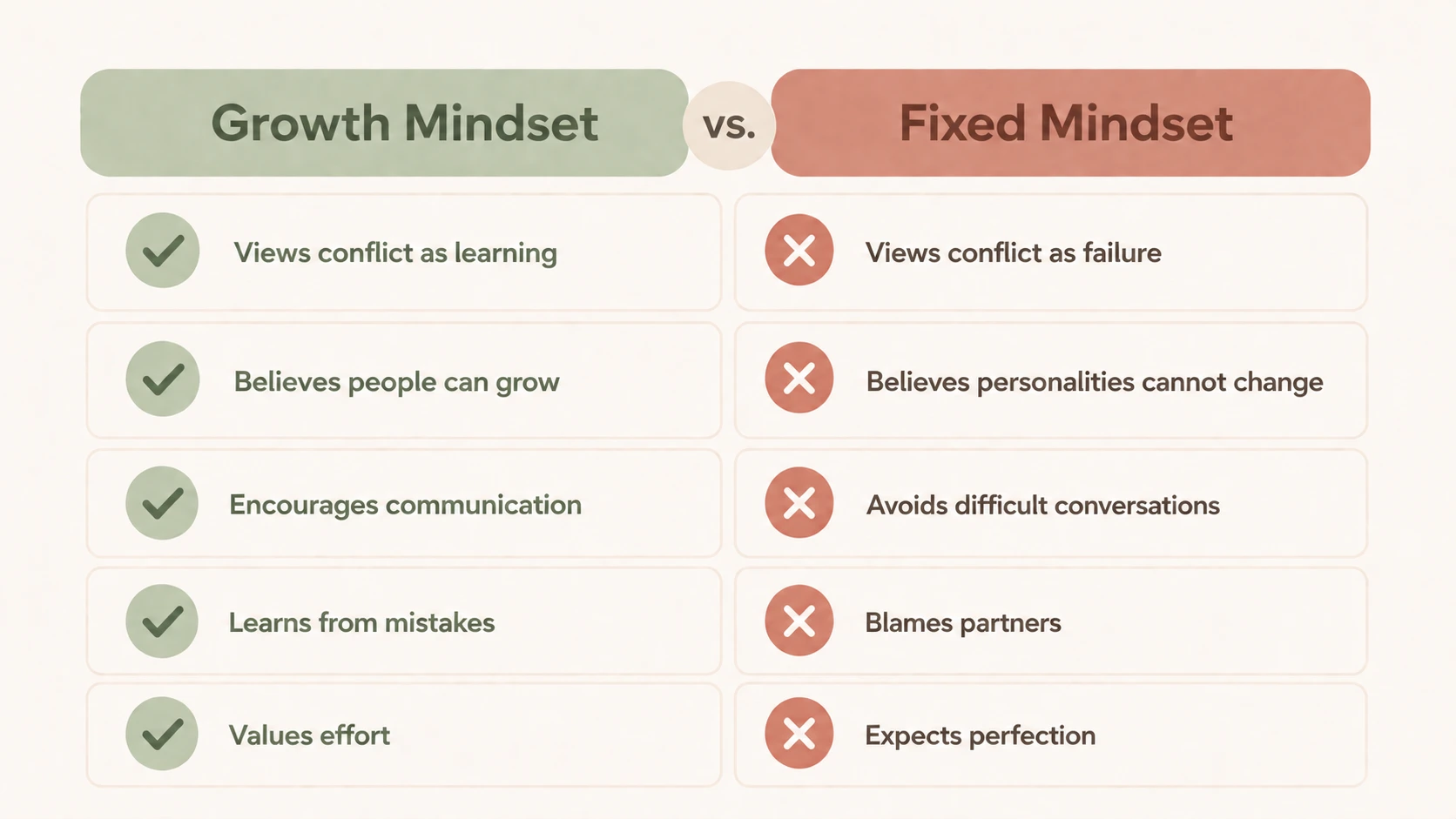
Growth mindset and fixed mindset represent two contrasting approaches to how people interpret relational challenges. A relationship growth mindset treats effort, communication, and adaptability as the foundation of long-term success. A fixed mindset in relationships treats compatibility and personality as static, often leading to avoidance or blame when problems arise. That said, a growth mindset isn’t about tolerating harm indefinitely — understanding when to walk away from a relationship is itself part of a healthy, self-aware mindset.
| Growth Mindset | Fixed Mindset |
|---|---|
| Views conflict as learning | Views conflict as failure |
| Believes people can grow | Believes personalities cannot change |
| Encourages communication | Avoids difficult conversations |
| Learns from mistakes | Blames partners |
| Values effort | Expects perfection |
In practice, growth-oriented partners are more likely to repair conflict quickly and treat setbacks as solvable. Fixed-mindset partners are more likely to disengage, since they perceive difficulty as evidence that the relationship “isn’t meant to be.”
What Is a Growth Mindset?
Growth Mindset Meaning
Growth mindset meaning centers on the belief that abilities, behaviors, and relational skills can be developed through effort, learning, and practice. Core characteristics include a willingness to learn from feedback, comfort with discomfort during change, and persistence after setbacks. While the concept originated in research on learning and achievement, it matters well beyond education — it directly affects how people handle emotional challenges, including those in romantic relationships.
Growth Mindset Defined
The formal definition of growth mindset describes it as a psychological orientation in which a person believes core qualities — including relational skills like communication and empathy — can improve with intentional effort. In everyday terms, this simply means believing that “we can get better at this” rather than “this is just how it is.” A common misconception is that a growth mindset means ignoring incompatibility or tolerating harmful behavior; in reality, it applies to effort and skill-building, not to excusing mistreatment.
How a Growth Mindset Improves Romantic Relationships
Better Communication
A growth mindset supports active listening, openness, and honest conversations by framing difficult topics as opportunities for understanding rather than confrontation. Partners are more willing to express needs directly instead of assuming the other person already knows.
Stronger Conflict Resolution
Growth-oriented couples are more likely to learn from disagreements, repair the relationship afterward, and manage emotional regulation during tense moments. Instead of avoiding conflict, they treat it as informative feedback about unmet needs.
Building Trust Over Time
Trust develops through consistent accountability, follow-through, and mutual respect. A growth mindset makes it easier to take responsibility for mistakes without treating them as permanent character flaws. Trust develops through consistent accountability, follow-through, and mutual respect — by contrast, lack of accountability in relationships is one of the fastest ways trust erodes.
Supporting Individual and Shared Growth
Growth-minded partners support both personal development and shared goals, recognizing that a healthy long-term partnership requires space for individual change alongside collective progress.
Relationship Mindset Examples
Examples of a Healthy Relationship Mindset
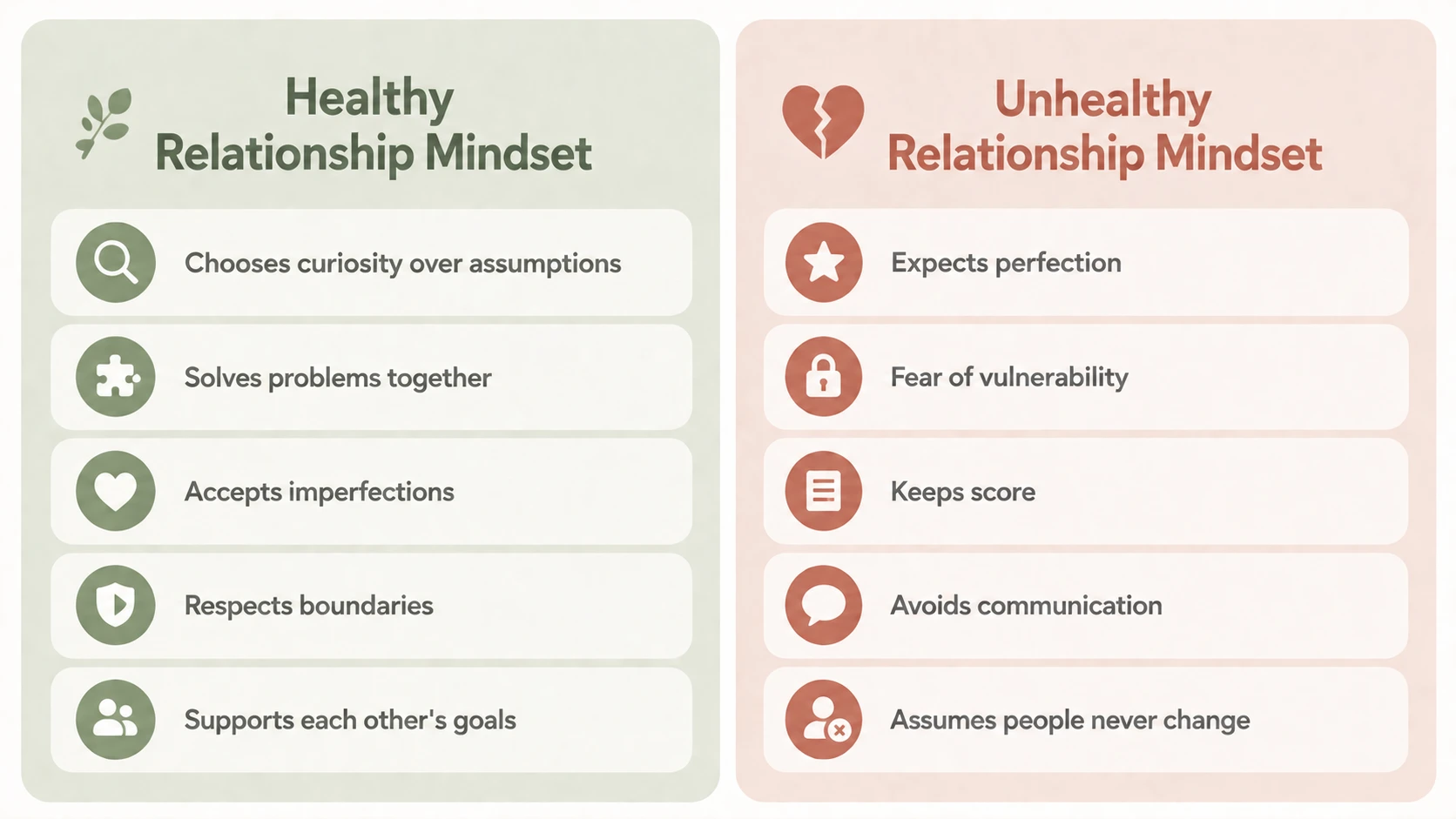
Healthy relationship mindset examples include:
- Choosing curiosity over assumptions when a partner’s behavior is unclear
- Solving problems together rather than assigning blame
- Accepting imperfections instead of expecting flawlessness
- Respecting boundaries as a normal part of connection
- Supporting each other’s individual goals and growth
Examples of an Unhealthy Relationship Mindset
Unhealthy patterns often include:
- Holding perfection expectations for a partner or the relationship
- Fear of vulnerability that prevents honest emotional expression
- Keeping score of past mistakes or favors
- Avoiding communication about difficult topics
- Assuming people never change, which discourages effort or repair
Different Types of Relationship Mindsets
Healthy Relationship Mindset
A healthy relationship mindset is characterized by emotional flexibility, mutual respect, realistic expectations, and a willingness to communicate openly, even during disagreement. It does not require the absence of conflict — only the presence of constructive ways to handle it.
Open Relationship Mindset
An open relationship mindset refers to the beliefs and communication style associated with consensual non-monogamy, one relationship structure among several. This mindset requires clear communication, explicit consent from all parties, and consistently respected boundaries. It is not inherently healthier or less healthy than monogamy — its success depends on the same underlying factors as any relationship structure: honesty, consistency, and mutual agreement.
Provider Mindset in a Relationship
Provider mindset meaning in relationship contexts traditionally referred to financial responsibility, but modern interpretations extend this to emotional support, shared responsibility, and reliability. A provider mindset can include:
- Financial contribution and stability
- Emotional availability and reassurance
- Consistency in meeting shared responsibilities
A common misconception is that provider mindset applies to only one gender or partner; in contemporary relationships, it is increasingly viewed as a shared role based on each partner’s strengths and circumstances rather than a fixed obligation.
Can Your Relationship Mindset Change?
Factors That Shape Relationship Mindsets
Relationship mindsets are shaped by several ongoing influences:
- Life experiences: Past relationships and personal milestones
- Culture: Societal norms around commitment, roles, and communication
- Family: Modeling from parents or caregivers during childhood
- Relationships: Direct experience with partners over time
- Personal growth: Therapy, self-reflection, and intentional skill-building
How to Develop a Growth-Oriented Relationship Mindset
Developing a more growth-oriented mindset is possible through consistent, intentional practice:
- Self-reflection: Identify recurring beliefs or patterns that limit connection
- Honest communication: Practice expressing needs directly and respectfully
- Feedback: Treat a partner’s feedback as useful information, not criticism
- Emotional intelligence: Build awareness of emotional triggers and responses
- Continuous learning: Approach relationship skills as ongoing, not fixed
- Healthy habits: Reinforce consistency through small, repeated actions
Common Mistakes That Limit Relationship Growth
Believing Compatibility Never Changes
This mistake assumes that initial compatibility is permanent and unchangeable. In reality, compatibility evolves as both partners grow. Overcoming it requires revisiting shared values and goals periodically rather than relying on early assumptions.
Expecting Perfect Communication
Expecting flawless communication sets an unrealistic standard that leads to disappointment. Miscommunication is normal; the solution is developing repair skills rather than aiming for perfection.
Avoiding Difficult Conversations
Avoidance often stems from fear of conflict, but it typically allows small issues to grow larger. Scheduling intentional check-ins can help normalize difficult conversations before they become urgent.
Treating Conflict as Failure
Viewing conflict as a sign of failure discourages honest engagement. Reframing conflict as a normal part of problem-solving reduces defensiveness and encourages resolution.
Comparing Relationships to Others
Comparing a relationship to others’ curated portrayals — especially on social media — creates unrealistic benchmarks. Focusing on the specific needs and values of the actual relationship prevents this distortion.
Practical Tips for Building a Strong Relationship Mindset
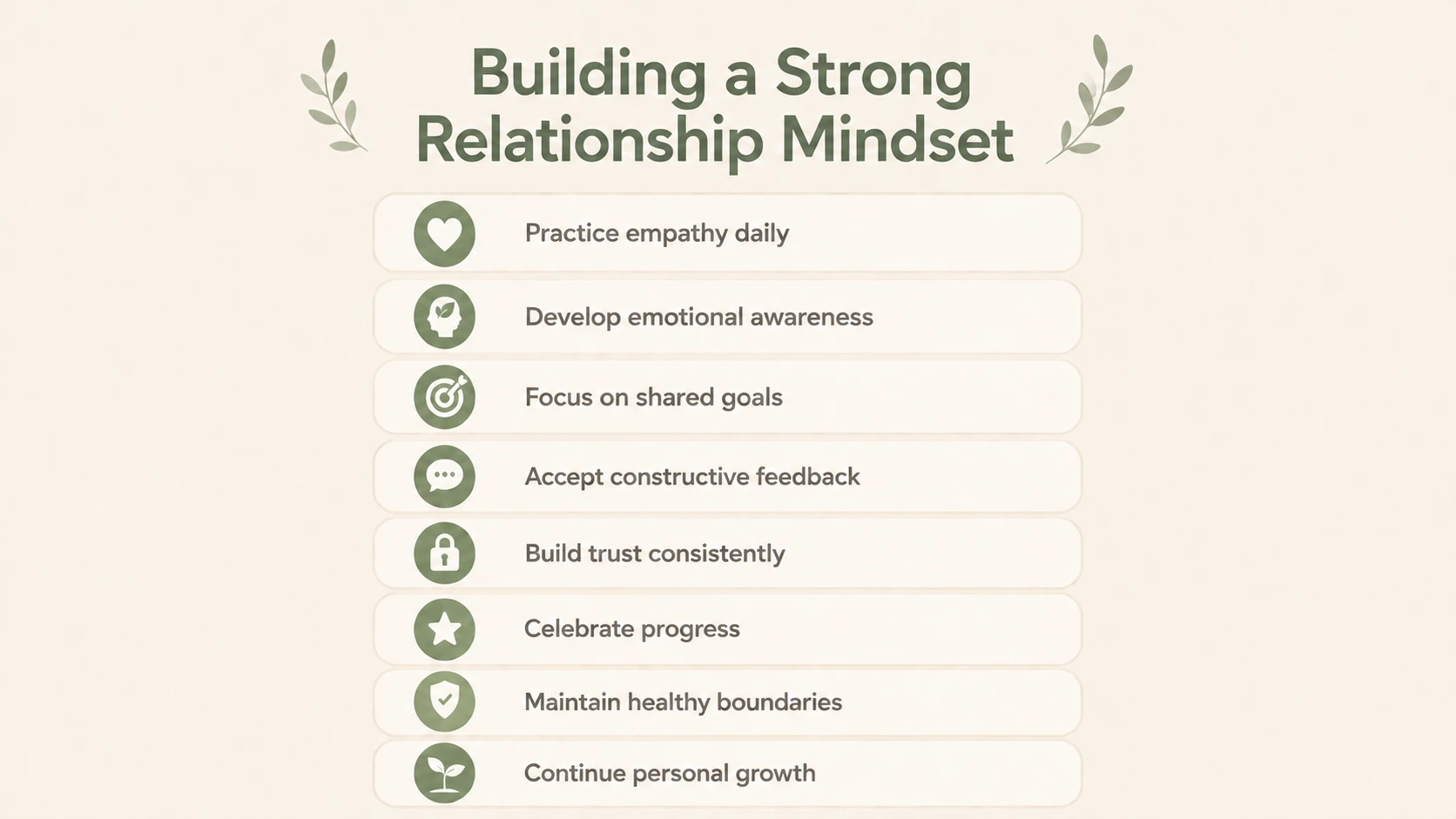
- Practice empathy daily by considering a partner’s perspective before reacting
- Develop emotional awareness to recognize triggers before they escalate
- Focus on shared goals rather than individual “winning” in disagreements
- Accept constructive feedback without treating it as a personal attack
- Build trust consistently through small, reliable actions
- Celebrate progress instead of only noting shortcomings
- Maintain healthy boundaries as a form of mutual respect
- Continue personal growth independently of the relationship
In our experience helping readers build better habits, small consistent actions — like a short daily check-in — tend to shift relationship mindset more effectively than large, infrequent conversations. Practice empathy daily by considering a partner’s perspective before reacting — empathy is one of the strongest predictors of relationship satisfaction.
Relationship Mindset and Personal Development
Relationship mindset is closely tied to broader personal development. A relationship building mindset draws on the same skills used in individual growth:
- Habit formation: Small, repeated relational habits build long-term trust
- Emotional intelligence: Recognizing and managing emotions supports healthier interactions
- Self-awareness: Understanding personal triggers reduces reactive behavior
- Resilience: The ability to recover from setbacks strengthens long-term partnership stability
- Goal setting: Shared and individual goals give the relationship direction
- Communication skills: Clear expression and active listening reduce misunderstandings
- Long-term personal growth: Ongoing self-improvement supports a more adaptable, resilient partnership
Your Daily Thrive recommends treating relationship growth the same way you would treat any other personal development goal — with consistency, reflection, and realistic expectations rather than one-time fixes.
Relationship Mindset vs Grit and Other Personal Growth Concepts
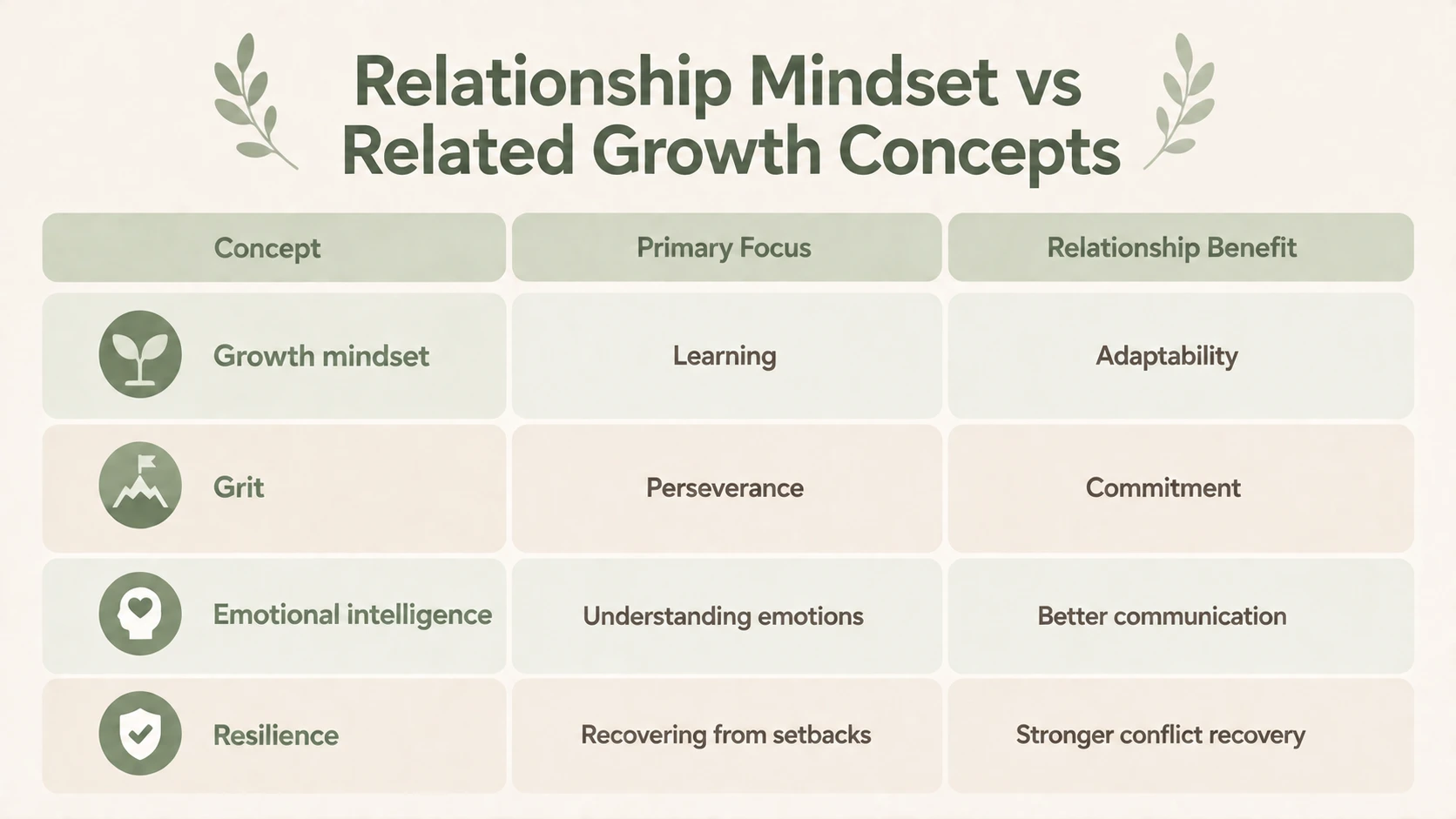
Relationship mindset overlaps with several related personal growth concepts, though each has a distinct focus.
| Concept | Primary Focus | Relationship Benefit |
|---|---|---|
| Growth mindset | Learning | Adaptability |
| Grit | Perseverance | Commitment |
| Emotional intelligence | Understanding emotions | Better communication |
| Resilience | Recovering from setbacks | Stronger conflict recovery |
The relationship between grit and growth mindset is complementary: growth mindset provides the belief that improvement is possible, while grit provides the sustained effort needed to follow through. Emotional intelligence and resilience support both concepts by improving how partners manage emotions and recover from difficulty. Together, these traits form a broader personal growth foundation that strengthens relationship outcomes.
Frequently Asked Questions About Relationship Mindsets
What is a relationship mindset?
A relationship mindset is the set of beliefs and expectations a person holds about how relationships function, grow, and endure, including views on communication, conflict, and change.
What is the difference between a growth mindset and a fixed mindset in relationships?
A growth mindset treats challenges as opportunities to learn and improve, while a fixed mindset treats challenges as evidence of permanent incompatibility or unchangeable personality traits.
Can a relationship mindset change over time?
Yes. Relationship mindsets can shift through life experience, self-reflection, therapy, and intentional practice, particularly when a person actively works on communication and emotional awareness.
How does psychology influence relationship mindset?
Psychology shapes relationship mindset through cognitive beliefs, attachment patterns, childhood experiences, and learned behaviors that combine to form a person’s default approach to relationships.
What are examples of a healthy relationship mindset?
Examples include choosing curiosity over assumptions, solving problems collaboratively, accepting imperfection, respecting boundaries, and supporting a partner’s individual growth.
Why is communication important for a growth-oriented relationship?
Communication allows partners to address needs, resolve misunderstandings, and repair conflict, all of which are essential for maintaining trust and long-term satisfaction.
How can someone develop a healthier relationship mindset?
A healthier relationship mindset can be developed through self-reflection, honest communication, openness to feedback, emotional intelligence practice, and consistent healthy habits over time.
Conclusion
A relationship mindset shapes how people interpret trust, communication, conflict, and long-term compatibility with a partner. Relationship mindset psychology shows that these beliefs are formed through cognitive patterns, attachment history, and learned behavior, and they directly influence relational outcomes. The contrast between growth mindset and fixed mindset highlights why adaptability and communication tend to produce stronger, more resilient partnerships than rigid expectations. By recognizing common mistakes, applying practical daily habits, and treating relationship skills as an ongoing area for growth, individuals can build a more supportive and sustainable connection. Ultimately, adopting a growth-oriented relationship mindset can improve communication, resilience, and long-term relationship satisfaction.