
Introduction
Journaling prompts are structured questions, statements, or themes that guide reflective writing in a journal. Journaling prompts help individuals overcome blank-page paralysis by giving direction to thoughts that would otherwise remain scattered or overwhelming. Instead of uncertain free writing, prompts create focus around emotions, habits, goals, and personal reflection.
At a psychological level, journaling prompts act as guided self-inquiry tools that encourage deeper thinking and emotional processing. They support mental clarity by turning vague internal experiences into structured language. Over time, this improves self-awareness, emotional regulation, and behavioral understanding, making journaling a practical tool for personal development and mental well-being.
QUICK SUMMARY
- Journaling prompts are structured questions for guided reflection
- They improve clarity, emotional processing, and self-awareness
- They reduce anxiety and overthinking by organizing thoughts
- They remove uncertainty about what to write in a journal
- They support habit-building and long-term personal growth
Why Journaling Prompts Work (Psychology & Behavioral Mechanisms)
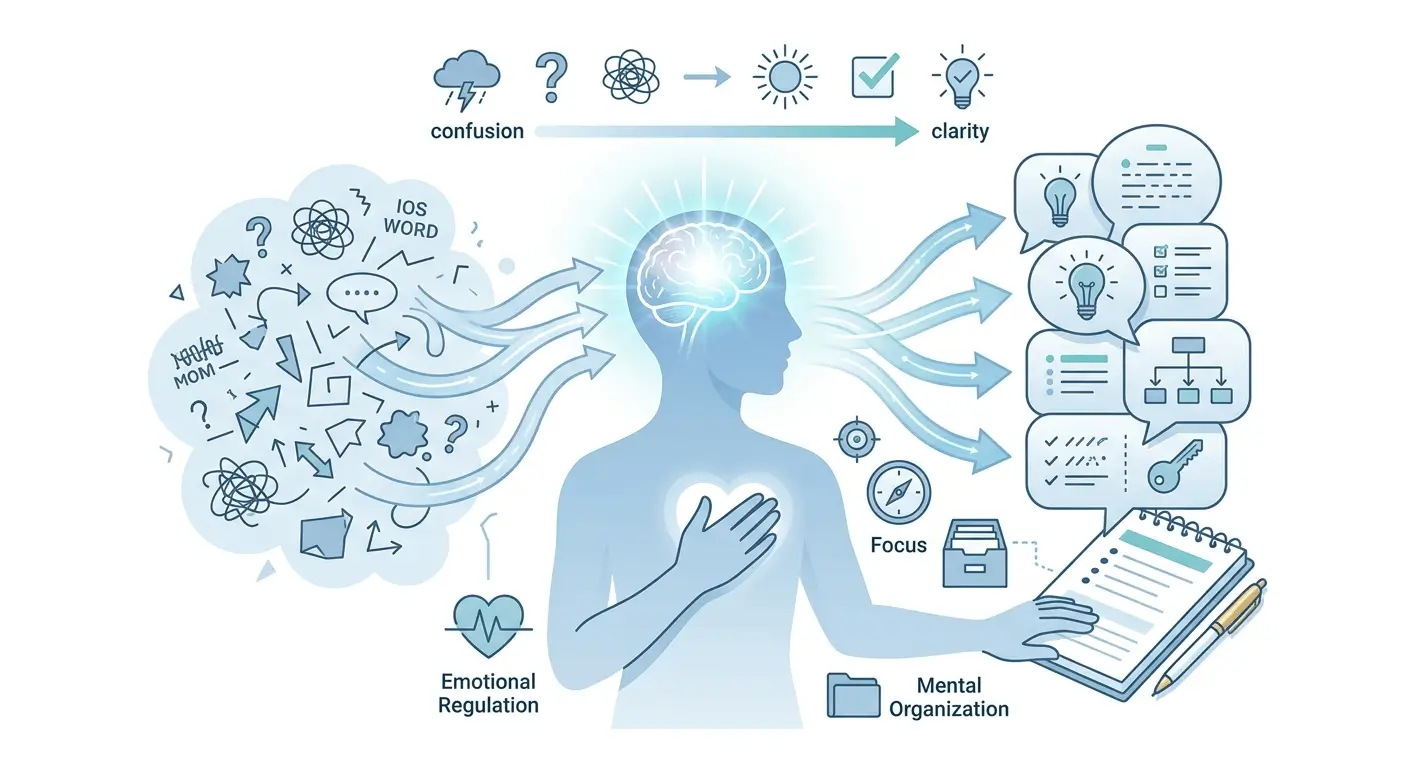
Journaling prompts work because they reduce cognitive overload and provide structured direction for thought processing. When the mind is given a clear question, it shifts from abstract thinking to focused reflection.
This process is driven by several psychological mechanisms:
- Reduction of decision fatigue: removes the mental load of choosing what to write
- Metacognitive activation: encourages thinking about one’s own thoughts and behaviors
- Emotional labeling: naming emotions reduces their intensity and improves regulation
- Cognitive organization: helps structure scattered thoughts into meaningful patterns
From a behavioral psychology perspective, prompts function as triggers that guide attention toward unresolved emotions or habits. This structured reflection helps individuals process stress, recognize patterns, and build emotional resilience over time.
Types of Journaling Prompts (Core Categories)

Self-Reflection Journal Prompts
These prompts focus on identity, habits, and behavioral awareness.
- What habits are currently shaping my identity?
- What thoughts do I avoid and why?
- What recurring patterns do I notice in my life?
These questions strengthen identity awareness and long-term behavioral insight.
Mental Health Journal Prompts
Designed to support emotional regulation and mental clarity.
- What am I feeling right now and where do I feel it?
- What triggered my emotional response today?
- What would I say to someone I care about in my situation?
These prompts help externalize emotions and reduce internal pressure.
Anxiety Journaling Prompts
Used to break cycles of overthinking and fear-based thinking.
- What evidence supports or contradicts this worry?
- What is the worst-case outcome, and how likely is it?
- What aspects of this situation are within my control?
These prompts are aligned with cognitive reframing techniques used in CBT-based approaches.
Self-Growth Journal Prompts
Focused on habits, goals, and personal improvement.
This directly connects with learning how to journal for self-growth, where structured prompts guide long-term personal improvement.
- What small habit would improve my life in the next 30 days?
- What does my ideal daily routine look like?
- What is currently blocking my progress?
These help connect identity with long-term behavioral change.
Fun Journaling Prompts
Used to reduce resistance and improve consistency.
- If today were a movie, what would its title be?
- What made me laugh recently?
- What unusual dream do I remember?
These reduce pressure and make journaling more sustainable.
Journaling for Anxiety and Emotional Healing

Journaling is widely used for anxiety reduction because it externalizes internal thoughts, which reduces emotional intensity and mental looping.
How it works:
- Moves thoughts from mind to paper
- Breaks repetitive worry cycles
- Helps identify emotional triggers and patterns
Healing-focused prompts:
- What emotional pain needs attention right now?
- What do I need to forgive myself for?
- What would emotional safety look like for me?
This process supports emotional processing and improves psychological stability over time.
Journaling Prompts for Beginners (How to Start)

Beginners often struggle due to lack of structure or fear of writing “incorrectly.” Journaling prompts solve this by providing direction and reducing uncertainty.
Best approach:
- Start with 5–10 minutes per day
- Use simple, direct questions
- Focus on consistency over depth
Starter prompts:
- What happened today?
- How do I feel right now?
- What am I grateful for today?
This lowers entry barriers and builds long-term journaling habits.
Journaling Systems and Formats
Daily Journaling Prompts System
- Morning: intention and planning questions
- Evening: reflection and review questions
Question-Based Journaling
Uses structured prompts such as:
- What did I learn today?
- What went well today?
Themed Journaling
Focuses on specific areas like:
- Mental health
- Gratitude
- Personal growth
These systems improve consistency and reduce mental effort.
Tools and Resources for Journaling Prompts
Journaling Apps and Generators
Digital tools that provide daily prompts, reminders, and tracking features to support consistency.
Journaling Prompt Books and PDFs
Structured collections of prompts that guide users through progressive reflection exercises.
AI Prompt Generators
Automated systems that generate personalized journaling prompts based on user input, reducing decision fatigue.
Common Problems and How to Solve Them
| Problem | Cause | Solution |
|---|---|---|
| “I don’t know what to write” | Lack of structure | Use guided prompts |
| Inconsistency | Weak habit system | Link journaling to daily routines |
| Overthinking answers | Perfectionism | Write without editing |
| Emotional discomfort | Avoidance | Start with neutral prompts first |
Best Practices for Journaling with Prompts
- Prioritize consistency over intensity
- Avoid self-judgment while writing
- Match prompts to emotional state
- Combine structured and free writing
- Review recurring patterns weekly
These practices improve habit sustainability and emotional insight over time.
Science-Backed Benefits of Journaling Prompts
Research in expressive writing and behavioral psychology shows that structured journaling can:
- Reduce stress and anxiety levels
- Improve emotional regulation
- Enhance self-awareness and decision-making
- Support behavioral change and habit formation
- Improve cognitive clarity and memory organization
These effects occur because structured writing reduces mental clutter and improves emotional processing efficiency.
Conclusion
Journaling prompts are powerful tools for structured self-reflection, emotional regulation, and personal development. They simplify journaling by removing uncertainty and guiding attention toward meaningful thoughts and behaviors.
The core principle is consistent: structured questions lead to structured thinking, and structured thinking leads to improved emotional balance, clarity, and long-term behavioral change.
FAQs
1. What are journaling prompts?
They are structured questions that guide writing and help organize thoughts, emotions, and reflections.
2. How do journaling prompts help with anxiety?
They reduce overthinking by structuring thoughts and helping reframe worries logically.
3. What are good journaling prompts for beginners?
Simple questions like “How do I feel today?” or “What happened today?” are best.
4. Can journaling prompts improve mental health?
Yes, they support emotional processing and reduce stress and mental clutter.
5. How often should I use journaling prompts?
Daily use is ideal, but even a few times per week can improve consistency.
6. What is the difference between prompts and free journaling?
Prompts provide structure, while free journaling is open-ended and unstructured writing.










One Response