
Introduction
Non dualism is the philosophical and spiritual idea that reality is not ultimately divided into separate parts, even though everyday life appears to be full of opposites such as self and other, mind and body, subject and object, or human and divine. In simple terms, non dualism suggests that separation is either incomplete, misunderstood, or only true at a surface level.
This concept appears in traditions such as Advaita Vedanta, broader Vedanta philosophy, Hindu thought, Christian mystical theology, and modern contemplative psychology. For personal growth, non dualism can help people question rigid identity patterns, reduce inner conflict, and relate to life with more awareness, humility, and emotional balance.
Quick Summary
- Non dualism means reality is ultimately not divided into separate, independent parts.
- Non duality often refers to the direct experience or realization of this lack of separation.
- In Advaita Vedanta philosophy, non dualism teaches that the individual self and ultimate reality are not separate.
- Practically, non dualism can support emotional regulation, reduced ego-identification, and a calmer relationship with thoughts and experiences.
- In self-improvement, non dual awareness can help separate identity from thoughts, emotions, achievement, and failure.
What Does Non Dualism Mean?
Non dualism means “not two.” It is the view that reality is not ultimately split into completely separate and independent parts, even though the mind experiences life through contrasts such as self and other, success and failure, pleasure and pain, or inner and outer.
A simple non dualism definition is this: distinctions may exist in everyday life, but they may not represent the deepest nature of reality. Non dualism does not always mean “everything is literally the same.” It means that practical differences can exist without being ultimately separate.
The mind naturally divides experience into opposites because categorization helps survival, decision-making, and communication. People need distinctions to function. For example, a person must distinguish danger from safety, rest from effort, and their own responsibilities from someone else’s. These distinctions are useful.
However, non dualism asks whether these divisions are final truths or mental models. In personal growth, this matters because many forms of suffering come from rigid identification.
For example:
- “I am my thoughts.”
- “My worth depends on achievement.”
- “Failure means I am a failure.”
- “My emotions define who I am.”
- “Other people’s approval determines my value.”
A non dual perspective softens these assumptions. It does not remove responsibility, goals, or effort. Instead, it helps a person see thoughts, roles, and outcomes as experiences within awareness rather than fixed definitions of identity.
Non Duality Definition in Plain Language
Non duality is the understanding or experience that the observer and the observed, the self and the world, or the individual and ultimate reality are not fundamentally separate. It does not deny everyday differences but points to a deeper unity beneath those differences.
In simple terms, non-duality meaning refers to seeing beyond the usual split between “me” and “life.” It is not the same as ignoring practical reality. A person still has a body, relationships, duties, goals, and boundaries. But non dual awareness changes how the person relates to those things.
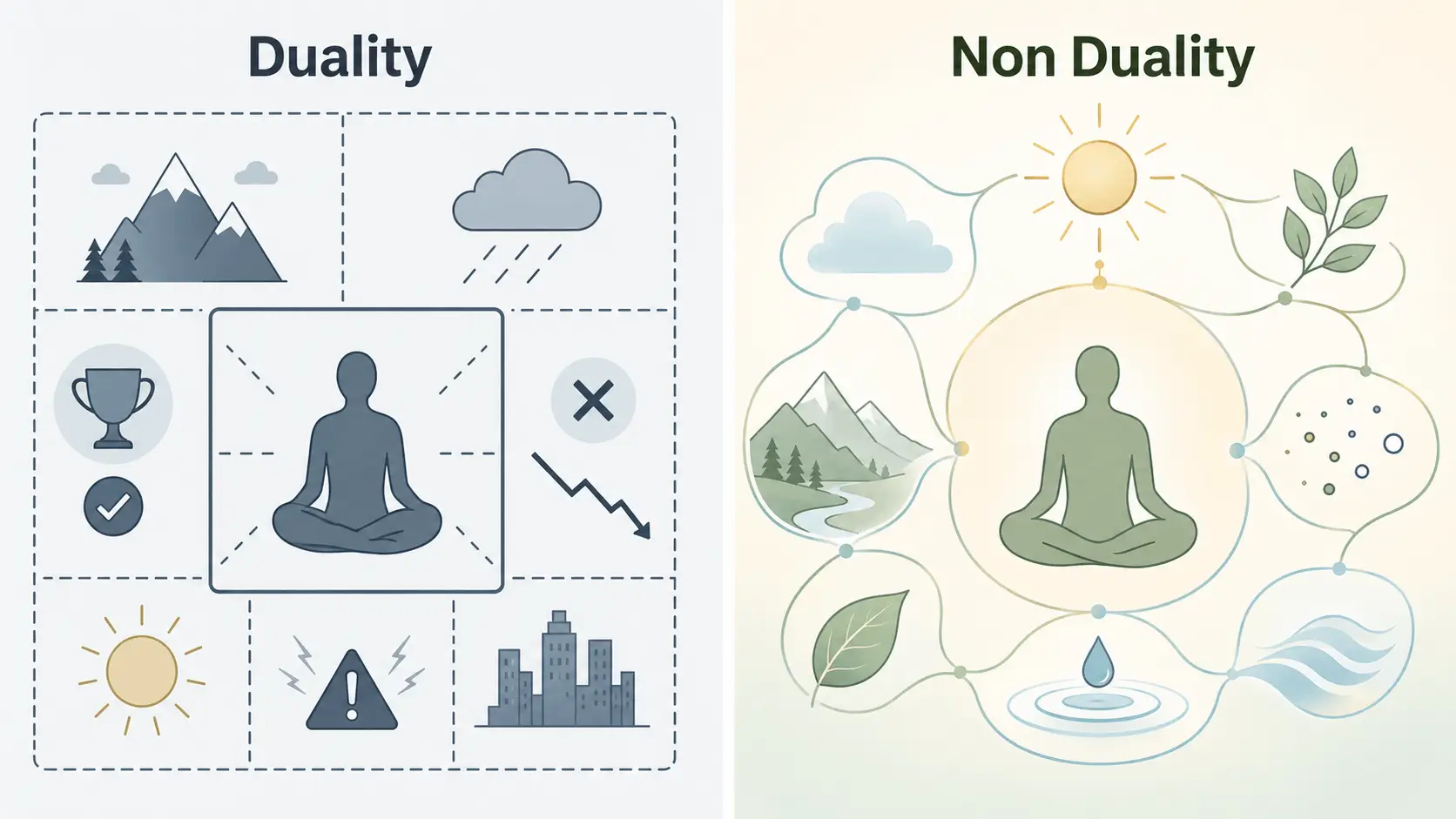
- Duality sees reality through separation: self vs world, good vs bad, success vs failure.
- Non duality sees these distinctions as useful but incomplete.
- Non dual awareness can reduce emotional reactivity because thoughts and feelings are seen as experiences, not as fixed identity.
- This can help people respond to life with more clarity instead of reacting from fear, shame, or ego protection.
For example, in a dualistic mindset, a stressful thought may feel like truth. In non dual awareness, the thought is recognized as something appearing in awareness. This creates space between stimulus and response, which supports emotional control and wiser action.
Duality and Nonduality: What Is the Difference?
Duality is the perception of separation, while nonduality is the insight that separation is not ultimate. Duality helps people navigate daily life, but nonduality helps people question whether the divisions created by the mind fully describe reality.
Duality and nonduality both matter. Daily life requires distinctions. A person needs to know where they end and another person begins, what actions are responsible, and which choices support health or harm. Without practical duality, decision-making becomes confused.
Nonduality, however, addresses a deeper layer. It asks whether the self is truly isolated from consciousness, nature, God, or reality. In Hindu traditions, duality and non dualism appear in different philosophical schools. Some emphasize a real distinction between the individual soul and God, while Advaita Vedanta emphasizes non-separation.
Duality vs Non Duality
| Concept | Duality | Non Duality |
|---|---|---|
| Basic view | Reality is made of separate things | Reality is ultimately not separate |
| Self-view | “I am separate from the world” | “The self is not isolated from reality” |
| Emotional effect | Can intensify fear, comparison, and control | Can support acceptance, awareness, and inner calm |
| Practical role | Useful for decision-making and daily life | Useful for deeper insight and reduced ego-identification |
| Risk if misunderstood | Rigid separation | Avoiding responsibility or denying real-world differences |
Duality non duality discussions are useful because they show two levels of understanding. One level helps people act responsibly. The other helps people stop turning every thought, emotion, and outcome into a permanent identity.
Non Dualism Philosophy: Core Ideas and Concepts
Non dualism philosophy examines whether reality is fundamentally one or many, whether the self is separate from consciousness, nature, or God, and whether subject and object are truly separate. It challenges the assumption that the individual self is completely independent.
Nondualism often begins with several philosophical questions:
- Is reality fundamentally one or many?
- Is the self separate from consciousness?
- Is the self separate from nature or God?
- Are subject and object truly separate?
- Is separation real, relative, or mistaken?
- Is the ego a fixed entity or a mental construction?
A central idea in non dualism is that the ego may not be a stable, separate self. The ego can be understood as a pattern of thoughts, memories, preferences, fears, roles, and stories. These patterns feel personal, but they constantly change.
This has a direct self-improvement application. Many people approach growth as “fixing the self.” Non dualism shifts the focus toward understanding the self more clearly. Instead of asking only, “How can I become better?” a person may ask, “What am I identifying with, and is that identification accurate?”
From a behavioral psychology angle, people often suffer because they over-identify with thoughts, emotions, roles, and stories. A thought such as “I am not good enough” becomes painful when it is treated as identity. An emotion such as anger becomes destructive when the person becomes fused with it.
Non dual reflection creates distance from automatic reactions. This supports emotional regulation because the person can notice an experience without immediately obeying it.
Non Dualism in Advaita Vedanta
In Advaita Vedanta, non dualism means that Atman, the true self, is not separate from Brahman, ultimate reality. Advaita means “not two,” and Advaita Vedanta philosophy teaches that the deepest reality is not divided into independent self and ultimate reality.
Vedanta refers to philosophical teachings connected with the end portion of the Vedas, especially the Upanishads. Advaita is one major Vedanta school. Its core insight is that ignorance causes people to identify with the body, mind, ego, and personal story instead of recognizing the deeper nature of the self.
Important concepts include:
- Atman: The true self or deepest self.
- Brahman: Ultimate reality.
- Maya: The power of appearance, illusion, or mistaken perception through which reality appears divided.
- Self-inquiry: The practice of investigating the nature of the self.
- Liberation: Freedom from ignorance and mistaken identification.
- Witness consciousness: Awareness that observes thoughts, emotions, and experiences without being limited by them.
For personal growth, Advaita can be applied carefully through observation. Instead of reacting to every thought, a person learns to observe thoughts. Instead of building identity only around success, status, productivity, or approval, a person develops deeper inner stability.
This can reduce anxiety caused by constant comparison. If a person believes they are only their achievements, every setback becomes a threat to identity. If they recognize that thoughts, roles, and outcomes appear in awareness, they can act with discipline without turning life into self-judgment.
Dualism and Non Dualism in Hinduism
Dualism and non dualism in Hinduism exist within a broad philosophical landscape. Hindu philosophy does not present one single position. It includes schools that emphasize difference, unity, qualified unity, devotion, inquiry, ritual, ethics, and direct realization.
Some Hindu schools emphasize a distinction between the individual soul and God. These approaches are often devotional and relational. Other schools, especially Advaita Vedanta, emphasize that the deepest reality is not divided.
A simple structure is:
- Dualistic approaches: God and the individual soul are distinct.
- Qualified non dual approaches: Unity exists, but differences still matter.
- Non dual approaches: The deepest reality is not divided.
This diversity matters because different paths suit different temperaments. A devotional person may grow through relationship, surrender, prayer, love, and service. A contemplative person may grow through inquiry, silence, meditation, and awareness.
Both can support humility, discipline, and ethical living. The practical goal is not to win a philosophical argument. The deeper goal is transformation: less ego-centered living, clearer perception, and wiser action.
Non Dualism vs Monism
Non dualism vs monism is an important distinction because the terms overlap but are not always identical. Monism usually means reality is made of one fundamental substance or principle. Non dualism means reality is not ultimately split into two independent realities.
Monism is often metaphysical. It asks what everything is made of. Non dualism is often experiential and contemplative. It asks whether the apparent split between subject and object, self and world, or individual and ultimate reality is final.
Non Dualism vs Monism
| Concept | Non Dualism | Monism |
|---|---|---|
| Main question | Is reality ultimately divided? | Is reality ultimately one substance or principle? |
| Focus | Overcoming the subject-object split | Explaining what everything is made of |
| Spiritual use | Often experiential and contemplative | Often metaphysical or philosophical |
| Example | Self and ultimate reality are not separate | Everything is one kind of reality |
| Practical takeaway | See through false separation | Understand unity at the level of existence |
The practical takeaway is simple. Monism may describe reality as one. Non dualism points to the collapse of false separation in direct understanding, especially the split between the observer and what is observed.
Non Duality Examples in Everyday Life
Non duality examples appear whenever a person notices experience without becoming trapped in rigid identity. These examples are practical because they show how non dual awareness can affect thoughts, emotions, relationships, and productivity.
Common examples include:
- Watching thoughts without identifying with them.
- Feeling emotion without becoming the emotion.
- Seeing conflict without reducing people to enemies.
- Experiencing flow states where self-consciousness fades.
- Recognizing that success and failure are experiences, not permanent identities.
These examples do not require a mystical state. They involve a shift in relationship to experience. Instead of saying, “This emotion is me,” the person sees, “This emotion is present.” That small shift can reduce reactivity.
Example 1 — Anxiety and Thought Identification
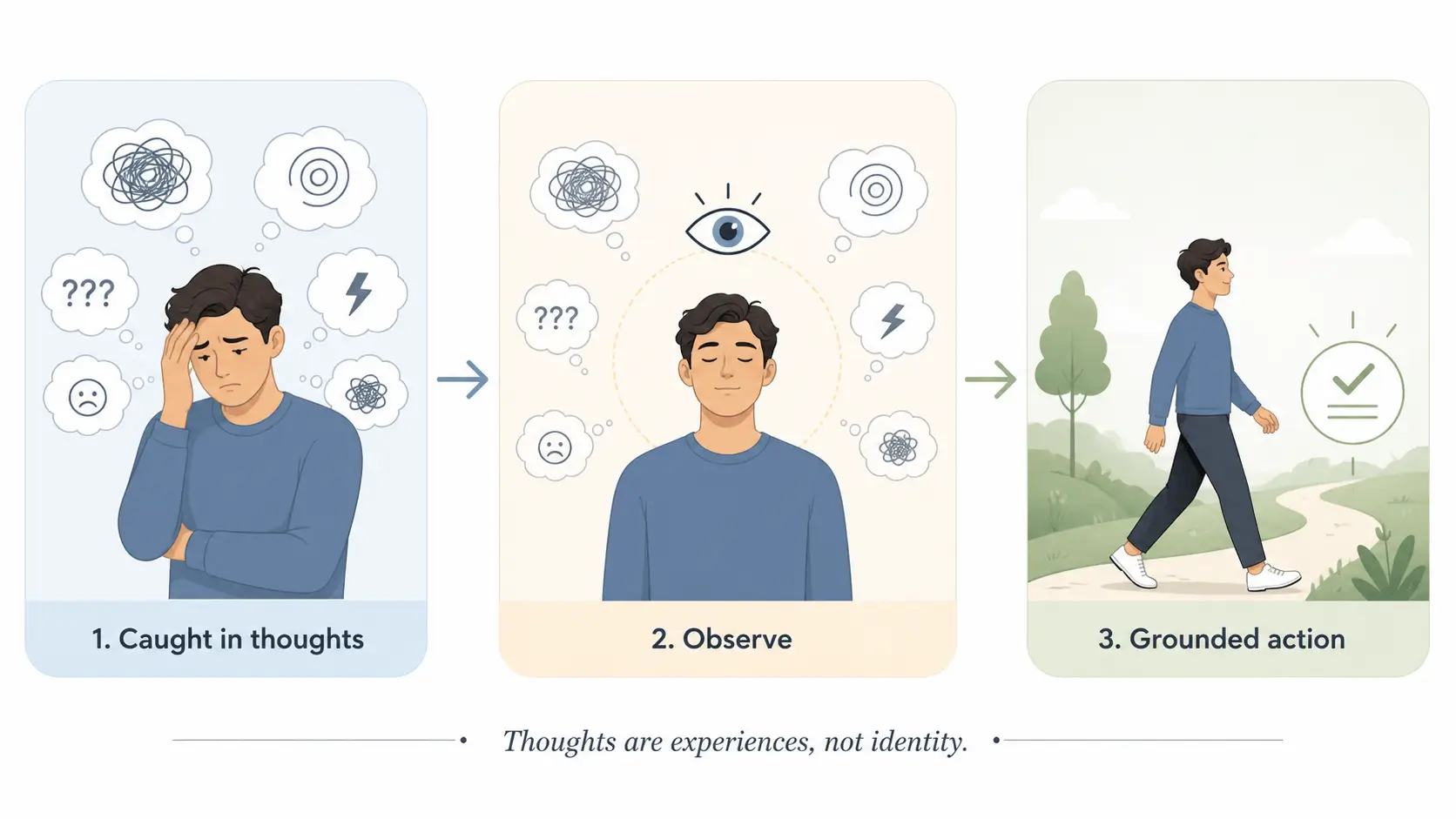
A person thinks, “I am going to fail.”
A dualistic reaction is: “This thought is me, and it defines my future.”
A non dual perspective is: “This thought is arising in awareness, but it is not my entire identity.”
This does not mean the person ignores the concern. They may still prepare, ask for help, or take action. But they do not let one anxious thought become their whole self-image.
Example 2 — Conflict With Another Person
A person feels attacked during criticism.
A non dual approach does not deny boundaries, but it may reduce ego defensiveness by seeing the other person as shaped by fears, needs, and conditioning too.
This can help the person listen more carefully, respond more calmly, and set boundaries without hatred. The goal is not passivity. The goal is less ego-driven reaction.
Example 3 — Productivity and Self-Worth
A person believes, “If I am not productive, I am worthless.”
A non dual insight separates awareness from performance identity. The person can still value discipline, focus, and improvement, but productivity no longer becomes self-punishment.
This supports sustainable effort. Work becomes an expression of values rather than a constant attempt to prove worth.
Is Non Duality Dangerous?
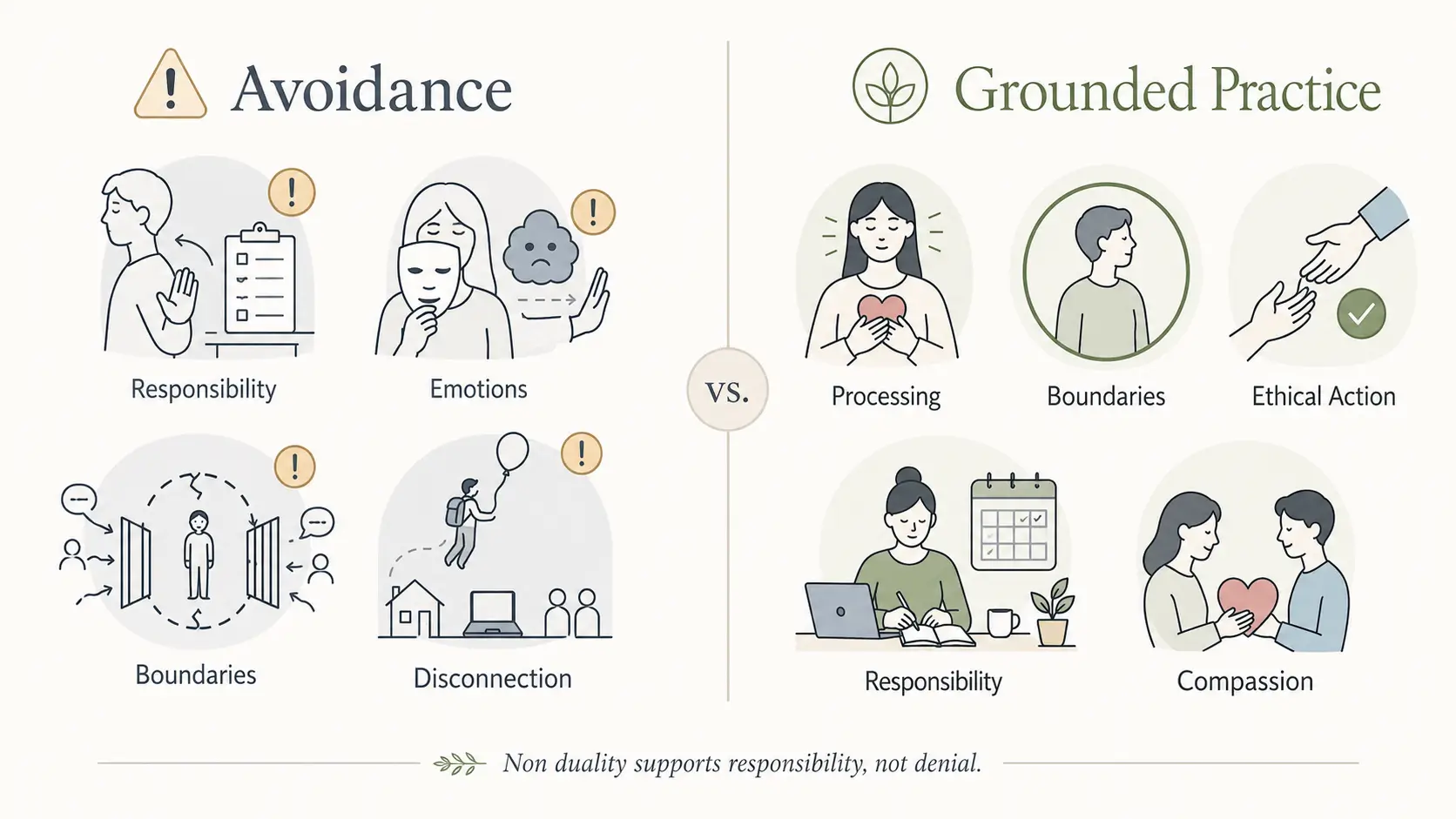
Non duality is not inherently dangerous, but it can become harmful when misunderstood, applied without grounding, or used to avoid responsibility, emotion, boundaries, or mental health needs. Healthy non duality supports clearer living; unhealthy interpretation can become avoidance.
Potential risks include:
- Using “everything is one” to avoid responsibility.
- Ignoring emotional pain instead of processing it.
- Denying personal boundaries.
- Dismissing mental health needs.
- Becoming detached from relationships or practical life.
- Mistaking intellectual understanding for emotional maturity.
- Using spiritual language to avoid accountability.
Non dual awareness should not become an excuse to deny ordinary human needs. Pain, grief, trauma, and conflict still require care. Relationships still require communication. Bodies still require rest. Responsibilities still matter.
Safe practice includes:
- Stay grounded in daily responsibilities.
- Maintain healthy boundaries.
- Do not use spiritual ideas to suppress trauma or grief.
- Seek professional support for severe anxiety, depression, dissociation, or trauma.
- Balance insight with ethics, compassion, and practical action.
Misunderstandings vs Healthy Understanding
| Misunderstanding | Why It Causes Problems | Healthier Interpretation |
|---|---|---|
| “Nothing matters” | Can lead to avoidance or apathy | Life still matters at the human level |
| “I have no self, so I need no boundaries” | Can enable unhealthy relationships | Boundaries are practical and necessary |
| “Pain is not real” | Suppresses emotional processing | Pain is real as experience, even if identity is deeper |
| “I understand non duality, so I am enlightened” | Strengthens spiritual ego | Insight must change behavior |
| “Action is unnecessary” | Reduces responsibility | Non dual insight should support wiser action |
A grounded approach keeps both levels in view: deeper unity and practical responsibility.
Non Dualism and Pantheism: Are They the Same?
Non dualism and pantheism are not automatically the same. Pantheism means God or divinity is identical with the universe or nature, while non dualism focuses on overcoming the idea that reality is ultimately divided into separate independent parts.
A pantheism definition is this: God and the universe are identical or deeply unified. Pantheism meaning often points to divinity as present in all of nature and existence. A pantheist sees the divine not as separate from the world, but as expressed through the whole of reality.
Pantheistic meaning and pantheistic definition can overlap with non dual themes because both challenge strict separation. However, they ask different questions.
Non dualism asks: Is reality ultimately divided?
Pantheism asks: What is the relationship between God and the universe?
Non Dualism vs Pantheism
| Concept | Non Dualism | Pantheism |
|---|---|---|
| Main focus | Reality is not ultimately divided | God and the universe are identical or deeply unified |
| Key concern | Self, consciousness, reality, separation | God, nature, cosmos, divinity |
| Religious or philosophical? | Both | Both |
| Same as Advaita? | Not always | Not always |
| Practical impact | Reduces ego-based separation | Can increase reverence for nature and existence |
The practical difference is important. Non dualism may focus on awareness, identity, and the subject-object split. Pantheism may inspire reverence for nature, existence, and the sacredness of the cosmos.
Non Dualism Catholic Perspectives
Non dualism Catholic perspectives require careful explanation because Catholic theology usually maintains a distinction between Creator and creation. Classical Catholic thought is not usually non dual in the same way as Advaita Vedanta.
However, some Christian mystics describe union with God in language that may sound non dual. They may speak of deep union, surrender, divine love, or the soul resting in God. The key difference is that mystical union does not normally erase the distinction between God and the human person.
This nuance matters:
- Catholic mysticism may speak of deep union with God.
- Advaita Vedanta may speak of the self and ultimate reality as not separate.
- These are not automatically the same claim.
For personal growth, Catholic contemplative practice may support surrender, humility, love, and detachment from ego. Non dual inquiry may support awareness and identity transformation. Both require ethical grounding to avoid self-centered spirituality.
A healthy comparison does not force the traditions into the same framework. It respects their differences while recognizing that both can speak to ego, humility, attention, and transformation.
Why People Struggle to Understand Non Dualism
People struggle to understand non dualism because the mind is built to categorize, separate, compare, and protect identity. Non dualism challenges the ordinary way people experience themselves as separate, fixed, and defined by thoughts, emotions, roles, and personal stories.
Several psychological barriers make non dualism difficult:
- The mind naturally divides experience into categories.
- Identity feels safer when it has clear boundaries.
- People confuse conceptual understanding with direct experience.
- Fear arises when the ego feels less central.
- Overthinking turns non duality into an abstract puzzle.
- Emotional resistance protects familiar self-images.
Common barriers include:
- Need for control.
- Fear of losing identity.
- Attachment to personal narratives.
- Emotional resistance.
- Spiritual bypassing.
- Treating non duality as a belief instead of an inquiry.
The cause-effect relationship is clear. When people identify strongly with thoughts, every emotion feels personal. A passing fear becomes “my truth.” A mistake becomes “who I am.” A criticism becomes a threat to survival.
When awareness expands, thoughts can be seen more clearly. They are still present, but they are not automatically believed. This reduces reactivity and creates space for intentional behavior.
Practical Ways to Apply Non Dual Insight in Daily Life
Non dual insight can be applied in daily life by observing thoughts before reacting, noticing the difference between awareness and identity, practicing self-inquiry during emotional triggers, and balancing acceptance with responsible action.
This application matters because personal growth often fails when people fuse identity with temporary states. A person feels fear and concludes, “I am weak.” They procrastinate and conclude, “I am lazy.” They fail once and conclude, “I am a failure.”
Non dual awareness interrupts this fusion.
Practical applications include:
- Observe thoughts before reacting.
- Notice the difference between awareness and identity.
- Practice responding instead of defending.
- Use self-inquiry during emotional triggers.
- Balance acceptance with responsible action.
- Recognize emotions as experiences, not permanent identity.
- Take grounded action instead of escaping into theory.
Step-by-Step Practice Framework
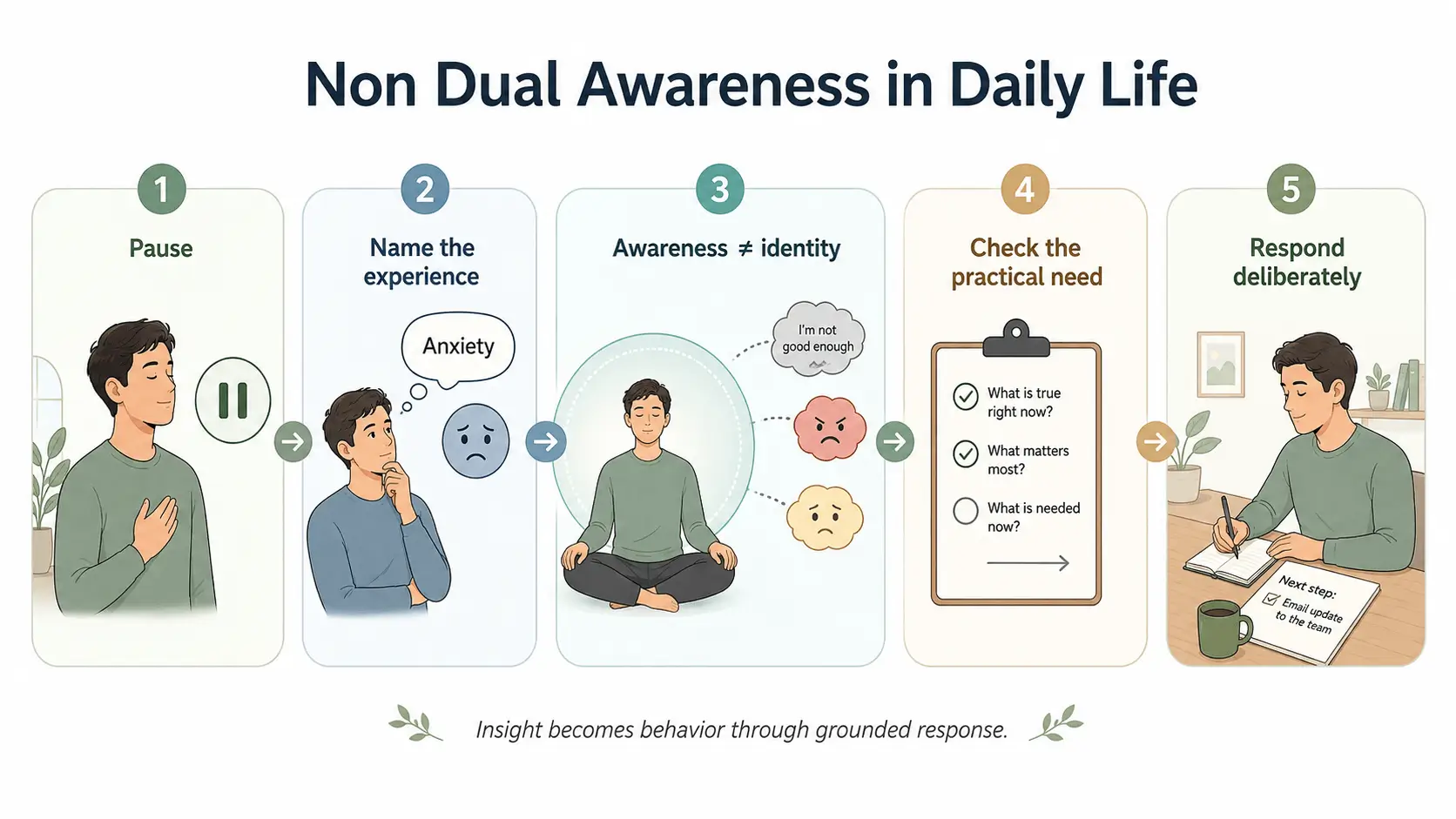
- Pause when a strong thought or emotion appears.
- Name the experience: “Anxiety is present” or “anger is arising.”
- Separate awareness from identity: “This is happening in awareness; it is not all of me.”
- Check the practical need: Is action, rest, communication, or boundary-setting required?
- Respond deliberately instead of reacting from fear or ego.
Non Dual Reflection Framework
| Situation | Automatic Reaction | Non Dual Reflection | Practical Response |
|---|---|---|---|
| Criticism | “I am being attacked” | “Defensiveness is arising” | Listen, evaluate, respond calmly |
| Failure | “I am a failure” | “Failure is an event, not identity” | Learn, adjust, try again |
| Anxiety | “Something is wrong with me” | “Fear is present in awareness” | Breathe, ground, take one step |
| Conflict | “They are the problem” | “Both of us are reacting from conditioning” | Set boundaries without hatred |
| Burnout | “I must push harder” | “The body and mind need care” | Rest, simplify, rebuild sustainably |
This framework keeps non duality practical. It does not replace action. It improves the quality of action.
Common Myths About Non Dualism
Common myths about non dualism usually come from confusing insight with denial. Healthy non dualism does not say emotions, discipline, relationships, or responsibilities are meaningless. It asks people to see through false separation while still living wisely.
Important myths include:
- “Non dualism means nothing exists.”
- “Non duality means you should ignore emotions.”
- “Non dual awareness removes all problems instantly.”
- “Non dualism is the same as pantheism.”
- “Non duality means you do not need discipline.”
- “Non dual insight makes ordinary life irrelevant.”
These myths can create confusion. If someone believes non duality means “nothing matters,” they may avoid responsibility. If someone believes emotions should be ignored, they may suppress pain. If someone believes ordinary life is irrelevant, they may neglect relationships, work, health, or ethics.
What actually works is different:
- Consistent reflection.
- Ethical behavior.
- Emotional honesty.
- Self-inquiry.
- Healthy routines.
- Grounded spiritual practice.
- Applying insight in relationships, work, and stress.
Non dualism becomes useful when it changes behavior. If insight does not lead to more humility, compassion, emotional regulation, and responsibility, it may remain only an idea.
Non Dualism, Motivation, Discipline, and Consistency
Non dualism can improve motivation, discipline, and consistency by reducing shame-based identity patterns. Discipline becomes less about proving worth and more about aligned action, while consistency improves when failure is not treated as a permanent self-definition.
Many people fail at personal growth because they turn improvement into ego pressure. They do not simply want to build a habit. They want the habit to prove they are valuable. When they miss a day, shame appears. Shame then creates avoidance, and avoidance breaks consistency.
Non dual awareness changes the relationship to effort. Motivation is seen as a temporary experience. Discipline is seen as a practical structure. Identity is not fused with daily performance.
Motivation vs Discipline Through a Non Dual Lens
| Concept | Motivation | Discipline |
|---|---|---|
| Source | Emotion, inspiration, desire | Commitment, structure, values |
| Weakness | Changes quickly | Can become rigid if ego-driven |
| Non dual insight | Motivation is an experience, not identity | Discipline is action without self-punishment |
| Best use | Starting change | Sustaining change |
| Practical result | Energy to begin | Stability to continue |
This supports long-term habits. A person can take action without waiting to feel inspired. They can return after failure without making the failure mean they are broken. They can build routines from values rather than fear.
Problem-Solution Section: Applying Non Dual Awareness to Common Struggles
Procrastination
Procrastination often happens because of fear, overwhelm, perfectionism, or identity protection. A person avoids the task not only because it is difficult, but because failure may threaten their self-image.
Non dual awareness helps separate the self from the fear of failure. Instead of thinking, “If I do badly, I am not enough,” the person can notice, “Fear is present, and avoidance is trying to protect me.”
Solution:
- Notice the fear behind avoidance.
- Start with one small action.
- Avoid turning procrastination into self-hatred.
- Ask what practical step is needed now.
- Treat action as learning, not identity proof.
Lack of Motivation
Motivation is a temporary mental state. It rises and falls based on mood, energy, environment, stress, and perceived reward. Waiting for motivation creates inconsistency because emotions are unstable.
Non dual awareness helps a person observe resistance without obeying it. The absence of motivation does not have to become a story such as “I am lazy” or “I cannot change.”
Solution:
- Build routines instead of depending on emotion.
- Use values-based action.
- Practice observing resistance without obeying it.
- Start with a small repeatable behavior.
- Let discipline carry the action when motivation is low.
Inconsistency
Inconsistency often comes from perfectionism. A person starts with intensity, misses one day, feels shame, and then stops completely. The problem is not only lack of effort. It is rigid identity.
Non dualism supports identity flexibility. A missed day is an event, not a final statement about the person.
Solution:
- Focus on returning, not never failing.
- Use small repeatable habits.
- Stop making missed days mean personal failure.
- Reduce the habit until it becomes sustainable.
- Track recovery, not perfection.
Overthinking
Overthinking happens when the mind creates separation, analysis, and inner conflict. A person becomes trapped in mental loops because every thought feels important, personal, and urgent.
Non dual awareness helps by showing thoughts as thoughts. A thought can be noticed without being treated as command, truth, or identity.
Solution:
- Label thoughts as thoughts.
- Return attention to direct experience.
- Take one practical action.
- Notice the body, breath, and environment.
- Stop trying to solve identity through analysis.
Burnout
Burnout often results from over-identifying with achievement. A person believes they must keep producing to remain valuable. Rest feels like failure, and limits feel like weakness.
Non dual insight separates worth from output. The body and mind are not machines for ego validation. Rest becomes part of sustainable action.
Solution:
- Treat rest as part of the system.
- Separate worth from output.
- Reduce unnecessary commitments.
- Rebuild routines around energy, not ego pressure.
- Practice disciplined recovery, not constant pushing.
Fear of Failure
Fear of failure becomes intense when ego identity turns failure into a threat. The person does not only fear the result; they fear what the result will mean about them.
Non dual reflection reframes failure as experience. The event may matter, but it does not define the deepest identity of the person.
Solution:
- Ask: “What happened?” instead of “What does this make me?”
- Learn from outcomes without fusing them with identity.
- Continue with humility and adjustment.
- Separate feedback from self-worth.
- Use failure as information, not condemnation.
Science-Backed and Psychological Insights Related to Non Dual Awareness
Psychological insights related to non dual awareness often support observing thoughts without over-identifying with them. While psychology does not prove the metaphysical claims of non dualism, it does support practices that create space between thoughts, emotions, and automatic reactions.
Mindfulness research often supports the value of noticing thoughts and emotions as passing experiences. This does not mean thoughts are meaningless. It means thoughts are mental events rather than unquestionable facts.
Cognitive defusion, used in acceptance-based therapies, helps people see thoughts as thoughts. For example, “I am a failure” becomes “I am having the thought that I am a failure.” This small shift reduces fusion with painful mental content.
Emotional regulation improves when there is space between stimulus and response. When a person pauses before reacting, they can choose a wiser behavior. This is directly relevant to non dual practice because awareness becomes larger than the immediate reaction.
Self-distancing can also reduce rumination and emotional overwhelm. When people observe their experience with some distance, they are less likely to become trapped in repetitive self-judgment.
The careful connection is this:
- Non dualism is a philosophical and spiritual view.
- Psychology does not prove all metaphysical claims of non dualism.
- However, many practical exercises related to awareness, self-observation, and reduced identification can support mental clarity.
- These practices may help with emotional regulation, stress response, overthinking, and behavior change.
Sustainable vs Unsustainable Ways to Practice Non Duality
Sustainable non dual practice is grounded in ordinary life, emotional honesty, ethical behavior, and consistent awareness. Unsustainable practice turns non duality into experience-chasing, emotional denial, spiritual ego, or avoidance of responsibility.
Sustainable vs Unsustainable Practice
| Unsustainable Approach | Why It Fails | Sustainable Approach |
|---|---|---|
| Chasing mystical experiences | Creates attachment to special states | Practice steady awareness in ordinary life |
| Denying emotions | Leads to suppression | Feel emotions without becoming them |
| Rejecting personal responsibility | Creates avoidance | Combine insight with ethical action |
| Over-reading philosophy | Keeps insight intellectual | Apply ideas in relationships and habits |
| Isolating from life | Weakens grounding | Practice in work, family, stress, and conflict |
What sounds impressive is not always what changes behavior. A person may read complex philosophy and still react with anger, fear, or ego defensiveness. A more grounded practice is to notice reactions during daily life and respond with more awareness.
Non duality is not proven by speaking abstractly. It becomes meaningful when it changes how a person handles criticism, failure, stress, rest, and relationships.
How to Begin Understanding Non Dualism
To begin understanding non dualism, start with the basic definition, compare duality and nonduality, study Advaita Vedanta if interested, reflect on everyday examples, and practice observing thoughts and emotions without forcing belief.
Beginner steps include:
- Learn the basic definition first.
- Compare duality and nonduality.
- Study Advaita Vedanta if interested in Hindu philosophy.
- Reflect on everyday examples.
- Practice observing thoughts and emotions.
- Avoid forcing belief.
- Stay grounded in responsibilities and relationships.
Non dualism should not be approached as something to believe blindly. It can be approached as inquiry. A person can investigate experience directly: What is a thought? What is awareness? Is identity fixed? Is every emotion truly “me,” or is it appearing in awareness?
Simple reflection questions include:
- Am I aware of this thought, or am I identified with it?
- Is this emotion asking for action, care, or simply attention?
- Am I turning this experience into a fixed identity?
- Can I respond without defending my ego?
- What changes if I stop seeing this moment as “me against life”?
These questions make non dualism practical. They connect philosophy with habits, emotional regulation, discipline, and daily self-awareness.
Conclusion
Non dualism is the view that reality is not ultimately divided into separate, independent parts. Its meaning appears in philosophy, spirituality, Advaita Vedanta, Hindu thought, contemplative traditions, and modern discussions of consciousness and self-awareness.
For personal growth, the value of non dualism is not only abstract theory. It can help people relate differently to thoughts, emotions, failure, conflict, discipline, and identity. When understood carefully, non dual awareness does not remove responsibility or deny ordinary life. Instead, it can support clearer perception, less ego-driven reaction, and more grounded action.
The main takeaway is simple: non dualism invites a person to question false separation while still living responsibly, compassionately, and practically.
FAQs About Non Dualism
What does non duality mean in simple words?
Non duality means that reality is not ultimately split into separate parts, even though ordinary life appears divided into self and other, mind and body, or subject and object.
What is a simple definition of non dualism?
Non dualism is the belief or insight that the deepest nature of reality is not two separate things. It points to unity beneath apparent differences.
What are common non duality examples?
Common examples include observing thoughts without identifying with them, feeling emotions without becoming them, experiencing flow states, and seeing failure as an event rather than a fixed identity.
Is non duality dangerous?
Non duality is not inherently dangerous, but it can be harmful if misunderstood. Problems arise when people use it to avoid emotions, deny responsibility, ignore boundaries, or dismiss mental health needs.
How is non dualism different from monism?
Monism says reality is ultimately one substance or principle. Non dualism says reality is not ultimately divided into two separate realities. They can overlap, but they are not always identical.
Is non dualism the same as Advaita Vedanta?
No. Advaita Vedanta is one major non dual tradition, but non dualism is a broader concept that can appear in different philosophical, spiritual, and contemplative systems.
What is the difference between duality and nonduality?
Duality sees reality through separation, such as self and world or good and bad. Nonduality sees those distinctions as practical but not ultimately separate.
Can non dualism help with anxiety or overthinking?
It may help some people by reducing over-identification with thoughts and emotions. Instead of believing every thought, a person learns to observe thoughts as temporary experiences.
Does non dualism mean nothing matters?
No. Healthy non dual understanding does not deny daily life. It suggests that life can be lived with less ego-centered fear while still honoring responsibility, ethics, relationships, and practical action.
How do I practice non dual awareness in daily life?
Start by pausing during emotional reactions, noticing thoughts as thoughts, observing sensations directly, and choosing a practical response instead of reacting automatically.