

Introduction
Feeling like you’re “losing your mind” can be frightening, but it often describes intense emotional overwhelm, anxiety, stress, panic, depression, burnout, hormonal changes, or feeling disconnected from yourself or reality. The phrase does not automatically mean you are actually losing control of your mind. It usually means your nervous system is overloaded and your thoughts, emotions, or body sensations feel harder to manage than usual.
This article explains why someone may feel like they’re losing their mind, what common emotional and physical causes may be involved, what to do in the moment, and when to seek professional support. Panic attacks, for example, can include fear of losing control, rapid heartbeat, trembling, shortness of breath, dizziness, and fear of dying.
Quick Summary
- Feeling like you’re losing your mind often comes from anxiety, panic, chronic stress, depression, burnout, hormonal shifts, or emotional overload.
- The feeling can be intense, but it does not always mean something dangerous is happening.
- Grounding, slow breathing, sleep support, reducing overstimulation, and talking to someone can help calm the nervous system.
- Seek urgent help if you feel unsafe, might harm yourself, are losing touch with reality, or cannot function.
What Does “Feeling Like I’m Losing My Mind” Actually Mean?
“Feeling like I’m losing my mind” usually means a person feels mentally overwhelmed, emotionally flooded, disconnected, or unable to control their thoughts, but it is not a diagnosis by itself. People often say “I feel like I am losing my mind” when their stress response becomes stronger than their current coping capacity.
Someone may ask, “Why do I feel like I’m losing my mind?” when they feel:
- Mentally overwhelmed
- Emotionally unstable
- Disconnected from reality
- Unable to control thoughts
- Frightened by intense physical sensations
- Exhausted from stress or depression
The brain can interpret emotional overload as danger. When the nervous system is activated, thoughts may feel fast, intrusive, repetitive, or uncontrollable. Physical sensations can also become alarming, especially if they appear suddenly.
The feeling is often a signal that the mind and body need regulation, support, rest, or professional care. It does not mean you are weak. It means your system may be carrying more pressure than it can process calmly.
Common Reasons You May Feel Like You’re Losing Your Mind
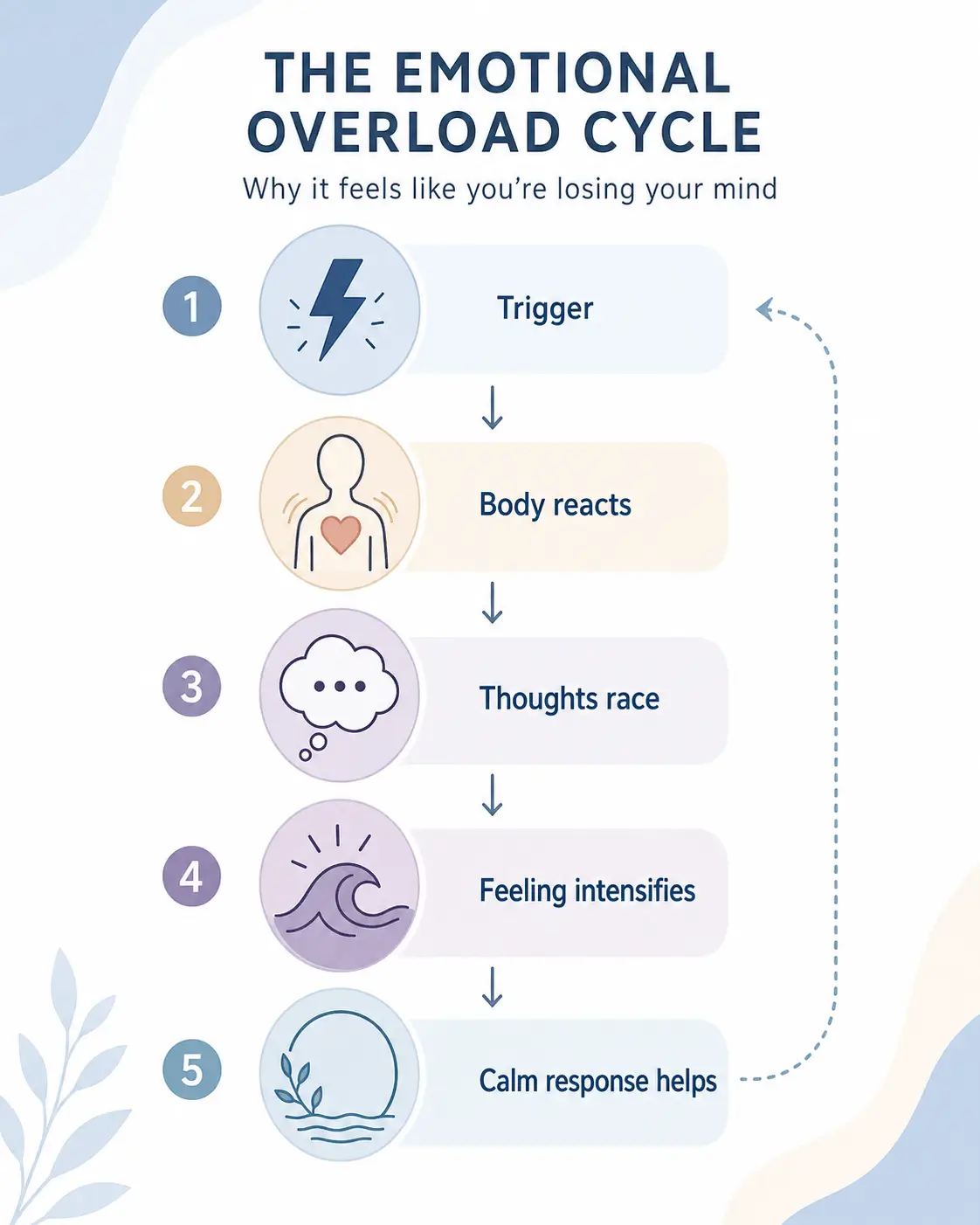
There are several common reasons behind the question, “Why do I feel like im losing my mind?” The pattern is often: a trigger activates the nervous system, the body reacts with stress symptoms, and the mind interprets those symptoms as danger or loss of control.
Common causes include anxiety, depression, chronic stress, burnout, hormones, poor sleep, trauma responses, overstimulation, and life instability.
Anxiety and Panic Attacks
Anxiety and panic attacks can make you feel like you are losing control because they activate the body’s fight-or-flight response. A panic attack can feel sudden and intense, even when there is no immediate danger. Mayo Clinic notes that panic attacks can make people think they are losing control, having a heart attack, or dying.
Common panic symptoms may include racing heart, chest tightness, dizziness, trembling, sweating, shortness of breath, fear of dying, or a sense of unreality.
- Anxiety activates the fight-or-flight system.
- The body releases stress hormones.
- Physical symptoms can feel dangerous.
- The mind may misread symptoms as “I’m going crazy.”
- Fear of the feeling can make the cycle stronger.
Panic disorder may involve repeated sudden panic attacks, feeling out of control, and fear of future attacks.
Chronic Stress and Burnout
Chronic stress can make you feel like you are slowly losing your mind because long-term pressure reduces emotional capacity. When work stress, caregiving, financial pressure, relationship conflict, overstimulation, or lack of recovery continue for too long, the nervous system may stay in alert mode.
This can explain thoughts such as “Why do I always feel like I’m losing my mind?” or “Why do I feel like I’m slowly losing my mind?”
- Chronic stress keeps the body in alert mode.
- Burnout can create emotional numbness, irritability, brain fog, and hopelessness.
- Lack of rest makes normal problems feel unmanageable.
- Stress becomes worse when people ignore early warning signs.
Burnout often develops when demand repeatedly exceeds recovery. The problem is not only workload. It is also the absence of emotional, physical, and mental repair.
Depression and Emotional Exhaustion
Depression can make someone think, “I feel like I’m losing my mind depression,” because it affects mood, energy, concentration, and how problems are interpreted. Depression may involve low mood, hopelessness, poor concentration, rumination, fatigue, emotional heaviness, or loss of interest.
This does not mean you should diagnose yourself. It means these symptoms deserve support, especially if they persist or interfere with daily life.
- Depression can distort how problems feel.
- Rumination can make thoughts feel repetitive and uncontrollable.
- Low energy reduces coping ability.
- Isolation can intensify fear and confusion.
When depression and anxiety overlap, a person may feel both emotionally heavy and physically activated. That combination can feel especially confusing.
Hormonal Changes, Periods, PMS, PMDD, and Menopause
Hormonal changes can affect mood, anxiety, sleep, irritability, and emotional sensitivity. This may explain questions such as “Why do I feel like im losing my mind before my period?” or “Why do I feel like I’m losing my mind on my period?”
ACOG lists emotional PMS symptoms that can include depression, angry outbursts, irritability, crying spells, anxiety, confusion, social withdrawal, poor concentration, and insomnia.
Some people also think, “I feel like I losing my mind menopause,” or ask, “Why do I feel like im losing my mind at 46?” ACOG says mood changes during perimenopause are real, and about 4 in 10 women experience mood symptoms during perimenopause that are similar to PMS.
- Track symptoms across cycles.
- Notice whether symptoms appear before or during periods.
- Consider perimenopause if symptoms appear in the 40s with sleep changes, hot flashes, cycle changes, or mood swings.
- Seek medical support if symptoms feel severe, sudden, or disruptive.
PMDD may involve severe symptoms that disrupt work, school, relationships, or daily functioning. Severe, predictable, cycle-linked distress should be discussed with a healthcare professional.
Sleep Deprivation and Overstimulation
Poor sleep weakens emotional regulation and makes thinking feel less stable. After too little sleep, the brain has less recovery time, so normal stressors may feel threatening or unmanageable.
Modern triggers can make this worse: doomscrolling, caffeine, late-night screen use, constant notifications, work overload, and multitasking.
- Sleep loss increases emotional reactivity.
- The brain becomes less able to filter intrusive thoughts.
- Caffeine and overstimulation can mimic anxiety symptoms.
- Restoring sleep can reduce the intensity of the feeling.
A sleep reset does not fix every mental health issue, but it often lowers the volume of emotional distress.
Depersonalization and Derealization
Depersonalization and derealization can feel like being detached from yourself or like the world is unreal. These experiences can feel dreamlike, strange, and disturbing. Mayo Clinic describes depersonalization-derealization as feeling outside your body or sensing that things around you are not real.
- This can happen during intense anxiety, panic, trauma, exhaustion, or stress.
- The feeling is scary but often connected to nervous-system overload.
- Grounding techniques can help bring attention back to the present.
The goal is not to panic about the sensation. The goal is to gently reconnect with your body, surroundings, and support system.
What To Do When You Feel Like You’re Losing Your Mind Right Now
If you think, “I feel like I’m losing my mind what do I do,” start by calming your body before trying to solve every thought. Immediate steps include slow breathing, grounding, reducing stimulation, gentle movement, and contacting someone safe.
Use a 5-Minute Stabilization Plan
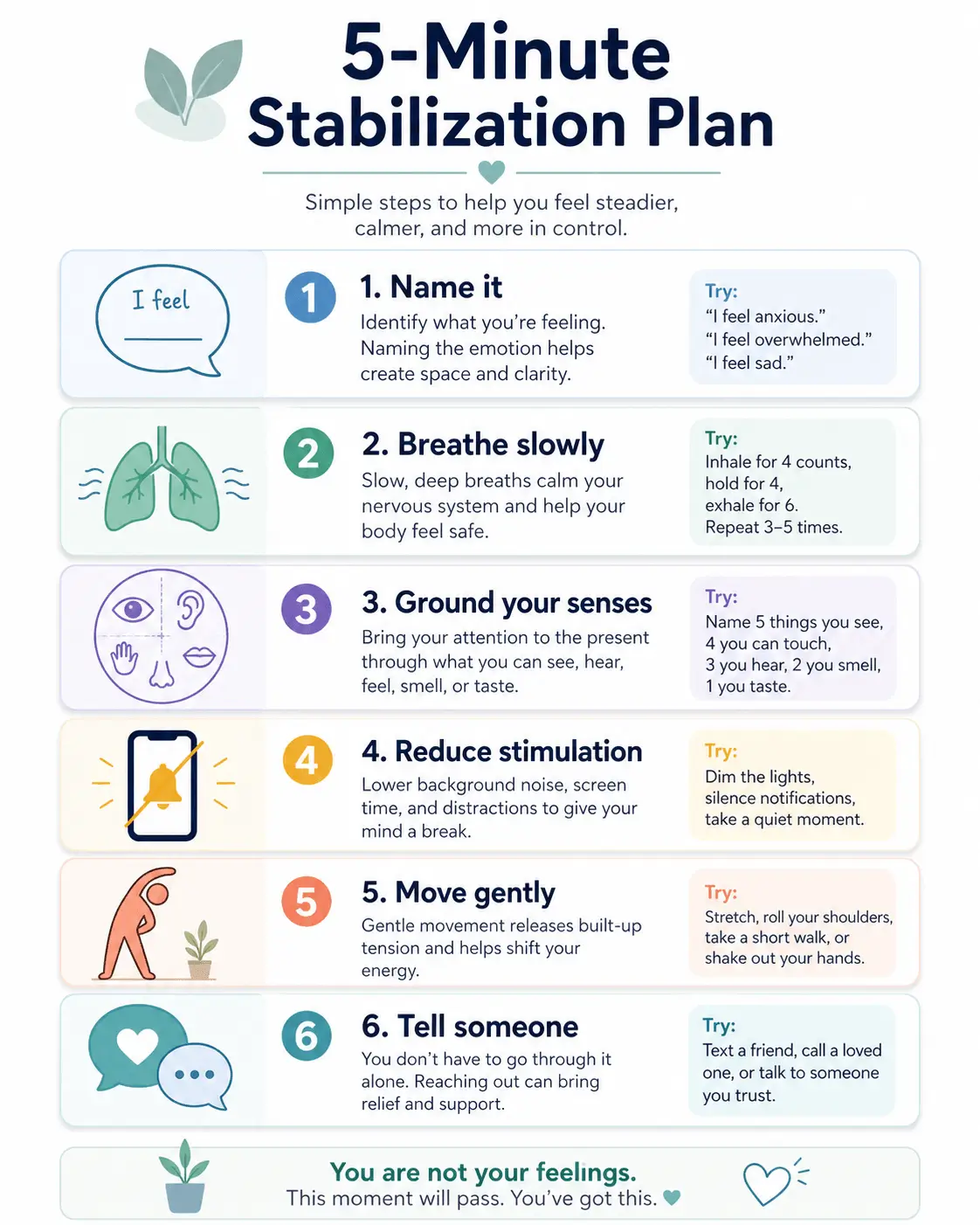
A 5-minute stabilization plan helps reduce panic by giving your brain clear, simple actions. NHS guidance for anxiety and panic recommends calming breathing exercises, talking to someone, physical activity, and improving sleep when anxiety or panic is difficult to manage.
- Name the experience: “I am feeling overwhelmed; this feeling is intense, but it may pass.”
- Slow your breathing: Breathe in gently, then exhale longer than you inhale.
- Ground through the senses: Name what you can see, hear, touch, smell, and taste.
- Reduce stimulation: Sit somewhere quieter, lower lights, and put your phone away.
- Move your body gently: Walk, stretch, or shake out tension.
- Tell someone: Message or call a trusted person and say, “I’m feeling overwhelmed and need support.”
What Not To Do in the Moment
Some reactions can strengthen the spiral instead of calming it.
- Do not search symptoms repeatedly for hours.
- Do not argue with every intrusive thought.
- Do not isolate if you feel unsafe.
- Do not overload yourself with caffeine, alcohol, or substances.
- Do not make major life decisions while emotionally flooded.
The immediate goal is stabilization, not perfect understanding.
Table-Friendly Section — Possible Causes, Signs, and First Steps
| Possible Cause | What It Can Feel Like | Why It Happens | Helpful First Step |
|---|---|---|---|
| Anxiety or panic | Fear, racing thoughts, feeling out of control | Fight-or-flight response becomes activated | Slow breathing and grounding |
| Chronic stress | Irritability, brain fog, emotional overload | Nervous system stays on high alert | Reduce demands and add recovery time |
| Depression | Hopelessness, rumination, low motivation | Mood and energy regulation are affected | Talk to a professional or trusted person |
| Poor sleep | Confusion, emotional sensitivity | Brain has less recovery time | Create a sleep reset routine |
| PMS/PMDD | Mood swings, anxiety, crying, anger | Hormonal changes affect mood regulation | Track cycle symptoms and seek care if severe |
| Perimenopause | Anxiety, mood shifts, sleep disruption | Hormone fluctuations increase sensitivity | Discuss symptoms with a healthcare provider |
| Burnout | Numbness, exhaustion, detachment | Long-term stress exceeds coping capacity | Rest, boundaries, workload changes |
Why the Feeling Gets Worse When You Fight It
The feeling gets worse when you fight it because fear adds more nervous-system activation to an already activated body. When you treat every sensation as danger, the brain monitors more closely, symptoms feel stronger, and the fear loop repeats.
The loop often works like this:
- A strange sensation appears.
- The mind labels it as dangerous.
- Fear increases body symptoms.
- Stronger symptoms confirm the fear.
- The person monitors themselves more closely.
- The cycle repeats.
Trying to force the feeling away can make it louder. A calmer response is to notice it, name it, regulate the body, and avoid feeding the fear loop.
A useful mindset shift is: “This feels uncomfortable, but I can respond to it without escalating it.”
A helpful next step is to focus on what you can control, such as your breathing, environment, sleep, support system, and next small action.
Motivation vs Discipline When You’re Mentally Overwhelmed
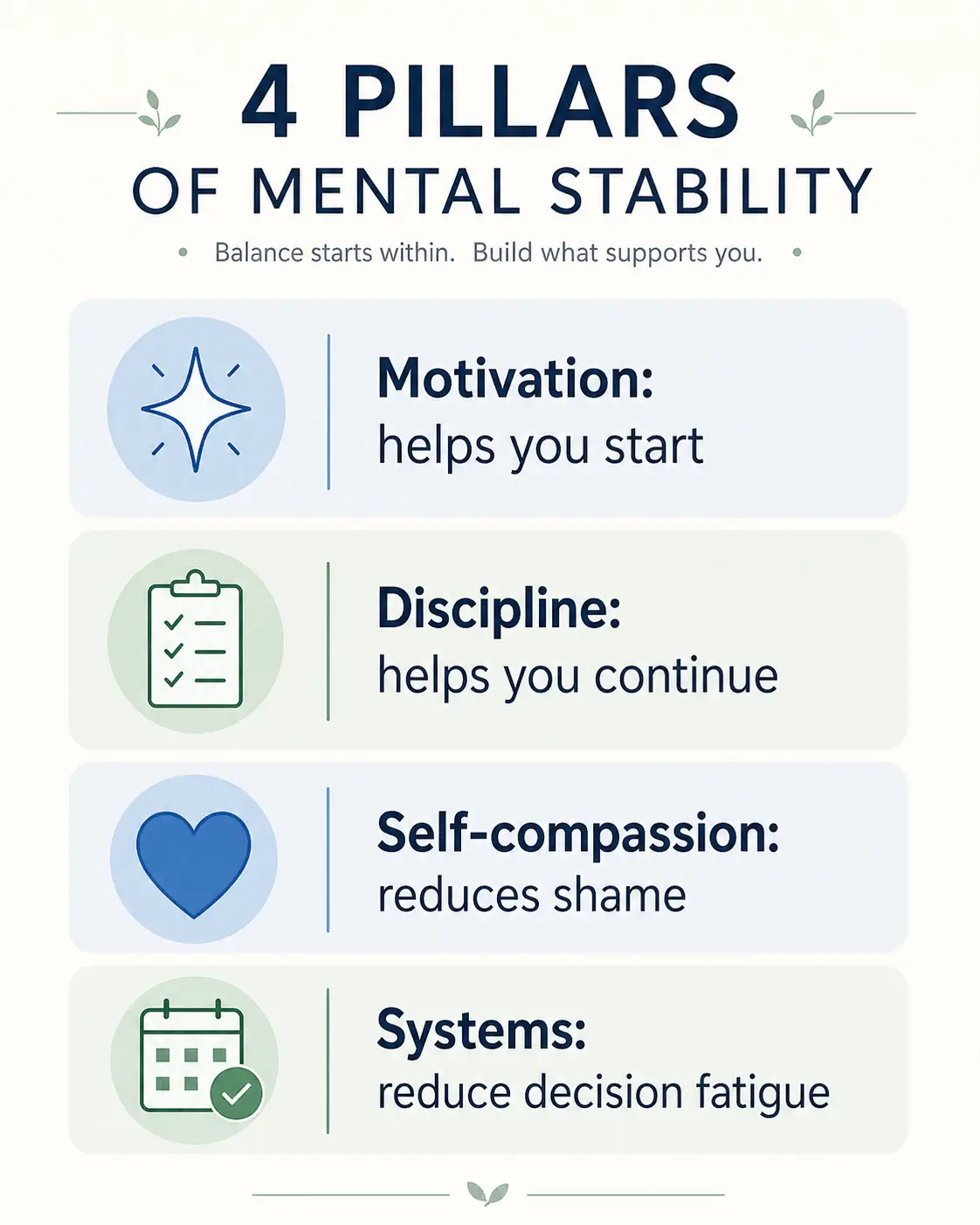
When you’re mentally overwhelmed, motivation is unreliable because stress, anxiety, depression, and burnout reduce emotional energy. Discipline helps when it creates gentle structure, but it should not become harsh self-pressure.
| Concept | What It Means | When It Helps | Limitation |
|---|---|---|---|
| Motivation | Feeling emotionally ready to act | Starting when energy is high | Unreliable during stress or depression |
| Discipline | Acting based on structure, not mood | Maintaining routines during low motivation | Can become harsh if not balanced with rest |
| Self-compassion | Responding to struggle without shame | Reducing panic, guilt, and avoidance | Must still include practical action |
| Systems | Pre-planned routines and supports | Reducing decision fatigue | Needs regular adjustment |
When someone feels like they’re losing their mind, the goal is not extreme discipline. The goal is gentle structure: sleep, food, movement, social support, therapy, and reduced overload.
A stable system works better than emotional force.
Consistency vs Intensity for Mental Stability
Consistency supports mental stability better than intensity because the nervous system responds well to repeated signals of safety. Small daily actions are easier to repeat than dramatic life changes made during panic or shame.
| Approach | Example | Likely Outcome |
|---|---|---|
| Intensity | “I’ll fix my whole life today.” | Burnout, pressure, unrealistic expectations |
| Consistency | “I’ll take one stabilizing step daily.” | More sustainable emotional regulation |
| Avoidance | “I’ll ignore this until it disappears.” | Symptoms may build over time |
| Support-based action | “I’ll talk to someone and make a plan.” | More safety, clarity, and accountability |
If emotional overwhelm is connected to disorganization, unfinished tasks, or daily chaos, learning how do i get my life in order can help you rebuild structure one step at a time.
- Small habits are easier to repeat.
- Repetition teaches the brain safety.
- Consistent sleep and routines reduce emotional volatility.
- Overly intense self-improvement can become another source of pressure.
The most useful routine is the one you can still do on a hard day.
Common Problems and How To Respond
Procrastination
Procrastination often happens because the task feels emotionally threatening. The brain avoids discomfort for short-term relief, but avoidance creates more pressure later. Overthinking can make action feel even harder.
How to fix it:
- Use a 2-minute starting rule.
- Break the task into the next visible action.
- Remove unnecessary choices.
How to prevent it:
- Build routines around time and place.
- Plan recovery time.
- Use accountability.
Lack of Motivation
Lack of motivation can happen when stress, depression, poor sleep, or overwhelm reduce emotional energy. Waiting to “feel ready” often delays action and increases guilt.
How to fix it:
- Start with body-based actions: shower, food, sunlight, walking.
- Use tiny commitments.
- Reward completion, not perfection.
How to prevent it:
- Create routines that do not depend on mood.
- Keep goals realistic.
- Reduce all-or-nothing thinking.
Inconsistency
Inconsistency often happens when goals are too large, life systems do not support the behavior, or emotional setbacks are treated as failure.
How to fix it:
- Shrink the habit.
- Attach it to an existing routine.
- Track patterns without judgment.
How to prevent it:
- Build flexible routines.
- Prepare for low-energy days.
- Use “minimum version” habits.
Overthinking
Overthinking happens when the mind tries to solve emotional uncertainty through analysis. Anxiety can create a false sense that more thinking equals more safety.
How to fix it:
- Set a worry window.
- Write thoughts down.
- Ask: “Is this a problem to solve or a feeling to regulate?”
How to prevent it:
- Reduce rumination triggers.
- Practice grounding.
- Make decisions with clear criteria.
Burnout
Burnout happens when demand exceeds recovery for too long. People often normalize exhaustion until the body pushes back through irritability, numbness, dread, brain fog, or emotional shutdown.
How to fix it:
- Reduce nonessential demands.
- Prioritize sleep and nourishment.
- Ask for practical help.
How to prevent it:
- Schedule recovery before collapse.
- Set boundaries.
- Watch early signs: irritability, numbness, dread, brain fog.
Fear of Failure
Fear of failure happens when the brain links mistakes with danger, shame, or rejection. Perfectionism makes action feel risky because anything less than perfect feels unsafe.
How to fix it:
- Redefine progress as learning.
- Use experiments instead of identity-based judgments.
- Start where failure has low consequences.
How to prevent it:
- Build emotional tolerance.
- Review what worked, not only what went wrong.
- Separate self-worth from performance.
Science-Backed Insights: What Actually Helps vs What Only Sounds Good
Some advice sounds motivating but does not help a dysregulated nervous system. What works better is usually practical, body-based, structured, and support-oriented. Mayo Clinic notes that panic attack treatment can include psychotherapy, medication, or both, depending on severity, history, preference, and access to trained professionals.
| Sounds Good | What Actually Works Better |
|---|---|
| “Just stop thinking about it.” | Regulate the body first, then challenge thoughts. |
| “Push through everything.” | Balance action with recovery. |
| “Wait until you feel motivated.” | Use small routines and support systems. |
| “Research symptoms all night.” | Track patterns and speak with a professional. |
| “Fix your whole life immediately.” | Stabilize sleep, stress, support, and daily structure first. |
Psychotherapy, medical support, habit changes, sleep routines, and social support can all play a role. The right support depends on the person, severity, history, and safety needs.
When Feeling Like You’re Losing Your Mind May Need Professional Help
Feeling like you’re losing your mind may need professional help when it happens often, worsens, disrupts daily function, or makes you feel unsafe. Support is appropriate even if you are unsure whether symptoms are “severe enough.”
Seek professional support if:
- The feeling happens often or keeps getting worse.
- You cannot work, sleep, eat, study, or care for yourself.
- You have panic attacks repeatedly.
- You feel detached from reality often.
- You feel depressed, hopeless, or unsafe.
- Your symptoms are linked to your cycle, perimenopause, medication, substances, or a medical condition.
- Self-help strategies are not enough.
Seek urgent help immediately if:
- You may hurt yourself or someone else.
- You feel unable to stay safe.
- You are hearing, seeing, or believing things others do not.
- You feel completely out of control.
- You are in immediate danger.
If there is immediate danger, contact local emergency services or a crisis line in your area.
Real-Life Scenarios
Scenario 1 — Sudden Panic at Night
You wake up with racing thoughts and think, “Why do I suddenly feel like I’m losing my mind?”
Practical response:
- Sit up.
- Slow your breathing.
- Name five things you see.
- Remind yourself: “This is a panic response, not proof I’m unsafe.”
- Avoid symptom-searching.
- Contact support if it does not settle or feels unsafe.
Scenario 2 — Feeling Unstable Before Your Period
You feel anxious, emotional, irritable, or unlike yourself before your period.
Practical response:
- Track mood changes for 2–3 cycles.
- Note sleep, caffeine, stress, and cravings.
- Reduce pressure during high-sensitivity days.
- Speak with a healthcare professional if symptoms disrupt life.
Scenario 3 — Feeling Like You’re Losing Yourself in Your 40s
At 46, you feel anxious, emotionally reactive, foggy, or unlike yourself.
Practical response:
- Consider stress, sleep, workload, hormones, and perimenopause.
- Track symptoms.
- Prioritize recovery routines.
- Discuss hormonal and mental health symptoms with a clinician.
Scenario 4 — Depression and Mental Exhaustion
You feel hopeless and think, “I feel like I’m losing my mind.”
Practical response:
- Tell someone directly.
- Reduce isolation.
- Focus on one stabilizing action: food, shower, sunlight, or sleep.
- Seek professional help, especially if hopelessness persists.
A Simple Daily Routine for Feeling More Grounded
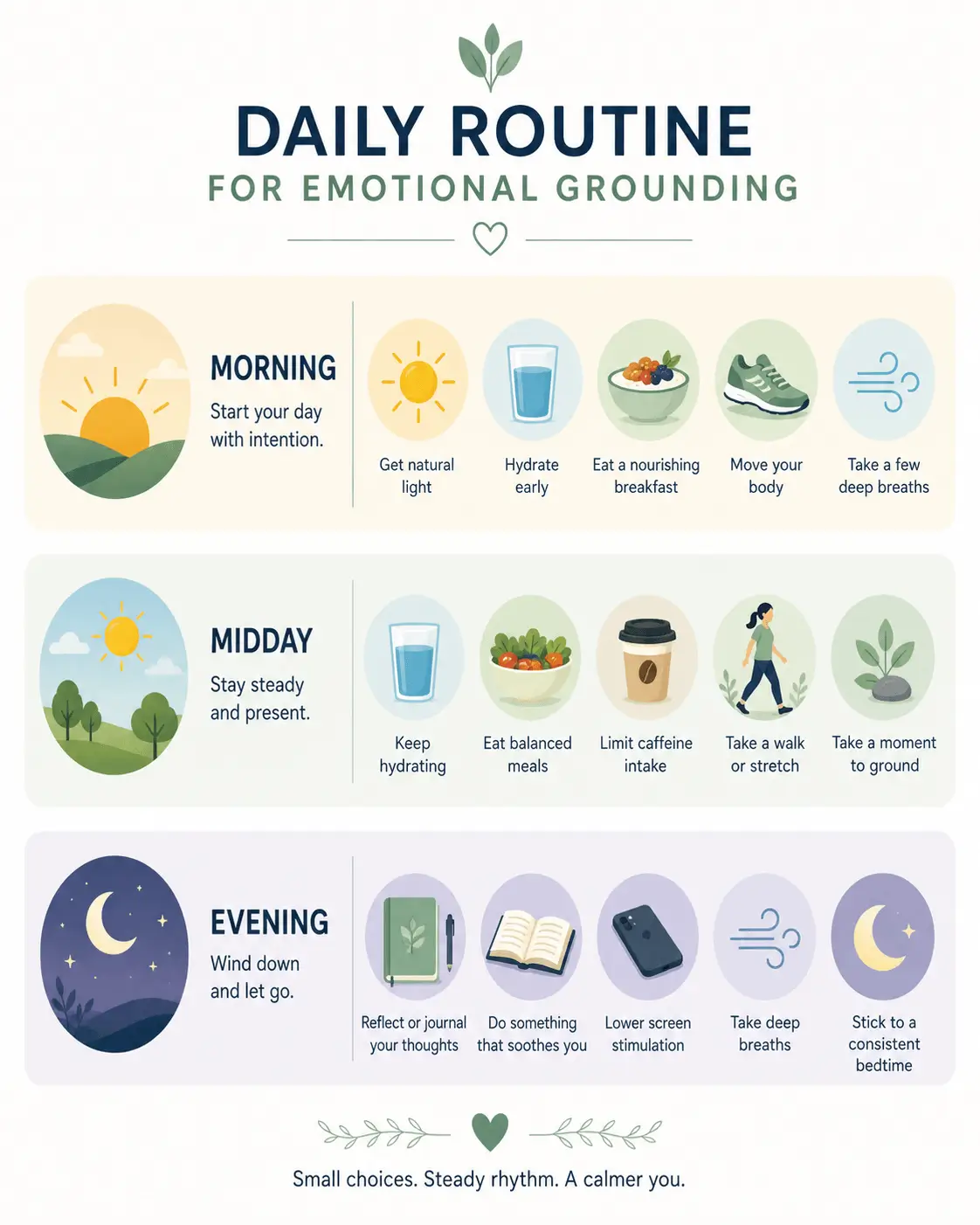
A simple daily routine can help you feel more grounded by reducing decision fatigue and giving your nervous system predictable signals of safety. The routine should be realistic, flexible, and easy to repeat.
Morning:
- Get light exposure.
- Drink water.
- Eat something balanced.
- Write one priority, not ten.
Midday:
- Take a short walk.
- Pause caffeine if it worsens anxiety.
- Do one grounding reset.
- Check whether you are hungry, tired, overstimulated, or avoiding something.
Evening:
- Lower screen stimulation.
- Write down worries for tomorrow.
- Prepare one small task for the next day.
- Keep bedtime consistent.
You can also use how to journal for self-growth as a simple way to track emotions, notice patterns, and reduce mental clutter.
Minimum version for hard days:
- Drink water.
- Eat something.
- Step outside for two minutes.
- Text one safe person.
- Breathe slowly for one minute.
The goal is not a perfect lifestyle. The goal is repeatable stability.
Common Myths About Feeling Like You’re Losing Your Mind
Myth 1: “If I feel this way, I must be broken.”
Reality: The feeling often signals overwhelm, stress, anxiety, depression, hormonal changes, or lack of support.
Myth 2: “I should be able to fix this alone.”
Reality: Support is part of recovery, not a sign of weakness.
Myth 3: “If grounding doesn’t work instantly, it failed.”
Reality: Regulation is a practice. The goal is to reduce intensity, not erase feelings immediately.
Myth 4: “Strong people don’t feel this way.”
Reality: High-functioning people can still experience panic, burnout, depression, or emotional overload.
FAQ
Why do I feel like I’m losing my mind sometimes?
You may feel this way when stress, anxiety, panic, depression, poor sleep, hormones, or emotional overload make your thoughts and body sensations feel intense or uncontrollable. Occasional episodes can happen during high stress, but repeated or severe episodes are a reason to seek support.
Why do I suddenly feel like I’m losing my mind?
A sudden feeling of losing your mind can happen during panic, acute stress, trauma triggers, lack of sleep, caffeine overload, or overwhelming life events. If the feeling is intense, focus on breathing, grounding, and contacting someone safe.
Why do I feel like I’m losing control of my mind?
This can happen when anxious thoughts, intrusive thoughts, or emotional overwhelm make it feel like your brain will not slow down. The goal is to regulate your nervous system first, then address the thoughts once your body feels calmer.
What should I do if I feel like I’m losing my mind?
Pause, breathe slowly, ground yourself through your senses, reduce stimulation, move gently, and tell someone you trust. If you feel unsafe, disconnected from reality, or unable to function, seek urgent professional help.
Can depression make me feel like I’m losing my mind?
Yes. Depression can create rumination, hopelessness, brain fog, emotional numbness, and low motivation, which can make your mind feel unfamiliar or out of control. Professional support can help, especially if symptoms persist.
Why do I feel like I’m losing my mind before or during my period?
Hormonal changes before or during your period can affect mood, anxiety, sleep, irritability, and concentration. If symptoms are severe, predictable, or disruptive, tracking them and speaking with a healthcare professional can help.
Why do I feel like I’m losing my mind at 46?
In your 40s, stress, sleep changes, caregiving pressure, health concerns, and perimenopause can all affect mood and emotional stability. If this feeling is new or worsening, consider both mental health and medical factors.
How do I stop feeling like I’m slowly losing my mind?
Start with stabilization: sleep, food, movement, reduced overstimulation, emotional support, and a simple daily routine. Then identify patterns such as stress, panic, depression, hormones, or burnout. If the feeling continues, seek professional help.
Conclusion
Feeling like you’re losing your mind is usually a signal of emotional overload, nervous-system activation, stress, anxiety, depression, burnout, hormonal changes, or lack of recovery. The key takeaway is not to shame yourself or panic about the feeling. Instead, slow down, regulate your body, reduce immediate pressure, track patterns, and reach out for support when needed.
The main shift is this: instead of asking, “What is wrong with me?” ask, “What is my mind and body trying to tell me, and what support do I need next?”










One Response