
Introduction
Growth mindset books for students are built around a simple idea: abilities and intelligence can develop through effort, effective strategies, feedback, and learning from mistakes, rather than staying fixed from birth. These books use stories, relatable examples, reflection questions, and practical exercises to help learners recognize and apply this way of thinking in school and everyday life. The most suitable book depends on a student’s age, reading level, developmental stage, and specific learning needs — a picture book that works for a first grader will not resonate with a high schooler facing exam pressure. This article covers book selection across elementary students, 10-year-olds, middle schoolers, teens, and older learners, with attention to how growth mindset connects to persistence, resilience, and academic challenges at each stage.
Quick Summary
- Growth mindset books help students understand that skills and abilities can develop through practice, strategies, feedback, and persistence.
- The right book depends on the student’s age, reading ability, maturity, and specific learning challenges.
- Younger students generally benefit from stories and simple examples, while teens may respond better to realistic challenges, reflection, and evidence-based explanations.
- Parents and educators can reinforce the ideas in these books by connecting reading to everyday learning experiences.
What Makes a Book Useful for Teaching Growth Mindset?
A useful growth mindset book goes beyond generic encouragement — it teaches students specific, actionable concepts they can recognize in their own academic experience. For a broader look at titles across age groups, see our full roundup of growth mindset books for kids.
Core concepts a growth mindset book should explain
Genuine growth mindset education is grounded in psychologist Carol Dweck’s research distinguishing a “fixed mindset” (the belief that ability is static) from a “growth mindset” (the belief that ability can develop). Related to this is the concept of neuroplasticity — the brain’s capacity to form new connections through learning and practice — which gives students a concrete, biological reason to believe change is possible. A strong book should clearly cover:
- Effort versus effective effort
- Learning from mistakes
- Persistence after setbacks
- Using feedback constructively
- Trying different strategies
- Developing skills over time
In our experience helping readers build better habits, the books that stick are the ones that separate “trying hard” from “trying smart” — simply praising effort without connecting it to strategy can unintentionally reinforce the very fixed-mindset thinking the book is trying to prevent.
How stories and examples help students understand mindset
Growth mindset is an abstract psychological concept, and narrative examples make it concrete. Effective books typically include:
- Characters facing failure or difficult tasks
- Progress shown over time, not just a single moment of success
- Examples of persistence and strategy changes
- Reflection questions and discussion prompts
Seeing a character struggle, adjust their approach, and eventually improve gives students a mental model they can apply to their own setbacks — a subject test, a tryout, or a group project that didn’t go as planned.
How to Choose Growth Mindset Books by Student Age
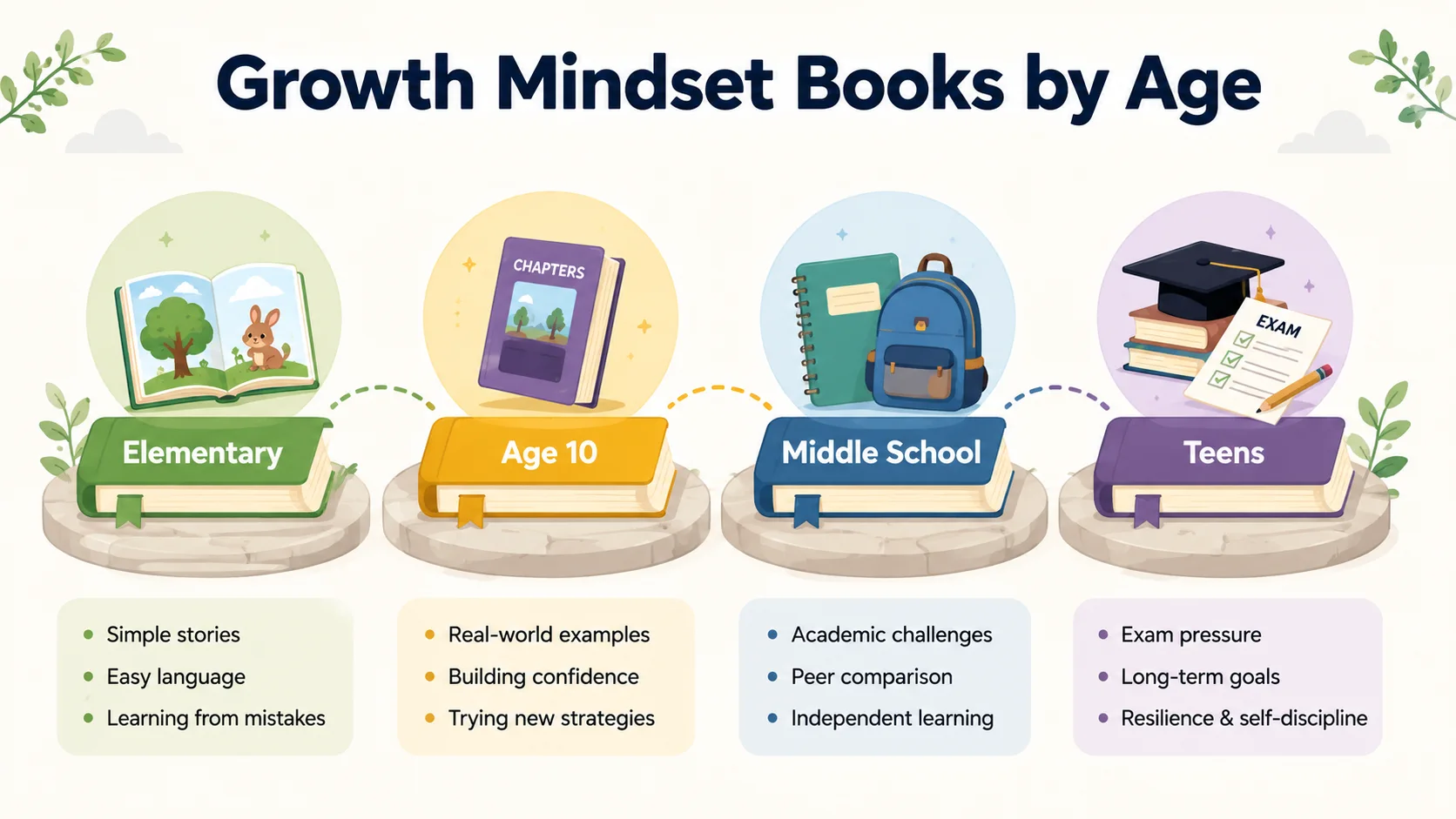
Growth mindset books for elementary students
Growth mindset books for elementary students should match early reading levels through picture books or short chapter books with simple, accessible vocabulary. At this stage, the goal is a straightforward explanation of mistakes, effort, and persistence — not abstract theory. Look for: If you’re shopping specifically for younger readers, our guide to growth mindset picture books breaks down the best options by age and theme
- Appropriate reading level and vocabulary
- Picture books and short chapter books
- Simple explanations of mistakes, effort, and persistence
- Stories that encourage students to try again without promoting unrealistic positivity
Your Daily Thrive recommends avoiding books that suggest a positive attitude alone solves every problem; even young readers benefit from a realistic picture of effort paired with support.
Growth mindset books for 10-year-olds
By around age 10, students can handle increasingly complex stories and real-world examples. Growth mindset books for 10-year-olds often feature characters navigating academic, social, or extracurricular challenges, paired with reflection activities that connect the story back to school and home life. A 10-year-old typically needs more nuanced material than a younger elementary reader because they are beginning to compare themselves to peers and notice more complicated academic demands. For a dedicated list of titles at this stage, check out our picks for growth mindset books for 10 year olds
Growth mindset books for middle schoolers
Middle school brings academic setbacks, changing expectations, and heightened awareness of peer comparison and identity. Growth mindset books for middle schoolers should address:
- Academic setbacks and changing expectations
- Confidence, peer comparison, and identity
- Learning how to respond to criticism and failure
- Building independent study habits
This stage marks a transition from elementary-level guided learning toward greater academic independence, and books should reflect that shift.
Growth mindset books for high school students and teens
Growth mindset books for high school students and growth mindset books for teens generally need to address more mature, longer-term concerns: managing challenging coursework, long-term goals and delayed results, exam pressure and academic setbacks, self-talk and resilience, and developing independence in learning. Adolescent readers often benefit most from books that address autonomy, identity, and motivation alongside realistic academic scenarios, rather than simplified stories aimed at younger children.
How Growth Mindset Books Differ for Students, Parents, and Adults
Books written directly for students
These use accessible language, student-centered stories, built-in activities and reflection prompts, and school-related examples students can relate to directly.
Books for parents supporting a student’s mindset
Growth mindset books for parents serve a different purpose than books students read independently. They focus on how adults communicate about effort and ability, how to respond when children struggle, avoiding praise that unintentionally creates a fixed mindset (such as “you’re so smart” rather than “you worked through that well”), and creating a home environment where mistakes are treated as part of learning.
Books for adults and older learners
Growth mindset books for adults apply the same core principles to professional and personal learning, typically with more advanced explanations of motivation and behavior and more emphasis on self-directed reflection and practice. An adult-focused resource may be more useful for a teacher or parent who wants a deeper theoretical grounding, or for an older student transitioning into more independent, self-directed learning.
Growth Mindset Books by Learning Goal
A book should match a student’s actual challenge rather than simply carrying a “growth mindset” label on the cover.
| Learning Goal | What to Look For in a Book | Why It Matters |
|---|---|---|
| Handling mistakes | Stories showing mistakes as learning opportunities | Reduces avoidance of difficult tasks |
| Persistence | Examples of setbacks followed by strategic effort | Builds resilience |
| Academic confidence | Realistic school-related challenges | Makes concepts easier to apply |
| Learning from feedback | Characters responding constructively to criticism | Supports improvement |
| Motivation | Clear goals and meaningful progress | Helps students sustain effort |
| Problem-solving | Multiple attempts and changing strategies | Shows that effort alone is not always enough |
Growth Mindset vs. Fixed Mindset: What Should Students Learn From These Books?
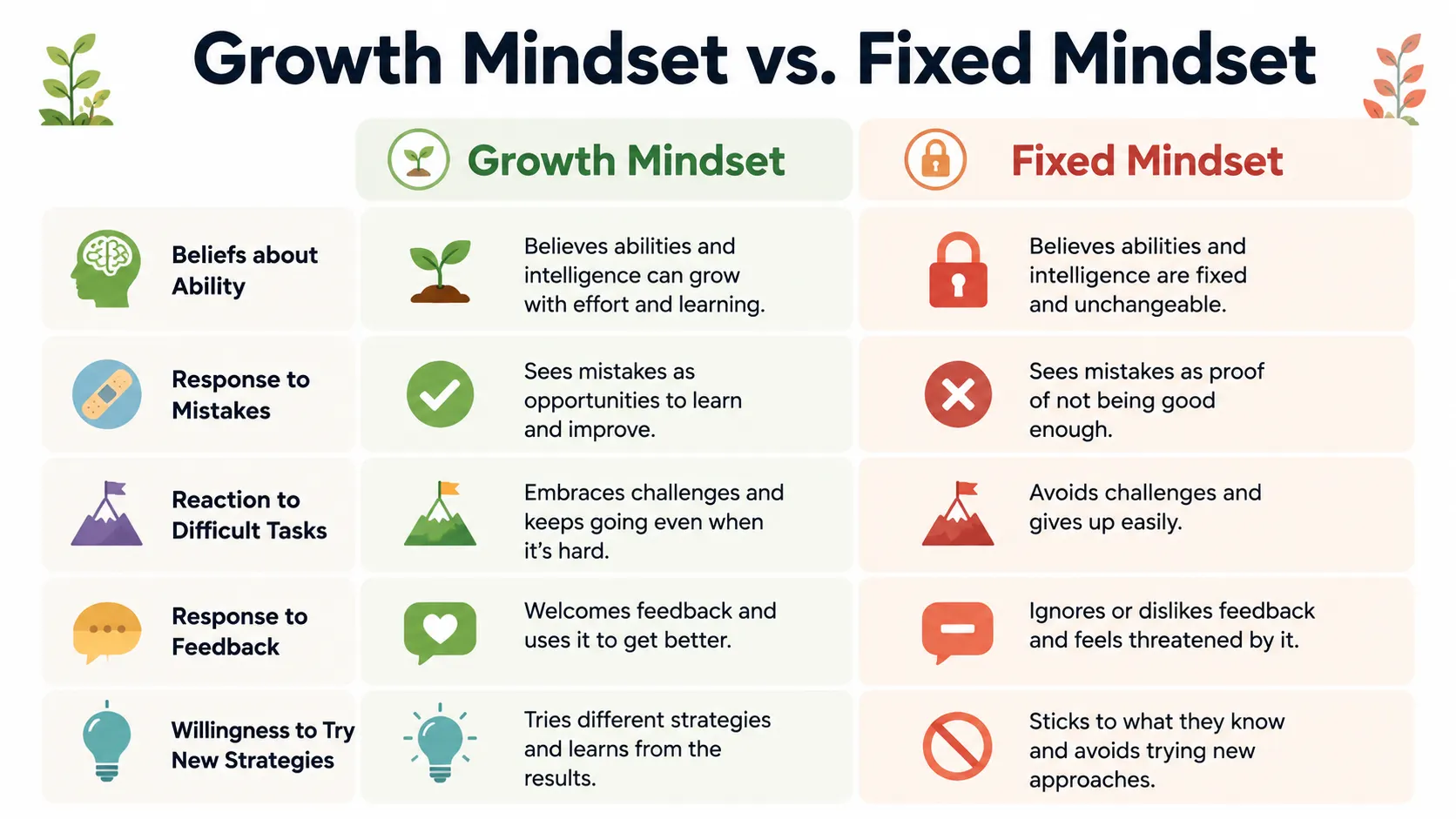
Key differences between the two mindsets
| Aspect | Growth Mindset | Fixed Mindset |
|---|---|---|
| Beliefs about ability | Can develop through effort and learning | Seen as fixed and unchangeable |
| Response to mistakes | Treated as information for improvement | Avoided or seen as failure |
| Reaction to difficult tasks | Viewed as opportunities to grow | Avoided to protect self-image |
| Response to feedback | Used constructively | Often dismissed or resisted |
| Willingness to try new strategies | High | Low |
Why growth mindset does not mean “just try harder”
A well-written book should make clear that effort must be paired with effective strategies. Students may need instruction, feedback, or additional support — not just more effort applied to an approach that isn’t working. Some barriers to progress are environmental, such as limited resources or instruction quality, rather than purely motivational. Progress can also take time, and books that promise quick transformation misrepresent how mindset development actually works.
How Parents and Educators Can Use Growth Mindset Books Effectively
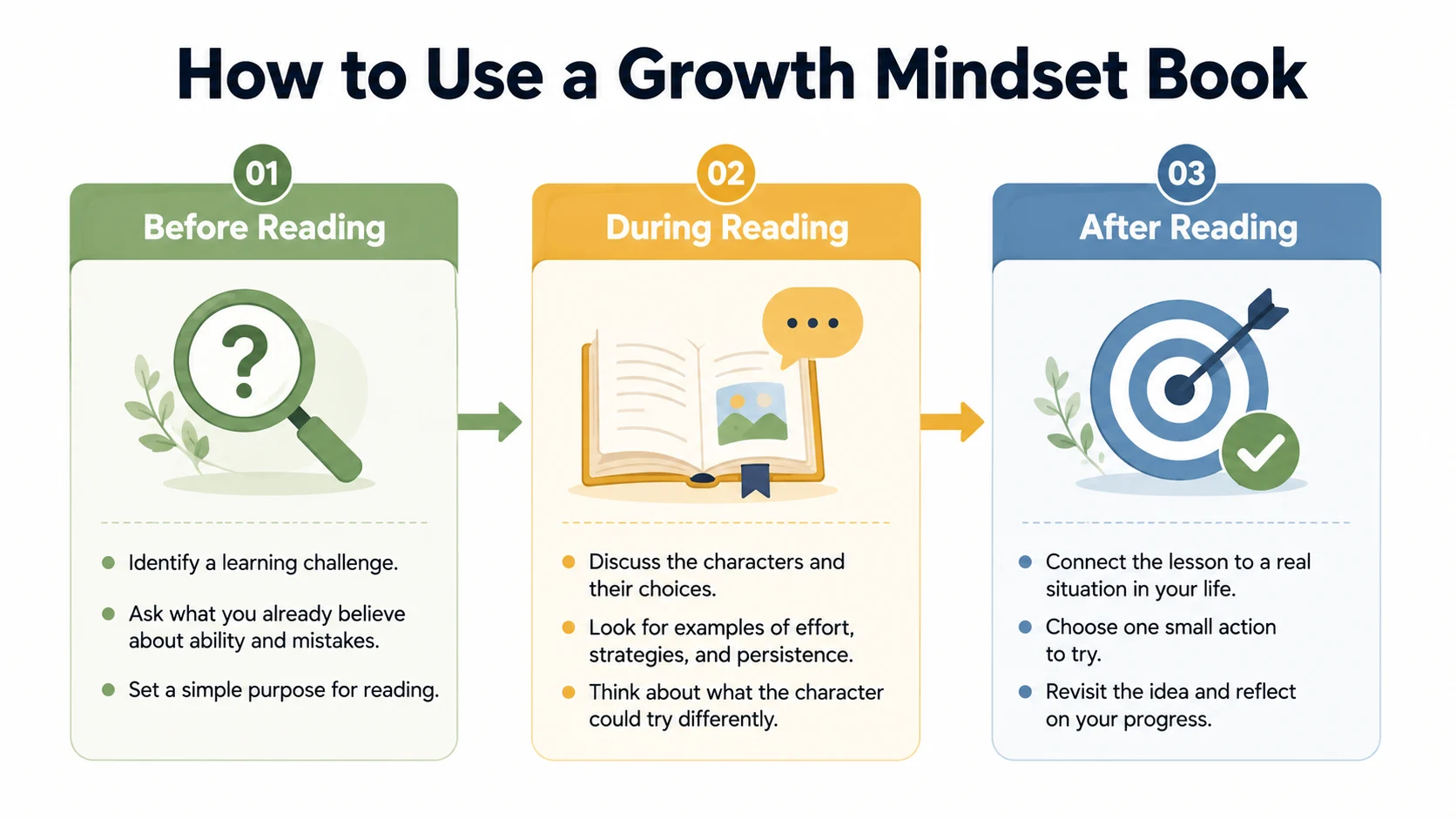
Before reading
- Identify a specific learning challenge the student is facing
- Ask what the student already believes about ability and mistakes
- Set a simple purpose for reading
During reading
- Discuss character decisions as they come up
- Identify examples of persistence and strategy changes
- Ask what the character could try differently
After reading
- Connect the lesson to a real school situation
- Set one small behavioral experiment based on the book’s ideas
- Revisit the idea after the student encounters a setback
Simply reading a growth mindset book is unlikely to change behavior on its own. The greatest practical value comes from connecting the book’s ideas to repeated real-world experiences, ongoing feedback, and supportive adult behavior.
Common Mistakes When Choosing or Using Growth Mindset Books
Choosing a book based only on the title. Check reading level, age appropriateness, and actual content — a book can mention perseverance in its title without teaching genuine growth mindset concepts inside.
Treating effort as the only solution. Encourage strategy changes, help-seeking, deliberate practice, and feedback alongside effort. “Try harder” can be counterproductive when the current strategy is simply ineffective.
Using growth mindset as pressure. Avoid implying that students can overcome every obstacle through attitude alone. Differences in resources, instruction quality, learning environments, and individual circumstances are real and should be acknowledged.
Expecting immediate behavioral change. Mindset development is gradual, and reinforcement through repeated classroom and home experiences matters more than any single book.
How to Match a Growth Mindset Book to a Student’s Situatio
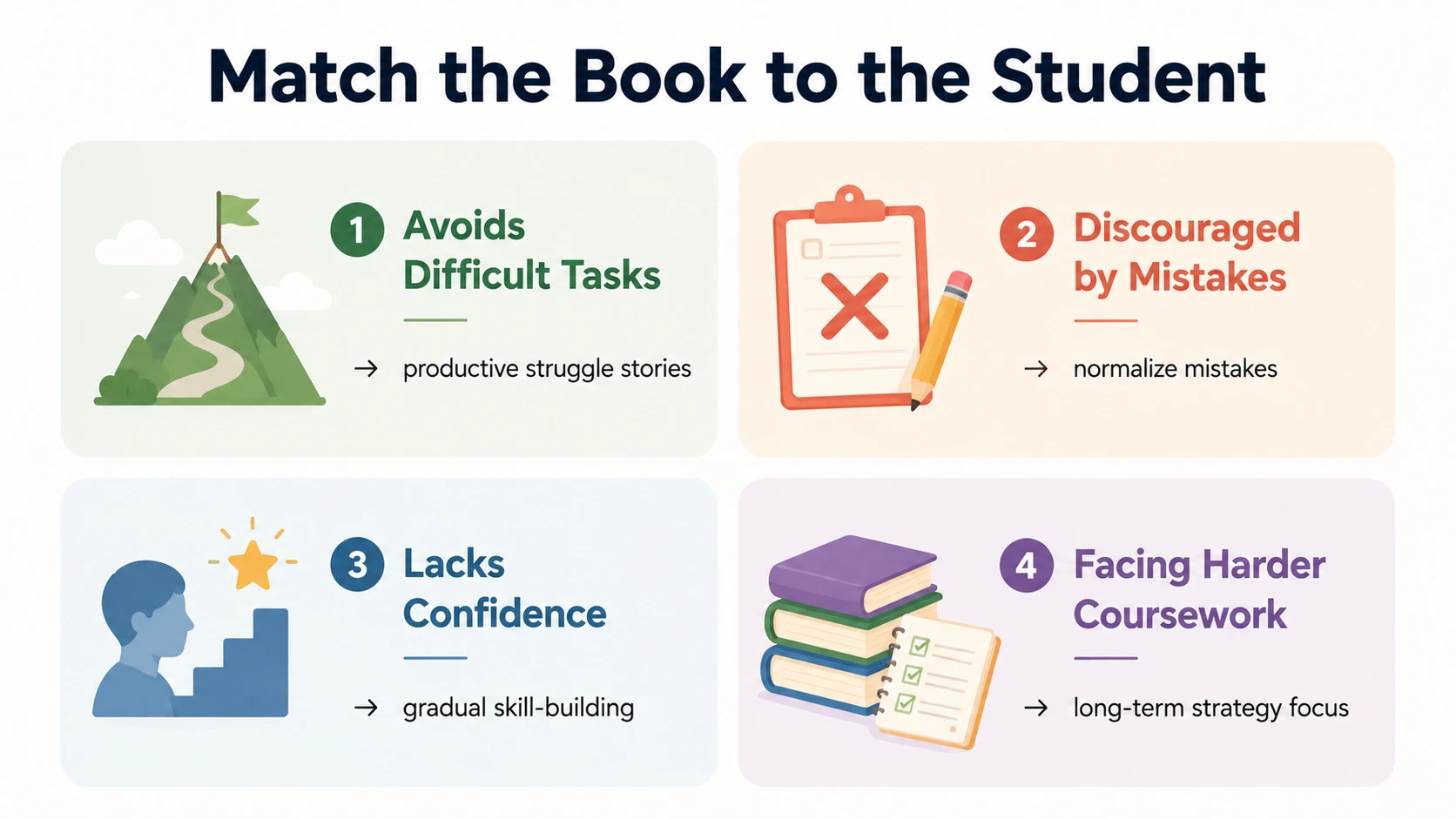
For a student who avoids difficult tasks: Prioritize stories about productive struggle and trying different approaches rather than instant success.
For a student who becomes discouraged by mistakes: Look for examples that normalize mistakes and demonstrate reflection rather than shame.
For a student who lacks academic confidence: Choose material showing gradual skill development over time rather than overnight transformation.
For a student preparing for increasingly difficult schoolwork: Favor resources that address long-term goals, strategy, feedback, and sustained persistence.
How Growth Mindset Books Connect With Broader Student Development
Growth mindset and habit formation
Repeated learning behaviors reinforce mindset concepts over time. Small, consistent actions make abstract principles practical rather than theoretical.
Growth mindset and goal setting
Effective application focuses on learning goals rather than only performance outcomes, using progress and strategy improvements — not just grades — as indicators of development.
Growth mindset and productivity
Planning, deliberate practice, and prioritization support sustained learning. Growth mindset should complement effective study methods, not replace them.
Growth mindset and resilience
Students learn to recover from setbacks by adapting strategies and seeking support, rather than simply tolerating failure and pushing through unchanged.
How to Tell Whether a Growth Mindset Book Is Actually Helping
Signs of useful application
- Student is more willing to attempt challenging work
- Student can describe what they learned from a mistake
- Student experiments with new strategies
- Student seeks useful feedback
- Student recognizes progress over time
What not to use as the only measure
- Immediate enthusiasm right after reading
- Repeating growth mindset phrases without applying them
- Finishing a book without changing any learning behavior
As of 2026, many educators note a growing emphasis on pairing growth mindset books with concrete strategy instruction rather than relying on the book alone — reflecting updated understanding that vocabulary about mindset is not the same as a genuine behavioral shift.
Conclusion
Growth mindset books for students are most useful when they match the learner’s age, reading level, challenges, and developmental needs — a picture book for a first grader and a reflective, strategy-focused book for a teenager serve very different purposes even though both address the same underlying concept. Across every age group, the central principles stay the same: abilities can develop, mistakes provide useful information, effective strategies matter as much as effort, and feedback supports improvement. Books work best as a starting point for conversations and repeated learning experiences — paired with supportive adults and real practice — rather than as a standalone solution.
Frequently Asked Questions
What are growth mindset books for students? Growth mindset books for students are books that teach the idea that abilities can develop through effort, strategy, and feedback, using age-appropriate stories, examples, and reflection activities to support learning and resilience.
At what age can children start reading growth mindset books? Children can begin with simple picture books in early elementary school, with content and reading level gradually increasing in complexity through upper elementary, middle school, and adolescence as reasoning and reflection abilities develop.
What should I look for in a growth mindset book for a child? Look for age appropriateness, an accessible reading level, realistic (not overly simplified) examples, practical strategies rather than vague encouragement, and built-in opportunities for reflection or discussion.
Are growth mindset books useful for 10-year-olds? Yes. Age 10 is often a useful stage for more complex discussions about mistakes, effort, strategies, and learning, since students at this age are becoming more aware of academic and social comparisons.
What are the differences between growth mindset books for elementary students and teens? Elementary books use simpler language, picture-book or short-chapter formats, and basic examples of trying again, while teen-focused books address longer-term academic pressure, identity, autonomy, and more realistic, strategy-based examples.
Can parents use growth mindset books with their children? Yes. Parents can use reading, discussion, modeling of their own response to mistakes, and consistent feedback to reinforce the concepts a growth mindset book introduces.
Does reading a growth mindset book automatically create a growth mindset? No. Reading can introduce and explain the concepts, but consistent application, practice, and a supportive learning environment are also necessary for real behavioral change.
Is growth mindset the same as simply working harder? No. Growth mindset depends on effective strategies, useful feedback, and deliberate practice alongside effort — effort applied to an ineffective approach does not reliably produce improvement.