

Introduction
A growth mindset mantra is a short, intentional phrase that reinforces the belief that abilities can improve through learning, effort, and persistence. Rather than relying on fixed talent, a growth mindset mantra reminds you that skills develop over time. These mantras shape thoughts, motivation, resilience, and daily habits by giving the mind a consistent, repeatable focus point during challenges. Growth mindset mantras are useful for students, professionals, parents, and anyone actively working on personal development, since the underlying psychology applies across ages and goals. This article explains what growth mindset mantras are, why they work, and how to choose and use them effectively. If you’d rather explore identity-based statements instead, see our full list of [growth mindset affirmations.
A growth mindset itself refers to the belief that intelligence and ability are not fixed traits but qualities that grow through practice, feedback, and persistence. A mantra differs from a general affirmation because it is tied specifically to this belief system rather than to self-esteem statements alone. Growth mindset mantras work by giving the brain a short, repeatable cue that redirects attention away from self-doubt and toward effort and process.
Quick Summary
- A growth mindset mantra is a short phrase that encourages learning, resilience, and continuous improvement.
- Consistently repeating meaningful mantras can strengthen positive thinking and support long-term personal growth.
- Different mantras work best for students, children, professionals, and specific life situations.
- Pairing a mantra with daily actions makes it more effective than repetition alone.
What Is a Growth Mindset Mantra?
Definition and Core Meaning
A mantra is a short, repeated phrase used to focus attention and reinforce a specific belief or intention. Growth mindset refers to the understanding that abilities, intelligence, and skills can be developed through dedicated effort, strategy, and feedback rather than remaining fixed from birth. When combined, growth mindset mantras become brief statements—such as “I improve through effort”—that reinforce this developmental belief during moments of difficulty, learning, or setback. Repeating growth mindset mantras consistently helps a person default to a learning-oriented response instead of a self-critical one when facing challenges.
How It Differs From Positive Affirmations
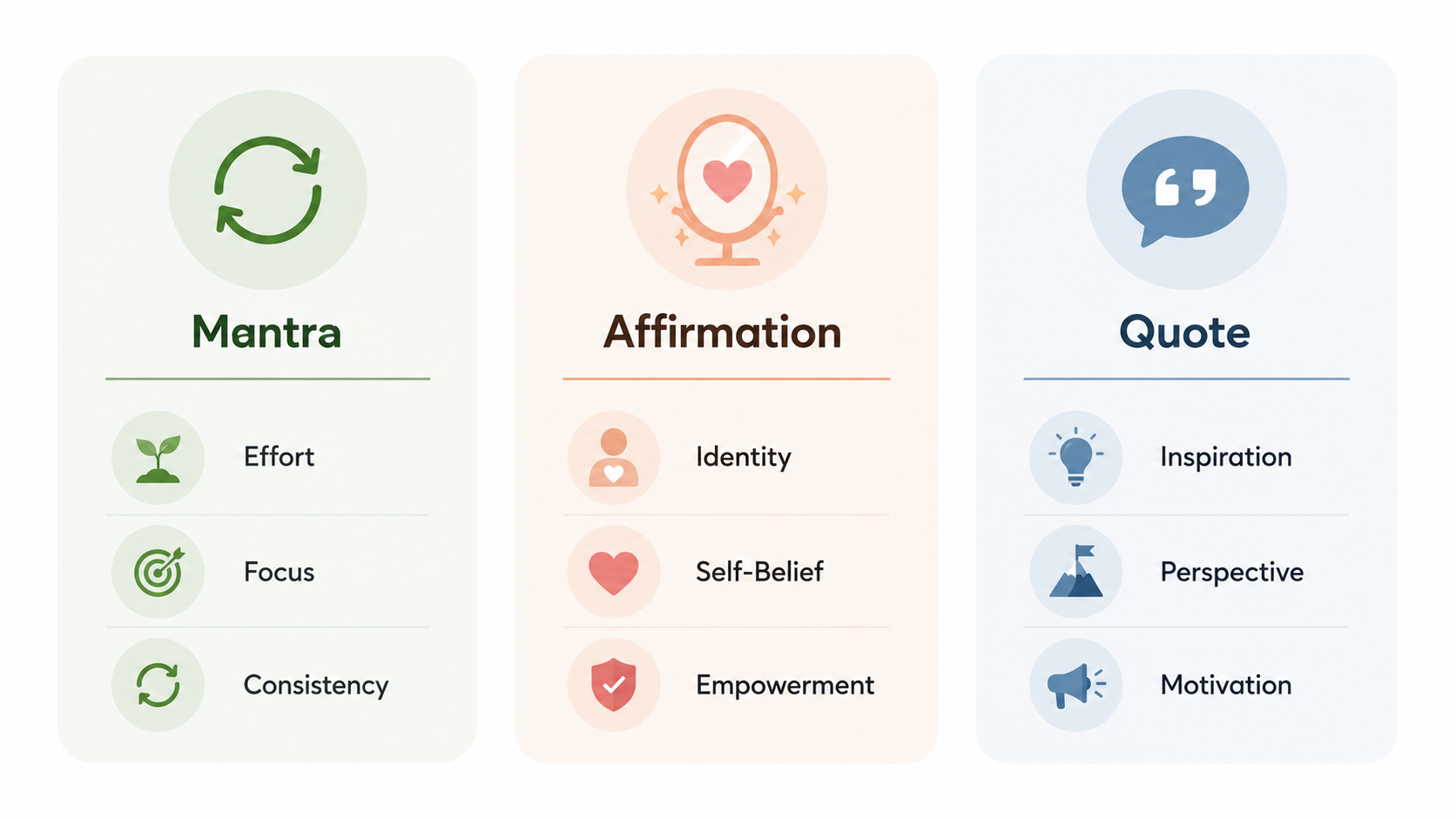
A growth mindset mantra is specifically tied to effort, learning, and process, while a general positive affirmation often focuses on self-worth or identity statements, such as “I am confident” or “I am capable.” Motivational quotes, by contrast, are typically borrowed from other people and used for temporary inspiration rather than daily reinforcement. Growth mindset mantras emphasize realistic, action-based thinking (“I can learn this with practice”) rather than unrealistic or purely identity-based claims (“I am the best”).
| Growth Mindset Mantra | Positive Affirmation | Motivational Quote | |
|---|---|---|---|
| Purpose | Reinforce belief in learning and effort | Reinforce self-worth or identity | Provide temporary inspiration |
| Focus | Process, effort, and improvement | Self-image and confidence | External wisdom or perspective |
| Typical Use | Daily practice during challenges | Daily self-talk | Occasional motivation |
Why Growth Mindset Mantras Matter
Psychological Benefits
Growth mindset mantras support several measurable psychological outcomes:
- Resilience: Short, repeated phrases help the mind reframe setbacks as part of the learning process rather than as failure.
- Confidence: Focusing on effort and progress builds steady, earned confidence rather than pressure-based confidence.
- Learning: Mantras that emphasize curiosity and practice encourage a stronger orientation toward acquiring new skills.
- Emotional regulation: A consistent mantra can interrupt spiraling negative self-talk during stressful moments.
- Persistence: Repetition of effort-based language supports continued effort even after difficulty or failure.
How Repetition Shapes Thinking
Repetition strengthens neural pathways associated with a specific thought pattern, a concept related to neuroplasticity—the brain’s capacity to reorganize itself based on repeated experience and practice. In simple terms, the more often a person repeats a growth-oriented phrase, the more automatic that thought pattern becomes during real challenges. Over time, this repetition influences self-talk, shifting internal dialogue away from fixed statements (“I’m not good at this”) toward growth statements (“I’m still learning this”). This shift supports long-term mindset development, since habitual thought patterns eventually shape how a person interprets everyday setbacks and successes.
Best Growth Mindset Mantra Examples
Below are categorized positive mantra examples and life mantra examples that reinforce a growth mindset. For a broader collection beyond growth-focused phrasing, check out these mantras examples.
Learning
- “Every mistake teaches me something useful.”
- “I am capable of learning new things.”
Confidence
- “My abilities grow with practice.”
- “I trust my ability to figure things out.”
Overcoming failure
- “Failure is feedback, not the end result.”
- “Setbacks are part of my progress.”
Persistence
- “I keep going, even when it’s difficult.”
- “Consistency matters more than perfection.”
Self-belief
- “I am not finished growing.”
- “I get better with effort and time.”
Success
- These mantra examples for success emphasize process: “Progress, not perfection, defines success.” / “Small steps lead to real results.”
Gratitude
- “I am grateful for the chance to learn.”
- “Every challenge is an opportunity.”
Daily motivation
- “Today I choose effort over doubt.”
- “I show up, even on hard days.”
Short Motivational Mantras for Everyday Use
Short motivational mantras work well because they are easy to remember and repeat throughout the day, especially during transitions or stressful moments.
- Mornings: “Today I grow a little more.”
- Stressful moments: “This feeling is temporary.”
- Work: “I focus on progress, not pressure.”
- Study: “Understanding comes with practice.”
- Personal growth: “I am becoming better each day.”
Growth Mindset Phrases for Students
Motivational Mantras for Students
A motivational mantra for students can support performance during exams, learning new skills, building confidence, and handling mistakes constructively. Examples of growth mindset phrases for students include:
- “I don’t know this yet, but I can learn it.”
- “Mistakes help me understand better.”
- “I prepare, and preparation builds confidence.”
- “Effort today builds skill tomorrow.”
Classroom Mantras for Students
Classroom mantras for students support a positive classroom culture that encourages participation, teamwork, and learning from mistakes rather than fearing them.
- “Everyone learns at their own pace.”
- “Mistakes are part of how we learn together.”
- “We support each other’s growth.”
- “Asking questions helps everyone understand more.”
Growth Mindset Mantras for Kids
Age-Appropriate Mantras
A growth mindset mantra for kids should use simple, concrete language that a child can easily repeat and understand. Repetition, encouragement, and confidence-building phrasing work best for this age group. Examples of growth mindset mantras for kids include:
- “I can try again.”
- “Practice helps me get better.”
- “It’s okay to make mistakes.”
- “I am learning something new.”
How Parents and Teachers Can Introduce Mantras
Parents and teachers can introduce growth mindset mantras through consistent, low-pressure routines, such as:
- Including a mantra in bedtime routines to reinforce calm, positive reflection.
- Using classroom activities like morning circle time to repeat a shared mantra.
- Placing visual reminders, such as posters or sticky notes, in learning spaces.
- Offering praise that focuses on effort (“You worked hard on that”) rather than fixed traits (“You’re so smart”).
Mantras for Success in Work and Career
Mantras for Professional Growth
A mantra for work success can reinforce confidence, productivity, leadership, and adaptability during demanding periods. Examples include:
- “I adapt and find solutions.”
- “My skills improve with each project.”
- “I lead by learning continuously.”
Mantra Examples for Success
Practical mantra examples for success can be applied directly to career, business, and personal goals:
- “Consistent effort builds lasting results.”
- “I focus on what I can control.”
- “Every challenge sharpens my skills.”
- “Progress compounds over time.”
How to Maintain a Growth Mindset
Daily Habits That Reinforce Growth
Understanding how to maintain a growth mindset involves building small, consistent habits rather than relying on motivation alone. Helpful growth mindset tips include: Pairing your mantra with reflection works well — try these journaling prompts for self growth . to deepen the practice.
- Practicing brief daily reflection on lessons learned.
- Journaling about challenges and how they were handled.
- Setting specific learning goals rather than only outcome goals.
- Actively embracing feedback instead of avoiding it.
- Reviewing progress regularly to reinforce continuous improvement.
Building Long-Term Consistency
Long-term consistency depends on realistic expectations, patience, and structured systems. Habit stacking—attaching a new mantra practice to an existing daily habit, such as brushing teeth or commuting—makes repetition easier to sustain. Accountability, whether through a journal, an app, or a trusted person, also supports consistency over time.
Common Mistakes When Using Growth Mindset Mantras
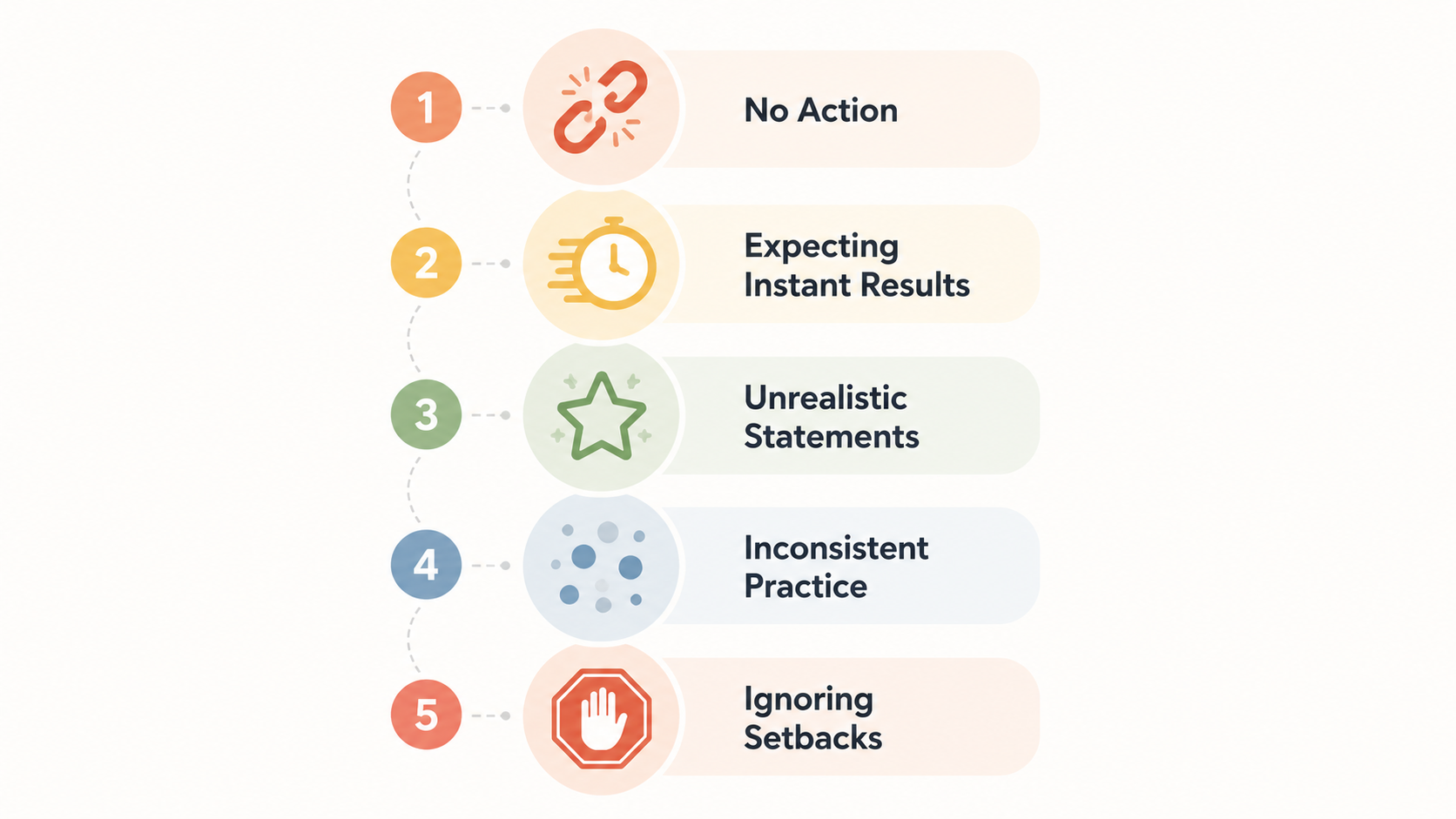
Several common mistakes reduce the effectiveness of growth mindset mantras:
- Repeating mantras without action: A mantra alone does not create change; it must be paired with real effort and behavior. The fix is linking each mantra to one specific daily action.
- Expecting instant results: Mindset shifts typically develop gradually. Setting realistic, longer-term expectations prevents early discouragement.
- Choosing unrealistic statements: Overly grand or vague mantras can feel disconnected from daily reality. Choosing specific, believable phrases improves consistency.
- Inconsistent practice: Sporadic repetition weakens the habit-forming effect. Scheduling a fixed time for mantra practice helps prevent this.
- Ignoring setbacks: Treating failure as proof the mantra “isn’t working” undermines the process. Reframing setbacks as expected parts of growth keeps the practice sustainable.
Choosing the Right Growth Mindset Mantra for Your Situation
Based on Your Goals
Different roles benefit from different mantra emphasis:
- Students often benefit from mantras focused on learning and exam preparation.
- Professionals benefit from mantras centered on adaptability and productivity.
- Parents benefit from mantras that model patience and effort for their children.
- Entrepreneurs benefit from mantras centered on resilience and problem-solving.
- General personal growth benefits from broad, effort-based mantras applicable to daily life.
Based on Challenges
Specific challenges call for targeted mantras:
- Fear of failure: “Failure is feedback, not a final result.”
- Low confidence: “My abilities grow with consistent practice.”
- Procrastination: “Starting is part of progress.”
- Stress: “I can handle this one step at a time.”
- Perfectionism: “Progress matters more than perfection.”
Growth Mindset Mantras vs Fixed Mindset Thinking
| Growth Mindset Thinking | Fixed Mindset Thinking | |
|---|---|---|
| Failure | Seen as feedback and a learning opportunity | Seen as a reflection of permanent ability |
| Challenges | Embraced as chances to develop skill | Avoided to prevent looking incapable |
| Feedback | Welcomed as useful information | Perceived as personal criticism |
| Learning | Viewed as an ongoing, lifelong process | Viewed as limited to natural talent |
| Success | Attributed to effort and strategy | Attributed to inherent ability |
Growth Mindset Meaning in Urdu
Growth Mindset Meaning Explained in Urdu
In simple terms, growth mindset meaning in Urdu can be understood as the belief that a person’s abilities and intelligence can improve through effort, practice, and learning, rather than staying fixed. This concept is often explained in Urdu as “soch ka wo tareeqa jisme insan yeh maanta hai ke mehnat aur seekhne se salahiyatein behtar ho sakti hain” (a way of thinking in which a person believes that abilities can improve through hard work and learning). A practical everyday example is a student who struggles with a subject but continues practicing, believing consistent effort will eventually lead to improvement rather than assuming the subject is simply “not for them.”
Practical Guide to Using Growth Mindset Mantras Daily

Growth mindset mantras become more effective when built into daily routines:
- Morning routine: Repeat one mantra while getting ready or during a quiet moment.
- Study sessions: Use a mantra before starting difficult material to set a learning-focused tone.
- Workday reminders: Place a mantra on a sticky note or phone lock screen for regular visibility.
- Journaling: Write down the day’s mantra along with one related action taken.
- Habit tracking: Use a simple checklist or app to track daily mantra practice.
- Visual cues: Post mantras in visible locations such as a desk, mirror, or notebook.
- Accountability methods: Share progress with a friend, mentor, or study group.
- Adapting routines: Adjust mantra timing and wording based on personal schedule, energy levels, and current challenges.
Difficulty & Time Investment
Growth mindset mantra practice is beginner-friendly and requires minimal daily time investment—often just a few minutes each day. The practice does not require special tools or advanced skills, making it accessible to students, professionals, and children alike. Consistency matters more than intensity; repeating a mantra briefly but regularly produces better results than occasional, lengthy sessions. Personal factors such as environment, existing habits, and current stress levels can influence how easily this practice is sustained.
Results Timeline
Early mindset shifts, such as noticing more balanced self-talk, often appear within the first one to two weeks of consistent practice. Gradual habit formation typically develops over several weeks as the mantra becomes a more automatic response to challenges. Deeper, long-term mindset development—reflected in how a person naturally responds to setbacks—generally unfolds over a period of months rather than days. Realistic expectations are important, since progress is often influenced by factors such as consistency, environment, and how frequently a person reflects on their experiences.
Conclusion
A growth mindset mantra is a short, intentional phrase that reinforces the belief that abilities improve through effort, learning, and persistence. Consistent practice—paired with real daily actions—strengthens resilience, confidence, and long-term personal growth far more effectively than occasional repetition alone. Choosing a growth mindset mantra that fits your specific goals and challenges, whether as a student, parent, or professional, makes the practice more meaningful and sustainable. Ultimately, a growth mindset mantra works best as part of a broader, action-oriented approach to learning, resilience, and continuous self-improvement.
Frequently Asked Questions
What is a growth mindset mantra?
A growth mindset mantra is a short, repeated phrase that reinforces the belief that abilities and skills can improve through effort, learning, and persistence rather than remaining fixed.
How is a growth mindset mantra different from a positive affirmation?
A growth mindset mantra focuses specifically on effort and learning, while a positive affirmation typically reinforces self-worth or identity rather than a developmental belief.
What are the best growth mindset mantras for students?
Effective mantras for students focus on learning and effort, such as “I don’t know this yet, but I can learn it” or “Mistakes help me understand better.”
Can children benefit from growth mindset mantras?
Yes, children benefit from simple, age-appropriate mantras like “I can try again,” especially when reinforced consistently by parents and teachers through routines and effort-based praise.
How often should I repeat a growth mindset mantra?
Repeating a mantra briefly once or twice daily, especially during challenges or routine moments like mornings, tends to be more effective than infrequent, lengthy repetition.
Do growth mindset mantras really improve motivation?
Growth mindset mantras can support motivation by reinforcing effort-based thinking, though they work best when paired with consistent action rather than repetition alone.
What is the best mantra for work success?
Mantras centered on adaptability and continuous improvement, such as “My skills improve with each project,” tend to support professional growth effectively.
What does growth mindset mean in Urdu?
Growth mindset meaning in Urdu refers to the belief that abilities and intelligence can improve through consistent effort and learning, often described as “mehnat aur seekhne se salahiyatein behtar ho sakti hain.”