
Introduction
A generative mindset is a way of thinking that focuses on creating possibilities rather than simply reacting to circumstances. It draws on curiosity, experimentation, continuous learning, and adaptation to turn problems into opportunities. Although the rise of generative AI has brought this term into everyday conversation, a generative mindset is not a technology-dependent concept — it is a fundamentally human approach to innovation and growth. Long before AI tools existed, generative thinkers were the people who imagined new solutions, questioned assumptions, and built value from limited resources. Understanding this mindset matters now more than ever, as generative AI has made creative and cognitive capabilities more visible, urgent, and relevant across education, business, and personal development. Related entities such as creativity, learning, experimentation, problem-solving, innovation, and adaptability all sit at the core of this concept.
Quick Summary
- A generative mindset emphasizes creating possibilities instead of simply reacting to challenges.
- It combines curiosity, experimentation, learning, and adaptability to generate better ideas and solutions.
- While closely associated with generative AI, the mindset is valuable in education, leadership, business, and personal development.
- Developing a generative mindset involves practicing exploration, reflection, collaboration, and continuous improvement.
What Is a Generative Mindset?
Generative Mindset Meaning
The generative mindset meaning centers on an orientation toward producing new ideas, solutions, and opportunities rather than passively responding to events. It reflects generative thinking definition principles: a cognitive approach built around imagining alternatives, testing assumptions, and building outward from existing knowledge instead of defending it. The concept originates from broader psychological and organizational research on creativity and growth-oriented cognition, later gaining renewed attention as generative AI systems demonstrated how idea generation could be scaled with technology. It is important to distinguish the mindset from any specific tool or technology. Generative AI can support the process, but the mindset itself is a human capability — a way of engaging with problems that existed long before AI-assisted creativity became mainstream.
Core Characteristics of a Generative Mindset
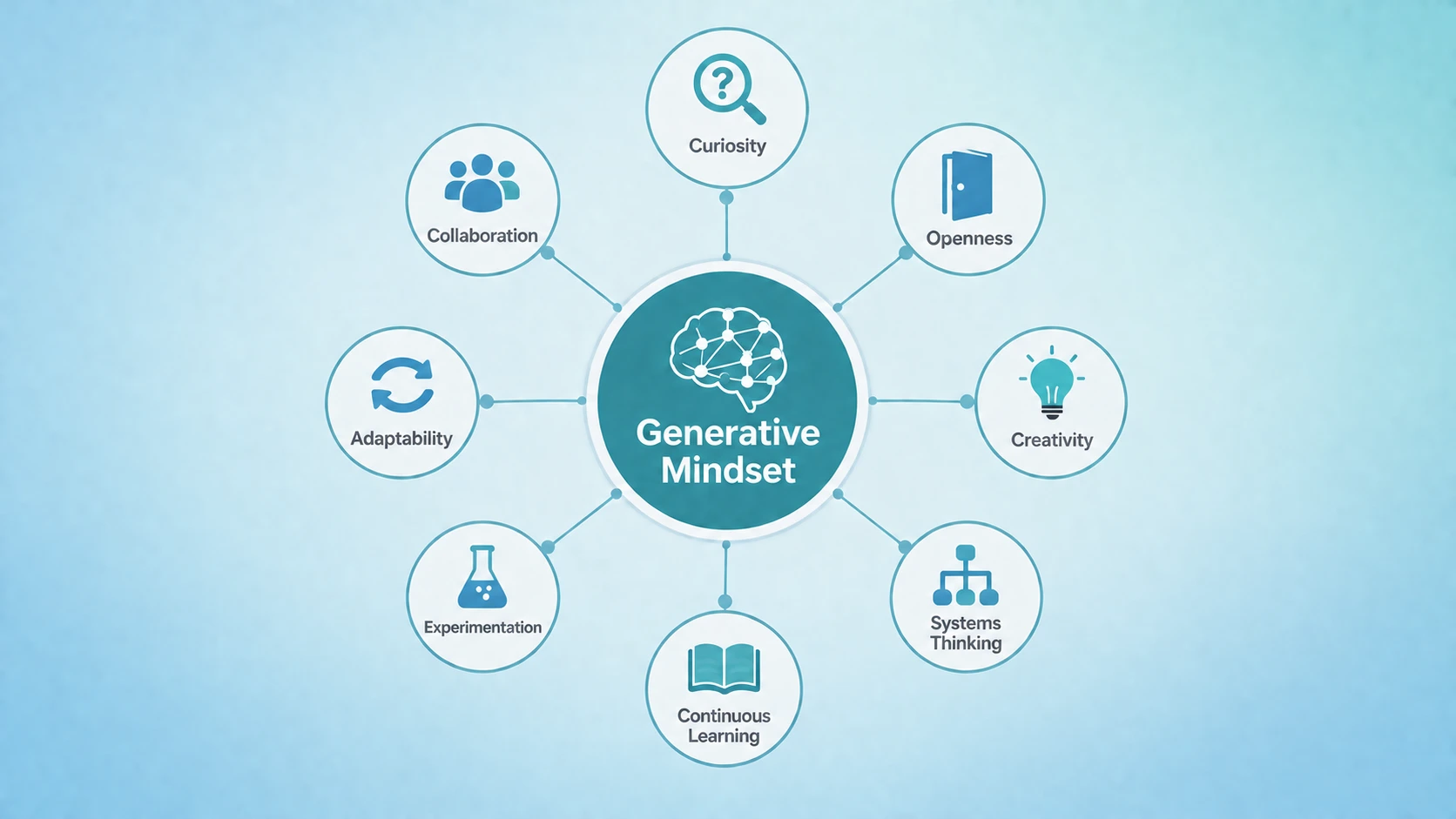
People with a generative mindset consistently display several identifiable traits:
- Curiosity — asking questions before accepting answers
- Openness to new ideas — welcoming perspectives that challenge existing assumptions
- Creativity — generating original combinations of ideas or solutions
- Systems thinking — understanding how parts of a problem interact
- Continuous learning — treating knowledge as evolving, not fixed
- Experimentation — testing ideas in small, low-risk ways
- Adaptability — adjusting approach based on new information
- Collaboration — building on the input and feedback of others
Why a Generative Mindset Matters Today
A generative mindset has become increasingly valuable due to rapid technological change, the growth of AI-assisted work, and the shift toward a knowledge economy where ideas — not just output — determine value. Complex problem solving now requires people who can move fluidly between disciplines, and innovation-driven careers reward individuals who continuously learn rather than rely on static skill sets. Organizations increasingly value employees who create opportunities instead of only completing assigned tasks. In our experience helping readers build better habits, the individuals who advance fastest in AI-influenced fields are rarely the most technically skilled — they are the ones who consistently generate new approaches to old problems. This mirrors why growth mindset matters in general — both frameworks treat challenges as opportunities to develop rather than threats to avoid
Generative Mindset vs Traditional Fixed Thinking
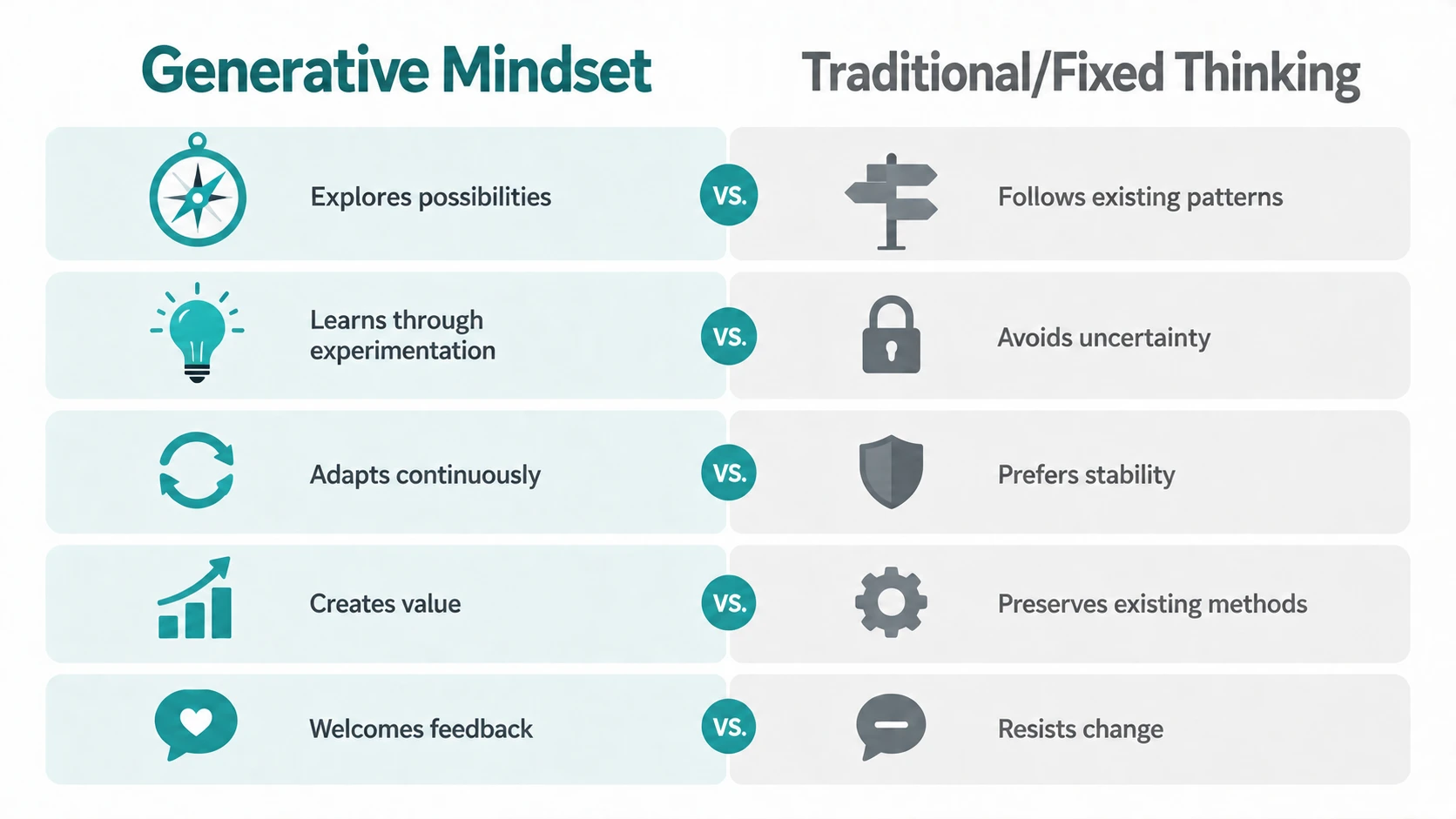
Understanding the difference between generative and fixed thinking clarifies why this mindset shift matters for decision making, creativity, learning, problem solving, and innovation. This distinction is closely related to the broader question of mindset vs attitude — mindset shapes the lens you see problems through, while attitude shapes how you respond emotionally in the moment.
| Generative Mindset | Traditional/Fixed Thinking |
|---|---|
| Explores possibilities | Follows existing patterns |
| Learns through experimentation | Avoids uncertainty |
| Adapts continuously | Prefers stability |
| Creates value | Preserves existing methods |
| Welcomes feedback | Resists change |
In decision making, a generative approach treats uncertainty as information rather than a threat. In creativity, it favors divergence before convergence. In learning, it treats mistakes as data rather than failure. Fixed thinking, by contrast, optimizes for consistency and predictability — useful in stable environments but limiting in fast-changing ones.
What Is Generative Thinking?
Generative Thinking Definition
The generative thinking definition refers to the cognitive process of producing multiple ideas, solutions, or possibilities before narrowing them down. It relies on divergent thinking — generating many potential paths — combined with creative exploration that intentionally avoids premature judgment. This process typically involves idea generation techniques such as brainstorming, analogical reasoning, and combining unrelated concepts to form new ones. Generative thinking is most effective in the early stages of problem-solving, when the goal is breadth rather than precision.
Generative Thinking vs Critical Thinking
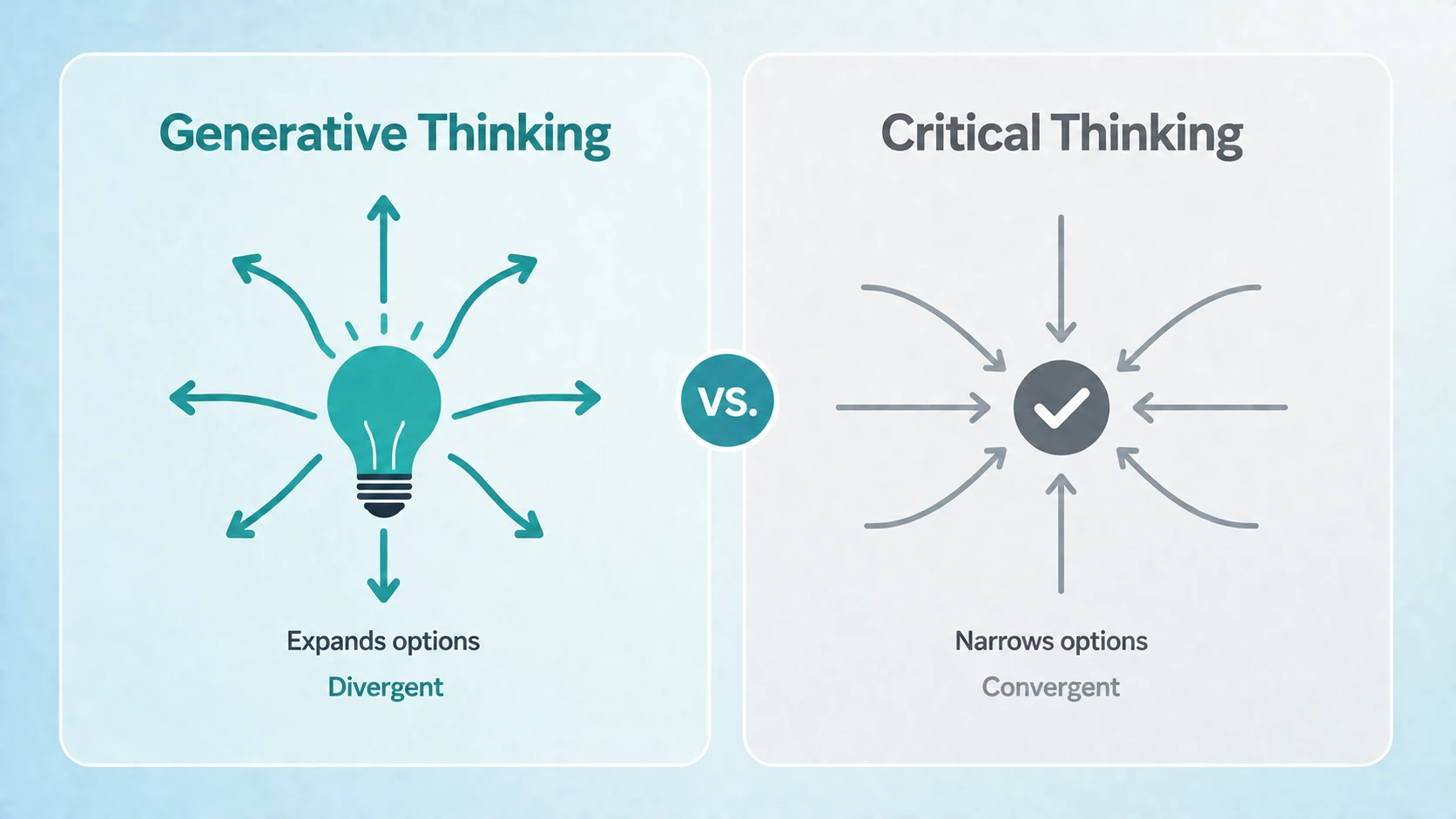
Generative thinking creates possibilities; critical thinking evaluates them. The two are complementary rather than competing skills, and effective problem solvers move deliberately between both modes.
| Generative Thinking | Critical Thinking |
|---|---|
| Expands options | Narrows options |
| Divergent process | Convergent process |
| Focuses on quantity of ideas | Focuses on quality and validity |
| Best used early in a process | Best used to refine and select |
| Encourages exploration | Encourages evaluation |
How Generative AI Is Changing the Meaning of a Generative Mindset
The Relationship Between Human Thinking and Generative AI
Generative AI has changed how people encounter the generative mindset, since AI tools can now produce drafts, ideas, and content at scale. However, human creativity still determines which ideas are worth pursuing. AI-assisted creativity works best when paired with human judgment, ethical use, and contextual understanding — the AI generates raw material, while the human generative mindset shapes it into something purposeful. This distinction is central to the generative ai mindset: using AI as an amplifier of human thinking rather than a replacement for it.
Why AI Is a Tool Rather Than the Mindset
AI generates outputs; humans generate purpose. AI systems can produce large volumes of text, images, or code, but they do not independently determine why an idea matters, whom it serves, or whether it is appropriate. Human oversight remains necessary to evaluate accuracy, apply context, and ensure originality. Without human direction, AI output has no inherent goal — it is the generative mindset of the person directing the tool that turns raw generation into meaningful value.
Beyond the Generative AI User Mindset
Becoming an AI Value Creator Instead of Only an AI User
Many people use generative AI tools without developing a deeper generative mindset. Moving beyond the generative ai mindset of simple prompting means becoming an AI value creator — someone who builds workflows, solves business problems, improves productivity, and designs new ideas using AI as one component of a larger creative process. This shift, sometimes described as looking at ai value creators beyond the generative-ai-user mindset, distinguishes casual AI users from professionals who treat AI as infrastructure for innovation rather than a novelty tool.
Skills That Differentiate AI Value Creators
- Prompt design — structuring requests to produce useful, targeted output
- Domain knowledge — understanding the subject well enough to judge quality
- Communication — translating AI output into clear, usable results
- Systems thinking — seeing how AI fits into a broader workflow
- Critical evaluation — checking accuracy, bias, and relevance
- Creativity — shaping raw AI output into original work
- Ethical reasoning — using AI responsibly and transparently
What Mindset Is Essential for Leading with Generative AI?
The mindset essential for leading with generative AI combines a strong learning orientation with adaptability, responsible AI use, curiosity, collaboration, strategic thinking, and comfort with decision making under uncertainty. Leaders who succeed with AI treat it as an evolving capability rather than a fixed tool, continuously updating their understanding as models and best practices change. What mindset is essential for leading with generative ai ultimately comes down to balancing technological fluency with human judgment — knowing when to trust AI-generated suggestions and when to override them based on context, ethics, or strategic priorities.
A Small-Data Mindset for Generative AI Creative Work
What Is Small-Data Thinking?
A small-data mindset for generative ai creative work focuses on using limited but meaningful information rather than large volumes of generic data. It prioritizes context over volume — personal knowledge, specialized expertise, and firsthand experience often produce more relevant and authentic results than broad, generic datasets. This approach recognizes that depth of understanding can outperform sheer quantity of input.
When Small Data Can Produce Better Creative Results
Small-data thinking is particularly effective in:
- Personalized writing that reflects an individual voice
- Brand voice development for specific audiences
- Design work grounded in niche aesthetic preferences
- Niche expertise that general AI training data may underrepresent
- Research requiring highly specific or localized context
- Education tailored to individual learner needs
The Generative Success Model
What Is a Generative Success Model?
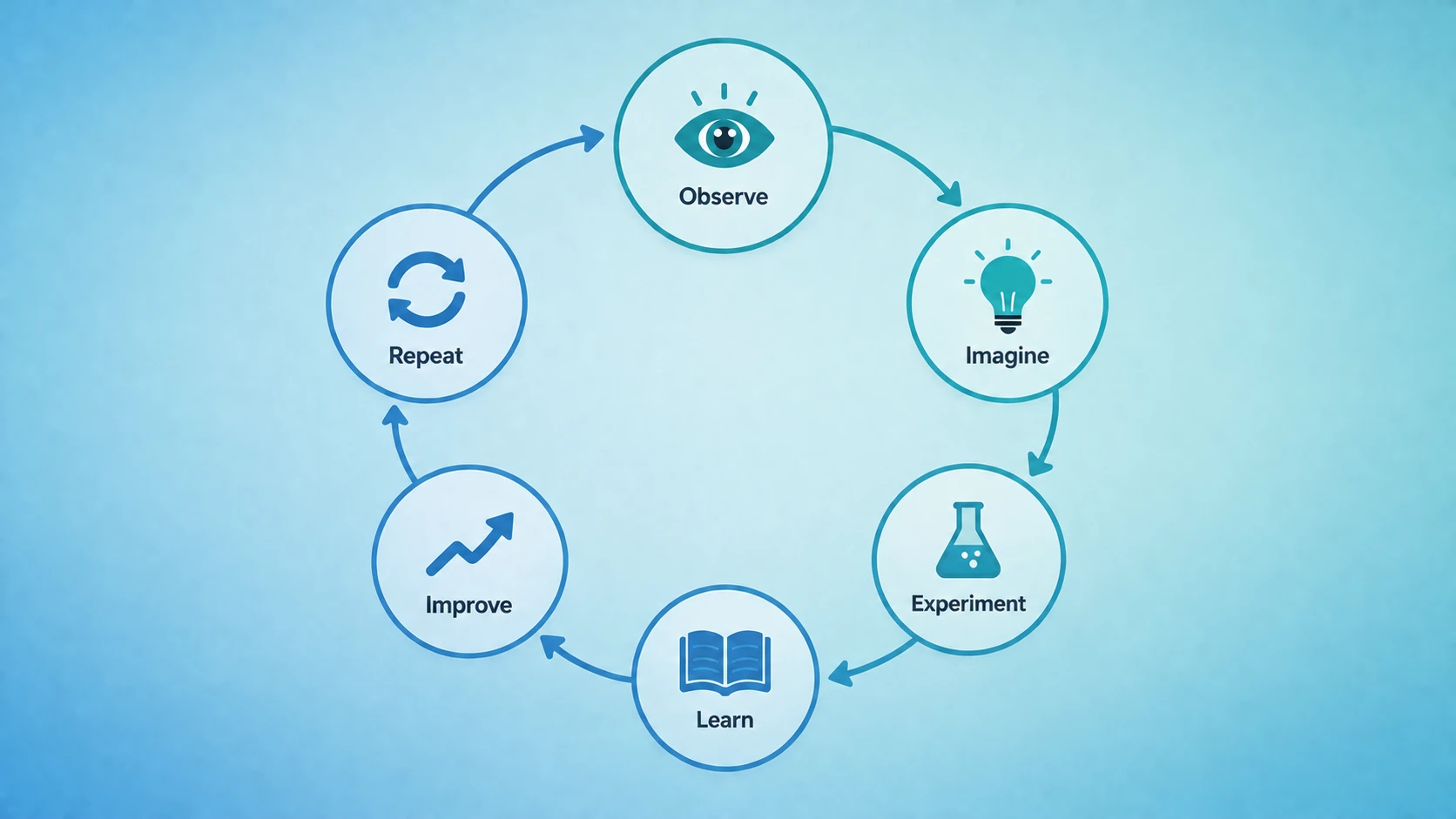
The generative success model is a practical framework for applying a generative mindset consistently. It typically follows six stages: Observe, Imagine, Experiment, Learn, Improve, and Repeat. This cycle mirrors established behavioral science principles around iterative learning, where each round of experimentation informs the next.
Applying the Model in Daily Life
- Students — observe course material, imagine study approaches, experiment with methods, and refine based on results
- Professionals — identify workplace inefficiencies, imagine solutions, test small changes, and scale what works
- Entrepreneurs — observe market gaps, imagine offerings, run small experiments before full investment
- Teams — collect feedback, brainstorm collectively, pilot ideas, and iterate based on outcomes
- Creators — study audience response, imagine new formats, test content, and refine style over time
How to Develop a Generative Mindset
Daily Practices
- Reflection on what worked and what didn’t
- Reading widely, including outside one’s field
- Asking better, more open-ended questions
- Small, low-risk experimentation
- Keeping an idea journal
- Committing to continuous learning
Habits That Encourage Creative Thinking
- Staying curious about unfamiliar topics
- Actively seeking feedback
- Iterating on ideas rather than perfecting them upfront
- Collaborating with people who think differently
- Treating failure as a source of learning rather than a setback
Common Challenges When Developing a Generative Mindset
Why People Get Stuck
Several patterns commonly prevent people from developing a generative mindset: fear of failure, perfectionism, fixed thinking habits, information overload, and overreliance on AI without independent judgment. Your Daily Thrive recommends recognizing these patterns early, since they often operate quietly and can go unnoticed until progress stalls.
Practical Ways to Overcome These Challenges
- Starting with small, low-stakes experiments
- Building in regular reflection time
- Deliberately building foundational skills, not just AI fluency
- Balancing AI use with independent thinking
- Practicing consistently rather than sporadically Overcoming fixed thinking patterns often starts with learning how to change your thoughts, since generative habits are built on shifting default reactions before they shift outcomes.
Common Beginner Mistakes
Several recurring gaps appear when people first attempt to build a generative mindset:
- Confusing AI tools with the mindset itself
- Expecting instant creativity without practice
- Copying existing ideas instead of generating original ones
- Ignoring critical thinking after the idea-generation phase
- Overreliance on AI tools without independent judgment
- Lack of experimentation, staying within comfortable patterns
Real-World Applications of a Generative Mindset
Education
In education, a generative mindset supports inquiry-based learning, where students generate questions and hypotheses rather than only memorizing answers.
Business and Leadership
In business, generative thinking drives innovation strategy, product development, and adaptive leadership in uncertain markets.
Creative Work
In creative fields, the mindset supports original ideation, iterative drafting, and openness to unconventional approaches.
Product Development
In product development, generative thinking enables rapid prototyping, user-centered experimentation, and iterative design cycles.
Personal Growth
In personal growth, the mindset supports habit formation, goal setting, and resilience by treating setbacks as data rather than failure.
Difficulty & Time Investment
Developing a generative mindset is generally beginner-friendly, though it involves a moderate learning curve as old habits of fixed thinking are gradually replaced. Consistency matters more than intensity — short, regular practice produces better results than occasional bursts of effort. Personal differences, such as existing comfort with ambiguity, and environmental influences, such as workplace culture, can both accelerate or slow progress.
Results Timeline
Early mindset shifts, such as increased curiosity or willingness to experiment, can appear within days of intentional practice. Noticeable improvements in creative output and problem-solving typically emerge over several weeks of consistent effort. Long-term benefits — including stronger adaptability, innovation skills, and confidence with uncertainty — tend to develop over months. Progress speed is influenced by factors such as practice consistency, existing mindset flexibility, and exposure to new ideas or environments.
Practice Guide
Building a generative mindset works best with a structured, sustainable routine:
- Daily exercises — brief idea-generation prompts or reflection questions
- Weekly reflection — reviewing what was learned and what to adjust
- Experiment tracking — logging small tests and their outcomes
- Learning goals — setting specific, achievable knowledge targets
- Accountability methods — sharing progress with a peer, mentor, or group
- Sustainable habits — keeping practices small enough to maintain long-term
- Adjustments for different groups — students may focus on study experimentation, professionals on workflow innovation, and entrepreneurs on market testing
How a Generative Mindset Connects to Broader Personal Growth
A generative mindset connects naturally to other areas of personal development, including habit formation, growth mindset, productivity, goal setting, resilience, and lifelong learning. As of 2026, updated approaches to personal development increasingly emphasize combining generative thinking with structured systems thinking, recognizing that isolated creativity without follow-through produces limited results. This mindset supports innovation not as an occasional event but as an ongoing practice woven into daily habits and long-term goals.
Conclusion
A generative mindset is the practice of creating possibilities rather than simply reacting to circumstances. It combines creativity, adaptability, and continuous learning into a durable approach to problem-solving that extends well beyond any single tool or technology. While generative AI has made this mindset more visible and relevant, its true value lies in human judgment, purpose, and originality — qualities no tool can replace. For individuals and organizations alike, cultivating a generative mindset offers long-term value: better decision-making, stronger innovation, and greater resilience in the face of ongoing change.
Frequently Asked Questions
What does a generative mindset mean?
A generative mindset means approaching challenges by creating new possibilities and solutions rather than simply reacting to circumstances, using curiosity, experimentation, and continuous learning.
Is a generative mindset only related to artificial intelligence?
No. A generative mindset is a human cognitive approach that predates generative AI and applies broadly to education, business, creativity, and personal growth, though AI has increased its visibility.
How is generative thinking different from critical thinking?
Generative thinking creates and expands possibilities, while critical thinking evaluates and narrows them; the two work together in effective problem-solving.
What mindset is most important when working with generative AI?
A learning-oriented, adaptable mindset combined with responsible AI use, curiosity, and strong human judgment is most important when working with generative AI.
How can someone develop a generative mindset in everyday life?
A generative mindset can be developed through daily reflection, curiosity-driven learning, small experiments, and consistently seeking feedback.
What are the benefits of a generative mindset in the workplace?
Workplace benefits include stronger innovation, better problem-solving, improved adaptability to change, and increased ability to create value rather than only complete tasks.
Can a generative mindset improve creativity without using AI?
Yes. A generative mindset improves creativity through human practices like experimentation, reflection, and idea generation, independent of any AI tool.
What are common mistakes people make when adopting a generative mindset?
Common mistakes include confusing AI tools with the mindset itself, expecting instant results, copying rather than creating, and neglecting critical evaluation of new ideas.