

Introduction
Books on how to change your mindset offer structured ways to reshape thinking, build confidence, and support long-term personal growth. Mindset shapes how people interpret setbacks, pursue goals, and respond to challenges, which is why it directly influences decision-making, learning, and resilience. Books alone cannot produce instant transformation, but they provide evidence-based psychological frameworks, practical exercises, and new perspectives that make lasting change achievable. Reading works best when paired with reflection and consistent action, since beliefs and habits shift gradually through repeated practice rather than a single insight. This article explains what mindset really means, why reading supports mindset change, and which nonfiction and fiction books are most effective for different personal growth goals.
Quick Summary
- Mindset can be developed through consistent learning, reflection, and practice, not through a single book or moment of insight.
- The most effective mindset books combine psychology, practical exercises, and real-world examples rather than motivation alone.
- Different books suit different goals, including confidence, career success, resilience, and general personal growth.
- Fiction can also shift mindset by building empathy and offering new perspectives, even without direct instruction.
- Applying lessons consistently matters more than the number of books read.
What Does It Mean to Change Your Mindset?
Understanding mindset itself provides the context needed before evaluating specific books or techniques.
What Is a Mindset?
A mindset is the set of beliefs, attitudes, and mental habits that shape how a person interprets events and makes decisions. Psychologist Carol Dweck’s research distinguishes between a fixed mindset, where abilities are seen as static, and a growth mindset, where abilities are seen as developable through effort. This distinction affects everyday choices, from how someone handles criticism to whether they pursue new skills. People with a growth-oriented mindset tend to view failure as feedback rather than a permanent judgment of ability, which influences motivation and persistence over time. ..people with a growth-oriented mindset tend to view failure as feedback rather than a permanent judgment of ability, which is why growth mindset matters for long-term motivation and resilience.
Can You Really Change Your Mindset?
Yes, mindset can change over time through neuroplasticity, repeated habits, and continuous learning. Neuroplasticity refers to the brain’s ability to reorganize neural pathways in response to new experiences and repeated behavior. This means that consistent exposure to new information, combined with deliberate practice, can gradually shift automatic thought patterns. Mindset change is not instantaneous; it typically results from sustained habit formation rather than a single realization, which is why books that include actionable exercises tend to be more effective than those offering motivation alone.
How Books Help Change Your Mindset
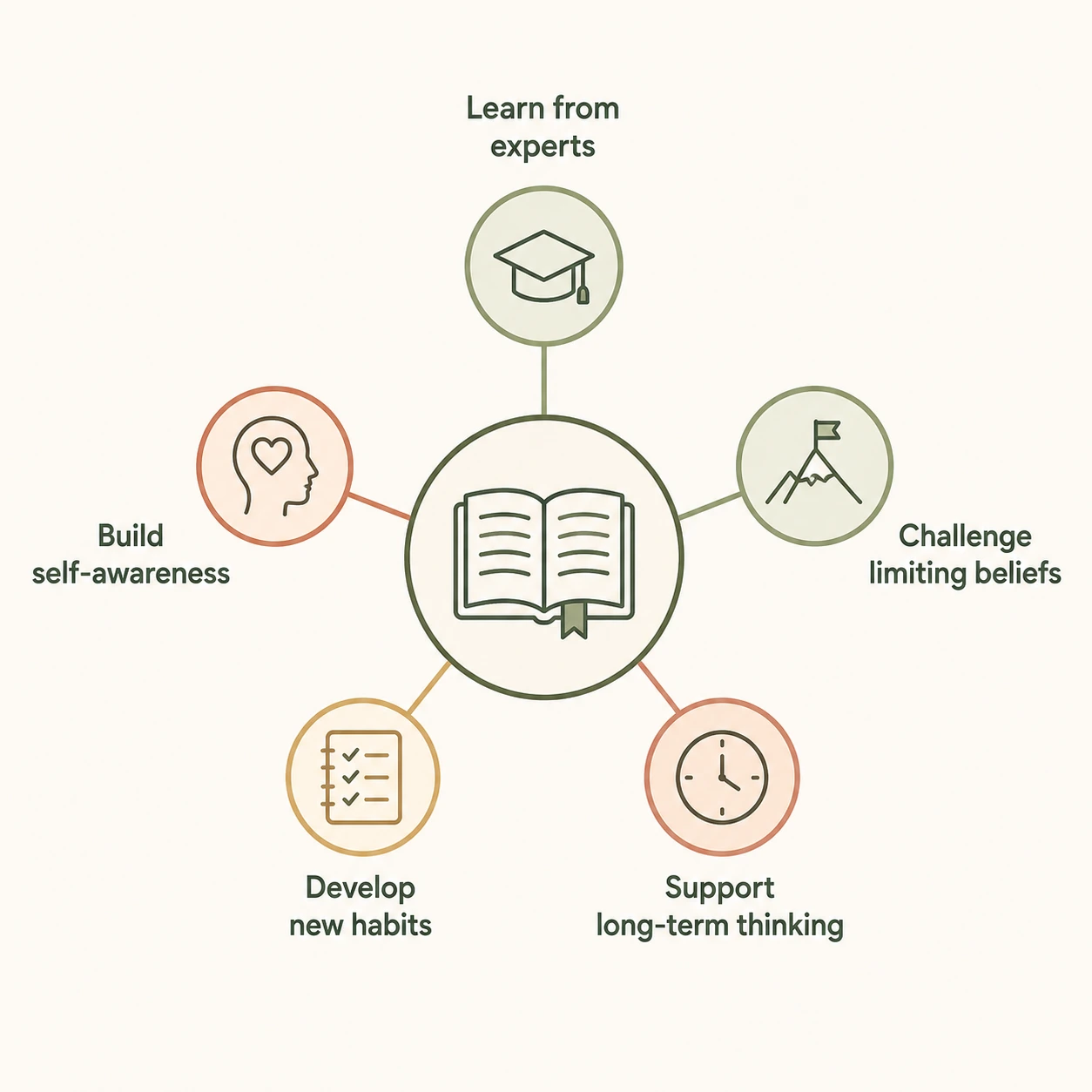
Books remain valuable tools for mindset development because they condense expert knowledge into structured, repeatable guidance.
- Learning from experts: Books distill decades of psychological research and real-world experience into accessible frameworks.
- Building self-awareness: Structured reflection prompts help readers identify existing thought patterns and limiting beliefs.
- Challenging limiting beliefs: Case studies and counterexamples encourage readers to question assumptions about their own capabilities.
- Developing new habits: Many books include step-by-step exercises that translate ideas into daily practice.
- Supporting long-term thinking: Reading regularly reinforces patience and persistence, both central to lasting mindset change.
Characteristics of the Best Books on How to Change Your Mindset
Evaluating a book’s structure and content is more reliable than relying on popularity or bestseller status alone.
Evidence-Based vs Motivational Books
Evidence-based books rely on psychological research, controlled studies, or established behavioral science, while motivational books focus primarily on encouragement and personal anecdotes. Both formats can be useful, but evidence-based titles typically offer more reliable, repeatable guidance for readers seeking measurable change.
Practical Exercises vs Theory
Books with practical exercises, such as journaling prompts or habit trackers, tend to produce stronger behavior change than books built primarily on theory. Theory helps readers understand why mindset shifts occur, while exercises help readers apply that understanding consistently.
Beginner-Friendly vs Advanced Reading
Beginner-friendly books use accessible language and clear examples, making them suitable for readers new to psychology or personal development. Advanced titles may assume familiarity with behavioral science terminology and are better suited to readers who have already built a foundation.
| Feature | Why It Matters |
|---|---|
| Scientific research | Builds credibility |
| Practical exercises | Encourages action |
| Real-life stories | Improves understanding |
| Reflection prompts | Supports behavior change |
| Clear language | Easier implementation |
Best Books on How to Change Your Mindset
Rather than a random ranking, mindset books are best understood in categories aligned with specific goals.
Classic Mindset Books
- Mindset by Carol Dweck — introduces the fixed vs. growth mindset framework.
- Atomic Habits by James Clear — focuses on small, consistent habit changes that compound over time.
- The 7 Habits of Highly Effective People by Stephen Covey — outlines principles for personal and interpersonal effectiveness.
- The Power of Now by Eckhart Tolle — emphasizes present-moment awareness as a foundation for mental clarity. introduces the fixed vs. growth mindset framework, and is often the starting point for readers exploring growth mindset books more broadly.
Books on Mindset and Success
Success-oriented mindset books typically emphasize:
- Goal setting and clear priorities
- Discipline and consistent execution
- Long-term thinking over short-term gains
- Resilience in the face of setbacks
- Personal responsibility for outcomes
Books for Adults Looking to Change Their Mindset
Adult readers often benefit from books addressing:
- Career growth and workplace confidence
- Relationship dynamics and communication
- Emotional intelligence and self-regulation
- Stress management techniques
- Navigating major life transitions
Fiction Books That Can Change Your Mindset
Fiction can influence mindset indirectly by building empathy, shifting perspective, and modeling resilience through character experiences. Unlike nonfiction, novels rarely provide direct instruction, but immersive storytelling can prompt readers to reconsider their own assumptions and emotional responses. Useful fiction categories include:
- Inspirational fiction: Stories centered on perseverance and personal transformation.
- Philosophical fiction: Narratives that explore meaning, purpose, and decision-making.
- Character-driven stories: Books focused on internal growth and changing self-perception over time.
Choosing the Right Mindset Book for Your Goals
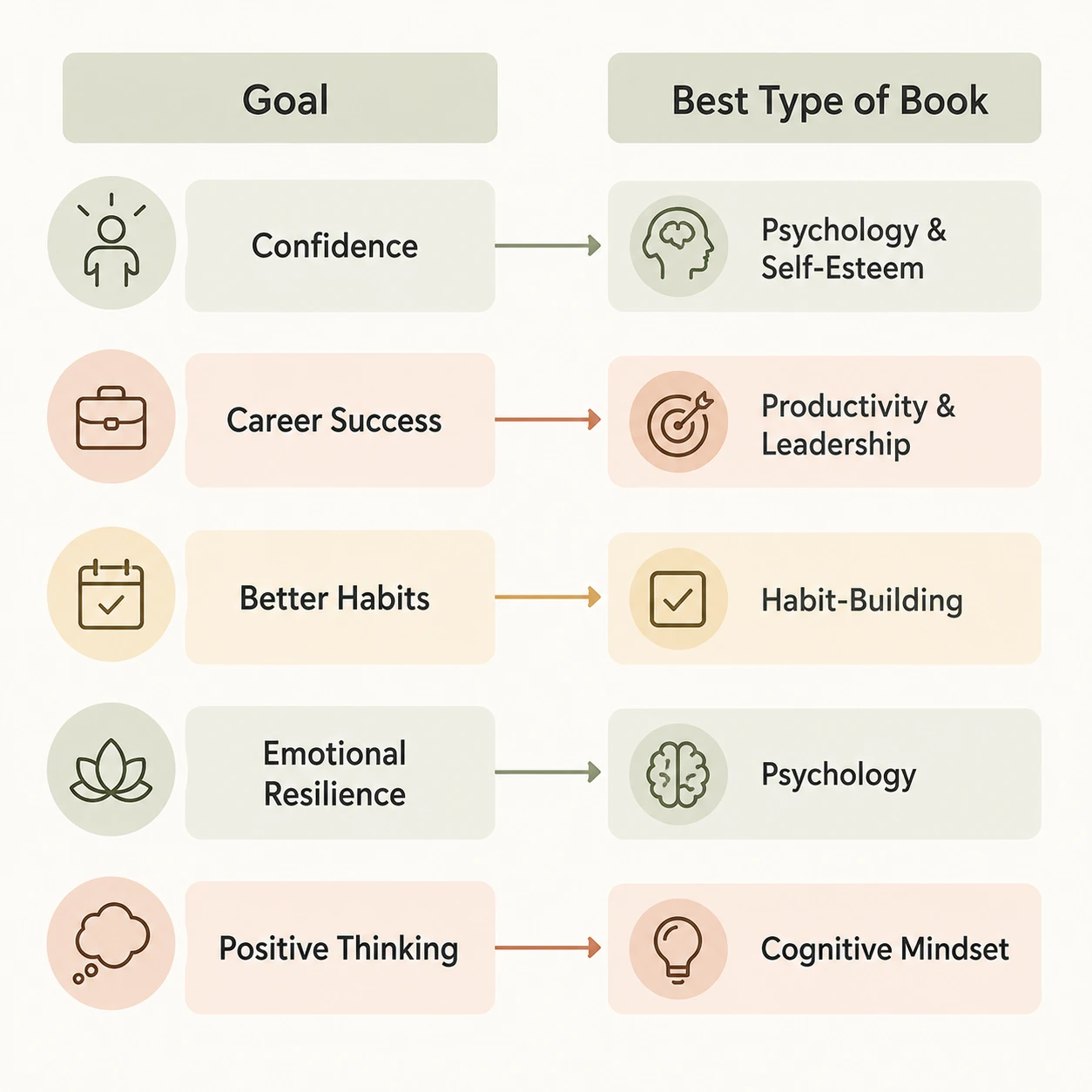
Matching a book to a specific goal increases the likelihood of meaningful, applicable takeaways.
| Goal | Best Type of Book |
|---|---|
| Confidence | Psychology & self-esteem |
| Career success | Productivity & leadership |
| Better habits | Habit-building |
| Emotional resilience | Psychology |
| Positive thinking | Cognitive mindset |
How to Read Mindset Books for Lasting Change
Reading strategy affects outcomes as much as book selection does. Readers who want lasting change should:
- Read actively rather than passively skimming
- Take notes on key concepts as they read
- Highlight actionable ideas for later review
- Practice recommended exercises daily
- Review key lessons on a regular schedule
- Apply one concept fully before introducing a new one
Common Mistakes People Make When Reading Self-Improvement Books
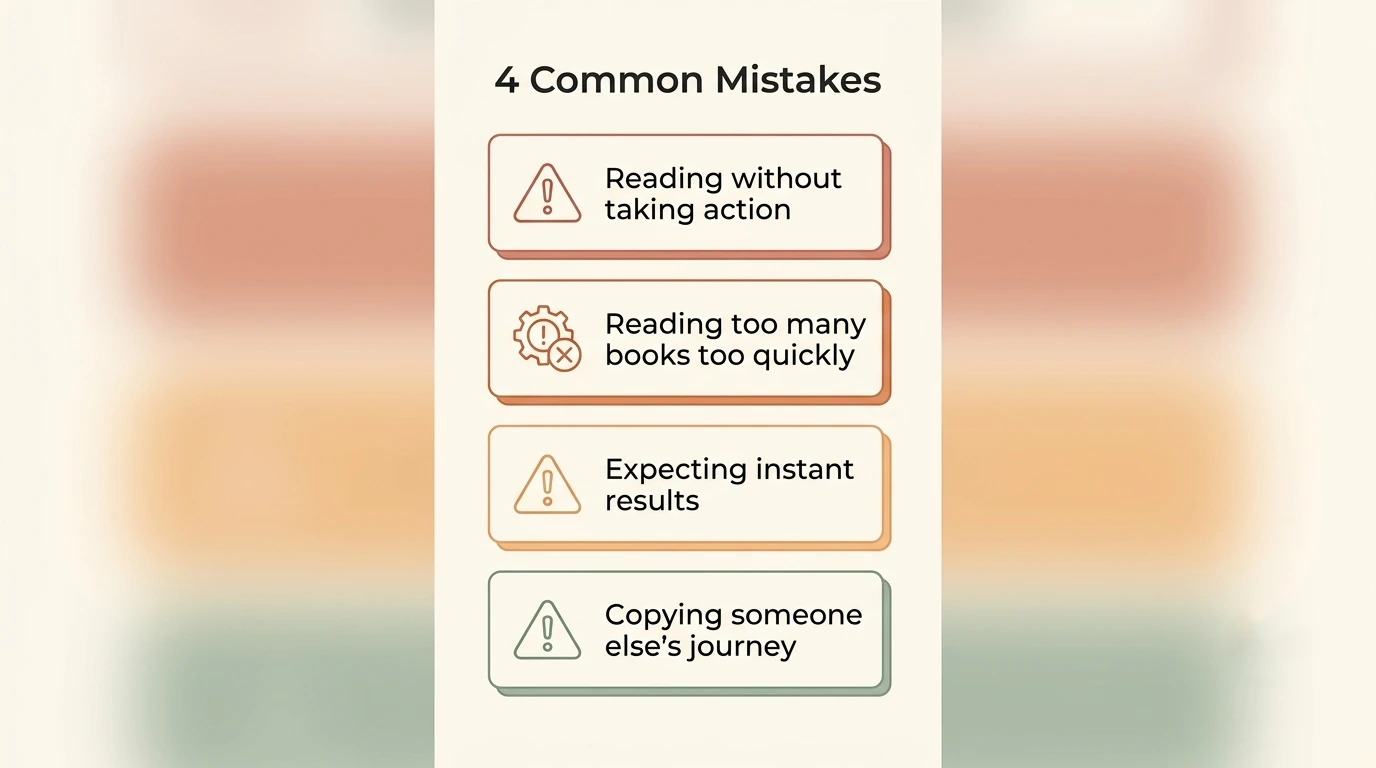
Understanding common pitfalls helps readers get more value from mindset books.
Reading Without Taking Action
This happens when readers treat books as entertainment rather than tools requiring follow-through. It can be fixed by pairing each chapter with one small, specific action, and prevented by scheduling regular reflection time to check whether ideas have been applied.
Reading Too Many Books Too Quickly
Moving from one book to the next without pausing to apply lessons can prevent any single idea from becoming a habit. Slowing down and focusing on fewer books at a time typically produces better results.
Expecting Instant Results
Mindset change relies on repeated practice, so expecting immediate transformation after one book often leads to discouragement and abandoned effort.
Copying Someone Else’s Journey
Personal growth paths vary by individual circumstances, so directly copying another person’s routine without adapting it to personal goals can reduce effectiveness.
Comparison: Different Types of Mindset Books
| Type | Best For | Limitations |
|---|---|---|
| Psychology | Understanding behavior | More theoretical |
| Habit formation | Daily improvement | Requires consistency |
| Success mindset | Career goals | May be business-focused |
| Memoirs | Inspiration | Less structured |
| Fiction | Perspective shifts | Less direct guidance |
How Confidence and Mindset Are Connected
Learning how to change your mindset to be more confident often starts with identifying and challenging limiting beliefs. Confidence develops through a combination of self-belief, positive self-talk, and repeated exposure to challenging situations. Books that address confidence typically pair cognitive reframing techniques with behavioral exercises, such as gradually taking on more difficult tasks to build evidence of competence over time. In our experience helping readers build better habits, small, repeated wins tend to build confidence more reliably than motivational statements alone.
Mindset Books in Different Formats
Mindset books are available in several formats, and choosing the right one depends on reading habits and accessibility needs.
- Print books: Useful for readers who prefer physical annotation and note-taking.
- eBooks: Convenient for portability and searchable text.
- Audiobooks: Suitable for readers who prefer listening during commutes or daily routines.
- Library editions: A cost-effective way to access popular titles.
- Accessible reading formats: Include large print and screen-reader-compatible editions.
Availability varies by publisher, platform, and region, so readers should check format options before selecting a title.
Difficulty & Time Investment
Most mindset books are beginner-friendly, though advanced titles may require more background knowledge. A typical reading commitment ranges from a few hours to a few weeks, depending on reading speed and depth of engagement. Books with reflection exercises require additional time beyond reading alone, since applying concepts takes longer than passively consuming text. Your Daily Thrive recommends allocating dedicated time for both reading and practice rather than treating them as a single activity, since personal factors such as prior exposure to psychology and available free time also influence overall difficulty.
Results Timeline
Initial mindset awareness often develops within the first few chapters, as readers begin recognizing existing thought patterns. Noticeable behavioral changes typically emerge after several weeks of consistent practice, since new habits require repetition to become automatic. Long-term mindset shifts, such as sustained confidence or resilience, generally develop over months of continued application. As of mid-2026, behavioral science research continues to reinforce that consistency, rather than reading volume, is the strongest predictor of lasting change. Results vary by individual, depending on starting habits, life circumstances, and how consistently exercises are applied.
Practice Guide for Applying Mindset Books
Turning reading into lasting change requires a structured practice routine:
- Establish a daily reading routine, even in short sessions
- Schedule weekly reflection to review progress
- Keep a journal to track insights and applied lessons
- Use habit tracking to monitor consistency
- Consider an accountability partner for added structure
- Revisit favorite chapters when motivation dips
- Apply one lesson fully before moving to the next book
- Maintain motivation by connecting practice to personal goals Keep a journal to track insights and applied lessons — see these journaling prompts for self growth for a structured starting point.
Mindset plays a central role in confidence, resilience, decision-making, and long-term personal growth, and books remain one of the most effective tools for supporting that change. The best books on how to change your mindset combine psychological research, practical exercises, and relatable examples, while fiction can complement these lessons by building empathy and perspective. Selecting books based on specific goals, such as confidence, career growth, or emotional resilience, improves relevance and results. Ultimately, consistent application of a few well-chosen ideas produces more meaningful mindset change than reading many books without follow-through.
Frequently Asked Questions
What are the best books on how to change your mindset?
The best books combine psychological research with practical exercises, such as titles focused on growth mindset theory, habit formation, and behavioral change, rather than relying solely on motivational content.
Can reading books really change your mindset?
Yes, books can support mindset change by introducing new frameworks and exercises, but lasting change requires consistent practice and application beyond reading alone.
Which mindset books are best for beginners?
Beginner-friendly mindset books use accessible language, clear examples, and step-by-step exercises rather than assuming prior knowledge of psychology or behavioral science.
Are fiction books effective for changing your mindset?
Fiction can support mindset change indirectly by building empathy and offering new perspectives, though it typically provides less direct, actionable guidance than nonfiction.
How long does it take to notice changes after reading mindset books?
Initial awareness often develops within the first few chapters, while measurable behavioral change typically requires several weeks of consistent practice.
What is the difference between mindset books and success books?
Mindset books focus broadly on beliefs and thought patterns, while success books apply mindset principles specifically to career growth, goal setting, and achievement.
Which books help build confidence and resilience?
Books that address confidence and resilience typically combine cognitive reframing techniques with exercises involving gradual exposure to challenges.
How many mindset books should you read at one time?
Reading one book at a time and fully applying its lessons is generally more effective than reading multiple books simultaneously without follow-through.
Internal Linking Opportunities
- Growth Mindset vs Fixed Mindset: Differences, Benefits, and Examples
- How to Build Better Habits That Actually Last
- Daily Self-Improvement Routine for Long-Term Personal Growth