
Introduction
Meditation moves refer to intentional physical movements combined with mindful awareness, creating a form of meditation that integrates body and mind. Unlike traditional seated meditation, this approach uses motion to anchor attention, making it easier to stay present and engaged. Meditation moves support focus, reduce mental overload, and improve emotional control by aligning attention with physical activity.
This method is especially useful for people who struggle with stillness, overthinking, or maintaining consistency in mindfulness practices. By combining movement with awareness, it lowers resistance and creates a more sustainable approach to building habits and mental clarity.
Quick Summary
- Meditation moves combine physical movement with mindfulness to improve focus and emotional regulation
- Movement-based meditation reduces stress by engaging both body and mind simultaneously
- It is easier to sustain than static meditation for beginners or restless individuals
- Consistency improves because it aligns with natural human behavior (movement + attention)
What Are Meditation Moves? (Definition & Core Concept)
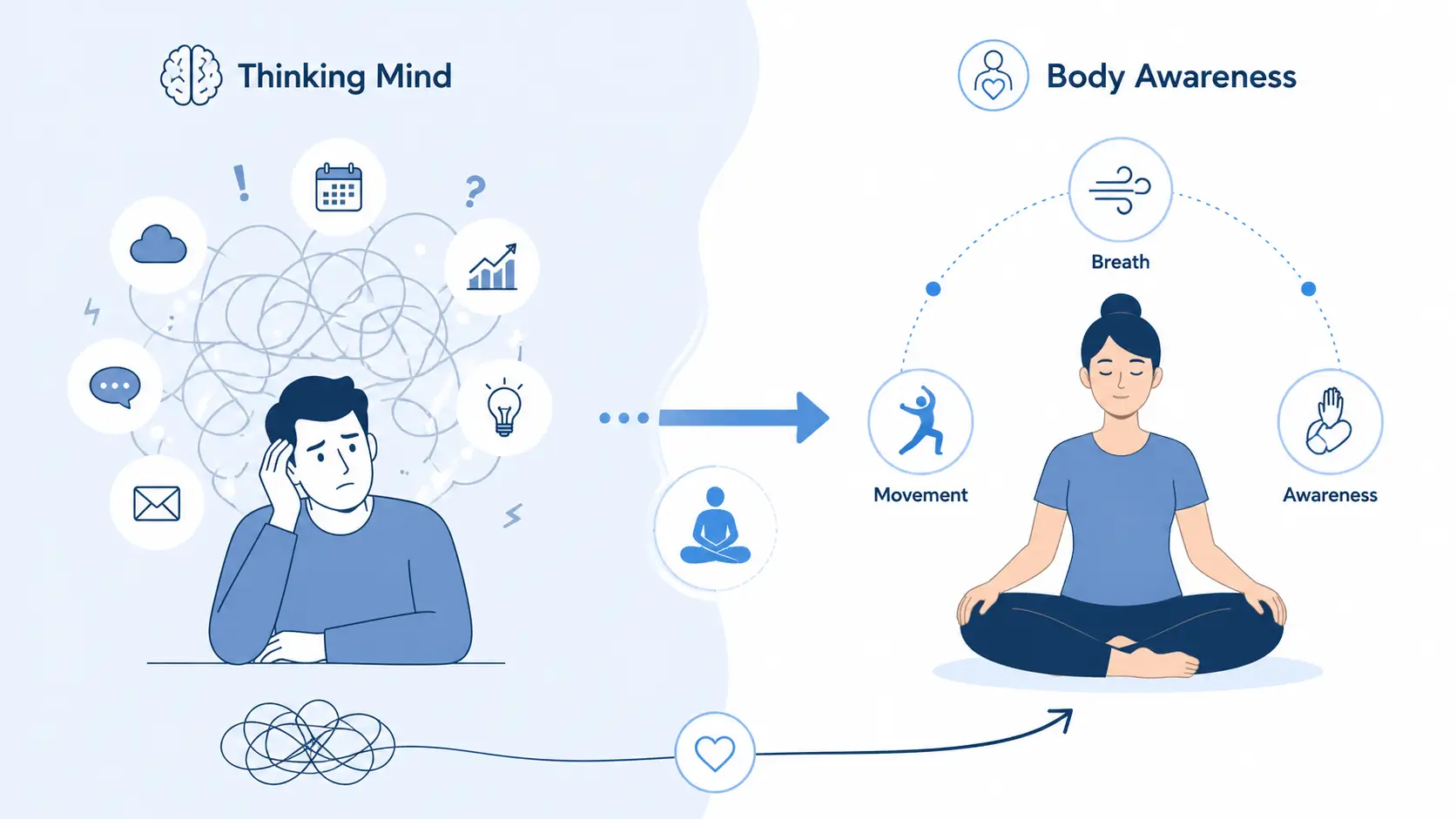
Meditation moves are structured or intuitive physical actions performed with full awareness of breath, body sensations, and present-moment attention.
Core Definitions:
- Moving meditation: Practicing mindfulness through motion instead of stillness
- Movement meditation: Using physical movement as the main focus anchor
- Meditative movement: Slow, intentional actions performed with awareness
- Meditation in motion: Applying mindfulness during everyday physical activities
The key shift is from thought-based awareness to body-based awareness. Instead of observing thoughts, attention is directed toward:
- Muscle movement
- Body positioning
- Breath rhythm
Exercise vs Mindful Movement:
- Exercise focuses on performance, intensity, and outcomes
- Meditation moves focus on awareness, control, and internal experience
This creates mind-body synchronization, where attention and movement work together to stabilize focus and reduce mental distractions.
How Moving Meditation Works (Mind-Body Mechanism)
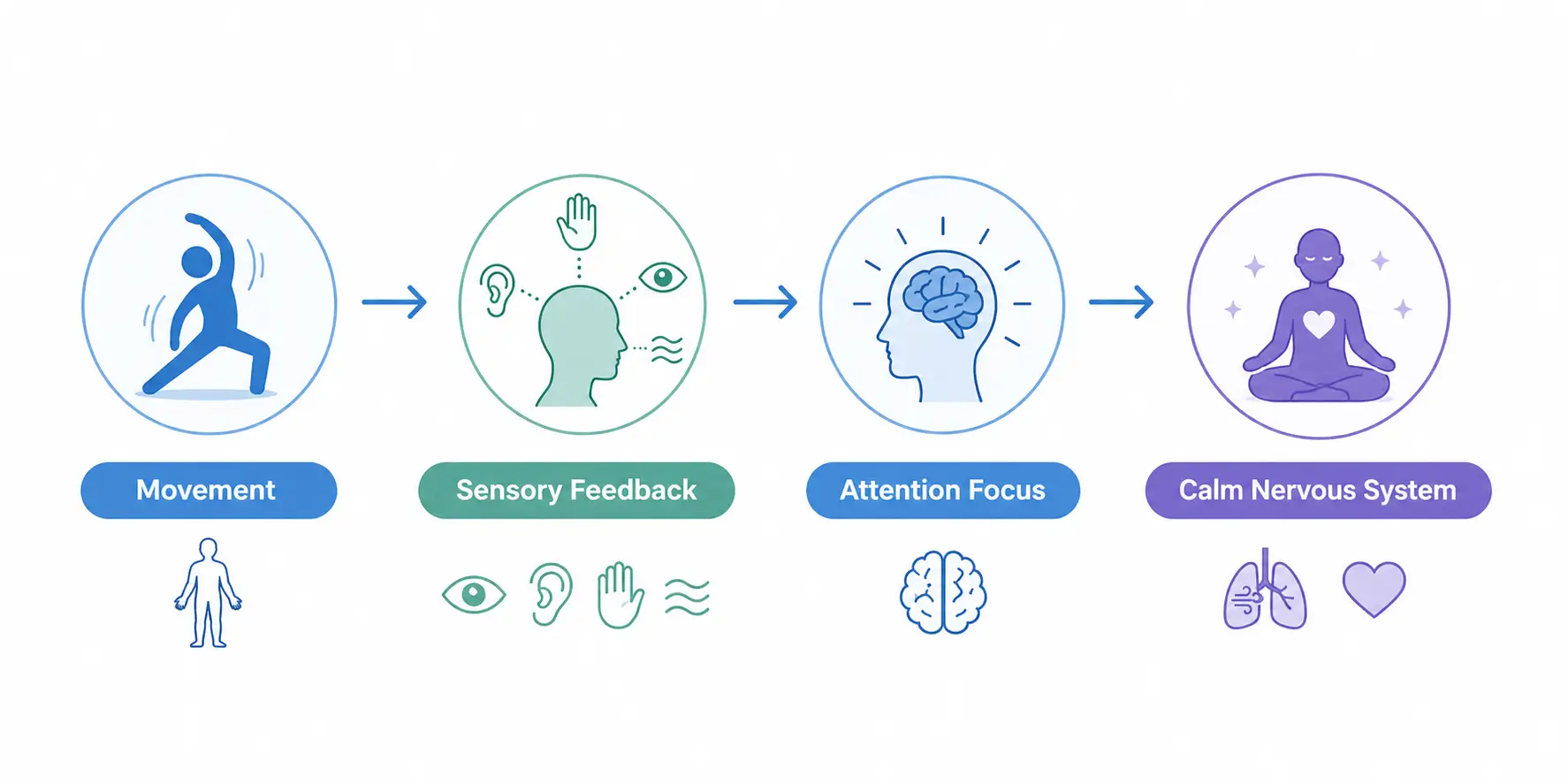
Movement acts as an anchor for attention, reducing cognitive overload and helping regulate the nervous system.
Key Mechanisms:
- Attention anchoring: Movement gives the mind a clear point of focus
- Reduced mental noise: Physical engagement limits overthinking
- Rhythmic motion: Repetition improves concentration and stability
- Breath synchronization: Regulates emotional responses
Nervous System Regulation:
- Slow movement activates the calm response (parasympathetic system)
- Reduces stress-driven reactions (fight-or-flight)
Sensory Feedback Role:
- Touch (contact with ground or surface)
- Balance (body alignment awareness)
- Motion (muscle engagement)
These signals keep attention grounded in the present.
Why Still Meditation Is Harder:
- No physical anchor for attention
- Increased mental wandering
- Requires higher initial discipline
Types of Movement Meditation Practices
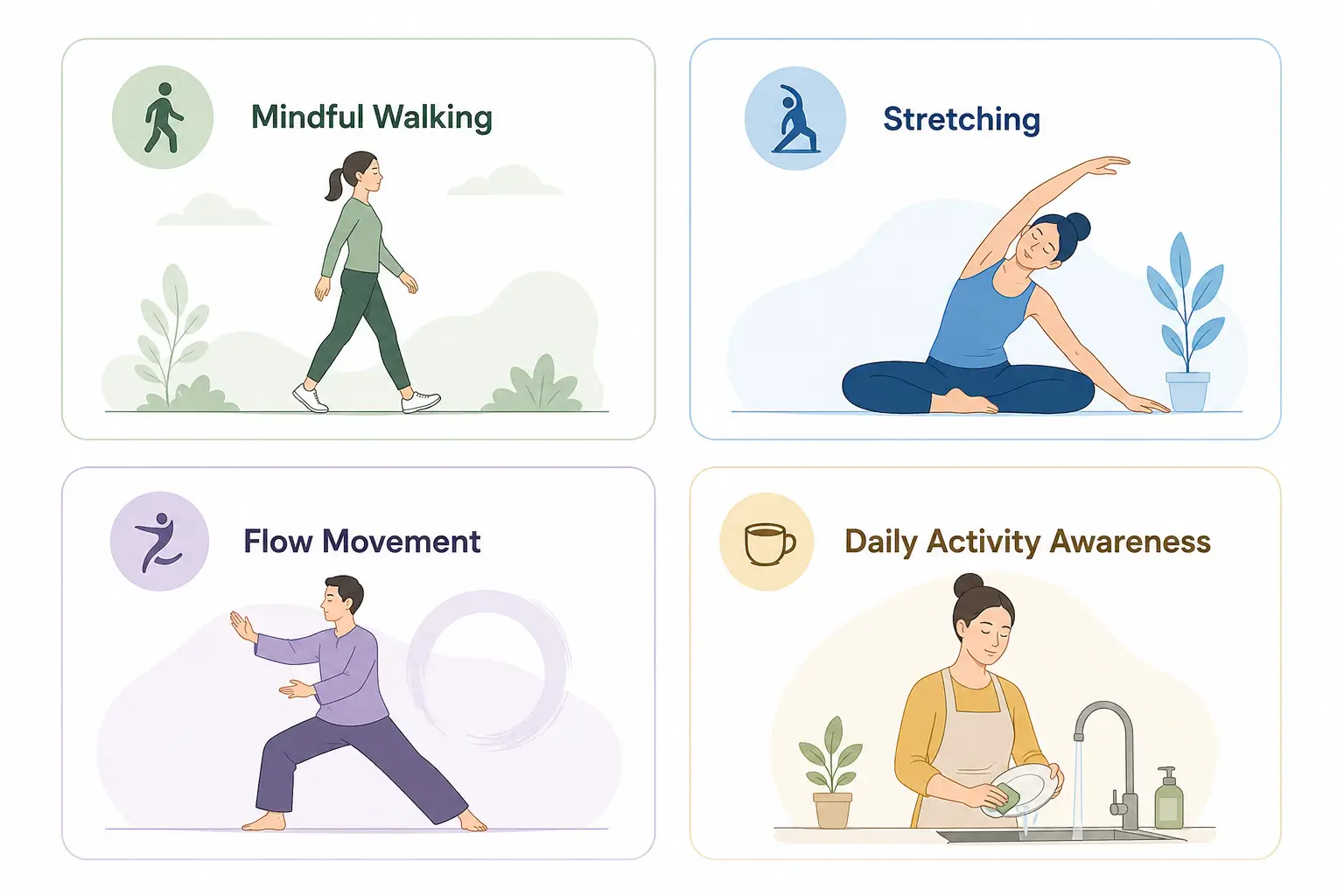
Different forms of meditation moves vary in intensity, structure, and purpose.
Common Types:
- Slow, controlled movements: Stretching, mindful walking
- Flow-based practices: Continuous, smooth motion patterns
- Breath-synced routines: Movement aligned with inhaling and exhaling
- Everyday awareness: Mindful cleaning, walking, or routine tasks
Accessibility:
- No equipment required
- Can be practiced anywhere
- Adaptable for all fitness levels
Beginner vs Advanced:
- Beginner: simple, repetitive movements with basic awareness
- Advanced: complex flows with continuous, sustained attention
Movement Meditation vs Traditional Meditation
| Aspect | Movement Meditation | Seated Meditation |
|---|---|---|
| Focus Anchor | Body movement | Breath or thoughts |
| Difficulty for Beginners | Easier (active engagement) | Harder (requires stillness) |
| Mental Distraction | Lower | Higher |
| Physical Involvement | Active | Passive |
| Consistency Potential | Higher | Often lower initially |
Key Insight:
Movement increases engagement, while stillness relies more heavily on discipline. This directly impacts long-term consistency.
Why People Struggle With Meditation (And How Movement Solves It)
Common Barriers:
- Restlessness and inability to sit still
- Overthinking and constant mental noise
- Lack of immediate results
- Boredom and disengagement
Why Movement Helps:
- Provides a physical outlet for excess energy
- Keeps attention externally anchored
- Reduces pressure to “clear the mind”
Behavioral Insight:
Many people fail due to an expectation vs reality gap. They expect immediate calm but experience discomfort instead. This creates habit friction, leading to inconsistency. Movement reduces this friction by making the process more engaging and natural.
Step-by-Step Guide: How to Practice Meditation Moves
Simple Beginner Routine:
- Choose a slow, repeatable movement (walking or stretching)
- Focus attention on physical sensations
- Sync movement with breathing
- Notice distractions without reacting
- Return attention to movement
Starting Guidelines:
- Begin with 3–5 minutes daily
- Increase duration gradually
- Focus on consistency over intensity
Building a Consistent Moving Meditation Habit
Habit Integration Strategy:
- Attach the practice to an existing routine (habit stacking)
- Start small to reduce resistance
- Use environmental cues (same time and place)
Practical Tips:
- Daily micro-practice (3–10 minutes)
- Practice at the same time each day
- Track consistency, not perfection
Behavioral Principle:
Adopt an identity-based approach:
“I am someone who practices awareness daily.”
Consistency builds automatic behavior over time.
Mental & Behavioral Benefits of Meditation Moves
Key Benefits:
- Reduced stress and emotional reactivity
- Improved focus and attention control
- Increased mind-body awareness
- Higher consistency in mindfulness practice
Cause-Effect Relationship:
- Movement → sensory engagement → reduced rumination
- Repetition → habit formation → long-term stability
Real-Life Outcomes:
- Better concentration at work
- Improved emotional responses in relationships
- Reduced overwhelm during daily tasks
Common Mistakes and How to Fix Them
| Mistake | Why It Happens | Solution |
|---|---|---|
| Treating it like exercise | Focus on performance | Shift focus to sensations |
| Expecting instant calm | Unrealistic expectations | Focus on process |
| Inconsistency | Lack of routine | Anchor to daily habits |
| Overcomplicating movements | Trying advanced techniques early | Keep movements simple |
Key Insight:
Simplicity increases consistency. Complexity creates resistance.
Real-Life Applications of Meditation in Motion
Everyday Examples:
- Walking mindfully during breaks
- Stretching with breath awareness
- Slow movement before sleep
Beginner vs Advanced:
- Beginner: short, guided awareness sessions
- Advanced: mindfulness integrated into all physical activity
Lifestyle Integration:
- Use during stressful moments
- Apply within daily routines
- Adapt to individual schedules
Motivation vs Discipline in Meditation Practice
| Factor | Motivation | Discipline |
|---|---|---|
| Nature | Emotion-driven | Habit-driven |
| Reliability | Inconsistent | Stable |
| Role | Helps you start | Helps you continue |
Key Insight:
Movement meditation reduces reliance on motivation by increasing engagement, making discipline easier to maintain.
Science-Backed Insights: Why Movement Enhances Mindfulness
Key Ideas:
- Movement activates sensory systems, improving attention
- Physical activity reduces stress hormones
- Rhythmic motion enhances mental clarity
Practical Explanation:
- Strengthens the brain-body connection
- Regulates the stress response system
- Reduces cognitive overload through physical engagement
This makes mindfulness more effective and easier to sustain.
Conclusion
Meditation moves offer a practical and sustainable way to build mindfulness by aligning with natural human behavior—movement. By combining physical motion with awareness, this approach reduces mental resistance, improves consistency, and makes meditation more accessible.
The key takeaway: consistency matters more than intensity. Start small, stay aware, and let movement guide your focus.
FAQs
1. What is moving meditation and how is it different from regular meditation?
Moving meditation combines physical movement with mindfulness, making it easier to maintain focus compared to traditional seated meditation.
2. Why do I struggle to sit still during meditation?
Restlessness is often caused by mental overload and lack of engagement. Movement provides a natural outlet for that energy.
3. How long should meditation moves practice be?
Start with 3–5 minutes daily and gradually increase as consistency improves.
4. Can movement meditation reduce stress effectively?
Yes, it regulates the nervous system by combining physical activity with mindful awareness.
5. What if I lose focus while doing movement meditation?
Losing focus is normal. Simply return your attention to your movement and breathing without judgment.
6. Is movement meditation suitable for beginners?
Yes, it is often easier for beginners because it reduces the difficulty of staying mentally engaged.