
Introduction
A successful mindset is a set of beliefs and mental habits that support learning, persistence, self-discipline, adaptability, goal setting, and resilience. Books for successful mindset are useful because they translate these abstract qualities into explainable concepts and repeatable practices. However, no single book creates success on its own; a book is only as valuable as the ideas a reader understands and applies consistently.
It’s worth separating related but distinct terms. Mindset refers to underlying beliefs about ability and change. Motivation is the temporary drive to act. Discipline is the capacity to act consistently regardless of motivation. Productivity is the effective use of time and effort toward goals. Personal development is the broader, ongoing process that includes all of the above. Understanding these distinctions helps readers choose books for better mindset that match what they actually need, rather than books that simply sound inspiring. This distinction is central when evaluating any list of the best books for successful mindset, and it shapes how the rest of this guide is organized — by problem and goal, not by popularity alone.
Quick Summary
- The best books for successful mindset focus on concepts such as growth mindset, resilience, self-discipline, goal setting, and productive thinking.
- Different books suit different goals: changing limiting beliefs, building discipline, improving confidence, or developing long-term resilience.
- Non-fiction and psychology-based books generally explain mindset concepts directly, while fiction can develop perspective, empathy, and reflective thinking.
- The most useful book is not necessarily the most popular one; it is the one whose ideas match the reader’s current needs and can be applied consistently.
What Should You Look for in Books About a Successful Mindset?
A useful mindset book explains a concept clearly, offers a way to practice it, and treats setbacks honestly rather than promising effortless transformation. Look for books that combine psychology books for successful mindset thinking with self-help books for successful mindset practicality, rather than relying on inspiration alone.
Strong mindset books generally share several characteristics:
- Clear psychological or behavioral concepts, defined in plain language
- Practical exercises, prompts, or frameworks readers can apply
- Evidence or established psychological principles, where relevant
- A realistic treatment of failure, plateaus, and setbacks
- Ideas that transfer across situations rather than motivational language tied to one story
In our experience helping readers build better habits, the books people return to are rarely the ones that felt the most exciting on a first read — they’re the ones with a concept simple enough to apply the next day. That distinction between inspiration and actionable guidance is often the difference between a book that entertains and one that changes behavior.
Growth Mindset, Resilience, Discipline, and Goal Setting
These four concepts overlap but are not interchangeable. Growth mindset concerns beliefs about whether abilities can improve through effort. Resilience concerns how a person recovers from setbacks. Discipline concerns consistency of action over time. Goal setting concerns the clarity and structure of what a person is working toward. A single book usually emphasizes one of these more heavily than the others, which is why understanding your specific gap matters more than searching for a single all-purpose title. Mindset, habit formation, productivity, and resilience are connected: a growth-oriented belief supports persistence, persistence depends on discipline, and discipline is easier to sustain when goals are clearly defined.
Evidence-Based Ideas vs. Motivational Advice
Not all self-improvement claims carry equal weight. Readers benefit from asking whether a book’s central claims are grounded in established behavioral science or psychological research, or whether they rely on anecdote and generalized encouragement. Science books for successful mindset typically cite research, describe mechanisms, and acknowledge limitations. Purely motivational material often simplifies “think positively and succeed” messaging without addressing why change is difficult or how to sustain it. This distinction matters because oversimplified advice can feel satisfying without producing lasting results.
What Are the Best Types of Books for Developing a Successful Mindset?
Rather than ranking titles, it is more useful to organize the best books on mindset and success by the problem they solve. The following categories reflect the most common reasons readers search for a top 10 books on mindset list, though popularity should never be the only selection criterion.
Books Focused on Growth and Learning
These books address beliefs about ability, learning, and mistakes — specifically, whether skills are fixed traits or can be developed through effort and strategy. This category is especially useful for readers who fear failure, avoid difficult challenges, or interpret setbacks as evidence of a fixed limitation rather than a normal part of learning.
Books Focused on Mindset and Discipline
Books on mindset and discipline explore the relationship between mental discipline, habits, consistency, delayed gratification, and goal-directed behavior. A key clarification: discipline is not purely willpower. It is heavily influenced by environment, routines, and systems that reduce the effort required to act consistently. Readers looking to build discipline benefit most from books that address structure, not just intention. Readers who want a deeper dive into this distinction can also read our guide on how to build discipline without motivation, which explains why relying on willpower alone tends to fail.
Books Focused on Success, Goals, and Achievement
This category covers goal setting, persistence, decision-making, and long-term achievement. It is important to distinguish healthy achievement — progress aligned with a person’s values and long-term wellbeing — from an overly narrow definition of success measured only by status, income, or external validation.
Psychology and Science-Based Books
Psychology books for successful mindset and science books for successful mindset explain why people think, behave, and respond to setbacks in particular ways. These books draw on cognitive and behavioral science to explain patterns such as avoidance, procrastination, self-doubt, and motivation, offering a deeper explanatory layer than purely motivational writing.
Self-Help Books for Practical Mindset Change
Self-help books for successful mindset translate psychological concepts into daily practice through exercises, reflection prompts, and behavioral experiments. Their strength is practicality; their limitation is that quality varies widely, and some titles prioritize appeal over evidence. Readers should evaluate self-help books using the same criteria applied to any mindset book — clarity, practicality, and realistic treatment of setbacks.
How Do Books Help You Change Your Mindset?
Books can change mindset, but reading alone rarely creates durable change. The realistic pathway runs from exposure to an idea, to reflection on how it applies personally, to repeated application in daily situations, to eventual behavioral change. Skipping the reflection and application steps is the most common reason mindset books fail to produce lasting results.
Identifying Limiting Beliefs
Books can help readers recognize unexamined assumptions about intelligence, failure, confidence, and capability. A reader searching for a change your mindset book is often looking for this specific function — a way to notice a belief that has been operating unconsciously. This is a conceptual need rather than one tied to a single title, and many books across different categories can serve this purpose.
Turning New Ideas Into Daily Behaviors
An idea has limited value until it is converted into a habit, decision, or small experiment. This connects mindset development directly to habit formation and productivity: a belief about growth or resilience only becomes useful once it changes what a person actually does on a given day. For real-world examples of this in action, see our related article on small habits that changed my life, which shows how tiny, consistent actions compound over time.
Using Reflection Instead of Passive Reading
Active engagement significantly improves the practical value of reading. A simple reflection method includes:
- Summarizing the central idea in your own words
- Identifying one belief or behavior to examine
- Applying one principle during the following week
- Reviewing what changed and what did not
This structure prevents passive consumption, where ideas are understood intellectually but never tested in practice. If you want a structured way to apply this reflection method, our guide on how to journal for self-growth offers prompts you can use alongside any mindset book.
Non-Fiction vs. Fiction for Developing a Successful Mindset
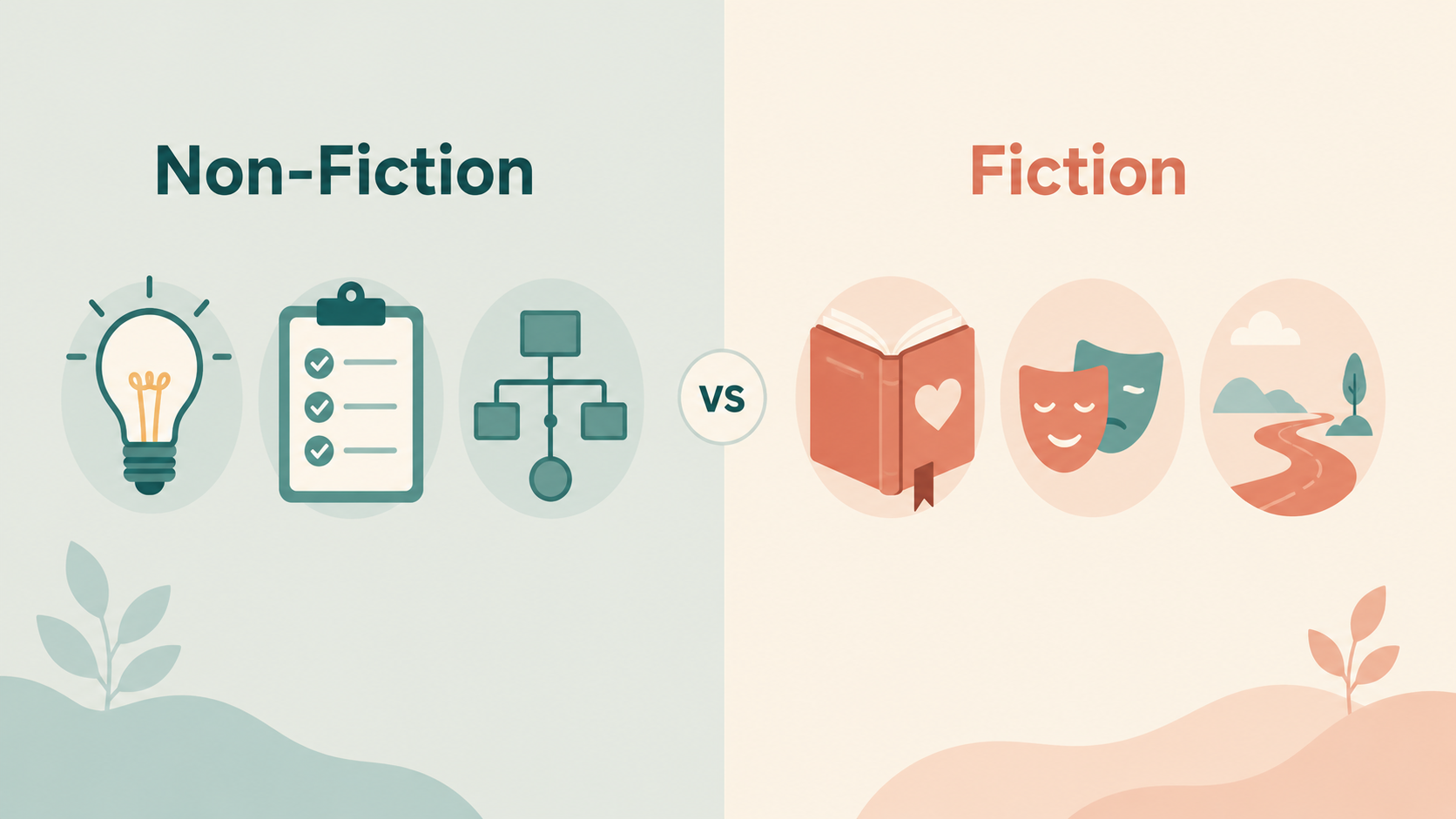
Mindset development does not require exclusively non-fiction reading. Non-fiction books for successful mindset and fiction books for successful mindset teach different things, and both can contribute to a well-rounded understanding.
What Non-Fiction Does Better
Non-fiction directly teaches frameworks, psychological concepts, habits, strategies, and exercises. It is best suited to readers who want explicit explanations and actionable systems they can apply immediately.
What Fiction Can Teach About Mindset
Fiction explores resilience, failure and recovery, ambition, identity, moral decision-making, and perspective through character and narrative rather than formal instruction. These lessons are generally learned indirectly, through empathy and reflection, rather than presented as explicit frameworks.
Comparison Table — Fiction vs. Non-Fiction
| Aspect | Non-Fiction | Fiction |
|---|---|---|
| Learning approach | Direct explanation and instruction | Indirect, through character and narrative |
| Typical strengths | Clear frameworks, exercises, evidence | Perspective-taking, empathy, emotional insight |
| Limitations | Can feel abstract without practice | Lessons are implicit, not formally structured |
| Best suited for | Readers wanting explicit strategies | Readers wanting reflection and perspective |
| Mindset themes covered | Growth, discipline, goal setting | Resilience, identity, adversity, ambition |
How Should Adults Choose Books for a Successful Mindset?
Books for successful mindset for adults should be chosen based on career stage, responsibilities, prior experience, and current challenges — not a single universal reading list.
For Adults Starting Personal Development
Beginners benefit most from accessible explanations, foundational concepts, and clear practical exercises. Starting with overly dense or highly technical frameworks can create confusion rather than momentum.
For Professionals and Career-Focused Readers
Career-focused readers benefit from books addressing decision-making, resilience, leadership, adaptability, productivity, and long-term learning. Mindset development supports professional growth, but success should not be equated solely with career advancement.
For Readers Already Familiar With Self-Help
Readers who have already covered foundational material benefit from deeper psychology, behavioral science, biographies, and books that offer contrasting or challenging viewpoints. Deliberately seeking perspectives that differ from familiar motivational messaging supports continued growth rather than repetition of the same ideas.
How Do You Choose the Right Mindset Book for Your Specific Goal?
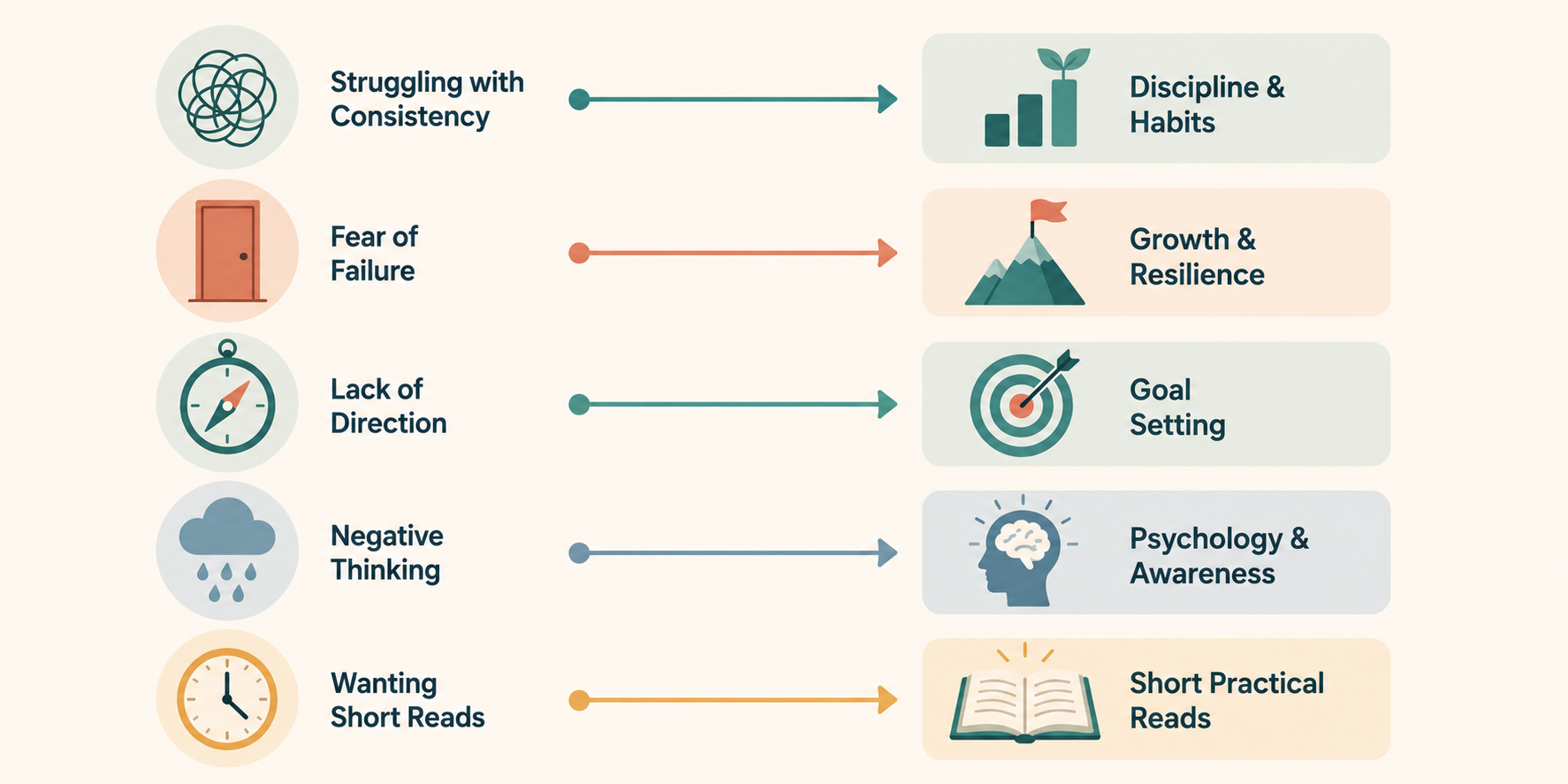
A practical decision framework is more useful than a fixed “top 10” ranking, since the right book depends on the reader’s immediate problem.
If You Struggle With Consistency
Prioritize books addressing habits, discipline, environment, and behavioral systems rather than motivation alone.
If You Fear Failure or Avoid Challenges
Prioritize books focused on growth, resilience, learning, and reframing failure as informative rather than threatening.
If You Lack Direction or Clear Goals
Prioritize books addressing goal setting, values clarification, decision-making, and purposeful action.
If You Feel Stuck in Negative Thinking
Prioritize books addressing cognitive patterns, self-awareness, emotional regulation, and evidence-based psychological approaches. Persistent or severe psychological difficulties may require professional support rather than books alone, and readers experiencing ongoing distress should consider speaking with a qualified professional.
If You Want Short, Practical Reads
Short books for successful mindset offer accessibility and a lower time investment, but a shorter length does not automatically mean greater effectiveness. Readers should weigh the trade-off between accessibility and the depth needed to fully understand and apply a concept.
How Should You Evaluate Reviews and Rankings of Mindset Books?
Ratings and bestseller status are useful signals but imperfect indicators of quality when evaluating reviews for books for successful mindset. A high rating can reflect broad appeal rather than practical depth or evidentiary rigor.
A more reliable framework asks:
- Is the central claim clearly explained?
- Are the recommendations practical and specific?
- Are psychological claims appropriately supported?
- Does the book acknowledge its own limitations?
- Does it offer a distinctive perspective rather than repeating common advice?
Top 10 books on mindset lists are most useful as starting points for further research, not as universal rankings that apply equally to every reader.
Are Free or PDF Mindset Books Worth Reading?
Free books for successful mindset, including material described as a strong mindset books PDF or books on mindset and success PDF, can be worthwhile when sourced legitimately. Format does not determine quality — a free, authorized book can be just as valuable as a paid one. Legitimate sources include public-domain works, author-provided downloads, libraries, and educational or open-access repositories. Readers should avoid unauthorized copies of copyrighted books, which are often incomplete, altered, or distributed illegally.
What to Check Before Reading a Free PDF
- Confirm the source is authorized (publisher, author, library, or educational institution)
- Check that publication details match a legitimate edition
- Verify the file appears complete rather than partial or edited
- Be cautious of unfamiliar download sites offering copyrighted material for free
Digital Books vs. Physical Books for Mindset Learning
Digital formats offer portability, searchability, and easy access, while physical books often support fewer distractions and more deliberate annotation. Neither format is inherently superior for mindset learning; the best format is the one that supports consistent, active reading for a given individual.
Common Mistakes People Make When Reading Mindset Books
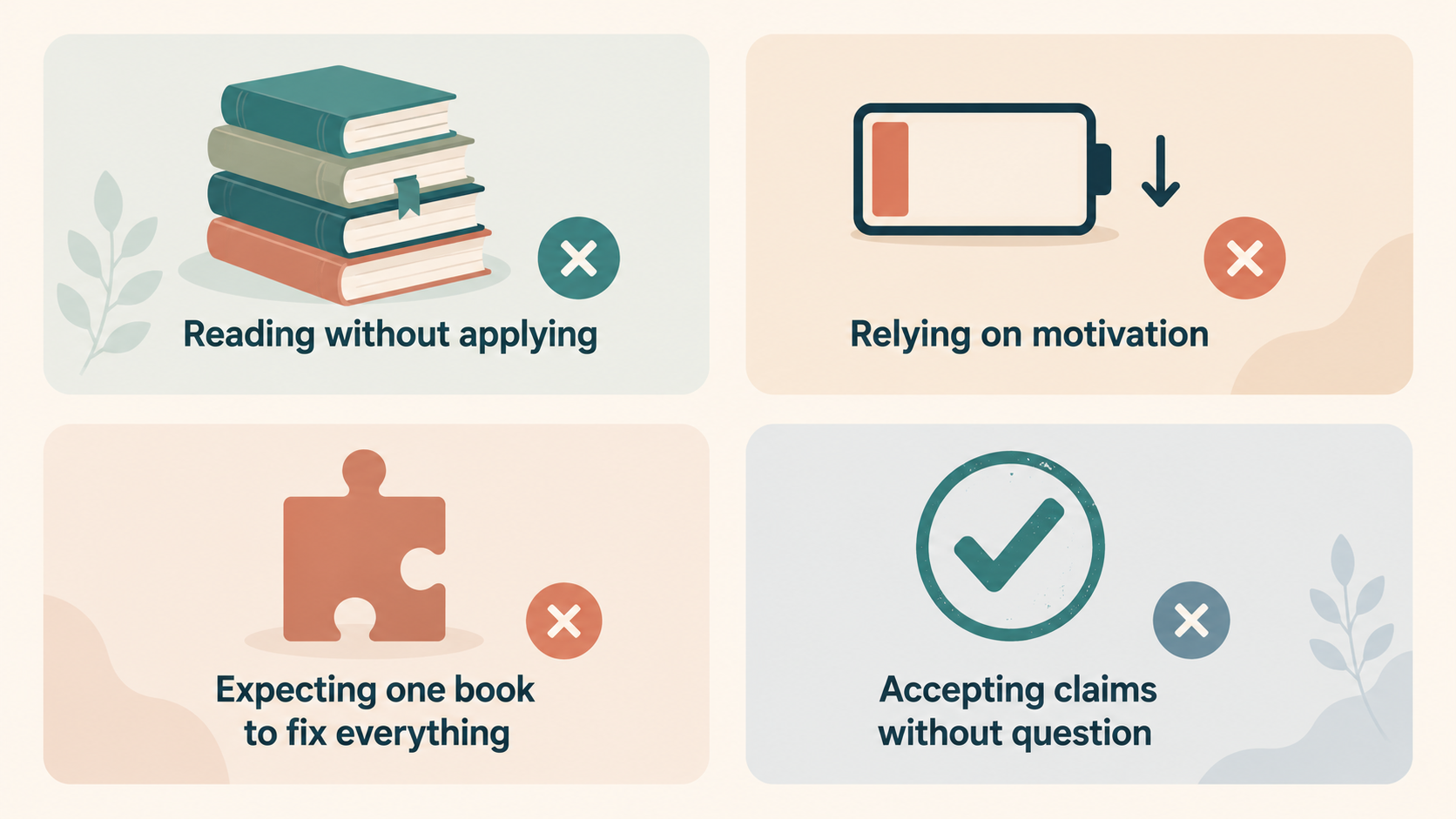
Beyond selecting the right book, several practical habits determine whether mindset reading actually produces change.
Reading Too Many Books Without Applying Any Ideas
Accumulating information is not the same as behavioral change. Applying one principle from a single book thoroughly is typically more effective than briefly sampling ideas from many books in sequence.
Treating Motivation as a Permanent State
Motivation naturally fluctuates and cannot be relied upon as a consistent driver of action. Long-term progress depends more on habits, systems, environment, and resilience than on sustained enthusiasm.
Expecting One Book to Solve Every Problem
Different books address different psychological and behavioral dimensions — growth, discipline, resilience, goal setting, and self-awareness rarely fit within a single title. A balanced reading approach across categories tends to produce more complete development.
Accepting Every Self-Help Claim Without Questioning It
Critical reading and comparison across competing perspectives help readers distinguish useful, well-supported frameworks from exaggerated promises that sound appealing but lack substance.
How Can You Turn a Mindset Book Into a Personal Development Practice?
Reading connects most directly to lasting change when paired with habit formation, goal setting, productivity, and time management practices, rather than treated as a standalone activity.
A Simple Read–Reflect–Apply–Review Method
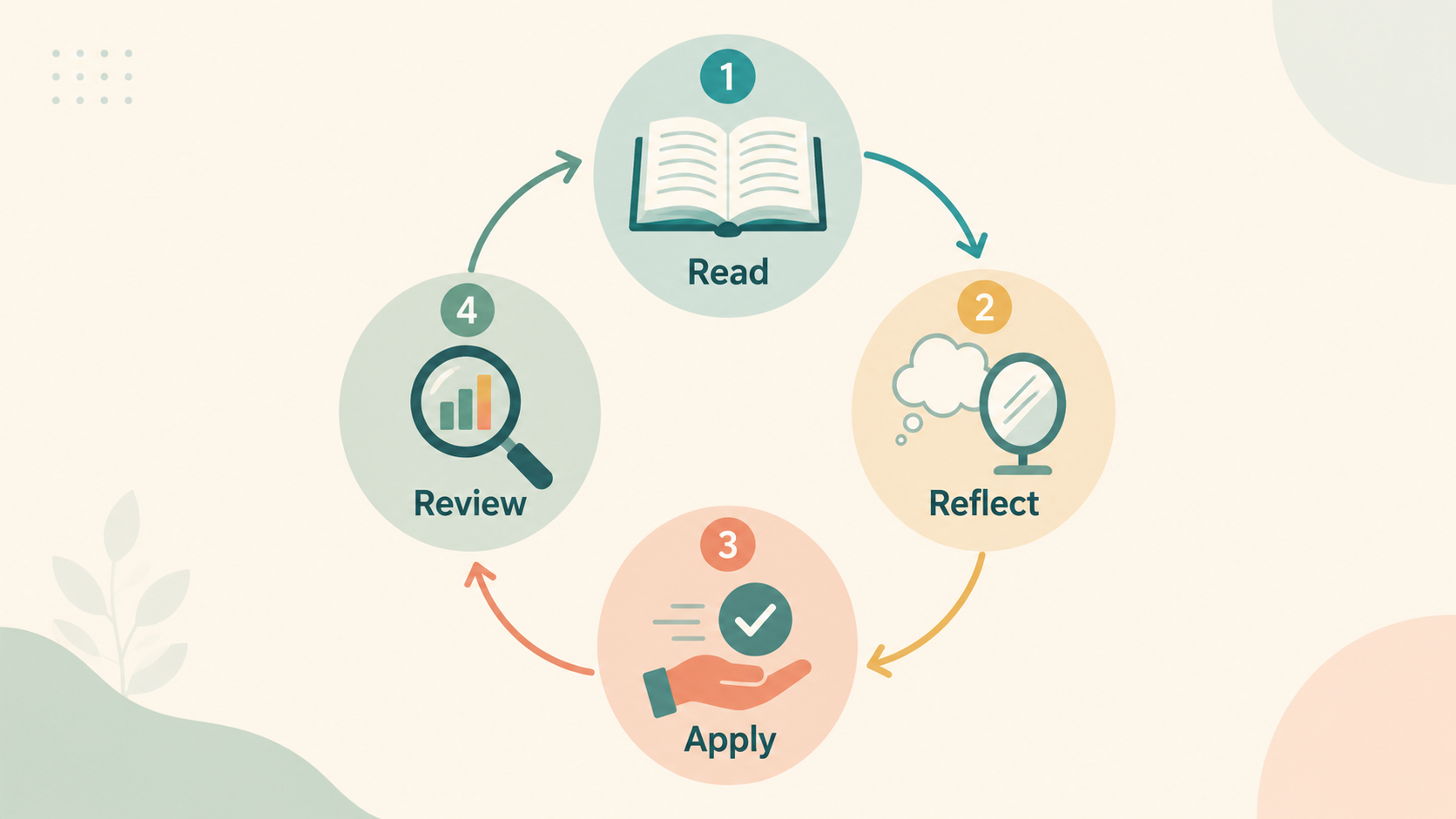
- Read: Identify the author’s central idea.
- Reflect: Relate the idea to a current challenge you’re facing.
- Apply: Test one specific behavior or principle.
- Review: Evaluate the result and adjust your approach.
This cycle prevents passive consumption and creates a repeatable structure for extracting practical value from any mindset book.
How Much Should You Read Before Applying an Idea?
Readers do not need to finish an entire book before testing a practical principle. It is more important to understand the context and limitations of an idea — when it applies and when it doesn’t — before applying it broadly across different situations.
How Long Does It Take to See Results From Reading Mindset Books?
Results from mindset reading generally follow three stages: immediate insight, short-term behavioral experimentation, and longer-term habit and belief change. The pace depends on consistency of application, existing environment, prior beliefs, and the complexity of the change being pursued.
As of 2026, behavioral science continues to emphasize small, repeatable actions over large, infrequent efforts as the more reliable path to lasting change, reinforcing that pacing expectations realistically matters as much as book selection itself.
Why Insight Can Happen Quickly but Change Takes Longer
Understanding an idea intellectually can happen within a single reading session, but repeatedly behaving according to that idea under real conditions — including stress, fatigue, or setbacks — takes considerably longer. This gap is precisely why habit formation and resilience are necessary complements to reading, not optional extras.
Which Mindset Book Approach Is Best for Different Readers?
| Reader Goal | Most Relevant Book Type | Main Concepts | What to Look For |
|---|---|---|---|
| Build resilience | Resilience-focused | Failure, recovery, adaptability | Practical coping frameworks |
| Improve discipline | Habit/discipline-focused | Consistency, systems, delayed gratification | Actionable routines |
| Change limiting beliefs | Psychology/growth-focused | Beliefs, learning, cognitive patterns | Research and practical exercises |
| Improve goal setting | Success/productivity-focused | Goals, planning, persistence | Concrete frameworks |
| Gain perspective | Fiction/biographical | Identity, adversity, empathy | Complex characters and situations |
| Start self-development | Beginner-friendly self-help | Awareness, habits, motivation | Clear explanations and exercises |
Conclusion
The best books for successful mindset depend on a reader’s goals, existing knowledge, and willingness to apply what they learn — not on a single universal ranking. The major categories worth understanding are growth, discipline, resilience, psychology, self-help, and fiction, each addressing a different dimension of how people think, act, and recover from setbacks. Reading provides ideas and frameworks, but it is repeated, reflective application that actually turns those ideas into a lasting mindset and behavioral change.
Frequently Asked Questions About Books for Successful Mindset
What are the best books for developing a successful mindset? The best choice depends on whether the reader wants to build growth-oriented thinking, discipline, resilience, confidence, goal-setting skills, or broader personal development, since no single category covers every need equally well.
What books help develop a strong mindset and discipline? Books addressing discipline are most effective when they explain the relationship between habits, consistency, environment, and mindset, rather than presenting discipline as simple willpower alone.
Can reading books actually change your mindset? Reading can create genuine insight, but lasting mindset change requires reflection and repeated application of an idea over time, not just exposure to the concept through reading.
Are fiction books useful for developing a successful mindset? Yes — fiction can develop perspective, resilience, empathy, and identity awareness through narrative, while non-fiction is generally more direct for explicitly teaching frameworks and strategies.
What are the best mindset books for adults? The best mindset books for adults vary by career stage, personal goals, experience level, and current challenges, so selection should be based on individual circumstances rather than age alone.
Are free PDF mindset books safe and useful to read? Free PDF mindset books can be valuable when sourced from authorized publishers, authors, libraries, or educational repositories; readers should avoid unauthorized copies of copyrighted material from unverified sites.
How many mindset books should I read to improve myself? There is no fixed number — applying the ideas from one well-chosen book consistently is typically more valuable than reading many books without putting their concepts into practice.