

Introduction
Questions about mindset are prompts that examine the beliefs and assumptions a person holds about ability, effort, failure, learning, and change. These questions matter because mindset shapes how someone interprets a difficult task, a mistake, or critical feedback. Mindset questions are used in self-reflection, classroom discussion, coaching, leadership development, and interviews. A distinction matters here: some questions simply identify a person’s current mindset, while others are designed to encourage a person to reconsider or develop it. Throughout this article, concepts like fixed mindset, growth mindset, self-awareness, resilience, learning, and behavior appear as the building blocks of effective mindset questions.
Quick Summary
- Mindset questions help people examine how they think about ability, effort, mistakes, challenges, feedback, and change.
- Growth mindset questions focus on learning, improvement, persistence, strategies, and responding constructively to setbacks.
- Questions can be adapted for students, adults, leaders, interviews, coaching, or group discussions.
- Comparing fixed and growth mindset questions can reveal whether a response emphasizes permanent ability or the possibility of learning and improvement.
What Are the Most Important Questions About Mindset?
The most important mindset questions are the ones that expose how a person actually reacts to difficulty, rather than what they claim to believe in the abstract. Broad, foundational questions matter because they establish a baseline before more specific questions — about students, leaders, or interviews — can be useful.
Questions for Understanding Your Current Mindset
These questions surface a person’s default reactions to challenge and setback:
- How do I respond when something feels difficult?
- What do I believe about my ability to improve?
- How do I react when I make a mistake?
- Do I avoid situations where I might fail?
- How do I respond to criticism or feedback?
- What do I tell myself when I struggle?
- Do I see effort as useful or as evidence that I lack ability?
In our experience helping readers build better habits, the most revealing answers come from recalling a specific recent moment rather than a general self-description.
Questions About Challenges, Failure, and Setbacks
These questions uncover the beliefs a person holds about difficulty and failure, including:
- What did this mistake teach me?
- What helped me persist after a setback?
- When did I last change my strategy instead of giving up?
- Do I ask for help when progress stalls?
- How do I respond when progress is slower than expected?
- Can I separate a temporary failure from my overall ability?
What Questions Help Identify a Fixed or Growth Mindset?
A fixed mindset treats intelligence and ability as largely unchangeable, while a growth mindset treats them as developable through effort, strategy, and feedback. Growth mindset is not the same as “thinking positively” — it is a set of assumptions about whether ability can change with the right conditions. This distinction was popularized by psychologist Carol Dweck, whose research is often summarized in Carol Dweck mindset quotes that capture the core difference in a single line.
Questions About Fixed and Growth Mindset
These questions explore:
- Whether intelligence and ability are viewed as fixed or developable
- How a person interprets difficult tasks
- Attitudes toward effort
- Reactions to other people’s success
- Responses to mistakes and criticism
- Willingness to try unfamiliar approaches
Fixed Mindset vs. Growth Mindset Questions
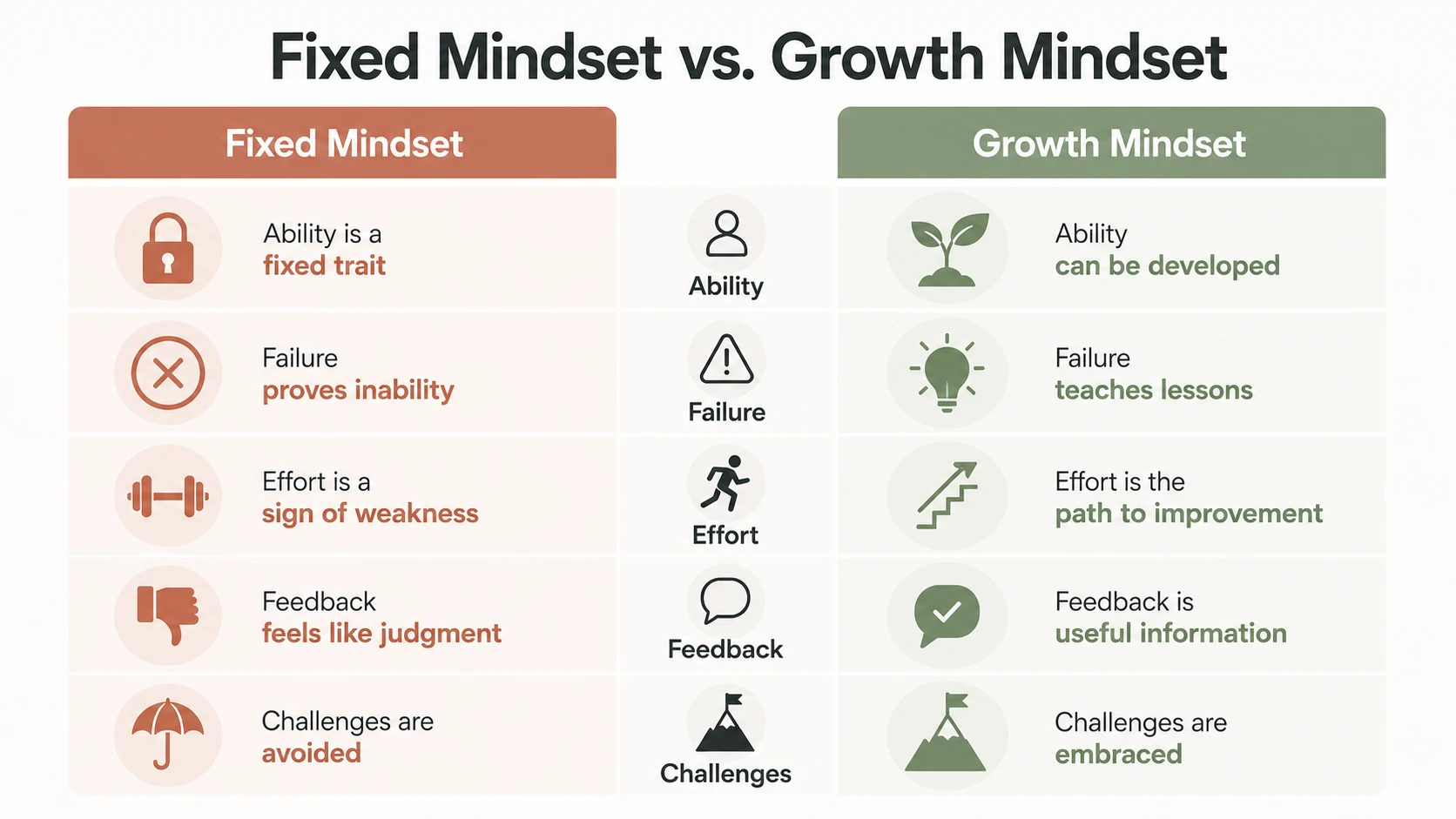
Questions about fixed and growth mindset can be organized by the area of belief they test and the assumption each response tends to reveal.
| Area | Fixed-mindset perspective | Growth-oriented perspective |
|---|---|---|
| Ability | Is ability something you either have or do not have? | How can ability be developed? |
| Failure | What does failure say about ability? | What can failure teach you? |
| Effort | Does needing effort mean you lack talent? | How can effort improve performance? |
| Feedback | Is criticism a judgment of ability? | What useful information does feedback provide? |
| Challenges | Should difficult tasks be avoided? | What can a difficult task help you learn? |
What Are Good Growth Mindset Questions and Answers?
Good growth mindset questions pair a prompt with a short explanation of the reasoning behind a growth-oriented response, rather than listing prompts without context.
Questions About Learning and Improvement
- Can people improve their abilities? Most skills improve with deliberate practice, feedback, and time, even when initial progress is slow.
- What should you do when you do not understand something? Break the material into smaller parts, ask targeted questions, and seek an alternative explanation or resource.
- How can effort contribute to learning? Effort builds the repetition and feedback loops that strengthen skill over time.
- What can you learn from a mistake? A mistake often points directly to the specific gap in knowledge or technique that needs attention.
- How can changing your strategy improve results? Repeating an ineffective method rarely produces a different outcome; adjusting the approach targets the actual obstacle.
Questions About Persistence and Resilience
Growth mindset connects closely to persistence, resilience, recovering from setbacks, seeking support, trying a different strategy, and maintaining realistic expectations during difficult periods. Persistence without adjustment can stall progress, so resilience works best when paired with periodic strategy review.
Questions About Feedback and Criticism
Growth-oriented thinking treats feedback as information that can guide improvement. At the same time, not every piece of criticism is accurate or useful — evaluating feedback for relevance and evidence is itself part of a growth-oriented approach.
What Are the Best Mindset Questions for Students?
Mindset questions for students apply the same core ideas to school, studying, academic challenges, peer comparison, exams, feedback, and learning habits. The goal is reflection, not labeling a student as having one permanent type of mindset.
Mindset Questions for Students
- What do you do when a subject feels difficult?
- What can you learn from getting an answer wrong?
- How do you respond when another student performs better than you?
- What study strategy could you change?
- How do you react when a teacher gives you difficult feedback?
- What does effort mean to you?
- What is something you could not do before but can do now?
- When should you ask for help?
Growth Mindset Questions for Students
Growth mindset questions for students focus specifically on learning from mistakes, improving through practice, trying new strategies, responding to difficult assignments, handling academic setbacks, and setting realistic learning goals.
How Teachers Can Use Mindset Questions
Teachers can build these questions into classroom discussions, journaling, one-to-one reflection, goal-setting exercises, post-assessment reflection, and group activities. Questions work best when they encourage curiosity and self-reflection rather than being used to categorize students as permanently “fixed” or “growth.”
What Are Useful Growth Mindset Questions for Adults?
Growth mindset questions for adults extend beyond school into careers, relationships, skills, personal goals, uncertainty, and lifelong learning.
Questions for Personal Growth
- What belief about myself may be limiting my actions?
- How do I react when I am outside my comfort zone?
- What skill would I like to develop?
- What past mistake taught me something valuable?
- Where could I use a different strategy?
- How do I respond when progress takes longer than expected?
Questions for Work and Career Development
These questions address learning new skills, receiving workplace feedback, handling professional setbacks, adapting to change, taking on unfamiliar responsibilities, and learning from colleagues. Your Daily Thrive recommends revisiting these questions during performance reviews or after a noticeable setback, when the answers tend to be most specific.
What Are Growth Mindset Questions for Leaders?
Growth mindset questions for leaders help examine personal behavior and create conditions that support learning, experimentation, accountability, and constructive feedback across a team.
Questions Leaders Can Ask Themselves
- Do I reward learning as well as results?
- How do I respond when a team member makes a mistake?
- Do I encourage people to ask for help?
- How do I respond to ideas that challenge my assumptions?
- Do I treat feedback as useful information?
- How do I react when a strategy fails?
Questions Leaders Can Ask Their Teams
- What did we learn?
- What could we try differently?
- Which assumption should we reconsider?
- What support would help?
- What part of the process worked?
- What should we change next time?
How Can Mindset Questions Be Used in Interviews?
Growth mindset interview questions assess how a candidate approaches learning, challenges, feedback, mistakes, and change. A strong answer demonstrates behavior and reflection rather than simply using the phrase “growth mindset.”
Common Growth Mindset Interview Questions
- Tell me about a time you had to learn a difficult skill.
- Describe a situation where you received challenging feedback.
- Tell me about a mistake and what you learned from it.
- What do you do when your first approach does not work?
- Describe a time you changed your strategy after a setback.
- How do you approach unfamiliar responsibilities?
What Makes a Strong Answer to a Mindset Interview Question?
A strong answer to an interview question about mindset typically includes a specific situation, a genuine challenge, actions taken, reflection or learning, adaptation, and a measurable or observable outcome where appropriate.
How Do You Create Effective Questions About Growth Mindset?
Readers benefit from learning to construct their own questions about growth mindset instead of relying only on a fixed list.
Start With a Real Situation
Questions become more useful when connected to a recent challenge, a mistake, a learning experience, feedback, a goal, or a change in circumstances, rather than posed in the abstract.
Ask About Thinking, Behavior, and Next Steps
Move beyond “Do you have a growth mindset?” by asking: What happened? How did you interpret it? What did you do? What did you learn? What would you do differently next time?
Avoid Leading or Judgmental Questions
Questions should not imply that one answer makes someone a “good” person and another makes them a “bad” person; this framing discourages honest reflection.
What Are Good Discussion Questions About Mindset?
Discussion questions about mindset work well in classrooms, workshops, coaching sessions, teams, or small groups when they are open-ended enough to generate discussion rather than yes/no responses.
Discussion Questions About Growth Mindset
- Can someone change the way they approach difficult tasks?
- Is effort always a sign of improvement?
- Can failure be useful even when the outcome is negative?
- How can feedback change the way we learn?
- Why might people avoid challenges?
- How does comparing yourself with others affect learning?
- When is persistence helpful, and when should you change strategies?
Discussion Questions About Mindset in Real-Life Situations
Good questions to ask about mindset can be grounded in scenarios such as academic setbacks, career changes, learning a new skill, team disagreements, receiving criticism, and failing at a personal goal.
How Can Mindset Questions Support Goal Setting, Habits, and Productivity?
Mindset questions connect to broader self-improvement work, though mindset alone does not guarantee success — strategy, environment, and consistency matter as well.
Mindset Questions for Goal Setting
- What am I trying to improve?
- Why does this goal matter?
- What skills or strategies will I need?
- What could prevent progress?
- How will I respond if my first plan fails?
Mindset Questions for Building Better Habits
These questions connect reflection to consistency, environment, small improvements, tracking progress, adjusting routines, and recovering after missed days.
Mindset Questions for Productivity and Resilience
These questions help identify unhelpful assumptions about perfectionism, procrastination, overcommitment, slow progress, setbacks, and workload and priorities.
Common Mistakes When Using Mindset Questions
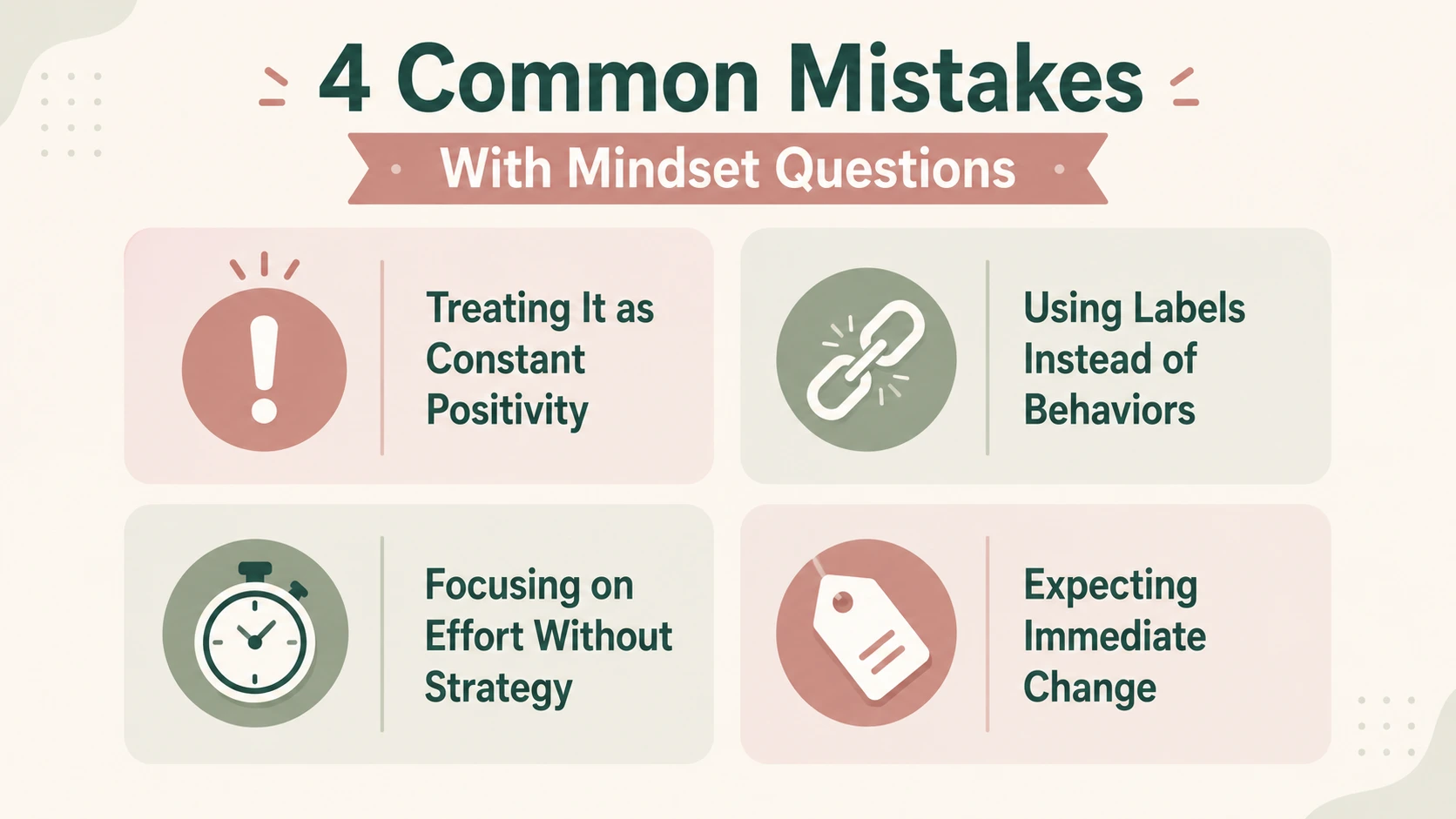
Treating Growth Mindset as Constant Positivity
Growth-oriented thinking does not mean pretending every setback is good or ignoring legitimate limitations. It means evaluating what actually happened and what can realistically change. Readers looking to build this understanding further may find our roundup of the best growth mindset books useful for sustained learning beyond reflection questions alone
Using Labels Instead of Exploring Behaviors
Asking “Are you fixed or growth mindset?” can oversimplify a person’s behavior, since most people show a mix of both depending on the situation.
Focusing on Effort Without Strategy
Effort is more useful when paired with effective methods, feedback, practice, and adjustment. Effort alone, without a change in approach, often produces limited results.
Expecting Immediate Change
Mindset development is connected to repeated experiences, reflection, behavior, and context rather than a single motivational exercise. As of 2026, behavioral science guidance increasingly emphasizes repeated, low-effort reflection over occasional intensive exercises.
How Should Mindset Questions Be Adapted to Different People and Situations?
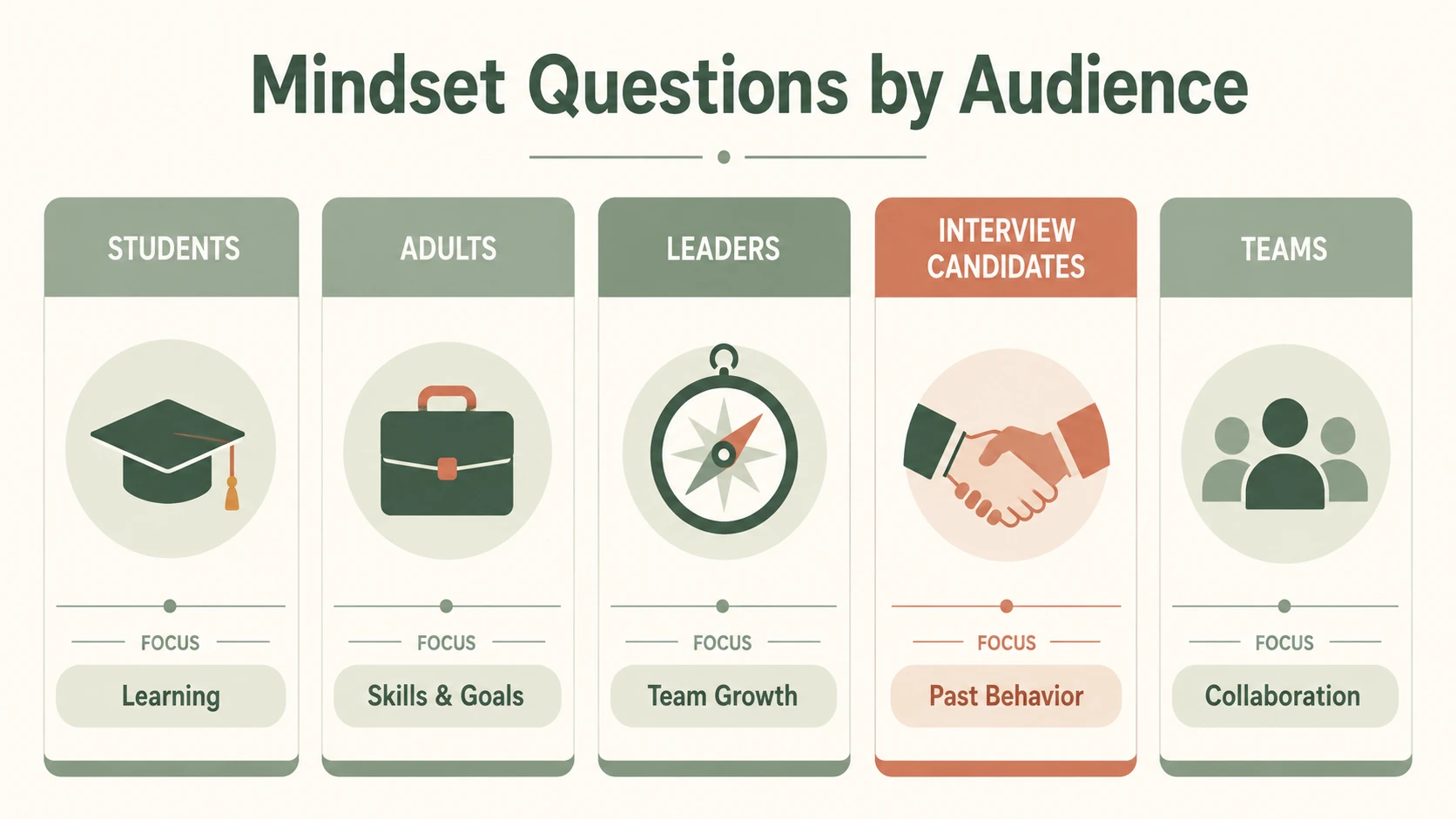
The same underlying question often needs different wording depending on age, role, experience, and circumstances.
| Audience | Primary focus | Useful question type |
|---|---|---|
| Students | Learning and academic challenges | “What could you try differently?” |
| Adults | Skills, goals, and setbacks | “What did this experience teach you?” |
| Leaders | Team learning and adaptation | “What can the team learn from this?” |
| Interview candidates | Past behavior and learning | “Tell me about a time you changed your approach.” |
| Teams | Collaboration and problem-solving | “What should we test or change next?” |
How Can You Turn Mindset Questions Into a Practical Reflection Exercise?
A Five-Step Mindset Reflection Method
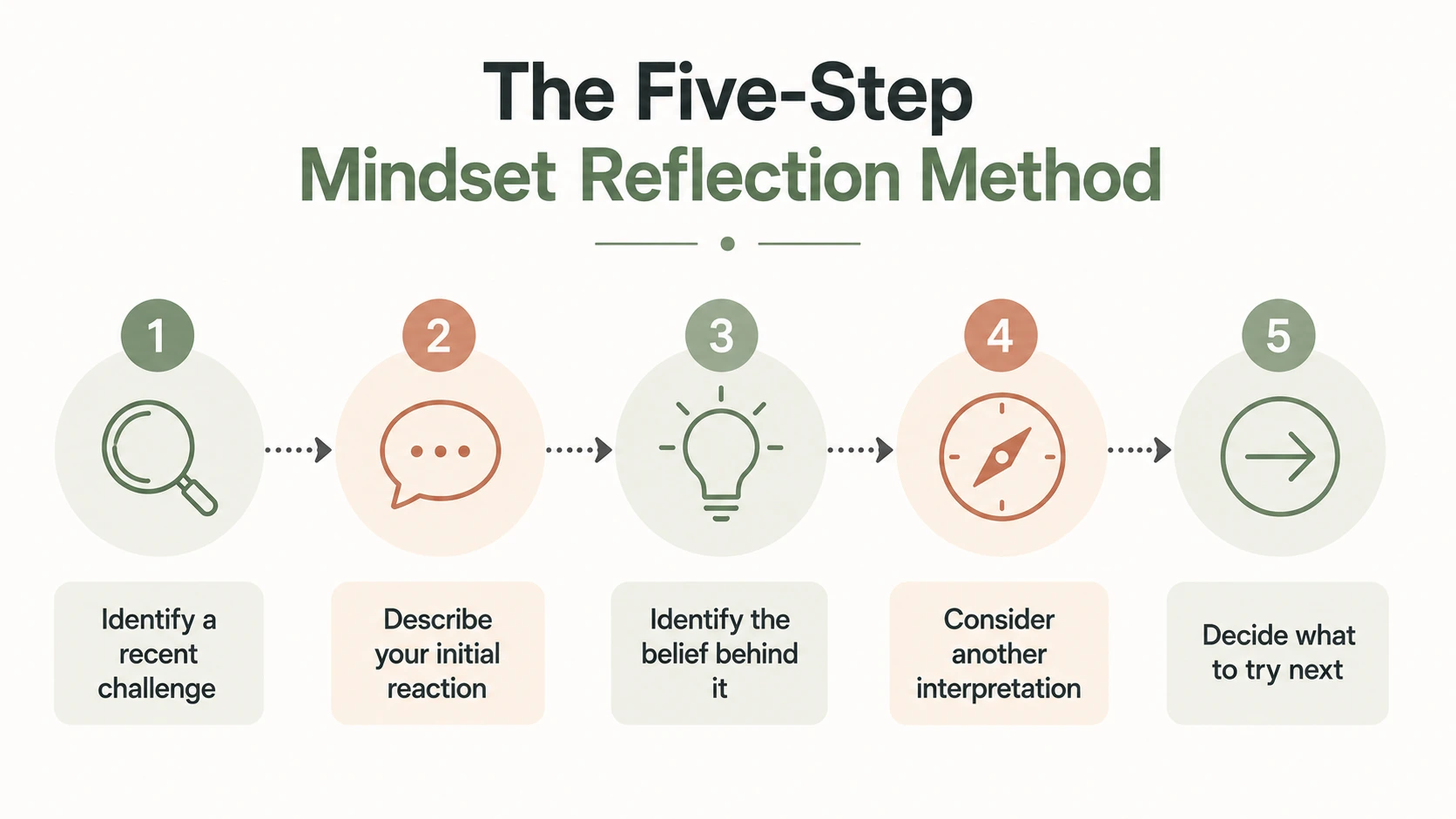
- Identify a recent challenge.
- Describe your initial reaction.
- Identify the belief behind that reaction.
- Consider another interpretation or strategy.
- Decide what you will try next. For a ready-made starting point, this list of growth mindset prompts can be used alongside the five-step method above.
How Often Should You Use Mindset Reflection Questions?
Mindset reflection questions are most useful after meaningful setbacks, during goal reviews, weekly or periodically for personal reflection, after receiving important feedback, and before or after challenging learning experiences. Consistency and relevance matter more than the frequency of journaling.
Conclusion: How Questions About Mindset Can Encourage Growth
Effective questions about mindset help people examine beliefs about ability, effort, challenges, mistakes, feedback, and change. Growth-oriented thinking involves learning and adapting rather than simply maintaining a positive attitude, and the most useful questions are adapted to a person’s specific role and situation — whether that’s a student, an adult managing a career, a leader guiding a team, or a candidate preparing for an interview. The most useful mindset question is often one that turns a setback or challenge into an opportunity to understand what happened, what can be learned, and what can be tried next.
Frequently Asked Questions About Mindset
What are good questions about mindset?
Good questions about mindset cover challenges, mistakes, feedback, ability, effort, learning, and personal improvement, such as “How do I respond when something feels difficult?” and “What do I tell myself when I struggle?”
What are some growth mindset questions?
Useful growth mindset questions focus on learning, adaptation, persistence, and strategy, such as “What can you learn from a mistake?” and “How can changing your strategy improve results?”
What questions can help identify a fixed mindset?
Questions about reactions to failure, challenges, effort, feedback, and other people’s success can reveal fixed-mindset assumptions, particularly when a response treats ability as unchangeable.
What are good growth mindset questions for students?
Student-friendly growth mindset questions address difficult subjects, mistakes, studying, feedback, effort, and improvement, such as “What study strategy could you change?”
What are useful growth mindset questions for adults?
Useful adult-focused questions address career development, learning new skills, setbacks, goals, feedback, and changing strategies, such as “What belief about myself may be limiting my actions?”
What questions can leaders ask to encourage a growth mindset?
Leaders can ask questions about team learning, experimentation, feedback, mistakes, problem-solving, and continuous improvement, such as “What did we learn?” and “What could we try differently?”
How are fixed mindset and growth mindset different?
A fixed mindset tends to interpret ability, effort, challenges, failure, and feedback as evidence of a permanent trait, while a growth mindset interprets the same experiences as opportunities to develop skill and strategy.
Can asking mindset questions actually change the way someone thinks?
Questions can promote reflection and awareness, but lasting change generally requires repeated reflection, experience, behavior, feedback, and practice rather than a single question or exercise.