
Introduction
Mindset refers to the underlying beliefs a person holds about their abilities, potential, and the causes of success or failure. These beliefs shape how people interpret challenges, respond to setbacks, learn new skills, and make decisions over time. The top 10 books on mindset featured here were selected as a curated comparison rather than a simple popularity ranking, based on usefulness, clarity, practical application, grounding in established psychological ideas, and relevance across different reader goals. Related concepts like growth mindset, positive thinking, confidence, discipline, and long-term success all intersect with mindset, but no single book works equally well for every reader. The right choice depends on individual goals, current challenges, and how someone prefers to learn.
Quick Summary
- The best mindset books cover different areas, including growth, confidence, discipline, resilience, positive thinking, and achievement.
- A strong mindset book provides useful concepts readers can apply, rather than offering motivation alone.
- Readers interested in success should look for books connecting mindset with habits, decision-making, persistence, and purposeful action.
- The best choice depends on whether the reader wants to improve confidence, build discipline, change limiting beliefs, or develop a growth-oriented approach to challenges.
What Should You Look for in the Top 10 Books on Mindset?
A useful mindset book does more than deliver inspiration; it gives readers a framework they can apply to real situations. Before ranking any book highly, it helps to evaluate it against a consistent set of criteria. This creates the foundation for the selections below and helps explain why each book earned its place.
Criteria for Evaluating a Mindset Book
- Quality and clarity of the central idea — the book should center on one clear, well-explained concept rather than a scattered collection of tips.
- Practical usefulness — ideas should translate into specific actions, not remain abstract theory.
- Evidence or established principles — stronger books draw on psychological research or widely recognized behavioral frameworks.
- Relevance to everyday challenges — the concepts should apply to real work, relationships, and personal goals.
- Long-term usefulness rather than temporary motivation — the book should hold value on a second or third reading.
- Suitability for beginners versus experienced readers — some books work best as an introduction, while others reward readers who already understand the basics.
Different Types of Mindset Books
Mindset is a broad category rather than a single subject. Books about mindset, growth mindset books, and other popular mindset books typically fall into a handful of major themes, and the top 10 books on this list intentionally span these categories so readers with different goals can find a relevant starting point. Mindset is a broad category rather than a single subject, and understanding how a growth mindset helps you clarifies why these themes matter beyond reading alone.
- Growth mindset
- Positive thinking
- Confidence and self-belief
- Discipline and consistency
- Success and achievement
- Resilience and overcoming setbacks
- Habits and behavioral change
- Leadership and business mindset
The Top 10 Books on Mindset
Each entry below explains the book’s central idea, the mindset concept it addresses, who benefits most from it, its practical value, and situations where a different book might be a better fit.
1. Mindset: The New Psychology of Success — Best for Understanding Mindset Change
Written by psychologist Carol Dweck, this book introduces the distinction between a fixed mindset, the belief that abilities are static, and a growth mindset, the belief that abilities can be developed through effort. It explains how these beliefs shape behavior in school, work, relationships, and sports. Readers who want a foundational understanding of mindset psychology before exploring more specific topics will benefit most. Its main limitation is that it stays largely conceptual, so readers looking for step-by-step routines may want to pair it with a more action-oriented book.
2. Grit: The Power of Passion and Perseverance — Best for Developing a Growth Mindset
Angela Duckworth’s research-based book focuses on how sustained effort and long-term passion, rather than raw talent, predict achievement. It emphasizes learning from failure, embracing difficult challenges, and maintaining commitment to goals over years rather than weeks. This book suits readers pursuing long-term ambitions such as career changes or skill mastery. It is less useful for readers seeking quick confidence boosts or short-term motivation.
3. The Confidence Code — Best for Confidence and Self-Belief
Authors Katty Kay and Claire Shipman examine the psychological and behavioral roots of confidence, distinguishing it from competence and self-esteem. The book explains how fear of failure holds people back and why taking action, even imperfectly, builds genuine self-belief over time. It is particularly useful for readers who understand what to do but hesitate to act. Readers seeking discipline-building routines rather than confidence psychology may prefer a different title on this list.
4. Atomic Habits — Best for Discipline and Consistency
James Clear connects mindset directly to behavior by explaining how small, consistent actions compound into significant results. The book covers identity-based habits, environmental design, and the mechanics of habit formation, linking self-control and delayed gratification to long-term consistency. It is highly practical and works well for readers who want structured systems rather than abstract encouragement. Readers who want deep psychological theory over actionable frameworks may find other books more suited to their needs.
5. Think and Grow Rich — Best for Success and Achievement
Napoleon Hill’s classic work explores how goal clarity, persistence, and decision-making influence achievement, drawing on interviews with highly successful individuals of his era. The book emphasizes purposeful action and resilience in the face of failure. It suits readers focused on ambitious long-term goals, particularly in business or career growth. Some concepts reflect the era in which it was written, so readers benefit from applying its principles selectively alongside modern behavioral science.
6. Learned Optimism — Best for Positive Thinking and Mental Resilience
Martin Seligman, a leading researcher in positive psychology, distinguishes constructive optimism from unrealistic positive thinking. The book explains explanatory style, how people interpret setbacks, and offers exercises for building resilience without ignoring real problems. It is well suited to readers who want a research-backed approach to mental resilience rather than surface-level positivity. Readers looking for business-specific strategies should look elsewhere on this list.
7. You Are a Badass — Best for Changing Limiting Beliefs
Jen Sincero’s book addresses self-doubt, identity, and unhelpful beliefs about ability and worthiness, using an accessible, conversational tone. It encourages readers to question assumptions about failure and possibility and to take consistent action despite fear. This book works well for readers new to personal development who want an approachable entry point. Readers who prefer a more clinical, research-heavy tone may find other books on this list a better match.
8. Extreme Ownership — Best for Business and Leadership Mindset
Authors Jocko Willink and Leif Babin, both former Navy SEAL officers, apply military leadership principles to business and decision-making. The book emphasizes accountability, adaptability, and how leaders should respond to setbacks and risk. It is especially relevant for readers in management or entrepreneurial roles who need mindset principles applied to team dynamics. Readers focused on personal, non-professional mindset growth may find its framing less directly applicable.
9. The 7 Habits of Highly Effective People — Best for Practical Personal Development
Stephen Covey’s framework translates mindset principles into everyday habits covering proactivity, prioritization, and long-term effectiveness. The book connects internal beliefs to concrete behaviors, routines, and decision-making processes. It suits readers who want mindset concepts converted into a structured personal system. Readers seeking a shorter, faster read may find its comprehensive structure more time-intensive than other options.
10. Awaken the Giant Within — Best Overall Choice for a Broad Audience
Tony Robbins’ book combines mindset psychology, decision-making, emotional management, and goal-setting into a single, wide-ranging framework. Its broad scope, accessible explanations, and practical exercises make it a strong starting point for readers who have not previously explored mindset literature. Because it covers many topics, readers with a narrow, specific goal, such as discipline alone, may eventually want to supplement it with a more focused book from this list.
Top 10 Mindset Books Compared at a Glance
| Book | Primary Mindset Focus | Best For | Difficulty | Practical Focus |
|---|---|---|---|---|
| Mindset | Mindset change | General readers | Beginner | High |
| Grit | Growth mindset | Long-term learners | Beginner | High |
| The Confidence Code | Confidence | Building self-belief | Beginner | High |
| Atomic Habits | Discipline | Consistency | Intermediate | High |
| Think and Grow Rich | Success | Goal-oriented readers | Beginner/Intermediate | High |
| Learned Optimism | Positive thinking | Resilience | Beginner | Medium/High |
| You Are a Badass | Limiting beliefs | Personal change | Beginner | High |
| Extreme Ownership | Business mindset | Professionals | Intermediate | High |
| The 7 Habits of Highly Effective People | Personal development | Practical improvement | Beginner | High |
| Awaken the Giant Within | Overall mindset | Broad audience | Beginner | High |
Which Mindset Book Should You Read Based on Your Goal?
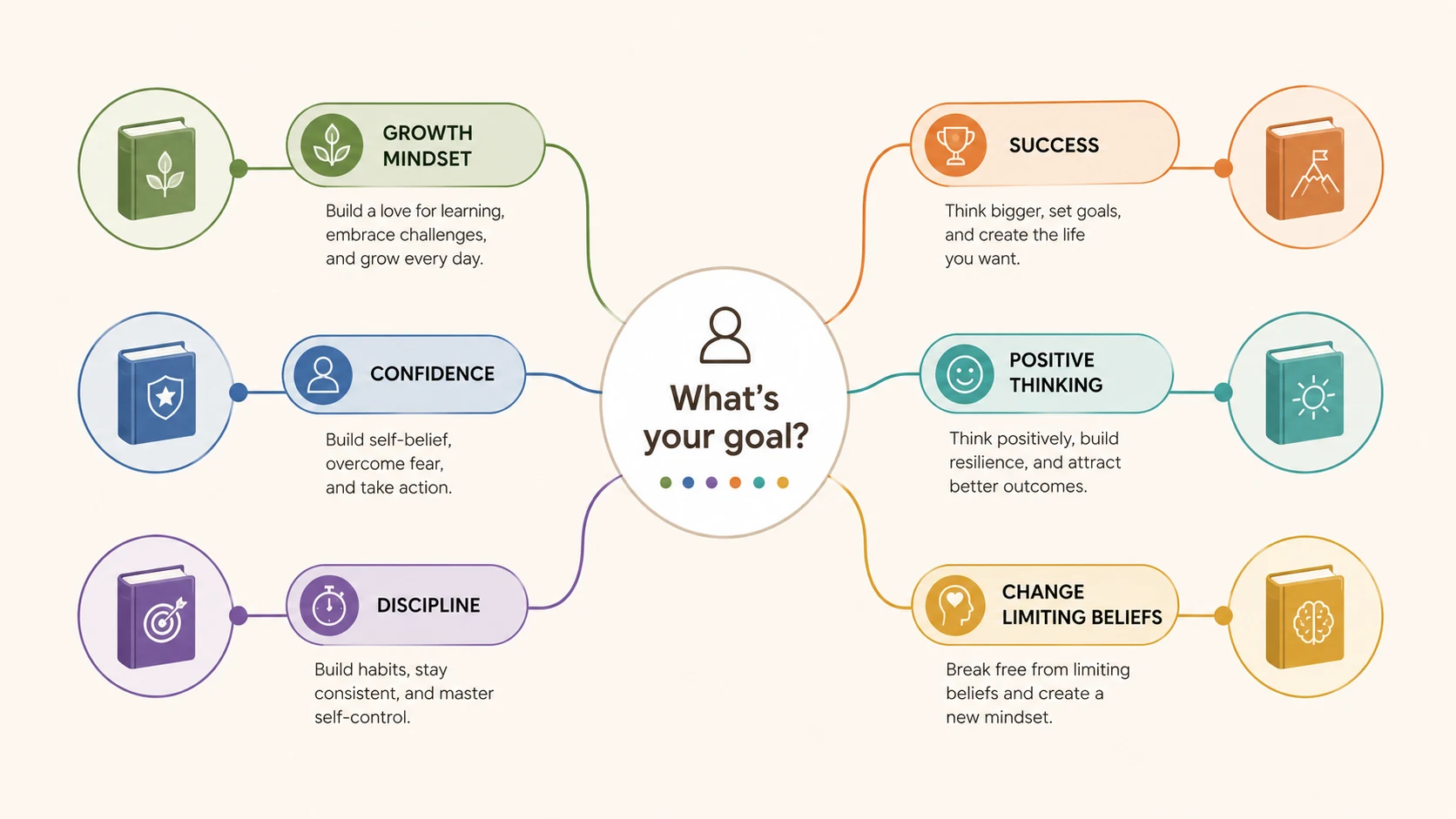
Choosing among the top 10 books on mindset is easier when the decision starts from a specific goal rather than general curiosity.
If You Want to Develop a Growth Mindset
Mindset and Grit are most relevant, since both focus directly on learning from failure, embracing challenges, and improving ability through sustained effort.
If You Want More Confidence
The Confidence Code and You Are a Badass focus most directly on self-belief, overcoming fear of failure, and building competence through action.
If You Want Better Discipline
Atomic Habits and The 7 Habits of Highly Effective People are the strongest choices, since both connect mindset to consistency, routines, and self-control. For readers who struggle on low-motivation days, how to build discipline without motivation offers a complementary, action-first approach.
If You Want More Success
Think and Grow Rich and Extreme Ownership support goal-setting, persistence, and decision-making, though mindset alone should not be treated as a guarantee of success without action.
If You Want to Think More Positively
Learned Optimism offers the clearest distinction between realistic, constructive thinking and unproductive negative thought patterns, backed by psychological research.
If You Want to Change Your Mindset Completely
Awaken the Giant Within provides the broadest starting framework, though meaningful change typically requires repeated reflection and consistent behavior change rather than a single book.
Mindset and Success: How Are They Connected?
Mindset and success are related but not identical, and the connection is often oversimplified in popular discussions.
- Mindset influences how people interpret setbacks, whether as temporary obstacles or permanent failures.
- Beliefs about ability affect willingness to attempt difficult or unfamiliar tasks.
- Resilience supports persistence after failure rather than giving up early.
- Confidence influences the willingness to take action and make decisions under uncertainty.
- Discipline turns intentions and beliefs into repeated, sustained behavior.
- External factors, including skills, resources, opportunities, and circumstances, also significantly affect outcomes, meaning mindset works alongside these factors rather than replacing them.
Mindset, Confidence, Discipline, and Growth: What’s the Difference?
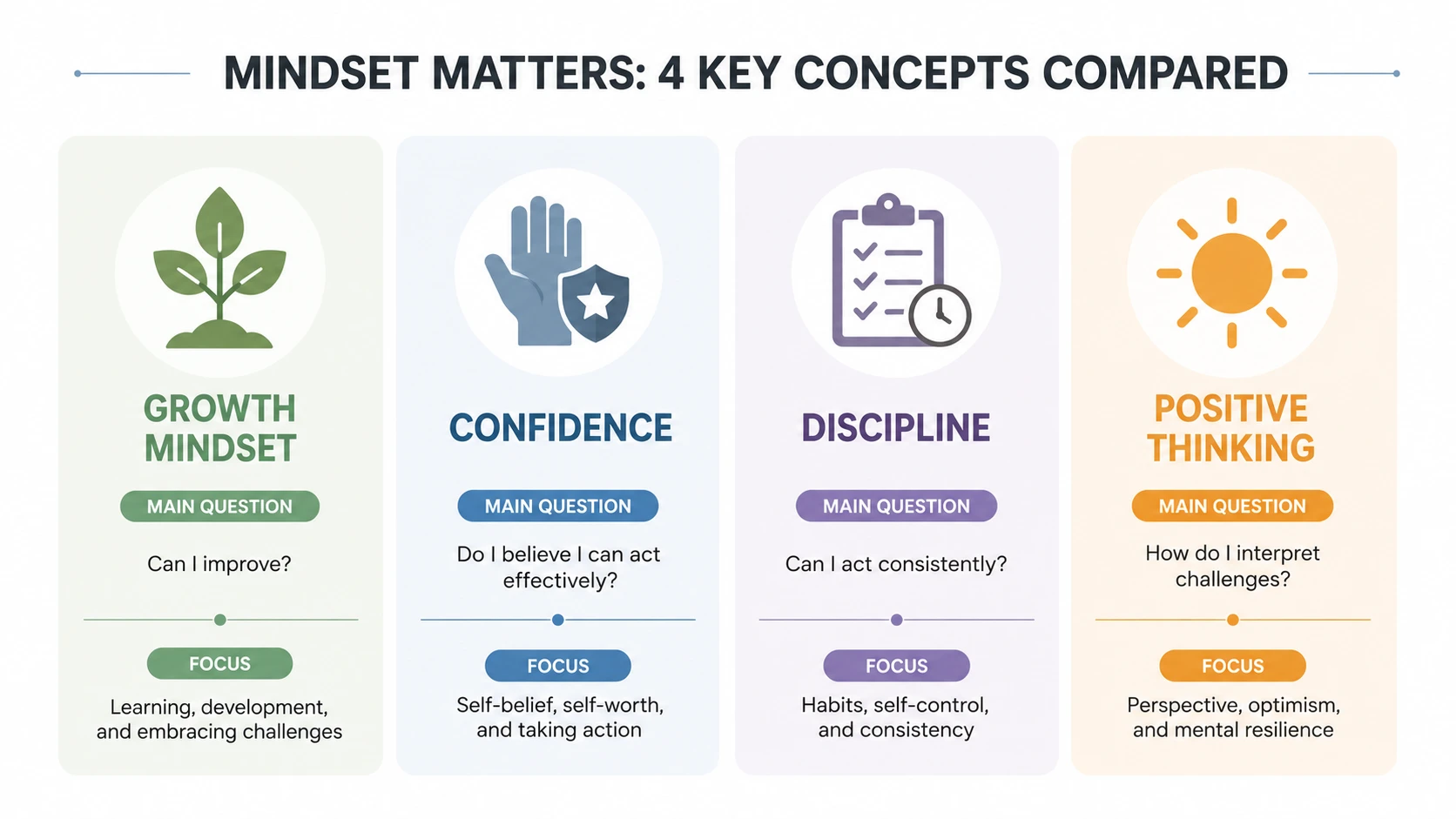
These four concepts frequently overlap in personal development writing, but they answer different underlying questions.
| Concept | Main Question | Typical Focus |
|---|---|---|
| Growth mindset | Can I improve? | Learning and development |
| Confidence | Do I believe I can act effectively? | Self-belief and action |
| Discipline | Can I act consistently? | Behavior and consistency |
| Positive thinking | How do I interpret challenges? | Perspective and optimism |
| Success mindset | How do I approach goals and setbacks? | Achievement and persistence |
Are Mindset Books Actually Useful?
Mindset books can meaningfully shape how readers think, but they have real limits worth understanding before picking up a title.
What Reading Can Change
- Introduce new mental models for interpreting challenges.
- Challenge existing assumptions about ability and failure.
- Provide language for understanding behavior and motivation.
- Encourage structured reflection on personal patterns.
- Offer practical strategies that can be tested in daily life.
What Reading Alone Cannot Guarantee
- Immediate behavior change without deliberate practice.
- Success without corresponding action.
- Confidence without repeated real-world practice.
- Discipline without consistent behavior over time.
- Positive outcomes regardless of external circumstances.
Common Mistakes People Make When Reading Mindset Books
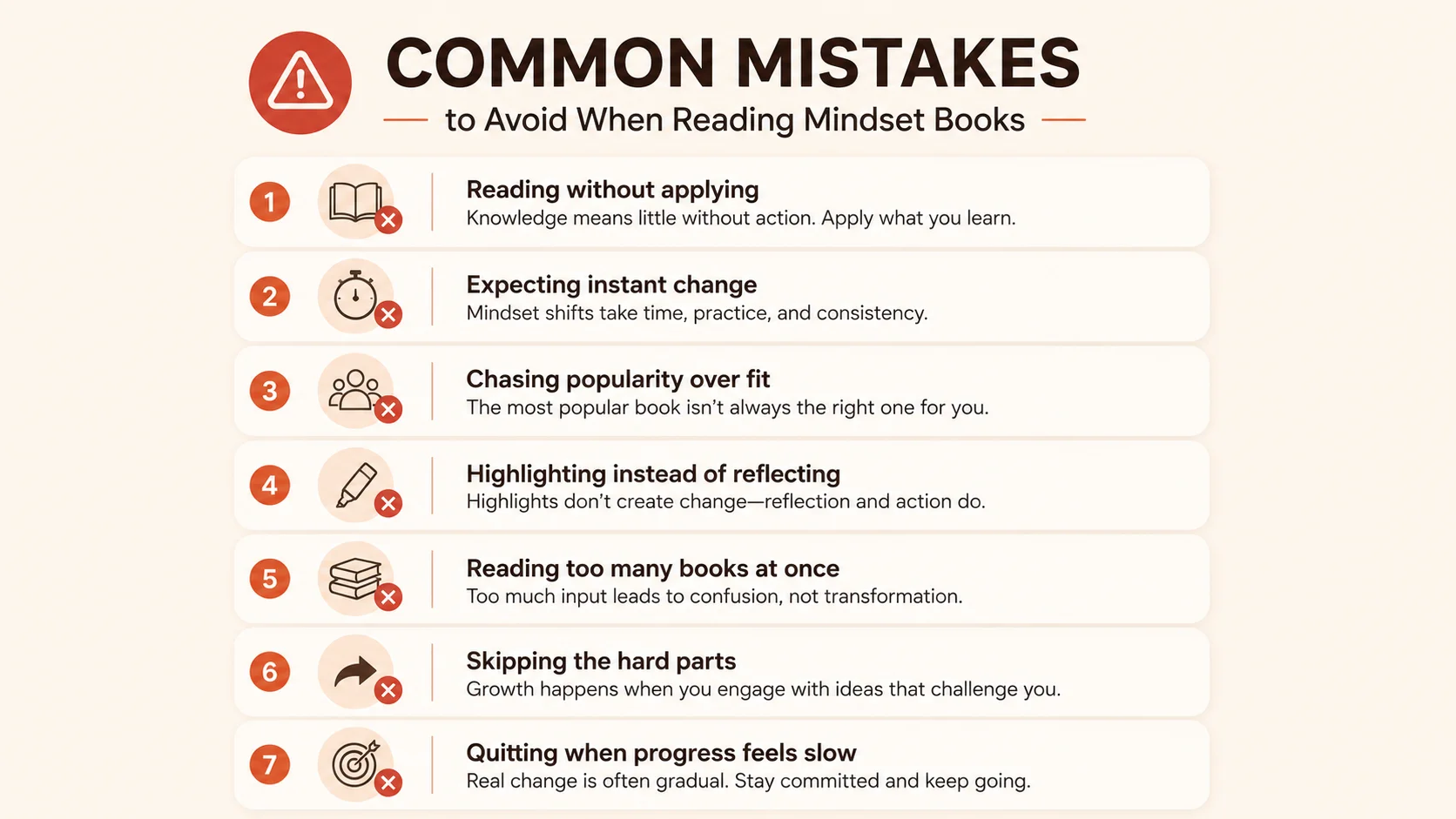
In our experience helping readers build better habits, the same implementation gaps appear repeatedly, regardless of which book someone chooses.
- Reading too many books without applying any of the ideas.
- Treating motivation as a substitute for discipline.
- Expecting instant personality or mindset transformation.
- Taking every idea literally without considering personal context.
- Choosing books based only on popularity rather than fit.
- Highlighting passages without ever revisiting or applying them.
- Abandoning a book for another whenever progress feels slow.
How to Get More Value From a Mindset Book
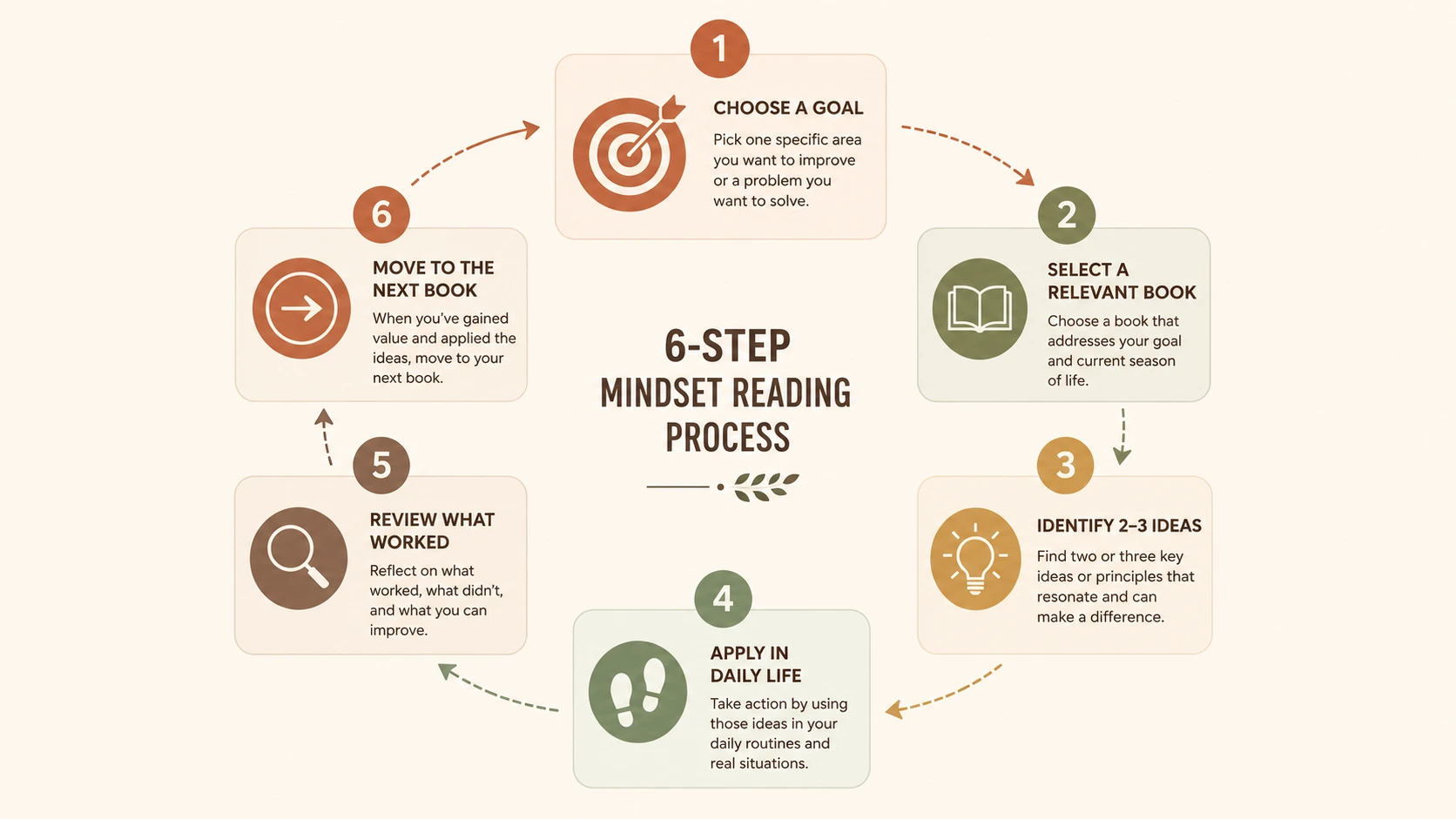
Your Daily Thrive recommends approaching mindset books as working tools rather than passive reading material.
- Choose one specific problem or goal before selecting a book.
- Select a book that directly addresses that problem.
- Identify two or three ideas from the book worth testing.
- Apply those ideas in everyday situations, not just in reflection.
- Review honestly what worked and what did not.
- Only move to another book after extracting practical value from the current one.
How to Choose the Best Mindset Book for Adults
Adult readers have varied needs depending on life stage, profession, and current challenges, so no single book on this list suits everyone equally.
- Beginners may benefit most from accessible explanations and guided exercises, such as those found in You Are a Badass or Mindset.
- Professionals may prefer books focused on decision-making, leadership, and performance, such as Extreme Ownership.
- Readers facing recent setbacks may prioritize resilience and perspective, making Learned Optimism especially relevant.
- Readers seeking long-term personal development may prefer books that connect mindset directly with habits and behavior, such as Atomic Habits or The 7 Habits of Highly Effective People.
How to Build a Mindset Reading Practice
Reading about mindset works best as an ongoing practice rather than a one-time project. Record key ideas in a notebook or app as they come up — journal prompts for growth mindset can help structure this reflection.
A Simple Weekly Reading Routine
- Set a realistic weekly reading target instead of an unsustainable pace.
- Read consistently in shorter sessions rather than attempting to finish quickly.
- Record key ideas in a notebook or app as they come up.
- Choose one idea to practice deliberately each week.
- Review progress at the end of the week and adjust the approach as needed.
Connect Reading With Goal Setting and Habits
Ideas from mindset books become useful only when converted into specific behaviors. As of 2026, many readers pair mindset books with habit-tracking apps or journals to translate abstract concepts, such as “embrace challenges,” into measurable actions like attempting one new skill-building task each week.
Avoiding Information Overload
Reading one useful book deeply, applying its ideas, and revisiting them over months typically produces more meaningful change than rapidly consuming many similar titles without follow-through.
How Long Does It Take to Change Your Mindset?
Mindset change happens at different speeds depending on what is being changed.
- Understanding a new idea intellectually can happen within a single reading session.
- Changing automatic thought patterns generally takes weeks to months of repeated practice.
- Behavioral change, such as building discipline or consistency, requires sustained repetition over time.
- Progress is often uneven and can be affected by stress, environment, prior experience, and consistency of effort.
- Different mindset goals require different amounts of practice; building confidence in a specific skill may happen faster than shifting a long-standing limiting belief.
Frequently Asked Questions
What is the best mindset book for beginners?
Beginners should prioritize accessibility and clear, practical concepts over popularity alone; Mindset and You Are a Badass are strong starting points due to their approachable explanations.
What are the best books on mindset and success?
Think and Grow Rich and Extreme Ownership most directly connect mindset with goal-setting, persistence, and decision-making related to achievement.
What are the best books on mindset and confidence?
The Confidence Code and You Are a Badass focus most closely on self-belief, overcoming fear of failure, and building confidence through action.
Which mindset books are best for developing discipline?
Atomic Habits and The 7 Habits of Highly Effective People focus most heavily on consistency, habit formation, and self-control.
What are the best growth mindset books?
Readers should look for books that address learning, effort, and response to feedback and challenges, such as Mindset and Grit.
Can reading mindset books actually change your mindset?
Reading can influence beliefs and perspective, but lasting change generally requires ongoing reflection, repeated practice, and consistent behavior change rather than reading alone.
How many mindset books should I read?
The depth of application matters more than the number of books completed; extracting and practicing a few ideas from one book often produces more change than skimming several titles.
Conclusion
The top 10 books on mindset featured here cover distinct areas, including mindset change, growth mindset, confidence, discipline, success, positive thinking, limiting beliefs, leadership, and practical personal development. The right book depends on a reader’s specific goal rather than general popularity, whether that goal involves building confidence, developing discipline, changing limiting beliefs, or adopting a more growth-oriented approach to challenges. The clearest takeaway is straightforward: choose a book aligned with your current goal, apply its central ideas consistently, and evaluate progress through actual behavior rather than motivation alone.