

Introduction
Mindset sports refers to the mental approach, attitudes, and psychological skills athletes use to perform consistently under pressure. A strong sports mindset works alongside physical training to determine how well an athlete executes skills, recovers from setbacks, and stays motivated over time. Sports psychology is the scientific field that studies this mental side of athletic performance, offering evidence-based techniques athletes can use to build focus, confidence, and resilience. Understanding mindset in sports performance helps athletes, coaches, and parents recognize that mental training is not optional — it is a trainable skill set with the same importance as strength, speed, or technique.
Quick Summary
- A strong sports mindset helps athletes improve focus, confidence, resilience, and consistency.
- Sports psychology provides evidence-based techniques that strengthen mental performance alongside physical training.
- Developing a growth mindset allows athletes to learn from setbacks instead of fearing failure.
- Mental skills can be trained just like physical skills through consistent practice.
What Is Mindset in Sports?
Mindset in sports is the set of beliefs, attitudes, and mental habits an athlete brings to training and competition. It shapes how an athlete interprets challenges, handles pressure, and responds to both success and failure. Mindset is distinct from motivation, which is a temporary drive to act, and from talent, which refers to natural physical or technical ability. An athletic mindset instead reflects consistent patterns in confidence, discipline, emotional control, and decision-making that influence performance across every training session and competition.
Why Mindset Matters in Athletic Performance
Mindset matters because it directly affects how consistently an athlete can access their physical skills under real conditions. Key areas influenced by mindset include:
- Focus — the ability to stay present and block out distractions
- Confidence — trust in one’s preparation and abilities
- Resilience — the capacity to bounce back from setbacks
- Adaptability — adjusting strategy when conditions change
- Consistency — performing at a similar level across different situations
- Recovery after mistakes — regaining composure quickly after an error
How Mindset Influences Sports Performance
Mindset influences performance by shaping reaction under pressure, learning speed, and the overall quality of practice. Athletes with a trained mindset tend to make clearer decisions in high-stakes moments and maintain competitive consistency across a season rather than fluctuating with mood or momentum. Mindset also plays a central role in managing performance anxiety, since athletes who interpret pressure as a challenge rather than a threat typically perform better.
Common mindset-related performance benefits include:
- Faster recovery from setbacks
- Better concentration during competition
- Improved confidence in high-pressure moments
- Higher motivation during long training cycles
- Stronger self-belief when facing tough opponents
What Is Sports Psychology?
Sports psychology is the applied study of how psychological factors affect athletic performance and how participation in sport affects psychological well-being. It combines principles from psychology for sport and general behavioral science to help athletes of all levels — from youth participants to professionals — build mental skills that support consistent performance. Sport and psychology intersect in areas such as motivation, emotional regulation, team dynamics, and recovery from injury.
What Does a Sports Psychologist Do?
A sports psychologist works with athletes to strengthen the mental skills that support performance. A psychologist in sport typically focuses on:
- Performance enhancement — building consistency and mental readiness
- Anxiety management — reducing the negative effects of pressure
- Confidence building — reinforcing belief through structured techniques
- Visualization — mentally rehearsing successful performance
- Communication — improving interactions with coaches and teammates
- Emotional regulation — managing frustration, fear, or overexcitement
People often search for what is sports psychologist or what is sport psychologist roles expecting therapy alone, but the role is broader — it blends performance coaching, education, and, when needed, clinical support.
Sports Mindset vs Sports Psychology
While closely related, sports mindset and sports psychology are not the same thing. A sports mindset is the personal mental approach an athlete brings to their sport, while sports psychology is the scientific discipline that studies and supports that mindset through structured methods.
| Sports Mindset | Sports Psychology |
|---|---|
| Personal mental approach | Scientific discipline |
| Can be self-developed | Often guided by professionals |
| Daily habits | Evidence-based interventions |
| Internal beliefs | Assessment and mental skills training |
Types of Athletic Mindsets
Athletes generally operate from one of two broad mindset orientations, first described in psychological research on motivation and learning. Understanding how to build the right athlete mindset starts with recognizing the difference between a growth orientation and a fixed one.
Growth Mindset in Sports
A growth mindset in sports is the belief that ability and skill can be developed through effort, coaching, and practice. Athletes with a growth mindset sports orientation view mistakes as information rather than failure, which supports faster skill acquisition. Growth mindset sports psychology research links this orientation to greater resilience and long-term improvement.
Fixed Mindset in Sports
A fixed mindset in sports is the belief that ability is largely innate and unchangeable. This orientation is associated with:
- Limiting beliefs about personal potential
- Fear of failure that discourages risk-taking
- Avoiding challenges that might expose weaknesses
Growth Mindset vs Fixed Mindset in Sports
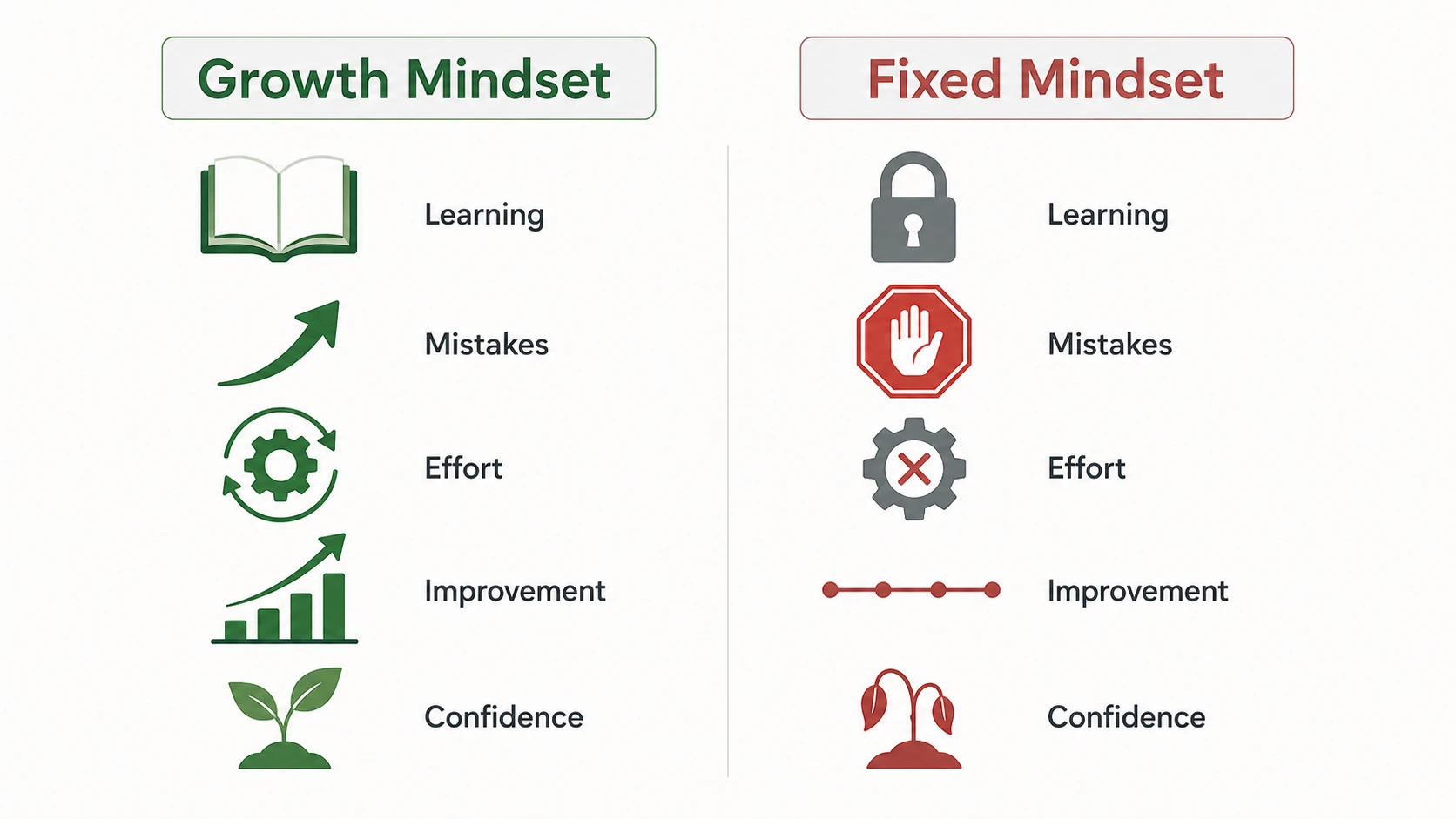
The growth mindset vs fixed mindset sports comparison highlights clear performance differences:
| Factor | Growth Mindset | Fixed Mindset |
|---|---|---|
| Learning | Sees skills as improvable | Sees skills as fixed |
| Mistakes | Treated as feedback | Treated as failure |
| Effort | Viewed as necessary for mastery | Viewed as a sign of low talent |
| Improvement | Pursued consistently | Avoided if risky |
| Confidence | Built through progress | Dependent on natural ability |
Characteristics of a Winning Sports Mindset
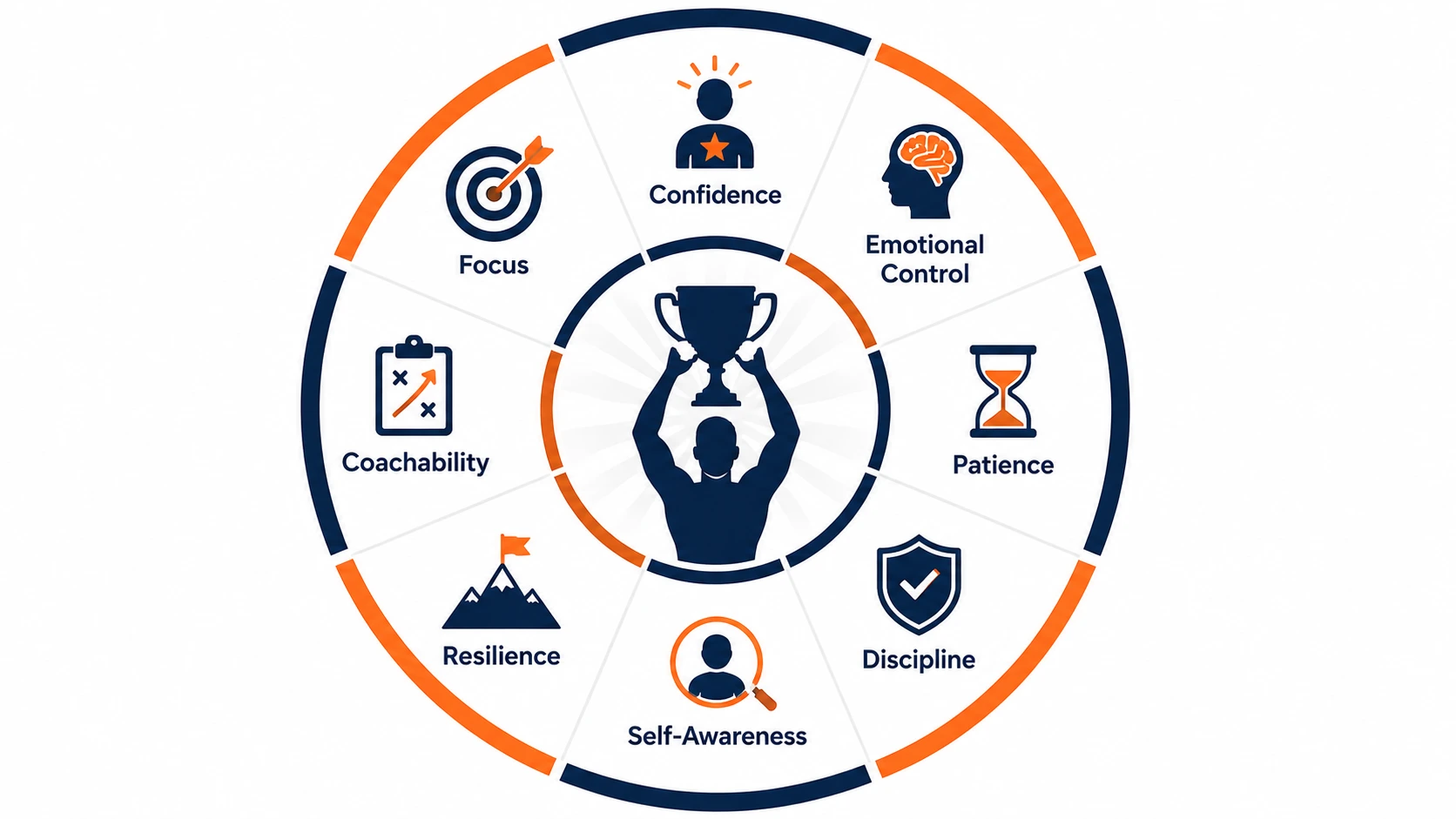
A winning mindset sports approach and an elite mindset sports orientation share identifiable traits. Athletes with a positive mindset sports foundation typically demonstrate:
- Confidence grounded in preparation
- Emotional control under pressure
- Patience during slow progress
- Discipline in daily habits
- Self-awareness of strengths and weaknesses
- Competitive resilience after setbacks
- Coachability and openness to feedback
- Sustained focus during competition
Proven Sports Psychology Strategies for Mental Performance
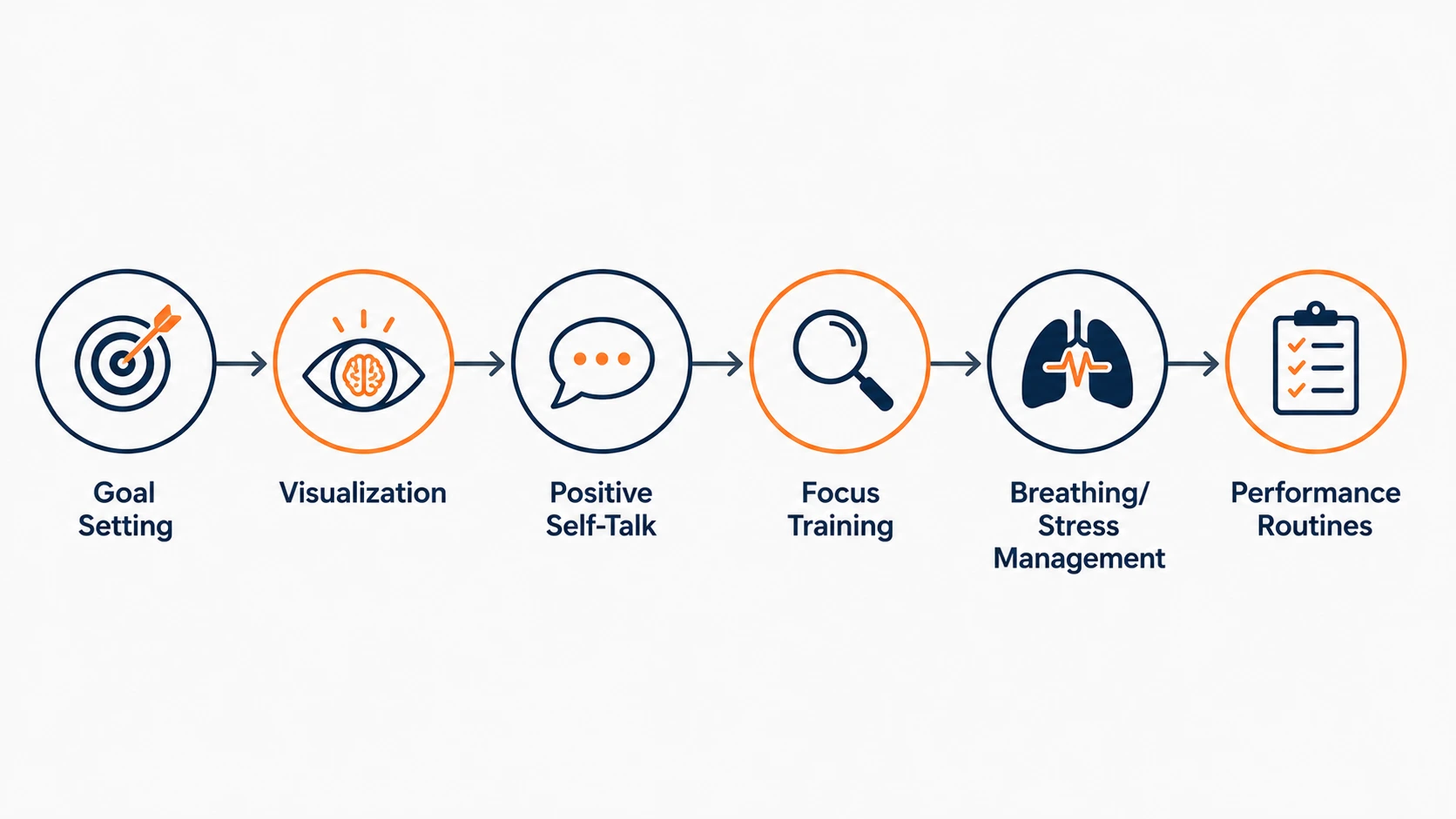
Several sports psychology strategies are widely used because they are supported by research on attention, motivation, and stress regulation. These sport psychology strategies can be trained independently or with professional guidance.
Goal Setting
Goal setting works because specific, measurable targets direct attention and effort more effectively than vague intentions. It is most useful at the start of a season or training cycle. A common mistake is setting only outcome goals (winning) instead of process goals (execution quality).
Visualization
Visualization works by mentally rehearsing successful performance, which reinforces neural patterns similar to physical practice. It is most effective before competition or when learning a new skill. A common mistake is visualizing only success without also rehearsing recovery from mistakes.
Positive Self-Talk
Positive self-talk works by replacing automatic negative thoughts with constructive, action-focused language. It is useful during high-pressure moments or slumps. A common mistake is using generic phrases that feel disconnected from the athlete’s actual situation.
Focus and Concentration Training
Focus training works by strengthening the ability to sustain attention on relevant cues while filtering out distractions. It is useful during both practice and competition. A common mistake is practicing focus only under low-pressure conditions. Part of this training involves learning to focus on what you can control instead of outcomes outside your influence.
Breathing and Stress Management
Controlled breathing works by regulating the body’s stress response, lowering heart rate and muscle tension. It is most useful immediately before or during high-pressure moments. A common mistake is only using breathing techniques after anxiety has already peaked.
Performance Routines
Pre-performance routines work by creating consistency and reducing decision fatigue in the moments before execution. They are useful for any repeatable action, such as free throws or serves. A common mistake is changing the routine based on recent results rather than keeping it stable.
How to Develop a Strong Sports Mindset
Daily Mental Training Habits
Consistent mental training habits build mindset skills gradually. Effective daily habits include:
- Journaling to track thoughts, emotions, and progress
- Reflection after practice or competition
- Visualization of upcoming performance
- Mindfulness practice to strengthen present-moment focus
- Routine building to create consistency Athletes new to journaling can start with structured journaling prompts for self growth to build the habit faster.
Building Confidence Through Practice
Confidence through preparation comes from repeated, deliberate practice rather than isolated moments of success. Focusing on process goals — such as technique quality or effort level — builds more stable confidence than focusing only on outcomes. Learning from mistakes, rather than avoiding them, reinforces long-term self-belief.
Common Mental Barriers Athletes Face
Athletes commonly encounter psychological barriers that limit performance if left unaddressed.
- Fear of failure — often prevented by reframing mistakes as learning opportunities and focusing on process goals.
- Perfectionism — addressed by setting realistic standards and separating self-worth from performance outcomes.
- Burnout — prevented through adequate recovery, varied training, and monitoring workload.
- Performance anxiety — managed through breathing techniques, routines, and reframing pressure as a challenge.
- Negative self-talk — reduced through awareness training and structured positive self-talk practice.
- Comparison with others — minimized by focusing on personal progress metrics rather than external benchmarks.
- Loss of confidence — rebuilt through small, achievable wins and consistent preparation.
Beginner Mistakes When Training Mental Performance
Athletes new to mental training often make avoidable errors that slow progress:
- Expecting instant results instead of gradual improvement
- Copying elite athletes’ routines without adapting them to personal needs
- Relying only on motivation instead of building consistent habits
- Ignoring recovery as part of mental performance
- Avoiding difficult situations instead of practicing under pressure
- Practicing mental skills inconsistently rather than on a regular schedule
How Coaches and Parents Can Support Athlete Mindset
Coaches and parents play a significant role in shaping an athlete’s mindset, particularly in youth sports, amateur athletics, and school programs. Supportive approaches include:
- Providing constructive feedback focused on specific, actionable improvements
- Using growth-oriented communication that emphasizes effort and progress
- Encouraging healthy competition rather than comparison-driven pressure
- Setting realistic expectations aligned with an athlete’s development stage
- Offering emotional support during setbacks, injuries, or slumps
When Professional Sports Psychology Support May Help
Some situations benefit from working directly with a licensed professional rather than relying on self-guided methods alone. These include:
- Prolonged performance anxiety that does not improve with basic techniques
- Recurring confidence issues affecting multiple areas of performance
- Injury recovery and the psychological challenges it creates
- Return-to-play challenges after a long absence from competition
- Elite-level competition with heightened mental demands
- Major performance slumps that persist despite technical adjustments
Sports psychologists complement technical coaching rather than replacing it — the two work best together, addressing both the physical and mental sides of performance.
Difficulty & Time Investment
Mental training is largely beginner-friendly and does not require special equipment. Typical time investment includes:
- 10–20 minutes daily for core practices like visualization or journaling
- Consistency matters more than intensity or session length
- Regular reflection to track patterns and adjust approach
- Progressive skill development, starting with simple techniques before advancing to more complex mental strategies
Individual differences — such as competition level, prior experience, and access to coaching — influence how quickly mental skills develop.
Results Timeline
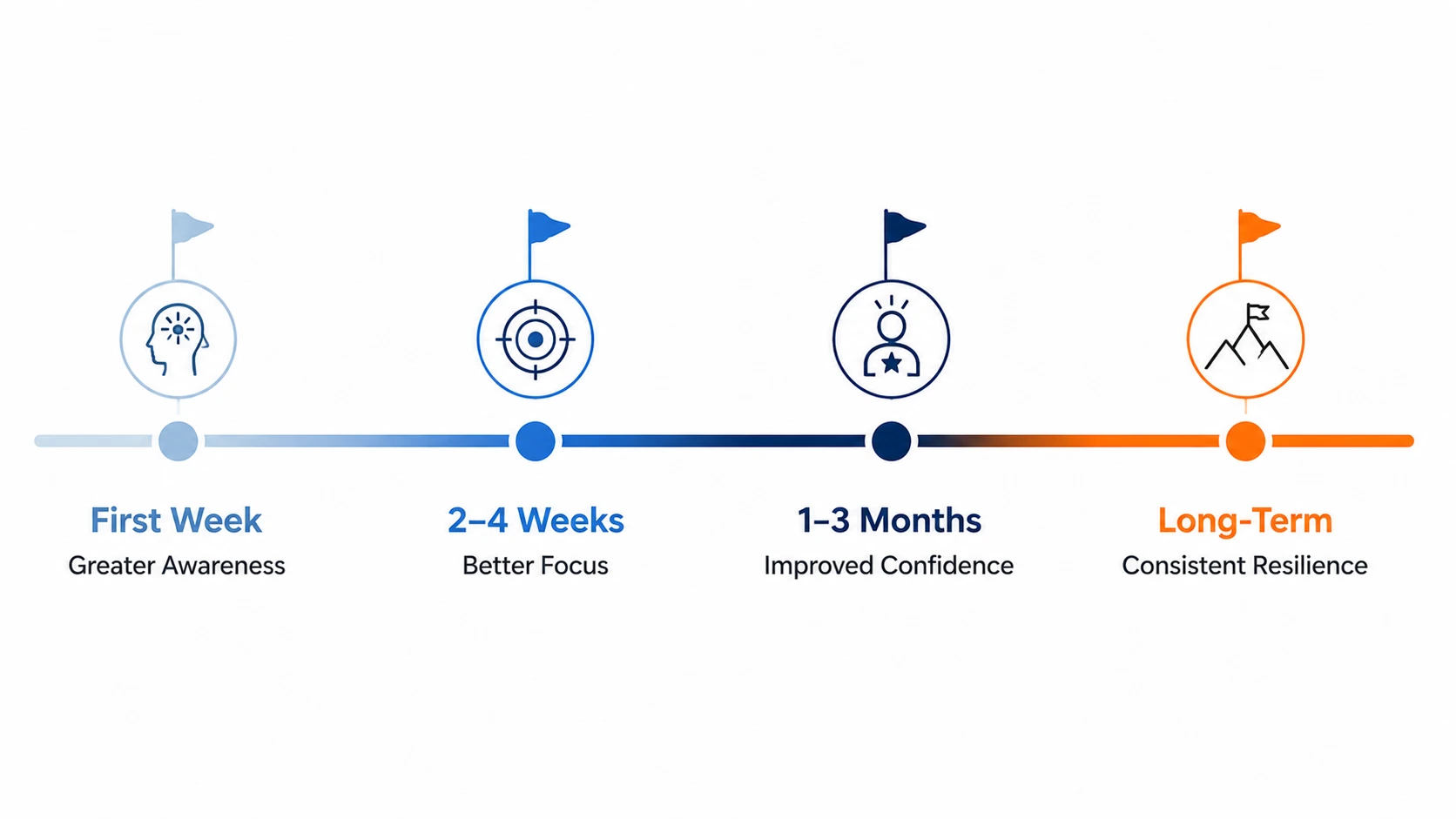
Mental performance improvements typically follow a gradual, cumulative pattern rather than appearing instantly.
| Time | Typical Progress |
|---|---|
| First week | Greater self-awareness of thought patterns |
| 2–4 weeks | Noticeably better focus during practice |
| 1–3 months | Improved confidence and emotional control |
| Long-term | Consistent mental resilience across competitions |
Results are influenced by coaching quality, consistency of practice, level of competition, and overall practice quality.
Practical Weekly Sports Mindset Training Plan
A structured weekly routine helps athletes build mental skills alongside physical training:
- Visualization — a few minutes rehearsing upcoming performance
- Goal review — checking progress against process and outcome goals
- Self-reflection — journaling on recent practices or competitions
- Mental rehearsal — practicing responses to pressure scenarios
- Recovery — dedicated time for mental and physical rest
- Performance review — analyzing recent competitions for lessons learned
Frequently Used Mindset Principles in High-Performing Athletes
High-performing athletes commonly rely on a consistent set of mindset principles:
- Continuous learning through feedback and self-assessment
- Accountability to personal goals and standards
- Adaptability when conditions or strategies change
- Resilience in the face of setbacks
- Intrinsic motivation that persists beyond external rewards
- Deliberate practice focused on specific improvement areas
This combination is often referred to as the winning mindset — a repeatable set of habits rather than a fixed personality trait.
Frequently Recommended Learning Resources
Athletes interested in deepening their mental training can explore several resource categories:
- Books — introductory and advanced titles covering mindset sports book topics and applied sports psychology
- Research articles — peer-reviewed studies on mindset training and performance psychology
- Mental skills workbooks — structured exercises for goal setting, visualization, and self-talk
- Educational workshops — short-term programs introducing core mental skills
- Certified coaching programs — offered through organizations such as a mindset training institute or accredited sport psychology bodies
Programs sometimes marketed as the mindset experience or similar branded offerings can be useful supplements, but should be evaluated based on the credentials of those delivering the content.
Conclusion
Mindset sports describes the mental foundation that supports consistent athletic performance alongside physical training. Sports psychology provides structured, evidence-based methods for building this foundation, from goal setting and visualization to breathing techniques and performance routines. A growth mindset allows athletes to treat setbacks as learning opportunities rather than threats, which supports long-term development. Because mental skills respond to consistent practice in the same way physical skills do, ongoing, deliberate training remains the most reliable path toward stronger mindset in sports performance and lasting competitive resilience.
Frequently Asked Questions
What is mindset in sports? Mindset in sports is the set of beliefs, attitudes, and mental habits that shape how an athlete handles pressure, setbacks, and competition, working alongside physical skill to determine performance consistency.
How does sports psychology improve athletic performance? Sports psychology improves performance by providing evidence-based techniques — such as visualization, goal setting, and stress management — that strengthen focus, confidence, and emotional control during training and competition.
What is the difference between a sports mindset and sports psychology? A sports mindset is an athlete’s personal mental approach, while sports psychology is the scientific discipline that studies and supports that mindset through structured, evidence-based methods.
Can athletes develop a growth mindset? Yes, a growth mindset can be developed through consistent practice, reframing mistakes as learning opportunities, and focusing on process goals rather than only outcomes.
What techniques do sports psychologists commonly use? Sports psychologists commonly use goal setting, visualization, positive self-talk, breathing exercises, and performance routines to strengthen an athlete’s mental skills.
How long does mindset training usually take? Basic improvements in focus and self-awareness can appear within the first few weeks, while deeper confidence and resilience typically develop over one to three months of consistent practice.
Can young athletes benefit from sports psychology? Yes, young athletes can benefit from age-appropriate mental skills training, particularly with support from coaches and parents who reinforce growth-oriented communication.
How can coaches help build a winning mindset? Coaches can support a winning mindset by giving constructive feedback, encouraging healthy competition, setting realistic expectations, and providing consistent emotional support.