
Introduction
A contrarian mindset is the practice of evaluating ideas on their own merits rather than accepting them simply because they are popular. The contrarian mindset meaning centers on independent judgment: a willingness to question consensus, examine evidence, and reach conclusions that may differ from the majority. This is different from simply disagreeing with others. A true contrarian does not oppose ideas out of habit or defiance — the goal is accuracy, not rebellion. What is a contrarian thinker, then? Someone who separates popularity from correctness. Contrarian thinking matters across psychology, decision-making, investing, innovation, leadership, and daily life because it protects people from blindly following flawed consensus while still allowing them to update their views when evidence warrants it.
Quick Summary
- A contrarian mindset means evaluating ideas independently rather than automatically following popular opinion.
- Healthy contrarian thinking relies on evidence, critical thinking, and intellectual independence — not disagreement for its own sake.
- Contrarian personalities can contribute valuable perspectives but may create challenges when opposition becomes habitual.
- Understanding the psychology behind contrarian behavior helps distinguish productive skepticism from unhealthy conflict.
What Is a Contrarian Mindset?
Contrarian mindset meaning explained
A contrarian mindset is a way of thinking that prioritizes independent evaluation over automatic agreement with the crowd. In our experience helping readers build better decision-making habits, the core philosophy is simple: popularity is not proof. A contrarian mindset does not automatically mean being negative, pessimistic, or difficult. It means pausing before accepting a widely held belief and asking whether the evidence actually supports it. This distinguishes a contrarian mindset from stubbornness — the intent is accuracy, not opposition.
Contrarian meaning vs. contrarian thinking
The word “contrarian” is used generally to describe someone whose views often diverge from the mainstream. Contrarian meaning, in a behavioral sense, connects to decision-making, beliefs, and how a person processes information under social pressure. Contrarianism refers to the broader philosophy or practice of taking positions that oppose prevailing consensus, often after independent analysis. It’s important to distinguish personality from thinking style: someone can have a naturally skeptical personality while still practicing disciplined, evidence-based contrarian thinking rather than reflexive contradiction.
What Makes Someone a Contrarian?
Psychological traits behind contrarian thinking
Several traits commonly appear in contrarian psychology:
- Independent thinking — forming conclusions without relying on group consensus
- Curiosity — a drive to understand why a belief is popular before accepting it
- Skepticism — treating claims as provisional until supported by evidence
- Confidence — comfort holding a minority position when reasoning supports it
- Need for autonomy — a preference for self-directed judgment over external validation
- Risk tolerance — willingness to be wrong publicly in pursuit of being right eventually
- Cognitive flexibility — the ability to update beliefs as new evidence emerges
These traits work together; independence without cognitive flexibility can turn into rigidity rather than genuine contrarian thinking.
Nature vs. environment
Contrarian behavior typically develops through a combination of factors rather than a single cause. Personality plays a role, as some people are naturally inclined toward autonomy and skepticism. Childhood experiences, education that rewards questioning over memorization, and life experiences involving being right when the majority was wrong can reinforce contrarian tendencies. Culture and professional environment also matter — fields like investing, science, and entrepreneurship often reward and cultivate contrarian thinking more than environments that prioritize conformity.
Contrarian Thinking vs. Simply Being Oppositional
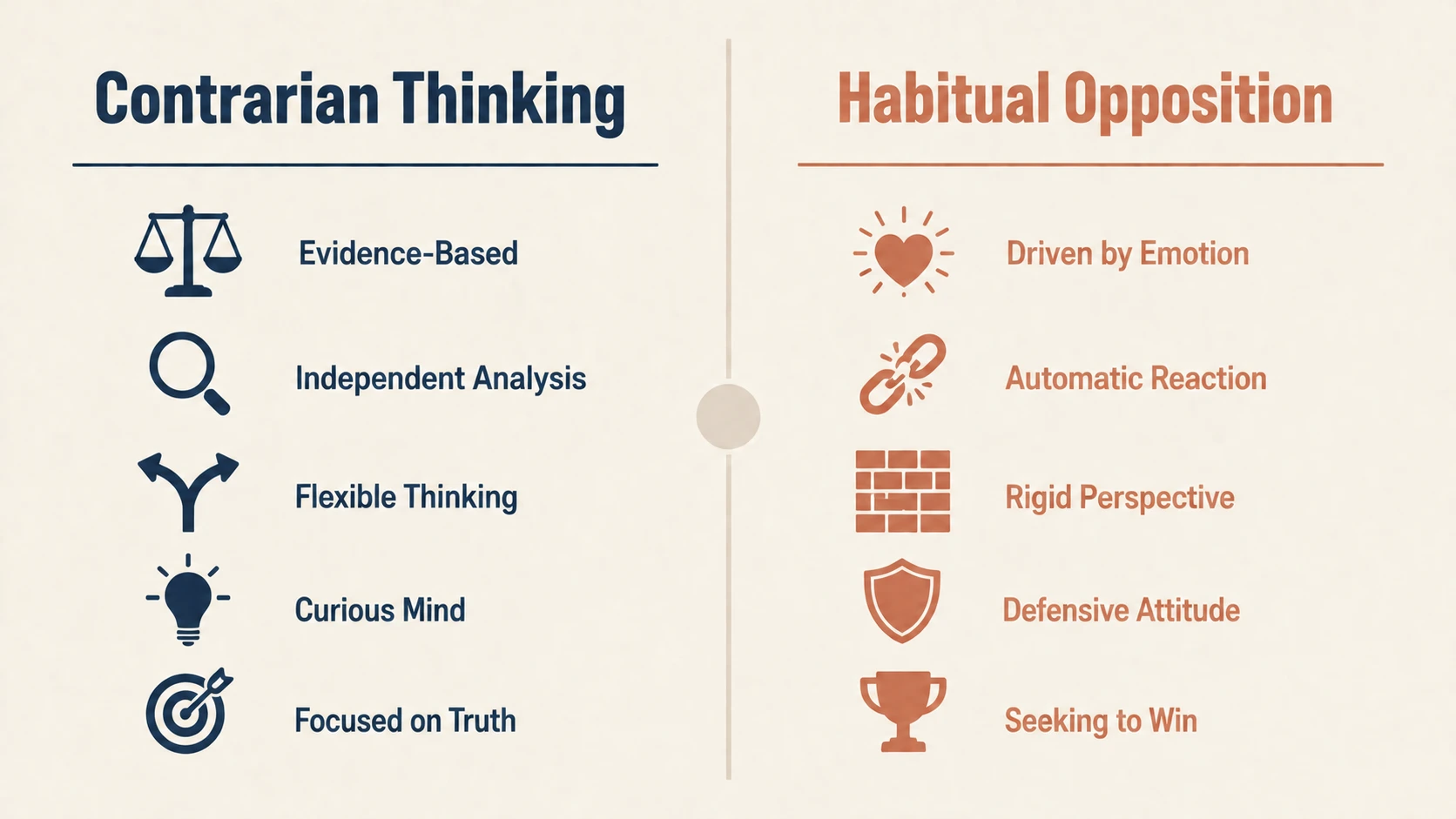
Healthy contrarian thinking is easily confused with reflexive disagreement, but the two are fundamentally different in both process and intent.
| Contrarian Thinking | Habitual Opposition |
|---|---|
| Evidence-based | Emotion-based |
| Independent analysis | Automatic disagreement |
| Flexible | Rigid |
| Curious | Defensive |
| Goal is truth | Goal is winning |
Understanding this distinction prevents readers from confusing productive skepticism with needless disagreement. A person practicing genuine contrarian thinking can be persuaded by strong evidence; someone who is simply oppositional resists persuasion regardless of the argument’s quality.
Characteristics of a Healthy Contrarian Mindset
Common traits
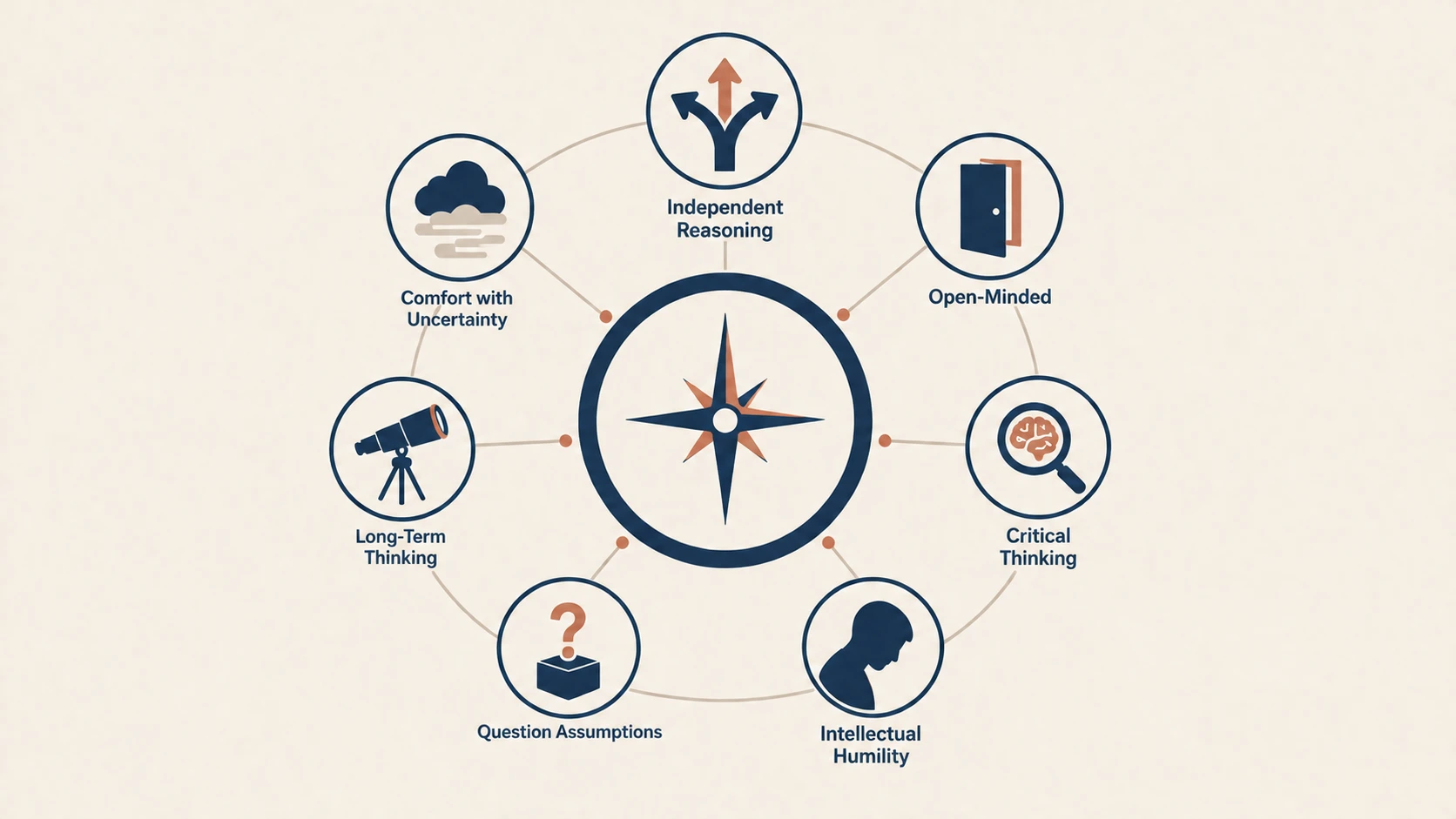
- Independent reasoning — evaluating claims without deferring to authority alone
- Open-mindedness — remaining receptive to being wrong
- Critical thinking — systematically analyzing evidence and logic
- Intellectual humility — acknowledging the limits of one’s own knowledge
- Willingness to question assumptions — examining the foundation of accepted ideas
- Long-term thinking — prioritizing accuracy over short-term social approval
- Comfort with uncertainty — tolerating ambiguity while gathering more information
Each trait contributes to better decisions because it reduces the influence of social pressure on judgment, allowing conclusions to be based more heavily on evidence.
Benefits of developing a contrarian mindset
- Better decision-making through reduced reliance on assumptions
- Increased innovation by challenging outdated norms
- Greater creativity from exploring unconventional angles
- Reduced groupthink in team and organizational settings
- Stronger problem-solving through diverse perspective-taking
- Greater resilience when facing social pushback
Contrarian Psychology: Why People Think Differently
Cognitive biases that influence conformity
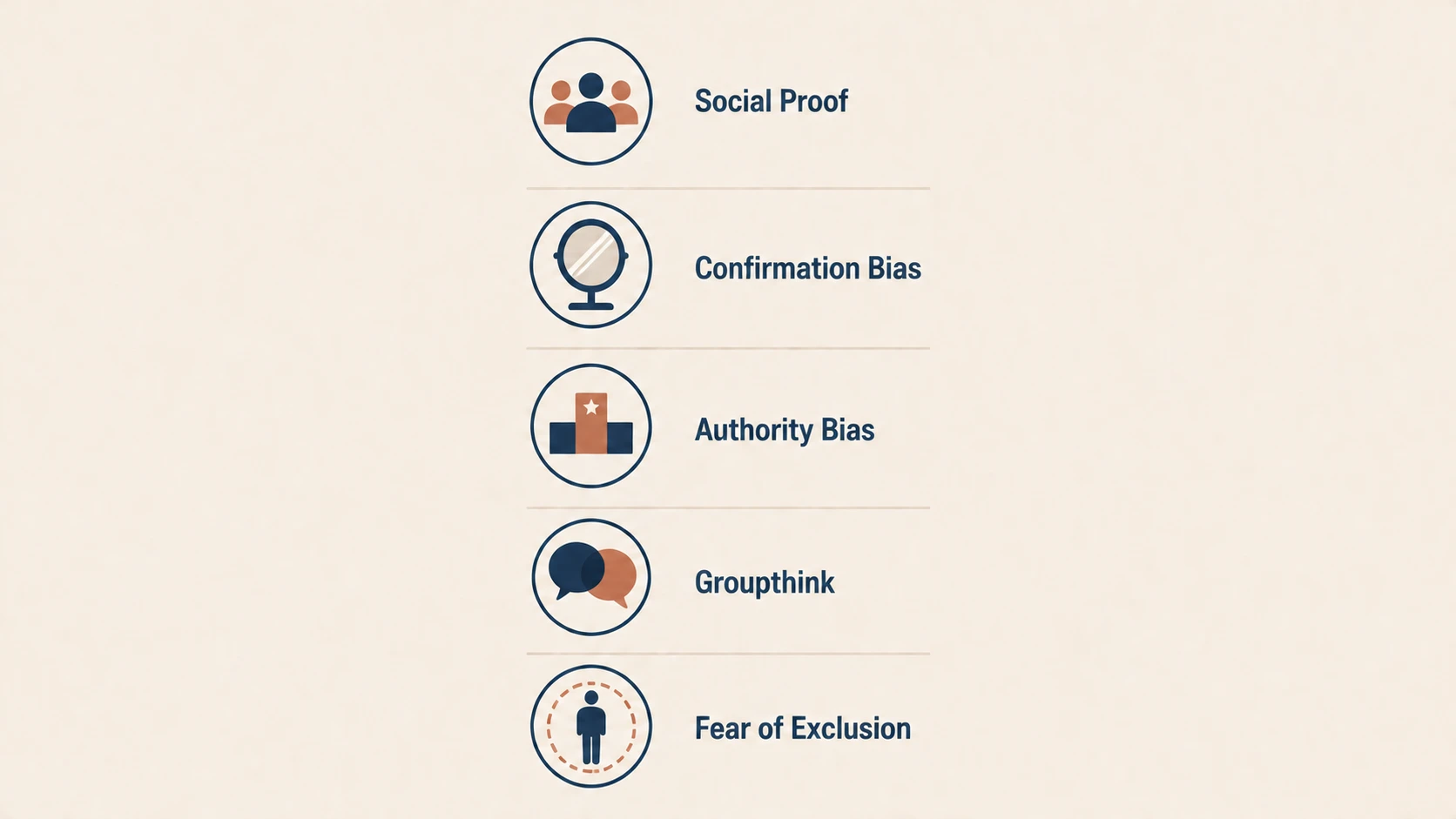
Several cognitive biases explain why most people default to consensus rather than independent analysis:
- Social proof — assuming an action or belief is correct because others hold it
- Confirmation bias — favoring information that supports existing beliefs
- Authority bias — over-trusting expert or high-status opinions without scrutiny
- Groupthink — prioritizing group harmony over accurate decision-making
- Fear of exclusion — avoiding minority positions to prevent social rejection These patterns are well documented in mindset psychology, which explores how internal beliefs shape behavior and decision-making.
Why contrarians resist social pressure
Contrarians tend to resist these pressures due to a combination of identity, personal values, independent judgment, confidence, and risk acceptance. Your Daily Thrive recommends viewing this resistance not as defiance, but as a deliberate decoupling of social comfort from factual accuracy — a skill that can be strengthened with practice.
Contrarian Thinking Examples in Everyday Life
Real-world examples
Contrarian thinking shows up across many domains:
- Business — questioning industry “best practices” that no longer serve customers
- Investing — buying undervalued assets others avoid
- Science — challenging accepted theories with new evidence
- Education — favoring critical inquiry over rote acceptance
- Career decisions — choosing unconventional paths based on personal analysis
- Personal finance — avoiding trends like excessive consumer debt
- Social trends — declining to adopt fads without evaluating their value
- Entrepreneurship — building products that address overlooked or dismissed needs
When contrarian thinking succeeds — and when it fails
Contrarian thinking succeeds when it is grounded in evidence rather than opinion, applied with attention to timing and context, and paired with adaptability. It fails when contrarians ignore data that contradicts their position or refuse to learn from mistakes. The distinguishing factor is not the willingness to disagree — it’s the willingness to be corrected.
Contrarian Mindset in Investing
Why investors think differently
Contrarian investors often buy assets when others are panic-selling and sell when others display excessive optimism. This approach relies on independent market analysis rather than following prevailing sentiment, since market extremes are frequently driven by emotion rather than fundamentals. This approach is closely tied to the broader investor mindset, which emphasizes long-term discipline over emotional, short-term reactions.
Lessons from Anthony Bolton’s approach
Discussions around the mindset of a contrarian investor Anthony Bolton commonly highlight several general investing principles rather than specific stock recommendations: a long-term investing horizon, discipline in sticking to a researched thesis despite short-term volatility, and patience while waiting for the market to recognize an asset’s true value. These principles reflect the broader contrarian philosophy of trusting independent analysis over crowd sentiment.
Common Misconceptions About Contrarians
Myths vs. reality
| Myth | Reality |
|---|---|
| Contrarians always disagree | Contrarians agree when evidence supports the majority view |
| Contrarians are pessimists | Contrarian thinking is about accuracy, not negativity |
| Contrarians are argumentative | Healthy contrarians prioritize evidence over conflict |
| Contrarians ignore experts | Contrarians evaluate expert claims rather than dismissing them |
| Contrarians enjoy conflict | Most contrarians seek truth, not confrontation |
Is Being Contrarian a Personality Disorder?
Understanding the misconception
“Contrarian personality disorder” is not a recognized mental health diagnosis in established clinical classifications. Being a contrarian describes a thinking style or personality tendency, not a clinical condition. It’s important to distinguish personality traits — which are stable but non-pathological patterns of thought and behavior — from diagnosable disorders, which involve significant impairment across functioning. Readers experiencing persistent interpersonal or behavioral concerns should seek evaluation from a licensed mental health professional rather than relying on self-diagnosis based on online descriptions.
Contrarian behavior vs. narcissistic traits
Healthy independence and narcissistic traits can superficially resemble each other but differ in motivation and impact. Healthy contrarian thinking is oriented toward accuracy and remains open to correction. Narcissism, by contrast, often involves a need for attention, ego-driven disagreement designed to assert superiority, and reduced empathy for how disagreement affects others. The presence of empathy and openness to being wrong is a useful marker separating the two.
How to Deal With a Contrarian Personality
In the workplace
- Listen first before responding defensively
- Ask for the evidence behind a contrarian position
- Avoid emotional escalation during disagreements
- Focus conversations on shared goals rather than personal positions
In relationships
Managing a contrarian personality in personal relationships benefits from clear communication, defined boundaries, mutual respect, and structured conflict resolution. These practices help ensure disagreement stays constructive rather than becoming a source of chronic tension.
When disagreement becomes unhealthy
Disagreement becomes unhealthy when it manifests as constant conflict, manipulation, or emotional exhaustion for those involved. In these situations, professional support — such as counseling or therapy — may be appropriate to address underlying relational or behavioral patterns.
Can You Develop a Contrarian Mindset?
Habits that encourage independent thinking
- Read opposing viewpoints regularly
- Question underlying assumptions before accepting conclusions
- Practice structured critical thinking exercises
- Analyze evidence directly rather than relying on secondhand summaries
- Delay snap judgments until sufficient information is gathered
- Reflect before agreeing with a popular position
Mistakes beginners make
Common mistakes when developing contrarian thinking include mistaking disagreement itself for intelligence, ignoring evidence that contradicts a preferred position, seeking attention through contrarian statements, becoming overly skeptical of all information, and rejecting consensus without a substantive reason.
Situations where a contrarian approach is not appropriate
Contrarian thinking is not appropriate in certain high-stakes contexts, including safety decisions, medical advice, emergency response situations, well-established scientific consensus, and other high-risk environments where deviation from proven protocols can cause harm. In these areas, deferring to expert consensus is typically the safer and more responsible approach.
Practical Ways to Apply Contrarian Thinking Responsibly
Decision-making checklist
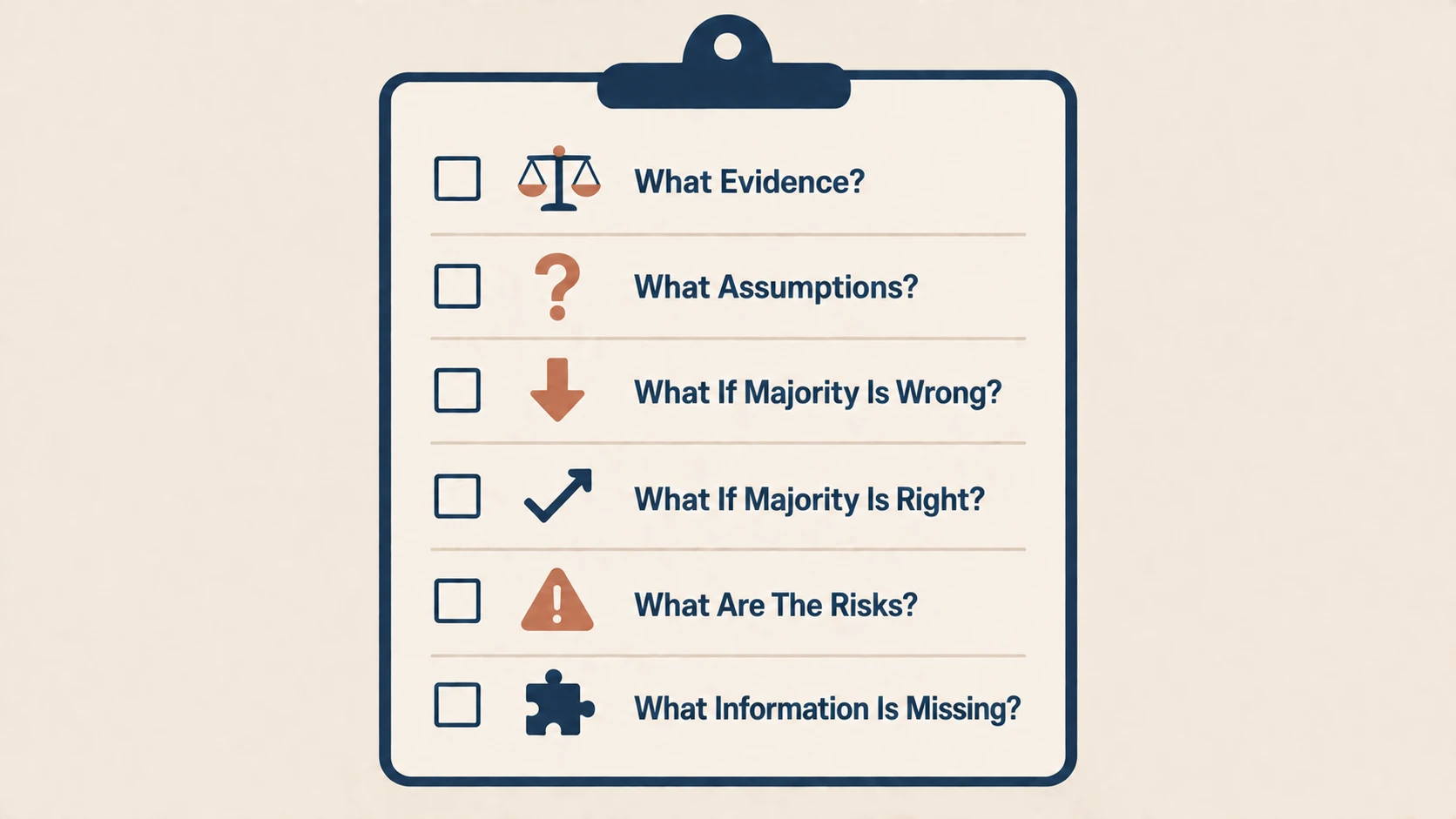
Before adopting a contrarian position, consider:
- What evidence supports this view?
- What assumptions am I making?
- What if the majority is wrong?
- What if the majority is right?
- What risks are involved in this position?
- What information is currently missing?
Balancing skepticism with open-mindedness
Effective contrarian thinking requires intellectual humility — the recognition that one’s own conclusions could be incomplete or mistaken. Updating beliefs in response to new evidence and maintaining a habit of continuous learning helps ensure that skepticism remains a tool for accuracy rather than a barrier to growth.
Contrarian Mindset Within Broader Personal Growth
A contrarian mindset connects naturally to several areas of personal development, including critical thinking, decision-making, and emotional intelligence. It shares common ground with a growth mindset, since both require openness to being wrong and a willingness to revise beliefs. Contrarian thinking also supports stronger problem-solving, more effective leadership, improved productivity, better habit formation, and greater resilience — all of which depend on the ability to evaluate situations independently rather than defaulting to convention.
Conclusion
A contrarian mindset means evaluating ideas independently, using evidence rather than popularity as the standard for what to believe. This differs meaningfully from habitual opposition, which prioritizes winning arguments over finding accurate answers. Effective contrarians challenge ideas constructively — they question assumptions, seek evidence, and remain open to changing their minds — rather than opposing everything by default. The practical takeaway is balance: healthy skepticism paired with genuine openness to new evidence leads to better decisions, stronger problem-solving, and more resilient thinking over time.
Frequently Asked Questions
What is a contrarian mindset?
A contrarian mindset is the practice of evaluating ideas independently and basing conclusions on evidence rather than automatically following popular opinion or consensus. Understanding this distinction also helps clarify the broader difference between mindset and attitude, two terms that are often used interchangeably but describe different psychological concepts.
What is the difference between a contrarian and someone who is simply argumentative?
A contrarian bases positions on evidence and remains open to changing their mind, while someone who is simply argumentative disagrees out of habit or a desire to win, regardless of the evidence presented.
Is being contrarian a personality disorder?
No. “Contrarian personality disorder” is not a recognized clinical diagnosis. Being contrarian describes a personality trait or thinking style, not a mental health condition.
Can anyone develop contrarian thinking skills?
Yes. Habits such as reading opposing viewpoints, questioning assumptions, and practicing critical thinking can help most people strengthen independent, evidence-based thinking over time.
What makes someone naturally contrarian?
Traits such as independent thinking, curiosity, skepticism, confidence, and a need for autonomy commonly contribute to a naturally contrarian personality.
Is contrarian thinking always beneficial?
No. Contrarian thinking is beneficial when grounded in evidence and applied appropriately, but it is not appropriate in high-stakes areas such as safety decisions, medical advice, or established scientific consensus.
How does contrarian psychology differ from independent thinking?
Contrarian psychology specifically involves resisting social pressure and conformity, while independent thinking more broadly describes forming judgments based on personal analysis, which may or may not diverge from consensus.
What are some simple examples of contrarian thinking in everyday life?
Examples include questioning popular financial trends before adopting them, choosing an unconventional career path after independent research, or declining to follow a social trend without evaluating its actual value.