
Introduction
Learning how to live a better life means improving the daily habits, choices, routines, and thinking patterns that shape your health, happiness, productivity, relationships, and purpose. It is not about creating a perfect life or changing everything overnight. It is about making small, repeatable improvements that help you live a better life with more energy, clarity, discipline, and emotional balance. Living a better life comes from consistent behavior change: taking care of your body, managing emotions, improving your environment, setting meaningful goals, and learning how to respond to challenges without giving up. To create a good life, you need practical systems that support better decisions every day.
Quick Summary
- To live a better life, focus on small daily habits that improve your health, mindset, relationships, and sense of purpose.
- A better life comes from consistency, not perfection or sudden motivation.
- Healthy routines, emotional awareness, clear goals, and better decision-making create long-term improvement.
- The most effective changes are simple, realistic, and easy to repeat.
- Better living is personal, practical, and built through behavior, not wishful thinking.
What Does It Mean to Live a Better Life?
To live a better life means improving the quality of your everyday experience through healthier choices, stronger habits, clearer thinking, and more meaningful priorities. It is not about chasing an unrealistic version of success. It is about feeling physically healthier, mentally calmer, emotionally stronger, and more aligned with your values.
A better life is personal. For one person, it may mean better health and more peace. For another, it may mean stronger relationships, better focus, or more purpose. The live a better life meaning is simple: make daily life healthier, more intentional, and more fulfilling.
Key parts of a better life include:
- Better physical health
- A calmer and more focused mind
- Stronger relationships
- Meaningful goals
- Better daily routines
- More self-discipline
- A healthier lifestyle
- Less stress and overwhelm
- A clearer sense of direction
When people ask how to live life well, how to have good life, or how to have a better life, the answer usually starts with behavior. Better life living is created by what you repeatedly do, how you think, how you manage energy, and how you respond when life becomes difficult.
Why People Struggle to Live a Better Life
People struggle to live a better life because knowing what to do is easier than doing it consistently. The problem is often not lack of information. It is friction, emotional resistance, poor routines, unclear goals, unrealistic expectations, and dependence on motivation.
Common reasons people struggle include:
- Trying to change too much at once
- Depending only on motivation
- Having no clear routine
- Setting vague goals
- Comparing their life to others
- Feeling overwhelmed by responsibilities
- Avoiding discomfort
- Quitting after small setbacks
- Confusing busyness with progress
Behavioral psychology explains why this happens. When a goal feels too big, unclear, or emotionally threatening, the brain often avoids action to reduce discomfort. This can look like procrastination, overthinking, distraction, or giving up.
For example, “I need to fix my whole life” feels overwhelming. But “I will walk for 10 minutes after lunch” feels clear and doable. The smaller action reduces mental resistance and makes progress easier.
People also fail because they expect motivation to stay high. Motivation naturally changes with mood, stress, sleep, and environment. Discipline and routines are more reliable because they reduce the need to decide again and again.
Start With Your Health: The Foundation of a Better Life
Physical health is the foundation of a better life because it affects energy, mood, focus, confidence, emotional control, and decision-making. When your body is tired, stressed, dehydrated, inactive, or poorly nourished, it becomes harder to stay disciplined, think clearly, and manage emotions.
A healthy lifestyle does not require perfection. It starts with basic daily habits:
- Sleep enough to support energy and emotional control
- Eat balanced meals most of the time
- Move your body regularly
- Drink enough water
- Spend time outside when possible
- Reduce habits that drain your energy
- Build routines that make healthy choices easier
If you want to know how to live a healthy life, start with the basics before chasing complicated routines. A good healthy lifestyle is one you can maintain. It supports your body without creating stress, guilt, or unrealistic pressure.
Healthy living tips that work in real life include preparing simple meals, walking daily, sleeping at consistent times, reducing late-night screen use, and avoiding all-or-nothing thinking. These steps to living a healthy life help you live a healthier and happier life because energy and mood influence behavior.
When your health improves, discipline becomes easier. You think more clearly, react less emotionally, and have more energy for meaningful goals.
Build Simple Daily Habits That Improve Your Life
Daily habits improve your life because repeated behaviors shape your future. A better life is usually the result of small actions repeated over time, not one dramatic transformation.
Effective daily habits may include:
- Making your bed
- Walking for 10–20 minutes
- Planning your top 3 priorities
- Reading or learning for 10 minutes
- Preparing simple healthy meals
- Practicing gratitude
- Reducing screen time before sleep
- Reflecting on your day
- Doing one uncomfortable but useful task
Small habits work because they reduce decision fatigue. When a behavior becomes routine, you do not need to rely on constant willpower. Repetition also builds identity. When you walk daily, you begin to see yourself as someone who takes care of your body. When you plan your day, you become someone who acts with intention.
Many people search for 7 tips to be happy in life or 100 ways to live a better life, but the principle is the same: choose practical actions you can repeat. Living a better life starts with repeatable behaviors, not dramatic life changes.
Use a Habit Framework to Make Change Easier
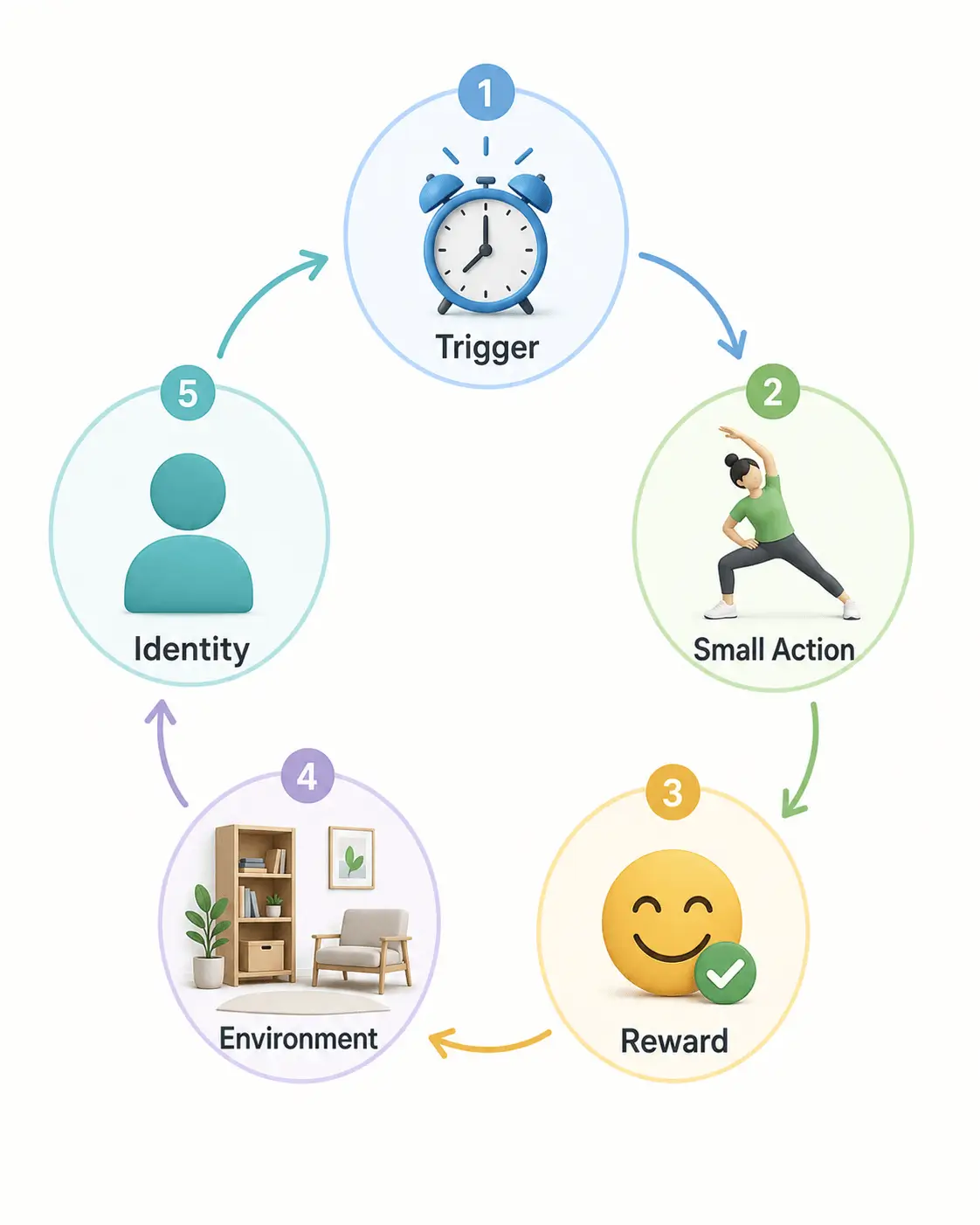
A habit becomes easier when it has a clear trigger, a simple action, and a reward. People often fail because they rely on willpower instead of designing habits that fit their real life.
| Habit Framework Element | What It Means | Example |
|---|---|---|
| Trigger | The cue that starts the habit | After brushing teeth |
| Small action | The behavior you want to repeat | Stretch for 2 minutes |
| Reward | The positive result or feeling | Feeling relaxed and accomplished |
| Environment | The setup that makes action easier | Keep workout clothes ready |
| Identity | The belief the habit supports | “I am someone who takes care of myself” |
To integrate a habit step by step, start with one behavior. Attach it to something you already do. Make the action so small that it feels easy to begin. Then repeat it at the same time or in the same context.
For example:
- After making coffee, write your top 3 priorities.
- After lunch, walk for 10 minutes.
- After brushing your teeth, stretch for 2 minutes.
- Before bed, place your phone away from your bed.
Starting friction is normal. New habits can feel awkward for the first days or weeks because your brain prefers familiar patterns. Consistency improves when the habit becomes predictable, easy, and connected to your identity.
Motivation vs Discipline: Which Matters More?
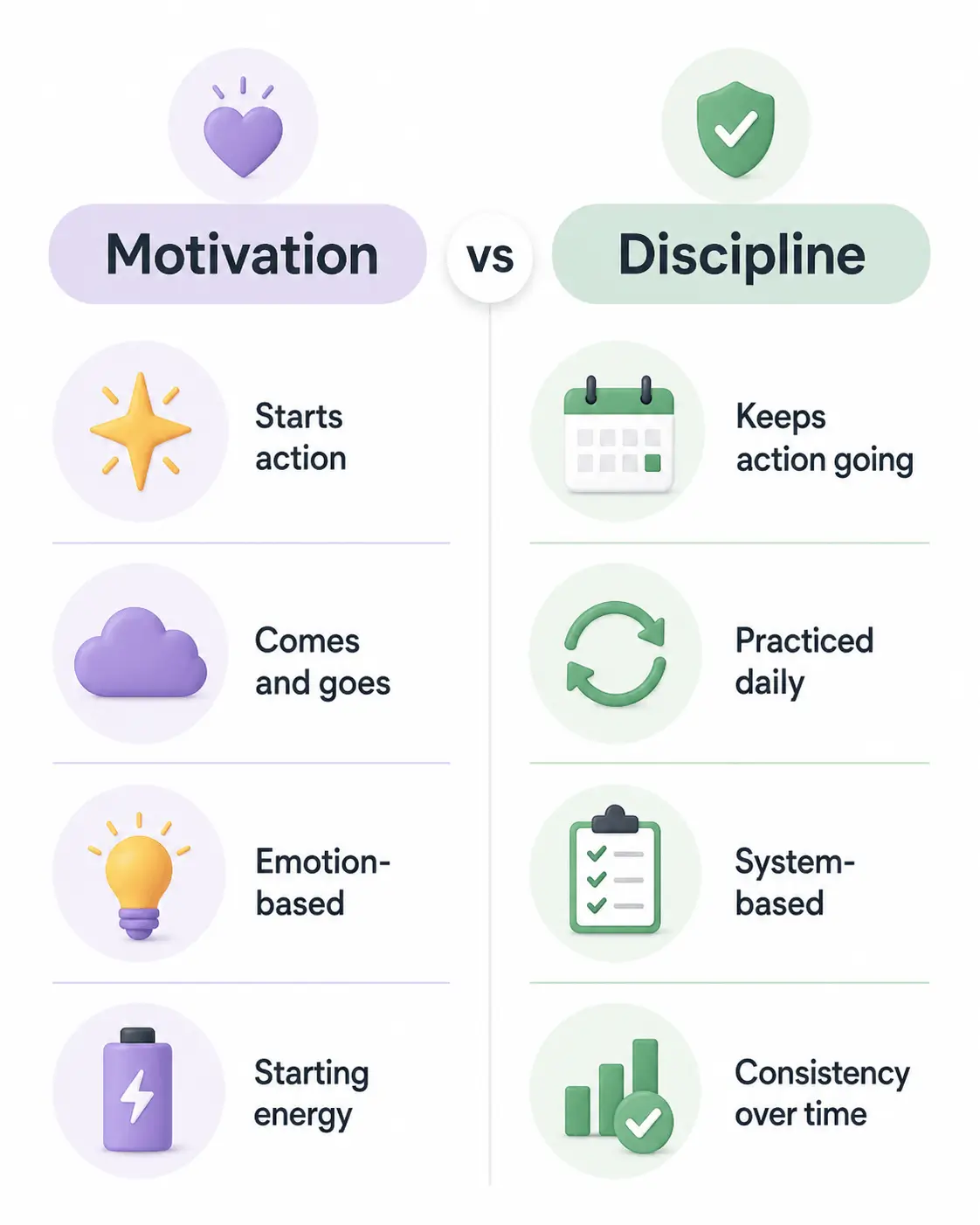
Motivation helps you start, but discipline helps you continue when motivation fades. A better life requires both, but relying only on motivation creates inconsistency because motivation changes with emotions, energy, stress, and circumstances.
| Motivation | Discipline |
|---|---|
| Emotion-based | System-based |
| Comes and goes | Can be practiced daily |
| Helps you begin | Helps you continue |
| Strong when life feels easy | Useful when life feels difficult |
| Works best with inspiration | Works best with routines |
People lose motivation because the emotional excitement of change naturally decreases. At first, a new goal feels inspiring. Later, the same goal may feel boring, difficult, or inconvenient. This is where discipline matters.
Discipline does not mean forcing yourself forever. It means building systems that make good choices easier when motivation is low. For example, keeping workout clothes ready reduces friction. Planning meals in advance reduces unhealthy decisions. Blocking distractions supports focus.
If you want to know how to have a happier life, understand that stable habits create confidence. Every time you keep a small promise to yourself, you build self-trust and emotional balance.
Consistency vs Intensity: Why Small Actions Work Better Long-Term
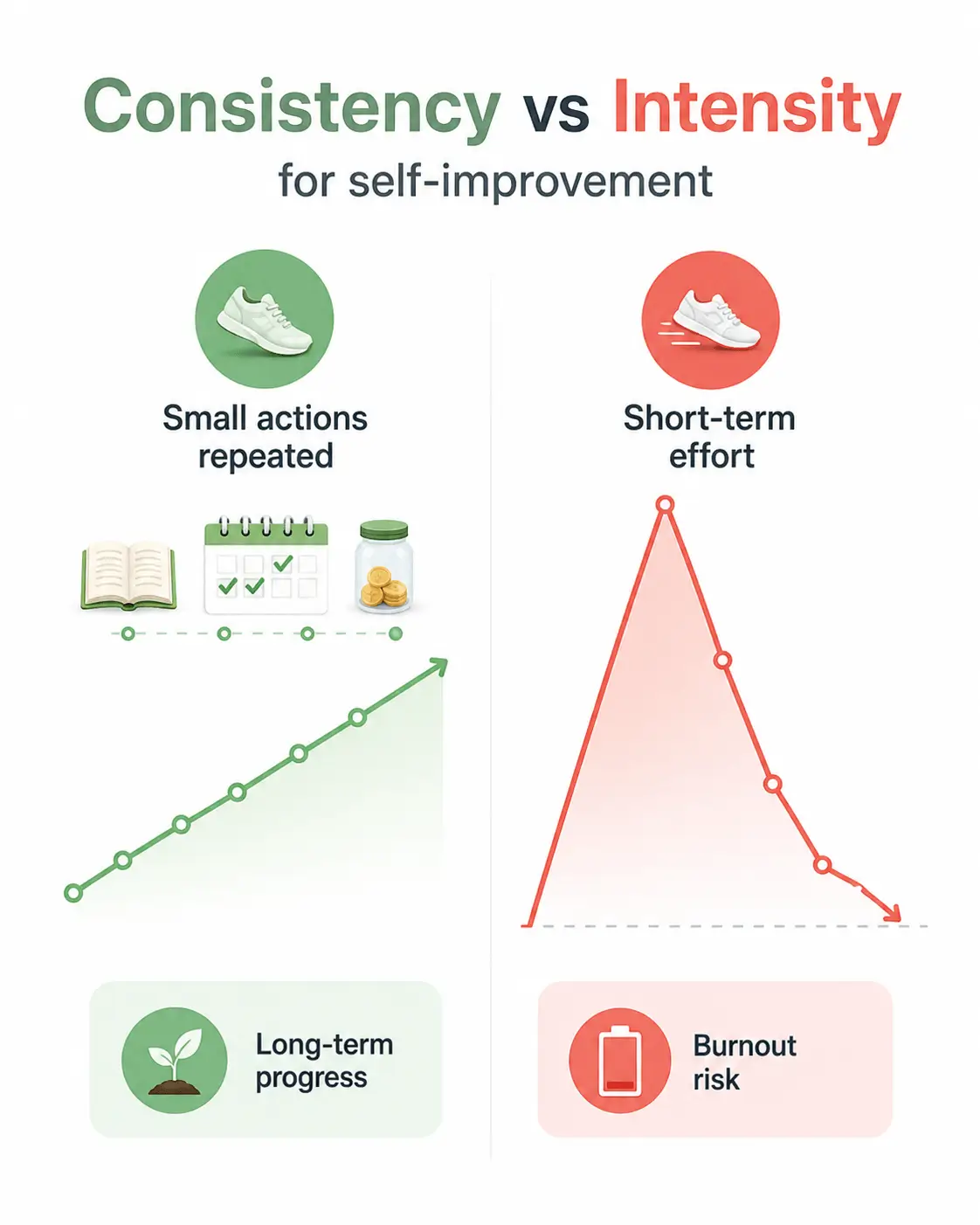
Consistency works better than intensity because small actions are easier to repeat and less emotionally exhausting. Many people try to improve their life with intense effort for a few days, then burn out because the plan is too demanding.
| Consistency | Intensity |
|---|---|
| Small actions repeated often | Big effort in short bursts |
| Builds trust with yourself | Often leads to burnout |
| Easier to maintain | Harder to sustain |
| Creates long-term results | Creates short-term excitement |
| Supports identity change | Depends on high energy |
Examples:
- Walking 20 minutes daily is better than exercising intensely once a week.
- Reading 5 pages daily is better than waiting for a perfect study day.
- Saving a small amount regularly is better than trying to fix finances all at once.
People fail to stay consistent when they make habits too large, expect fast results, or quit after one missed day. Sustainable habits work because they fit real life. Unsustainable habits require perfect conditions, high motivation, and constant effort.
To live better life long-term, choose actions you can do even on average days. Living a better life is not about maximum effort. It is about repeatable effort.
Create a Better Morning and Evening Routine
Routines reduce mental clutter because they remove repeated decisions. A good routine does not need to be complicated. It should support your energy, focus, and emotional balance.
A simple morning routine may include:
- Wake up at a consistent time
- Drink water
- Avoid checking your phone immediately
- Move your body briefly
- Review your priorities
- Start with one meaningful task
A simple evening routine may include:
- Prepare for tomorrow
- Reduce screen time
- Reflect on one lesson from the day
- Keep your sleep schedule consistent
- Do something calming before bed
Routines are systems. Goals tell you what you want, but systems decide what you do repeatedly. A goal may be “be more productive,” but a system is “plan tomorrow every evening and complete one important task before checking social media.”
Better living becomes easier when your routines support the person you want to become. Morning routines create direction. Evening routines improve recovery. Together, they make self-improvement more automatic.
Set Goals That Actually Improve Your Life
Goals improve your life when they are specific, realistic, and connected to daily behavior. A goal such as “I want to live a better life” is useful only when it becomes a clear action you can repeat.
A practical goal-setting process:
- Choose one area to improve first.
- Define what “better” means in that area.
- Break the goal into a small daily or weekly action.
- Track progress simply.
- Review and adjust every week.
Examples:
- Instead of “be healthier,” choose “walk 20 minutes after lunch.”
- Instead of “be happier,” choose “write down three good things each evening.”
- Instead of “be productive,” choose “finish one important task before checking social media.”
Vague goals fail because they do not tell your brain what to do next. Specific behaviors work because they reduce uncertainty. If you want to know how to have a good life or create a good life, translate your values into actions.
A meaningful goal should answer three questions:
- What exactly will I do?
- When or where will I do it?
- How will I know I completed it?
Clear goals create direction. Simple systems create progress.
Improve Your Mindset Without Ignoring Real Problems
A better mindset means responding to problems with clarity, patience, and responsibility. It does not mean pretending everything is positive or ignoring real difficulties.
Helpful mindset shifts include:
- From “I failed” to “I learned what needs adjustment”
- From “I have no time” to “I need better priorities”
- From “I need to change everything” to “I can improve one thing today”
- From “I am not disciplined” to “I can build discipline through practice”
- From “It is too late” to “small progress still matters”
Your thoughts influence your emotions. Your emotions influence your behavior. Your behavior shapes your results. This cause-effect chain matters because self-improvement is not only about action; it is also about interpretation.
For example, if you think, “I missed one day, so I failed,” you may quit. If you think, “I missed one day, so I will restart today,” you protect momentum.
Mental models help you think more clearly. A useful mental model is “progress over perfection.” Another is “systems over wishes.” These thinking patterns reduce overthinking, self-doubt, and fear of failure.
Manage Procrastination, Overthinking, and Fear of Failure
Procrastination often happens when a task feels unclear, uncomfortable, boring, or emotionally risky. Overthinking happens when the mind tries to avoid uncertainty by analyzing instead of acting.
Why Procrastination Happens
- The task feels too big
- The first step is unclear
- The outcome feels uncertain
- You fear doing it badly
- You are mentally tired
- The reward feels too far away
When a task feels threatening, the brain often chooses short-term relief. That relief may come from scrolling, delaying, organizing, or thinking without acting. The problem is that avoidance reduces discomfort now but increases stress later.
How to Fix It
- Make the first step very small
- Use a 5-minute starting rule
- Remove distractions before beginning
- Define what “done” means
- Focus on progress, not perfect results
For example, instead of “write the full report,” start with “write the first three bullet points.” Instead of “clean the whole house,” start with “clear one table.” Action becomes easier when the first step is obvious.
How to Prevent It
- Plan tasks the night before
- Work at the same time each day
- Break large goals into visible steps
- Reward completion, not perfection
Fear of failure often decreases when you treat action as feedback. You do not need perfect results to improve. You need repeated attempts, clear adjustments, and the willingness to restart.
Build Better Relationships and Social Habits
A better life is not only about personal productivity or health. Relationships strongly influence happiness, stress, confidence, emotional well-being, and resilience.
Healthy relationship habits include:
- Listening without immediately judging
- Communicating clearly
- Setting boundaries
- Spending time with supportive people
- Reducing toxic or draining interactions
- Expressing appreciation
- Apologizing when needed
- Asking for help instead of isolating yourself
Supportive relationships reduce stress because they create emotional safety, belonging, and perspective. People are more resilient when they feel connected to others. Strong social habits also improve confidence because you learn to communicate needs, respect boundaries, and handle conflict more calmly.
Living a happy life does not mean avoiding all difficult people or uncomfortable conversations. It means building healthier patterns in how you connect, listen, speak, and protect your emotional energy.
If you want to know how to have a happier life, pay attention to the people and conversations that shape your daily mood.
Reduce Burnout by Managing Energy, Not Just Time
Burnout happens when people push themselves without enough recovery, boundaries, or realistic expectations. Time management helps, but energy management is just as important because you cannot perform well when your body and mind are exhausted.
Common burnout triggers:
- Saying yes to everything
- Poor sleep
- No recovery time
- Constant digital stimulation
- Unrealistic goals
- Perfectionism
- Lack of emotional support
Better solutions include:
- Schedule rest before exhaustion
- Focus on fewer priorities
- Take short breaks during deep work
- Protect sleep and recovery
- Set boundaries with work and people
- Track energy patterns during the day
A common time management mistake is filling every hour with tasks. This may look productive, but it often creates overwhelm. Sustainable self-improvement requires recovery. Rest is not laziness; it supports focus, emotional control, and long-term consistency.
Managing energy means knowing when you focus best, when you need breaks, and what drains you unnecessarily. Better living is not doing more all the time. It is doing what matters with enough recovery to continue.
What Actually Works vs What Only Sounds Good
Some self-improvement advice sounds inspiring but is difficult to apply. A better life comes from realistic systems, not motivational slogans.
| Sounds Good | Actually Works |
|---|---|
| Change your whole life overnight | Improve one habit at a time |
| Wake up at 5 AM no matter what | Build a routine that fits your energy |
| Stay motivated every day | Create systems for low-motivation days |
| Never fail | Learn quickly and restart |
| Work harder all the time | Balance effort with recovery |
| Think positive always | Think clearly and act responsibly |
What works in real life is usually simple, repeatable, and flexible. Online advice often focuses on intensity because it sounds impressive. Real behavior change depends on sustainability.
For example, waking at 5 AM may help some people, but it is not automatically better. If it reduces sleep, it may hurt focus and mood. A better approach is to build a routine that supports your energy and responsibilities.
The most reliable self-improvement strategy is not inspiration. It is designing your environment, habits, routines, and goals so good decisions become easier.
Real-Life Examples of Living a Better Life
Living a better life depends on context, responsibilities, energy, and personal needs. A beginner, professional, student, and caregiver may need different routines.
Beginner Example
A beginner may start with:
- Sleeping 30 minutes earlier
- Walking 10 minutes daily
- Planning one important task each morning
- Drinking more water
- Reducing phone use before bed
For beginners, the goal is not to change everything. The goal is to build confidence through small wins.
Busy Professional Example
A busy professional may focus on:
- Time-blocking deep work
- Preparing healthy meals in advance
- Setting work boundaries
- Taking short movement breaks
- Reviewing weekly priorities
For busy professionals, better living often requires protecting attention and recovery. Without boundaries, productivity can turn into burnout.
Student Example
A student may improve life by:
- Creating a study routine
- Avoiding last-minute cramming
- Sleeping consistently
- Exercising lightly
- Managing social media distractions
For students, consistency matters more than panic-based effort. Small study sessions repeated over time are more effective than relying on last-minute pressure.
Parent or Caregiver Example
A parent may focus on:
- Simple routines instead of perfect routines
- Asking for support
- Protecting small moments of rest
- Preparing essentials ahead of time
- Practicing emotional regulation during stress
For parents and caregivers, better living must be realistic. Small routines, emotional awareness, and support systems matter more than perfect schedules.
A Simple Step-by-Step Plan to Live a Better Life
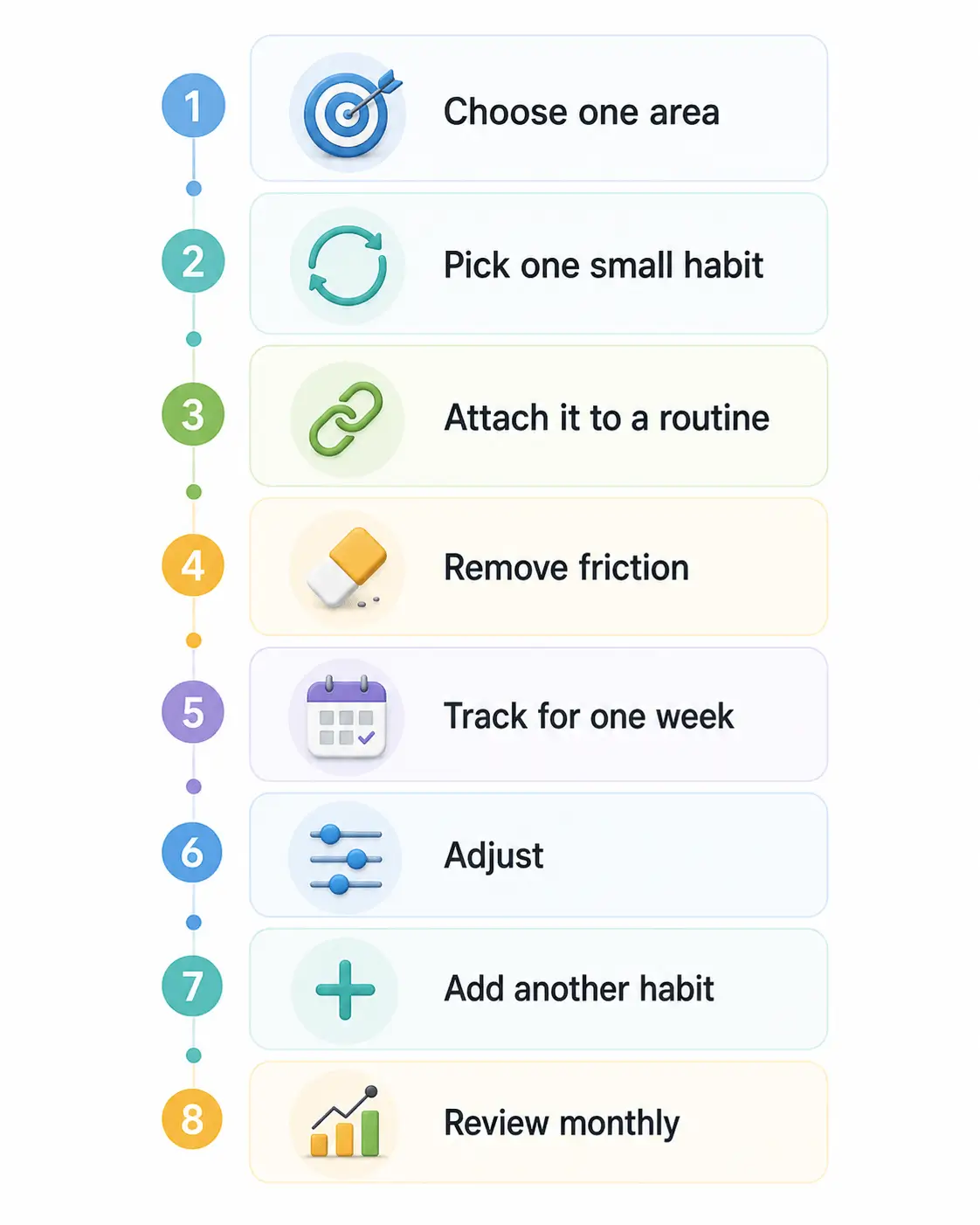
A simple plan to live a better life is to choose one meaningful area, create one small habit, attach it to an existing routine, reduce friction, and repeat it consistently before adding more changes.
Step-by-step plan:
- Choose one area of life to improve first.
- Identify the smallest useful habit related to that area.
- Attach the habit to an existing routine.
- Remove one source of friction.
- Track the habit for one week.
- Adjust instead of quitting.
- Add another habit only after the first feels stable.
- Review your progress monthly.
Example:
| Area | Health |
|---|---|
| Small habit | Walk after dinner |
| Trigger | After putting dishes away |
| Friction removed | Shoes placed near the door |
| Review | Track walks for 7 days |
This plan works because it makes improvement clear and manageable. Instead of asking how to live a better life in a broad way, you turn the answer into one repeatable action.
To live better, start smaller than you think you need to. Small habits create momentum. Momentum builds confidence. Confidence supports bigger changes over time.
Common Mistakes That Make Life Harder
Many people make life harder by trying to improve too many things at once, waiting for motivation, ignoring health, or expecting perfect consistency. These mistakes create overwhelm and reduce long-term progress.
| Mistake | Why It Hurts Progress | Better Approach |
|---|---|---|
| Trying to change everything | Creates overwhelm | Start with one habit |
| Waiting for motivation | Causes inconsistency | Build routines |
| Comparing yourself to others | Reduces confidence | Measure personal progress |
| Ignoring sleep and health | Lowers energy and focus | Protect basic health habits |
| Setting vague goals | Makes action unclear | Use specific behaviors |
| Quitting after setbacks | Breaks momentum | Restart quickly |
| Chasing perfection | Creates pressure | Focus on repeatable progress |
The biggest mistake is treating setbacks as proof that change is impossible. Setbacks are normal. A missed workout, a distracted day, or a failed routine does not erase progress. The better approach is to restart quickly and adjust the system.
Realistic expectations protect consistency. A better life is not built through perfect days. It is built through repeated returns to the habits that matter.
Science-Backed Insights About Better Living
Behavior change becomes easier when actions are small, repeated, and connected to clear cues. The brain prefers familiar patterns, so new habits require repetition before they feel natural.
Useful insights include:
- Small habits lower resistance because they feel easier to start.
- Clear cues reduce decision fatigue.
- Immediate rewards make habits more likely to repeat.
- Identity-based habits help people act in line with who they want to become.
- Sleep, movement, and nutrition influence emotional control and motivation.
- Social support increases accountability and resilience.
Habit science shows that behavior is strongly shaped by cues, rewards, repetition, and environment. If a habit is difficult to start, the problem may not be your character. The system may be too hard.
For example, if you want to exercise but your shoes are hidden away, friction increases. If your shoes are near the door, action becomes easier. If you want to reduce screen time but your phone is next to your bed, the environment works against you.
Better living becomes easier when your surroundings support your goals. Repetition builds familiarity. Rewards reinforce action. Identity gives the habit meaning.
FAQ About How to Live a Better Life
How can I start living a better life today?
Start with one small action that improves your health, mindset, or environment. For example, take a short walk, clean one area, plan tomorrow, drink more water, or complete one important task. Small actions create momentum and make change feel possible.
Why do I struggle with consistency?
You may struggle with consistency because your goals are too vague, too large, or too dependent on motivation. Consistency improves when habits are small, scheduled, and connected to routines you already have. Clear triggers and simple actions make follow-through easier.
How do I stay disciplined long-term?
Long-term discipline comes from systems, not willpower alone. Make good habits easier, remove distractions, track progress, and repeat the same behavior until it becomes part of your identity. Discipline grows through practice, not pressure.
What if I lose motivation?
Losing motivation is normal. Instead of waiting to feel inspired, lower the difficulty of the habit and take the smallest possible step. Action often rebuilds motivation because progress creates energy, confidence, and emotional momentum.
How do I live a healthier and happier life?
Focus on basic health habits first: sleep, movement, nutrition, hydration, stress management, and supportive relationships. These habits improve energy and mood, which makes happiness, discipline, and productivity easier to sustain over time.
What is the difference between a good life and a successful life?
A successful life often focuses on achievement, while a good life includes well-being, health, relationships, purpose, peace, and personal growth. The best version balances both by pursuing meaningful goals without sacrificing health or emotional stability.
How long does it take to build a better life?
Building a better life is ongoing. Some improvements can be felt quickly, such as better sleep, cleaner surroundings, or less phone use. Deeper changes in habits, mindset, emotional control, and identity require consistent effort over time.
Conclusion
Learning how to live a better life starts with understanding that improvement is built through small, consistent choices. A better life is not created by perfection, constant motivation, or sudden transformation. It is created by healthy routines, clear goals, emotional awareness, better relationships, and habits that match the person you want to become.
The clearest takeaway is simple: choose one meaningful area, start with one small action, repeat it consistently, and let progress build over time. Better living becomes easier when your systems support your values, your habits support your health, and your mindset helps you restart instead of quit.









One Response