
Introduction
An intuitive mindset is an approach to understanding situations and making decisions by drawing on rapid, largely unconscious pattern recognition, feelings, prior experience, and internal signals, rather than step-by-step conscious analysis. This is the core of intuitive mindset meaning: it is a cognitive process, not a mystical sense. Intuition differs from simply acting on an unexplained impulse — genuine intuitive judgment is shaped by accumulated experience, context, and learned patterns, even when a person cannot immediately explain why they reached a conclusion. Emotions and analytical thinking both interact with intuition, and understanding this interplay is central to using intuition well.
Quick Summary
- An intuitive mindset involves using rapid internal judgments, pattern recognition, experience, and feelings to understand situations or make decisions.
- Psychology suggests that intuition can arise from unconscious processing and learned patterns rather than from conscious step-by-step reasoning.
- Intuition can be valuable when a person has relevant experience and receives reliable feedback, but it can also be distorted by bias, emotion, incomplete information, or unfamiliar situations.
- The strongest approach is often to combine intuition with deliberate reasoning when the decision is important or uncertain.
What Does an Intuitive Mindset Mean?
Core characteristics of intuitive thinking
The intuitive mindset meaning centers on several observable characteristics: rapid judgment, pattern recognition, internal feelings, contextual awareness, and reliance on prior experience. An intuitive response can surface before a person can consciously explain why they reached a conclusion — the answer arrives first, and the reasoning (if any) follows afterward.
It’s important to distinguish intuition from impulsiveness, guessing, and emotional reactivity:
- Intuition draws on relevant experience and recognizable patterns, even if the process is unconscious.
- Impulsiveness is acting on a sudden urge without regard for consequences.
- Guessing involves no meaningful pattern recognition at all.
- Emotional reactivity is driven primarily by a current emotional state rather than accumulated experience.
How an intuitive mindset develops
Intuition is built, not innate. Repeated exposure, learning, experience, and feedback create recognizable mental patterns that the brain can later retrieve quickly. This is why intuition tends to become more reliable in familiar domains — a chess player, a nurse, or a mechanic can often sense that something is off before they can articulate exactly what.
Feedback plays a critical role in this development. Accurate, timely feedback helps refine intuition over time, sharpening the patterns a person relies on. Misleading or absent feedback, by contrast, can reinforce poor judgments, allowing flawed intuitive habits to persist unchecked.
How Does an Intuitive Mindset Work in Psychology?
Intuition and unconscious mental processing
Intuitive mindset psychology draws on several established concepts, including automatic processing, pattern recognition, implicit learning, and heuristics. The brain can process large amounts of information without conscious awareness of every intermediate step, integrating cues from the environment and matching them against stored patterns from past experience. This is often described as a dual-process view of cognition, distinguishing fast, automatic thinking from slower, deliberate reasoning. Understanding intuition also requires a broader grounding in mindset psychology, which explains how thought patterns form and shift over time.
Intuition, emotion, and internal signals
People often experience intuition as a feeling — a sense of certainty, discomfort, or “gut feeling.” These emotional signals can carry genuinely useful information, since emotion is one channel through which the brain communicates the results of unconscious processing. However, emotional signals can also reflect fear, anxiety, prior negative experiences, or cognitive bias rather than an accurate read of the current situation. Critically, the subjective feeling of certainty does not automatically mean a judgment is correct; confidence and accuracy are not the same thing.
When is intuition more likely to be reliable?
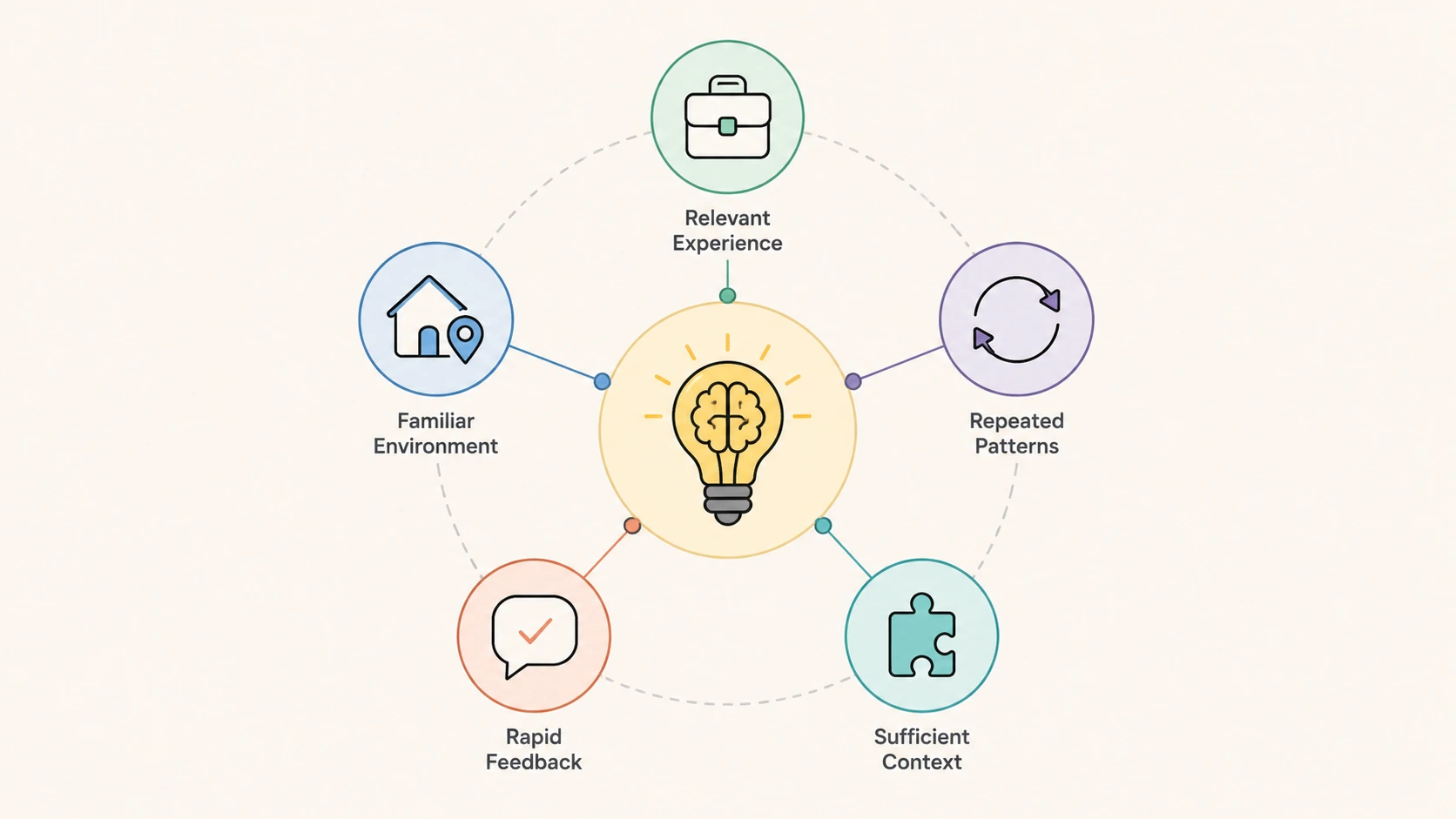
Intuitive judgment tends to be strengthened under specific conditions:
- Relevant, substantial experience in the domain
- Familiar environments
- Repeated, stable patterns
- Rapid, accurate feedback
- Sufficient contextual information
These conditions contrast sharply with situations involving novelty, randomness, extreme uncertainty, or high emotional pressure — circumstances where intuition is far less trustworthy, because there are no reliable patterns to draw on.
What Are Examples of an Intuitive Mindset in Everyday Life?
Understanding intuitive mindset examples across different contexts helps clarify how intuition functions in practice — as a signal produced by an underlying pattern or experience, not an abstract concept.
Workplace and professional decisions
A project manager may sense that a project is drifting off course before any metric confirms it. A team lead might notice a subtle communication problem in a meeting. An experienced professional may quickly recognize a familiar problem based on prior cases. In each instance, professional intuition is a useful starting signal, but it should be validated with evidence — data, documentation, or direct conversation — before major decisions are made.
Relationships and social situations
People often intuitively detect shifts in tone, behavior, or social dynamics — sensing that a friend seems distant or that tension exists between colleagues. Interpersonal intuition can be genuinely useful, drawing on years of social pattern recognition, but it is also vulnerable to assumptions and projection, where a person’s own emotional state colors their reading of others.
Everyday choices and problem-solving
Choosing between familiar alternatives, navigating a well-known environment, troubleshooting a recurring technical issue, or instantly recognizing a familiar situation are all everyday expressions of intuition. In these cases, intuition works differently — and more reliably — when the person has relevant prior experience with that specific type of choice or problem.
Intuitive Mindset vs. Rational Mind: What Is the Difference?
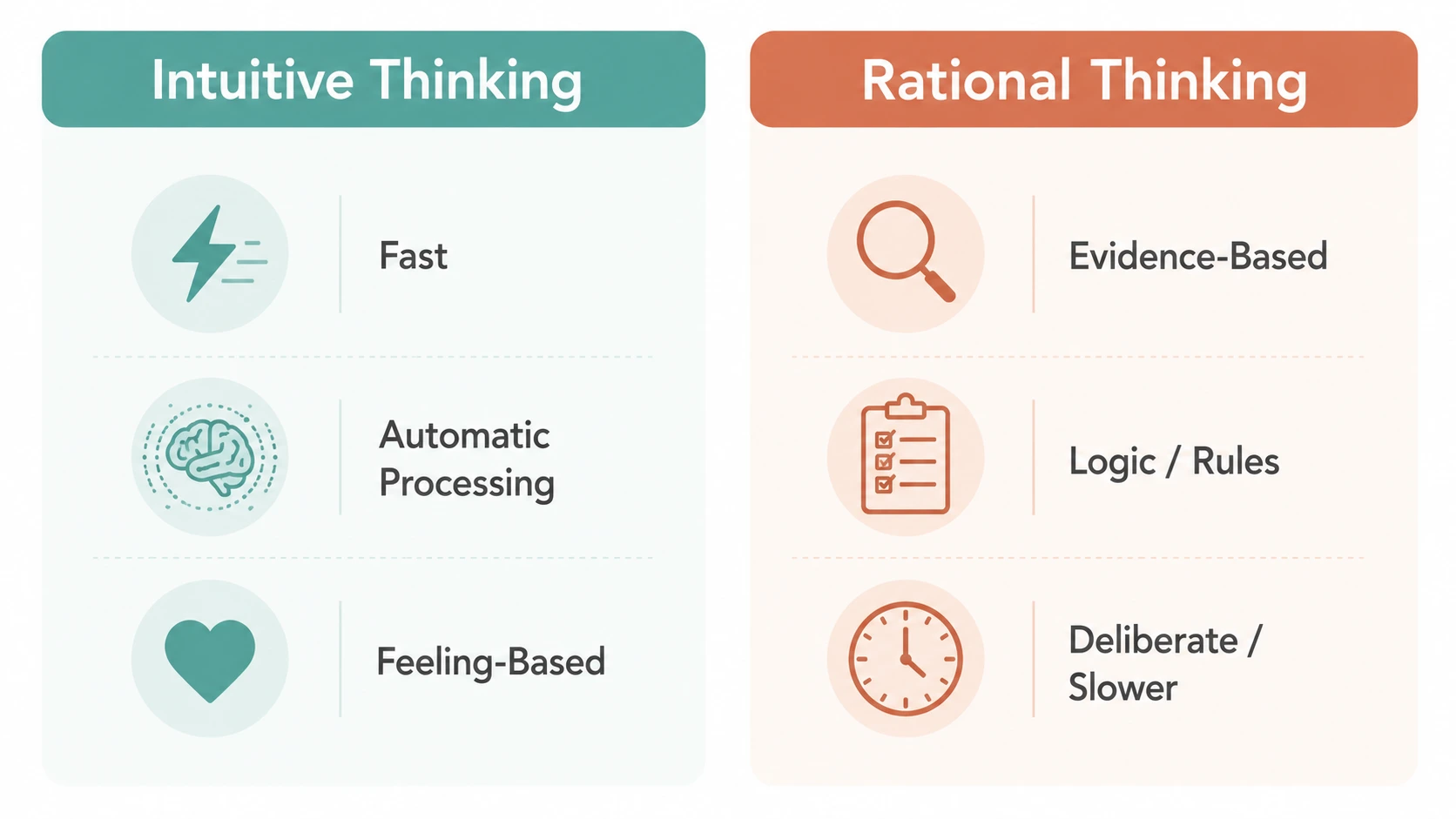
The comparison of intuitive mind vs rational mind does not describe two opposing personality types. Most people use both modes of thought, often shifting between them within the same decision. This tension between fast, feeling-based judgment and slower, deliberate reasoning is closely related to the broader question of logic vs emotion in decision-making.
| Aspect | Intuitive thinking | Rational/analytical thinking |
|---|---|---|
| Processing style | Rapid and largely automatic | Deliberate and conscious |
| Main inputs | Patterns, experience, internal signals | Evidence, logic, rules, calculations |
| Speed | Usually faster | Usually slower |
| Strength | Useful for familiar or time-sensitive situations | Useful for complex, high-stakes, or unfamiliar decisions |
| Main limitation | Bias and mistaken pattern recognition | Time, cognitive effort, and information overload |
| Best use | Initial judgment or pattern recognition | Verification and structured evaluation |
When should intuition and reasoning be combined?
A practical approach is “intuition first, analysis second”: let an intuitive judgment generate an initial hypothesis, then use deliberate reasoning to test it. An intuitive signal should trigger investigation rather than immediate action whenever the stakes are meaningful. For high-stakes decisions — financial, medical, legal, or otherwise difficult to reverse — evidence and deliberate reasoning deserve significantly greater weight than the initial gut response.
What Are the Limitations of an Intuitive Mindset?
Many articles about intuition emphasize its benefits without adequately explaining its boundaries. In our experience helping readers build better decision-making habits, this gap is one of the most common sources of poor outcomes: intuition is not automatically accurate simply because it feels strong.
Major limitations include:
- Cognitive biases
- Stereotyping
- Emotional influence
- Limited experience
- False pattern recognition
- Confirmation bias
- Unreliable feedback
- Novel or unpredictable environments
Intuition should be questioned more rigorously whenever the consequences of being wrong are significant — the greater the stakes, the more scrutiny an intuitive judgment deserves.
When can intuitive judgment be misleading?
Fear, stress, overconfidence, excessive familiarity, and previous negative experiences can all distort intuitive judgments, sometimes producing a confident-feeling conclusion that has little grounding in the current situation. A useful distinction is between a genuine warning signal — something specific and traceable to real experience — and an unsupported assumption dressed up as a “feeling.”
How Can You Develop a More Balanced Intuitive Mindset?
Developing a stronger intuitive mindset is best framed as improving the quality of intuitive judgment, not simply learning to “trust your gut” more. This connects naturally to broader self-improvement work involving mindset, self-awareness, decision-making, and resilience.
Build experience and recognize patterns
Deliberate practice and repeated exposure to relevant situations sharpen pattern recognition over time. Your Daily Thrive recommends treating each significant decision as a learning opportunity — the goal is not just experience, but experience paired with attention to outcomes.
Create space for reflection
Reviewing important intuitive decisions afterward, and comparing the initial intuition against the eventual evidence or outcome, is one of the most effective ways to improve judgment. This kind of reflection can reveal recurring biases and steadily sharpen future decisions.
Know when to pause and verify
Practical decision rules help here: seek additional evidence whenever a situation is unfamiliar, high-stakes, emotionally charged, or difficult to reverse. A brief pause before acting on intuition costs little and can prevent costly errors.
Common Mistakes People Make When Using Intuition
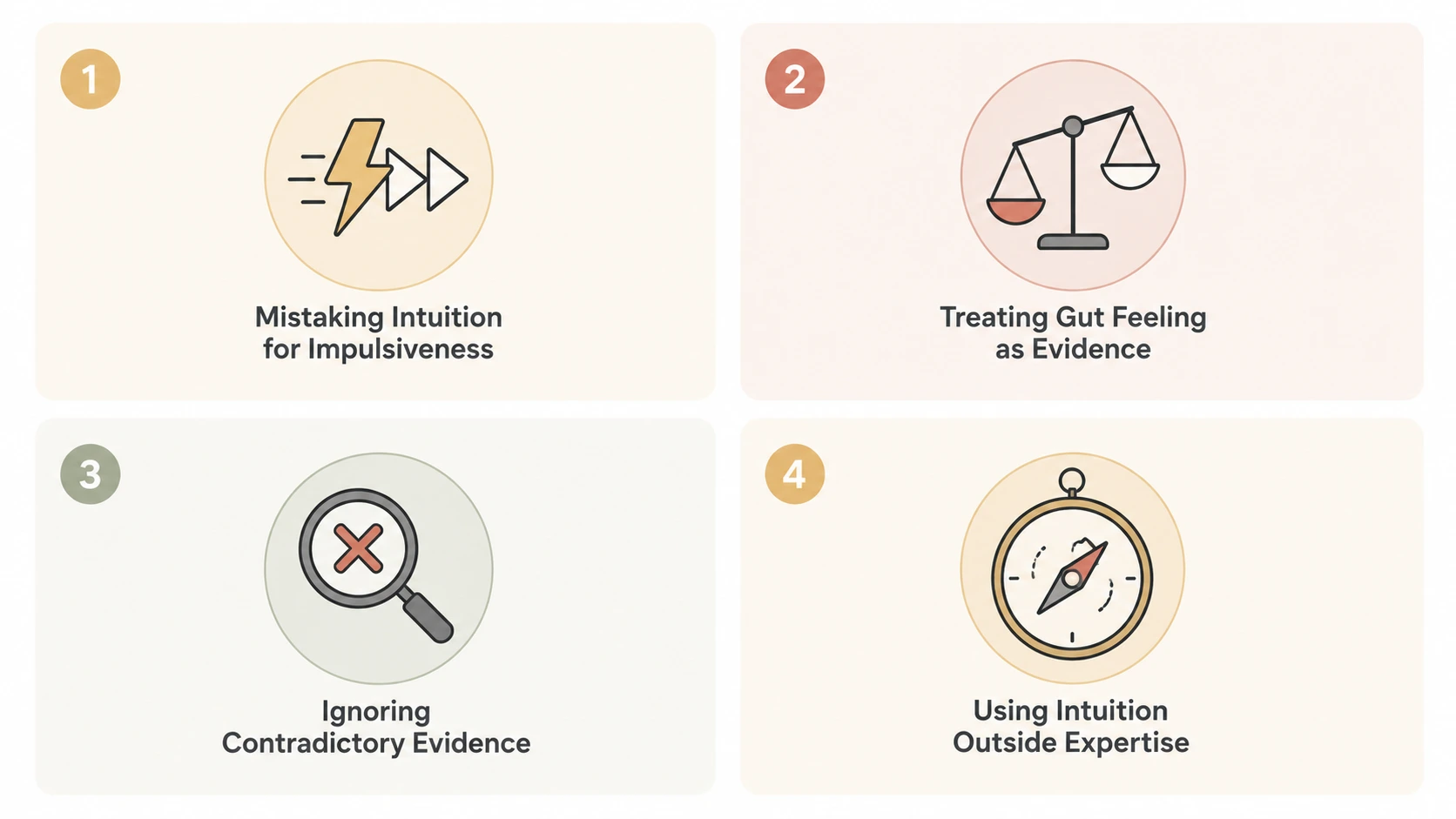
Mistaking intuition for impulsiveness
A rapid judgment informed by real experience is different from an immediate reaction driven by emotion or desire. A short, deliberate pause before acting can help distinguish the two.
Treating every gut feeling as evidence
An internal feeling is a signal to investigate — not necessarily proof of anything. Checking that feeling against available evidence, where possible, improves decision quality.
Ignoring contradictory evidence
Confirmation bias can make intuitive confidence resistant to new information. Deliberately asking, “What evidence would prove me wrong?” is a simple, effective way to counter this tendency.
Using intuition outside an area of expertise
Intuition developed in one domain does not automatically transfer to another. Reliable intuition depends on relevant experience, feedback, and domain-specific knowledge — without those, an intuitive judgment carries little more weight than a guess.
When Is an Intuitive Mindset Most Useful—and When Is It Not?
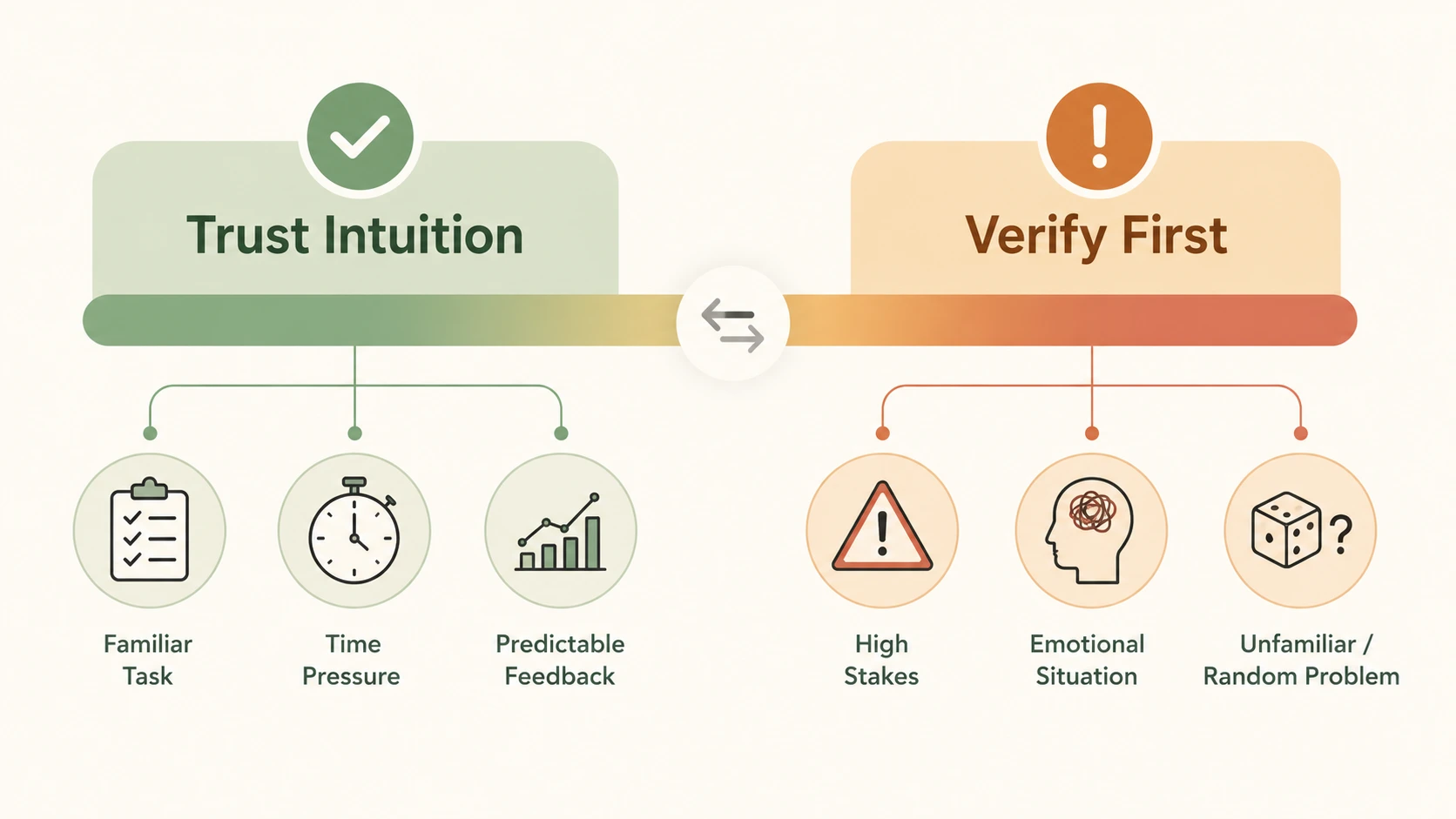
Rather than treating intuition as universally good or bad, it helps to evaluate it against the specific conditions of a situation.
| Situation | Role of intuition | Why |
|---|---|---|
| Familiar task | Often useful | Experience can support pattern recognition |
| Time-sensitive decision | Potentially useful | Rapid processing can be valuable |
| Complex unfamiliar problem | Use cautiously | Existing patterns may not apply |
| High-stakes decision | Verify carefully | Consequences of error are greater |
| Emotionally charged situation | Pause and check | Emotions can distort judgment |
| Predictable environment with feedback | More likely to improve | Outcomes help calibrate intuition |
| Random or highly unpredictable situation | Less reliable | Patterns may be misleading |
As of 2026, behavioral science continues to reinforce this conditions-based view rather than framing intuition as either universally trustworthy or inherently flawed — the reliability of intuition is best assessed situation by situation.
Conclusion: Using an Intuitive Mindset Wisely
An intuitive mindset is the ability to draw on rapid pattern recognition, experience, contextual information, and internal signals to understand situations and make decisions. Its psychological basis lies in automatic processing, implicit learning, and heuristics, and it offers real practical benefits — particularly speed and efficiency in familiar, feedback-rich environments. At the same time, intuition carries genuine limitations, including susceptibility to bias, emotional distortion, and false pattern recognition, which is why deliberate analytical verification matters most when stakes are high or situations are unfamiliar. Effective intuitive thinking is not about abandoning logic; it is about knowing when intuition provides useful information and when deliberate reasoning should take over.
FAQs About an Intuitive Mindset
What is an intuitive mindset? An intuitive mindset is the practice of drawing on rapid, largely unconscious pattern recognition, feelings, and prior experience to understand situations and make decisions, rather than relying solely on step-by-step conscious reasoning.
What does an intuitive mindset mean in psychology? In psychology, an intuitive mindset reflects automatic mental processing, pattern recognition, implicit learning, and cognitive heuristics, allowing the brain to reach conclusions from experience and emotional cues without full conscious analysis.
What are examples of an intuitive mindset? Examples include sensing a project is off track at work, noticing subtle shifts in a friend’s behavior, or quickly recognizing a familiar problem based on past experience — each drawing on prior pattern recognition rather than explicit calculation.
Is an intuitive mindset the same as trusting your gut? They overlap, but they are not identical: trusting your gut implies acting on a feeling, while a well-developed intuitive mindset treats that feeling as a signal to weigh against evidence, especially when the decision carries real consequences.
What is the difference between an intuitive mind and a rational mind? An intuitive mind processes information rapidly and automatically using patterns and experience, while a rational mind works deliberately through evidence and logic; the two are complementary modes of thought rather than competing personality types.
When is an intuitive mindset useful? Intuition is most useful when a person has relevant experience, the situation involves familiar patterns, time pressure limits deliberate analysis, and the environment provides reliable feedback to calibrate judgment.
Can an intuitive mindset lead to bad decisions? Yes — cognitive bias, emotional influence, limited experience, false pattern recognition, and unfamiliar or unpredictable situations can all cause intuitive judgments to be inaccurate, even when they feel confident.
How can someone improve their intuitive thinking? Improvement comes from building relevant experience, engaging in deliberate practice, reflecting on outcomes to refine future judgment, seeking reliable feedback, and combining intuition with analytical verification for important decisions.