
Introduction
Facts about mindset show that a mindset is the collection of beliefs, attitudes, and assumptions that shape how a person thinks, learns, makes decisions, responds to challenges, and pursues goals. Rather than being a fixed personality trait, mindset works more like a mental lens: it filters how events are interpreted and how effort, failure, and feedback are processed. In psychology, mindset is closely tied to motivation, learning behavior, and self-perception. Understanding mindset matters across many areas of life, including education, career development, relationships, and personal growth, because the beliefs a person holds about their own abilities directly influence what they attempt, how they respond to setbacks, and how far they are willing to persist.
Quick Summary
- Mindset influences how people interpret challenges, failures, and opportunities.
- Psychology identifies different mindset patterns that affect learning, behavior, and success.
- Mindsets are shaped by experiences, beliefs, environment, and habits—and they can change over time.
- Developing a positive or growth mindset often improves resilience, learning, and long-term achievement.
- Research by psychologist Carol Dweck established the foundation for how fixed and growth mindsets are understood today.
What Is a Mindset?
A mindset is the underlying set of beliefs and mental frameworks a person uses to interpret experiences and guide behavior. It is not a single opinion but an ongoing pattern of thought that influences decisions, effort, and reactions to difficulty.
Mindset Definition in Psychology
In psychology, mindset refers to an established set of attitudes, beliefs, and assumptions that shape how an individual perceives themselves, other people, and the world around them. These mental frameworks act as a filter: two people can face the same situation and interpret it in completely different ways depending on their underlying beliefs. Psychologists generally distinguish mindset from personality traits because mindset is more responsive to experience, feedback, and intentional practice, meaning it can shift over time rather than remaining static.
What Is a Mindset? Examples in Everyday Life
Mindset shows up in ordinary situations far more often than people realize. A student who believes intelligence can improve through effort is more likely to keep studying after a poor grade, while a student who believes intelligence is fixed may give up. At work, an employee with a growth-oriented mindset views critical feedback as useful information, while a colleague with a more fixed outlook may see the same feedback as a personal attack. In relationships, someone with a flexible mindset is more willing to adapt communication styles, while a rigid mindset can make compromise feel threatening. In health and fitness, mindset determines whether a missed workout is seen as a minor setback or a reason to quit entirely.
Why Is Mindset Important?
The Importance of Mindset in Daily Life
Mindset plays a central role in everyday functioning because it shapes motivation, confidence, emotional resilience, learning, and problem-solving. A person’s beliefs about their own capability influence whether they take initiative, how quickly they recover from disappointment, and how effectively they process new information. When mindset supports growth and adaptability, daily challenges become opportunities for learning rather than sources of ongoing stress. This is one of the clearest facts about mindset: it is not a passive trait, but an active influence on behavior throughout the day.
Why Is Mindset Important for Achieving Success?
Mindset is important for achieving success because it directly affects persistence, adaptability, goal achievement, and continuous learning. People who view ability as something that can be developed are more likely to sustain effort after setbacks, seek out feedback, and adjust their strategies rather than abandon their goals. Long-term achievement tends to depend less on innate talent and more on the willingness to keep learning, which is a mindset-driven behavior. This connection between mindset and success is one of the most consistently supported findings in behavioral science research. This connection between mindset and success is one of the most consistently supported findings in behavioral science research — and it’s a big part of why growth mindset matters so much for long-term achievement.
How Is Mindset Formed?
Factors That Shape Mindset
Mindset is formed gradually through a combination of internal beliefs and external influences, including:
- Childhood experiences – early feedback about effort and ability shapes core beliefs.
- Parents and caregivers – the language used around success and failure influences self-perception.
- Education – teaching styles and grading practices reinforce fixed or growth-oriented thinking.
- Culture – cultural attitudes toward achievement, effort, and failure affect mindset development.
- Environment – supportive or critical environments shape confidence and resilience.
- Successes and failures – repeated outcomes reinforce existing beliefs about ability.
- Personal beliefs – internal narratives about self-worth and capability strengthen mindset patterns.
- Social influences – peer groups and role models model behaviors that get adopted over time.
Can Mindset Change Over Time?
Yes, mindset can change over time. Brain adaptability, often referred to as neuroplasticity, allows thought patterns to shift in response to new experiences and learning. Mindset change typically develops through repeated exposure to new information, intentional habit formation, and consistent self-reflection. While early beliefs about ability can feel deeply ingrained, psychological research confirms that deliberate practice and awareness can gradually reshape how a person interprets challenges and effort.
The Four Main Types of Mindset
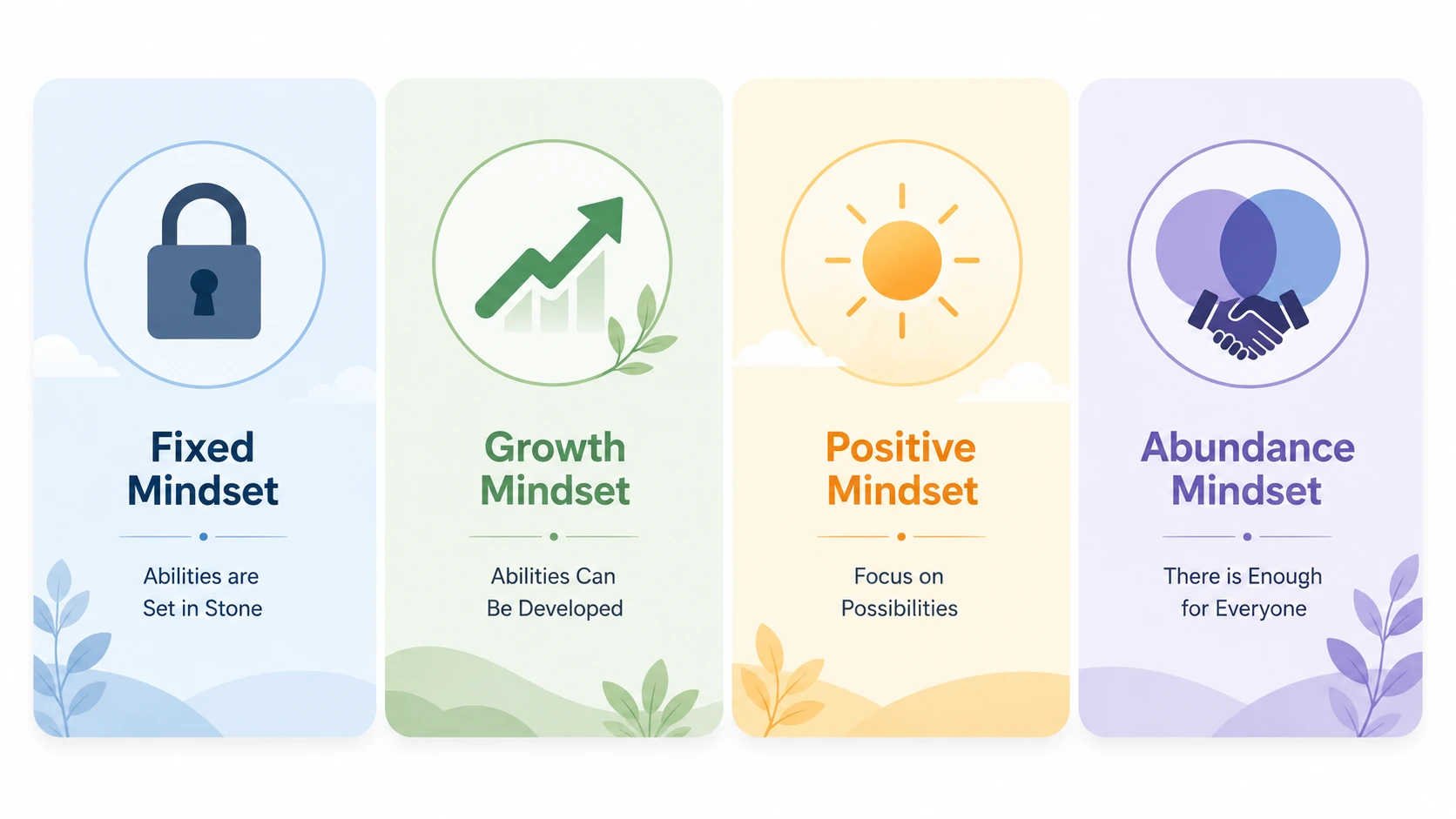
Understanding the 4 types of mindsets helps clarify how different belief systems influence behavior and outcomes.
| Mindset Type | Core Belief | Typical Behavior | Common Strengths | Possible Challenges |
|---|---|---|---|---|
| Fixed Mindset | Abilities are static and unchangeable | Avoids challenges, gives up easily | Confidence in known strengths | Limited growth, fear of failure |
| Growth Mindset | Abilities can be developed through effort | Embraces challenges, learns from setbacks | Resilience, continuous improvement | Can require patience and consistency |
| Positive Mindset | Focus on constructive interpretation of events | Approaches problems with optimism | Emotional resilience, better coping | Risk of overlooking real problems if unchecked |
| Abundance Mindset | Opportunities and resources are not limited | Collaborates, shares credit and ideas | Long-term thinking, stronger relationships | May underestimate real constraints |
Fixed Mindset
A fixed mindset is the belief that intelligence, talent, and abilities are largely unchangeable traits. People with this mindset often avoid challenges to protect their self-image, give up quickly when facing obstacles, and view effort as a sign of weakness rather than growth. A common example is a person who avoids trying new skills because they fear looking incompetent.
Growth Mindset
A growth mindset is the belief that abilities can be developed through dedication, effort, and learning. People with this mindset actively seek out challenges, view mistakes as valuable feedback, and treat effort as the primary path to mastery. This mindset supports continuous improvement across academic, professional, and personal domains.
Positive Mindset
A positive mindset centers on interpreting situations constructively while maintaining emotional resilience. It involves optimism paired with realistic problem-solving, rather than ignoring difficulties. People with a positive mindset tend to recover from setbacks more quickly and maintain steadier motivation.
Abundance Mindset
An abundance mindset is grounded in the belief that opportunities, resources, and success are not strictly limited. This mindset encourages collaboration, generosity, and long-term thinking, since individuals do not view others’ success as a threat to their own progress.
Growth Mindset vs Fixed Mindset
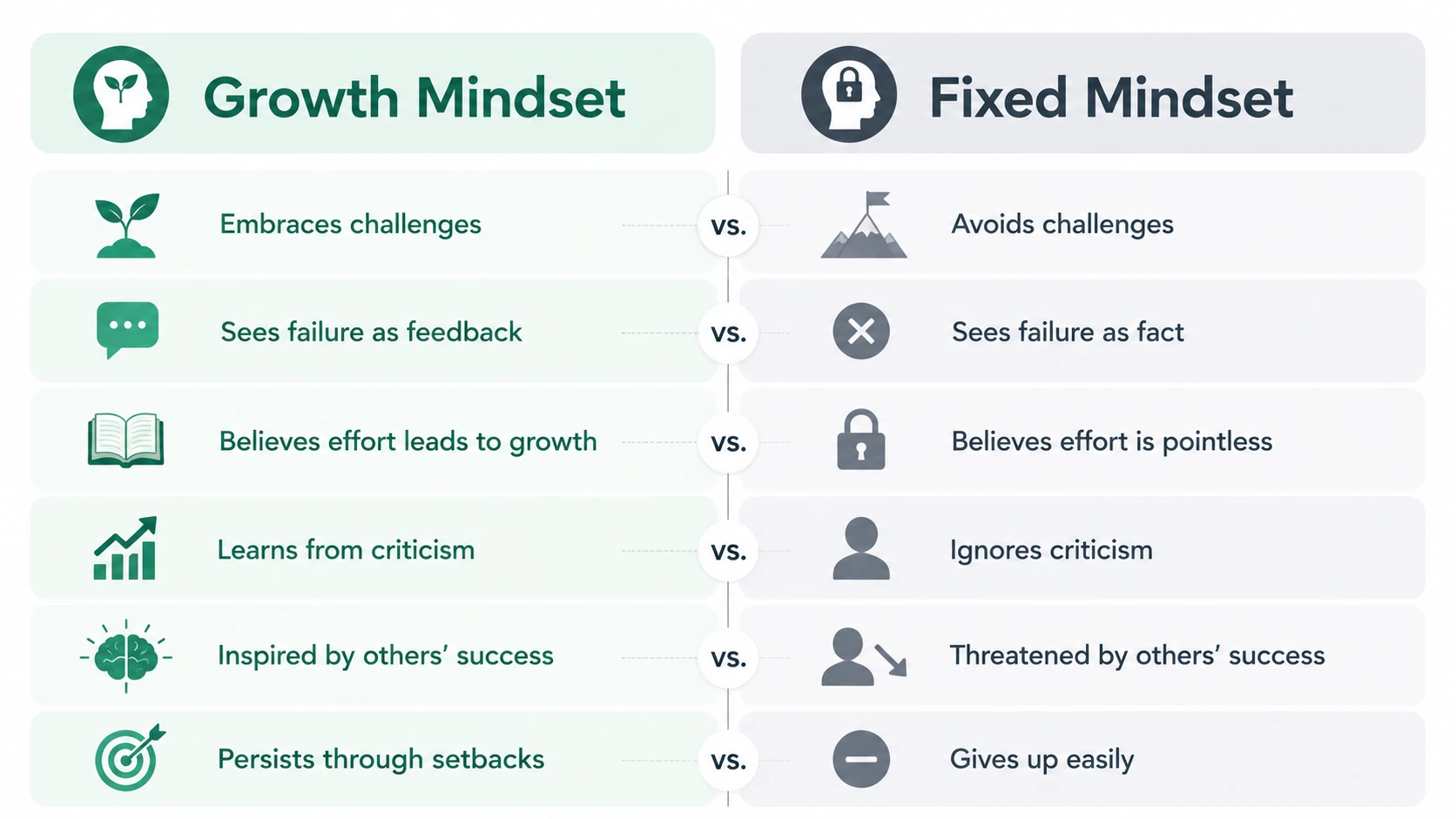
Facts about growth mindset and facts about fixed mindset are easiest to understand side by side, since they represent opposite approaches to learning and challenge.
| Growth Mindset | Fixed Mindset |
|---|---|
| Views learning as an ongoing process | Views ability as a fixed trait |
| Sees failure as feedback | Sees failure as a reflection of self-worth |
| Welcomes constructive feedback | Feels threatened by criticism |
| Embraces challenges as opportunities | Avoids challenges to prevent failure |
| Motivated by effort and progress | Motivated by proving existing ability |
| Success is built through persistence | Success is expected to come naturally |
| Long-term outcomes favor adaptability | Long-term outcomes favor stagnation |
Interesting Facts About Mindset
Psychological Facts About Mindset
Evidence-based psychological facts about mindset include the following:
- Beliefs influence behavior, often shaping actions before a person consciously recognizes why.
- Expectations affect performance, a phenomenon studied extensively in educational psychology.
- Confidence impacts decision-making, particularly under pressure or uncertainty.
- Mindset influences resilience, determining how quickly someone recovers from setbacks.
- Learning changes neural pathways, meaning repeated practice physically reinforces new thought patterns.
Fun Facts About Mindset
Some engaging fun facts about mindset and fun facts about growth mindset include:
- The brain continues learning and adapting throughout life, not just during childhood.
- Small daily habits can noticeably shift long-term thinking patterns.
- Positive expectations have been shown to improve persistence on difficult tasks.
- Mindset can vary by situation, meaning a person may show a growth mindset in one area of life and a fixed mindset in another.
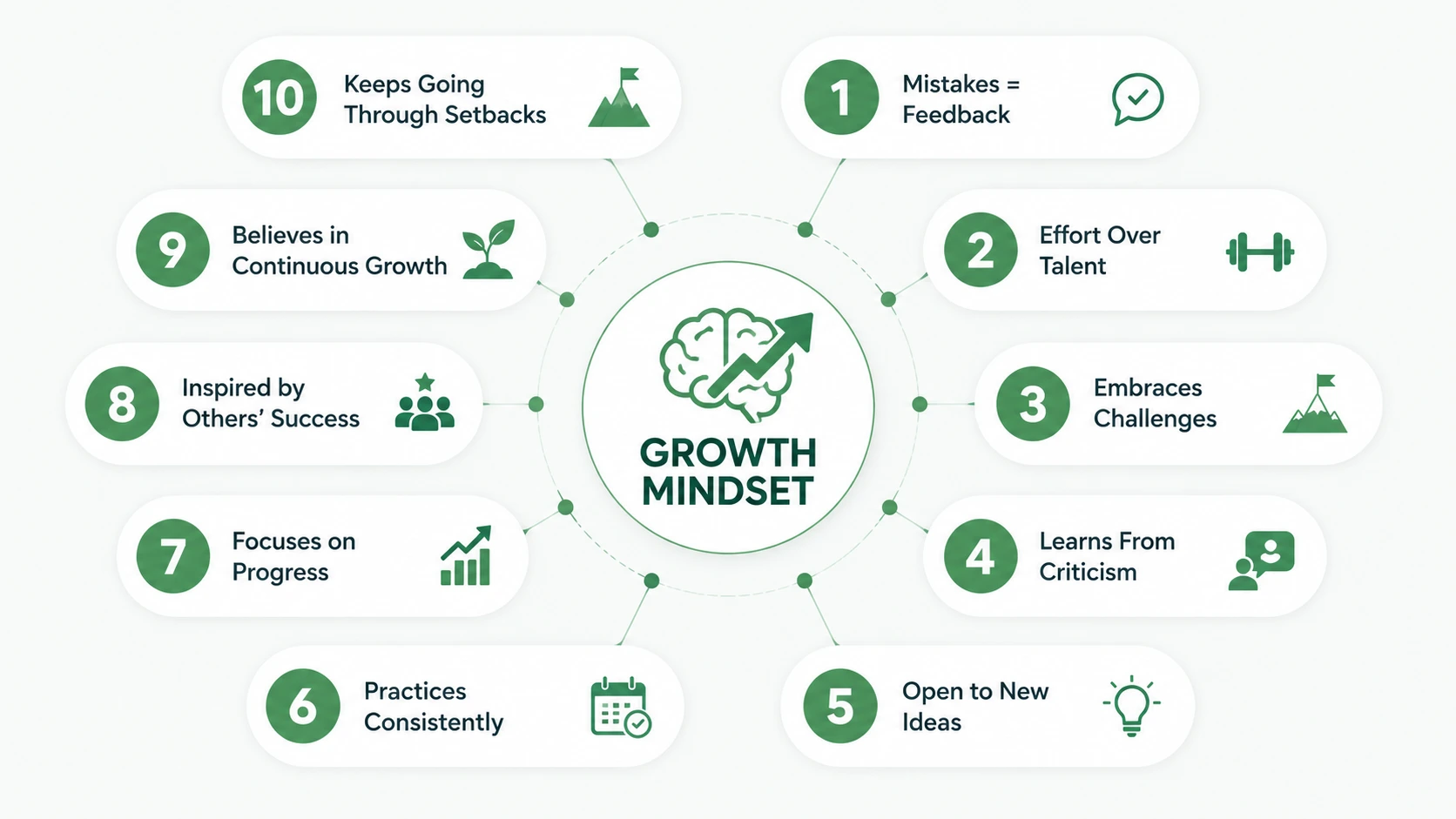
10 Facts About Growth Mindset
- Growth mindset treats learning as an ongoing, lifelong process.
- Mistakes are viewed as useful information rather than failures.
- Curiosity is actively encouraged and rewarded.
- Feedback is welcomed as a tool for improvement.
- Persistence is valued over immediate results.
- Deliberate practice is seen as essential to skill development.
- Adaptability allows strategies to change when something isn’t working.
- Lifelong improvement is prioritized over proving fixed talent.
- Confidence grows through effort and experience, not just natural ability.
- Problem-solving skills strengthen through repeated challenge exposure.
Five Essential Facts About Growth Mindset
- Growth mindset is built through consistent effort, not overnight change.
- Setbacks are reframed as learning opportunities.
- Feedback is treated as valuable data, not personal criticism.
- Effort and strategy are seen as more important than natural talent alone.
- Growth mindset can be strengthened intentionally through practice and reflection.
Facts About Positive Mindset
Facts about positive mindset show a clear distinction between healthy optimism and unrealistic thinking. A genuinely positive mindset involves constructive interpretation of events while still acknowledging real challenges, rather than dismissing them. This approach supports emotional flexibility, allowing a person to adjust their outlook based on new information. It is also linked to better coping strategies during stress and healthier decision-making, since positive framing tends to reduce impulsive or fear-based reactions.
How to Develop a Positive Mindset
Practical Daily Habits
Building a positive mindset relies on consistent daily habits, including:
- Practicing gratitude to shift focus toward what is working well.
- Engaging in regular reflection to process experiences and emotions.
- Strengthening self-awareness to recognize unhelpful thought patterns.
- Prioritizing ongoing learning to build confidence through competence.
- Maintaining healthy routines that support emotional stability.
- Using positive self-talk to counter automatic negative thinking.
- Setting realistic, achievable goals to build momentum. For a structured starting point, try these journal prompts for growth mindset to build daily self-awareness.
How to Change Your Mindset to Positive
Changing your mindset to positive typically follows a structured process:
- Identify limiting beliefs that reinforce negative thinking patterns.
- Challenge negative thoughts by examining whether they are accurate or exaggerated.
- Replace unhealthy thinking with more balanced, realistic interpretations.
- Build supportive habits that reinforce constructive thought patterns.
- Practice consistently, since mindset change strengthens with repetition over time.
How to Develop More Positive Thoughts
Practical strategies for developing more positive thoughts include mindfulness, which helps individuals observe thoughts without automatically reacting to them, and journaling, which creates space to process emotions and identify recurring patterns. Cognitive reframing—consciously reinterpreting a situation from a more balanced perspective—is another effective technique, along with cognitive restructuring, a more structured approach often used in behavioral therapy. Surrounding oneself with a supportive, low-stress environment also plays a meaningful role in sustaining positive thought patterns.
Common Myths and Misconceptions About Mindset
Several misconceptions persist about mindset:
- Mindset is permanent. In reality, mindset can shift with awareness and consistent practice.
- Positive thinking alone guarantees success. Positive thinking supports motivation, but it does not replace effort, skill-building, or strategy.
- Growth mindset means ignoring weaknesses. Growth mindset involves acknowledging weaknesses and actively working to improve them, not pretending they don’t exist.
- Successful people never struggle. Struggle and setbacks are a normal part of long-term achievement, even for highly successful individuals.
- Intelligence cannot change. Research on neuroplasticity shows cognitive abilities can develop through learning and practice.
Common Mistakes When Trying to Change Your Mindset
Many people struggle to shift their mindset due to a few recurring mistakes:
- Expecting instant results. Mindset change is gradual, and expecting immediate transformation often leads to frustration and giving up early.
- Ignoring habits. Mindset shifts are reinforced by daily actions; without supporting habits, new beliefs rarely stick.
- Negative self-talk. Persistent self-criticism undermines progress even when someone is consciously trying to think more positively.
- Comparing yourself to others. Constant comparison distorts self-perception and can reinforce fixed or negative thinking.
- Lack of consistency. Sporadic effort weakens the neural reinforcement needed for lasting change.
- Unrealistic expectations. Setting overly ambitious goals for mindset change can create discouragement rather than motivation.
These mistakes typically happen because mindset change is often approached as a single decision rather than an ongoing practice. They can be addressed and prevented by setting realistic timelines, building small supporting habits, tracking progress rather than expecting perfection, and treating setbacks as part of the process rather than proof of failure.
Difficulty, Time Investment, and Results Timeline
How Difficult Is It to Change a Mindset?
The difficulty of changing a mindset varies significantly based on individual circumstances. Beginners often find early stages challenging because old thought patterns are deeply reinforced, while those with more self-awareness experience a smoother transition. Individual differences—such as personality, past experiences, and current stress levels—affect how difficult the process feels. Environmental influences, including support from family, workplace culture, or community, can either ease or complicate mindset change.
When Can You Expect Results?
Early mindset shifts, such as noticing automatic negative thoughts, can appear within a few weeks of consistent practice. More substantial changes in behavior and resilience typically develop over several months of sustained effort. Progress speed depends on factors such as consistency, environmental support, and the complexity of the beliefs being changed. Sustainable, long-term change usually results from ongoing practice rather than a single short-term effort.
Daily Practice Guide for Building a Better Mindset
A practical framework for building a better mindset includes:
- Morning mindset habits – starting the day with intention-setting or gratitude practice.
- Daily reflection – reviewing thoughts, reactions, and progress each evening.
- Weekly reviews – assessing patterns and adjusting strategies on a broader timescale.
- Accountability methods – using a journal, mentor, or accountability partner to stay consistent.
- Tracking progress – recording small wins to reinforce motivation.
- Motivation techniques – reconnecting with personal goals and reasons for change.
- Long-term consistency – treating mindset development as an ongoing practice rather than a finished task.
- Adjustments for different lifestyles – adapting routines to fit work schedules, family responsibilities, or personal energy levels.
In our experience helping readers build better habits, the readers who see the most lasting mindset change are the ones who track small, consistent wins rather than aiming for dramatic overnight transformation.
Carol Dweck’s Contribution to Mindset Research
Who Is Carol Dweck?
Carol Dweck is a psychologist widely recognized for her research on fixed and growth mindsets. Her work examined how beliefs about intelligence and ability influence motivation, learning, and achievement. Dweck’s research has had a significant influence on education, workplace development, and personal growth practices, providing a psychological framework that is still widely referenced today. Her research has had a significant influence on education, workplace development, and personal growth practices — and continues to be referenced through widely shared Carol Dweck mindset quotes that capture her core findings.
The Mindset Book Explained
Dweck’s influential book on mindset outlines the core distinction between fixed and growth mindsets and explains how these belief systems shape behavior across school, sports, business, and relationships. The book’s main lessons emphasize that praising effort and strategy—rather than innate talent—encourages resilience and long-term achievement. Key takeaways include the idea that abilities can be cultivated through dedication and that setbacks should be treated as part of the learning process. Practical applications drawn from the book include reframing failure as feedback and adjusting language used around effort and success. Your Daily Thrive recommends this book as a foundational resource for anyone looking to better understand the psychology behind mindset change, which is part of why it remains influential well beyond its initial publication.
How Mindset Connects to Broader Personal Development
Mindset does not operate in isolation—it connects closely to several other areas of personal development:
- Habit formation – mindset shapes which habits feel achievable and worth sustaining.
- Goal setting – belief in one’s ability to grow influences how ambitious goals are set.
- Productivity – a growth-oriented mindset supports persistence through difficult tasks.
- Emotional intelligence – self-awareness strengthens the ability to manage mindset-driven reactions.
- Confidence – repeated small successes reinforce a more empowered mindset over time.
- Resilience – mindset directly shapes how setbacks are interpreted and processed.
- Lifelong learning – a flexible mindset supports ongoing skill development throughout life.
Conclusion
Facts about mindset make clear that mindset is far more than a passing attitude—it is a foundational set of beliefs that shapes learning, resilience, decision-making, and long-term success. Psychological research, including Carol Dweck’s work on fixed and growth mindsets, shows that beliefs about ability directly influence motivation and behavior. While mindset is shaped by childhood experiences, environment, and habits, it is not permanent; consistent practice, self-reflection, and supportive habits can gradually shift thought patterns toward growth and positivity. Understanding these facts about mindset offers a practical starting point for anyone looking to build stronger resilience, sustain motivation, and pursue meaningful personal growth.
Frequently Asked Questions (FAQs)
What is a mindset in simple words?
A mindset is the collection of beliefs and attitudes a person holds that shapes how they think, learn, and respond to challenges in everyday life.
What are the four main types of mindsets?
The four main types of mindsets are fixed mindset, growth mindset, positive mindset, and abundance mindset, each reflecting different beliefs about ability, opportunity, and change.
Can a person’s mindset really change?
Yes, mindset can change over time through neuroplasticity, consistent practice, self-reflection, and intentional habit formation.
Why is a growth mindset important?
A growth mindset is important because it supports persistence, adaptability, and continuous learning, all of which contribute to long-term achievement and resilience.
How long does it take to develop a positive mindset?
Early shifts can appear within a few weeks of consistent practice, while more substantial and lasting change typically develops over several months.
What is the difference between a positive mindset and a growth mindset?
A positive mindset focuses on constructive interpretation of events, while a growth mindset centers on the belief that abilities can be developed through effort and learning; the two often work together but are not identical.
How does psychology explain mindset?
Psychology explains mindset as a set of established beliefs and mental frameworks that influence perception, motivation, and behavior, often studied through frameworks like fixed and growth mindset theory.
Which daily habits help improve mindset?
Daily habits that help improve mindset include practicing gratitude, engaging in self-reflection, using positive self-talk, setting realistic goals, and maintaining consistent, supportive routines.